Cheers Review (2026): GEO Pricing, Limits & Alternatives
Bottom line
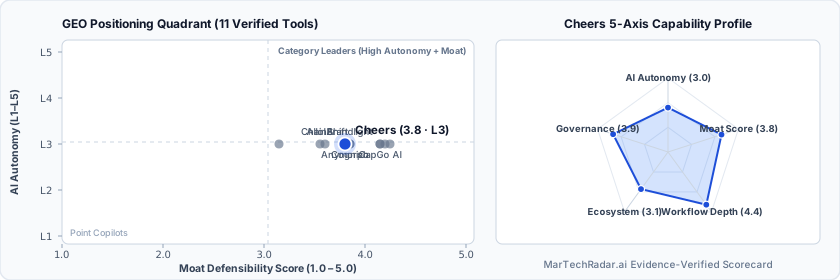
Cheers is a Web SaaS tool for GEO (GEO Brand Tracking & LLM Rank Tracking) in GEO & AI SEO. Pricing: From $3/mo. Best suited to SEO Directors, Brand Strategy Leaders and Growth Marketers. Editor ratings: AI autonomy L3 (conditional automation); moat score 3.8/5.0 (Proprietary moat). Fact-checked by Julie Brot on Oct 11, 2026.
Local Generative Engine Optimization (GEO) and brand reputation platform tracking multi-LLM citation frequency and managing local business visibility.
Cheers buyer fit verdict: when to choose vs. when to walk away
Choose Cheers if (Best Fit)
- Target ICP & Stack Fit: You operate as SEO Directors, Brand Strategy Leaders and Growth Marketers requiring a Web SaaS deployment for GEO.
- L3 Architecture & Defensibility: Defensibility relies on domain-specific local schema automation and historical prompt-response tracking pipelines across regional search queries, though baseline multi-model benchmarking remains exposed to standard API provider churn.
- Commercial Model Fit: Your procurement budget aligns with From $3/mo.
Walk away from Cheers if (Deal-Breakers)
- Walk away if your workflow requires uncapped enterprise volume on the From $3/mo entry plan without upgrading tiers.
- Walk away if your workflow cannot tolerate stochastic query drift: Generative model responses vary per session, meaning rank positions fluctuate without deterministic validation across differing temperature settings.
- Walk away if multi-location scaling lag is a deal-breaker for your team: Executing localized prompt combinations across hundreds of distinct geographic territories creates compute overhead and API concurrency constraints.
Cheers key facts & scorecard
| Pricing | From $3/moVendor pricing page |
|---|---|
| Free plan | No / not disclosed |
| Delivery | Web SaaS |
| Audience | SEO Directors, Brand Strategy Leaders, Growth Marketers |
| AI autonomy level | L3 · Conditional automationEditor-verified |
| Moat tier & score | 3.8 / 5.0 · Proprietary moatEditor-verified |
| Funding | Pre-seed |
| Total funding | $835KBacked by Y Combinator, Transpose Platform |
| Founders | Amadeus Peterson, Dylan Allen |
| Company size | 2-10 employees |
| Governance & docs | API & Docs ↗ · Privacy ↗ |
| Headquarters | San Francisco, California |
| Founded | 2023 |
| Last verified |
Cheers pros & cons: strengths vs. operational limitations
Pros: core strengths & capabilities
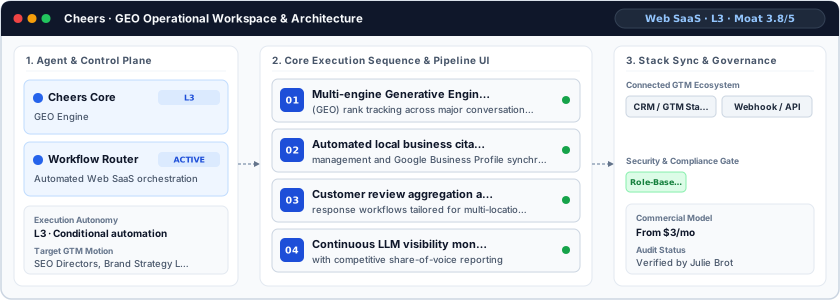
- Multi-engine Generative Engine Optimization: (GEO) rank tracking across major conversational AI platforms
- Automated local business citation: management and Google Business Profile synchronization
- Customer review aggregation and: response workflows tailored for multi-location brands
- Continuous LLM visibility monitoring: with competitive share-of-voice reporting
Cons: operational limitations & risks
- Stochastic Query Drift: Generative model responses vary per session, meaning rank positions fluctuate without deterministic validation across differing temperature settings.
- Multi-Location Scaling Lag: Executing localized prompt combinations across hundreds of distinct geographic territories creates compute overhead and API concurrency constraints.
- Direct Attribution Blindspots: Generative engines provide limited referral headers, restricting direct revenue mapping between synthetic brand citations and physical foot traffic.
Cheers TCO & deal-breaker stress test
Simulate 12-month stepped TCO, hidden cost multipliers, contract lock-in exposure, and stack failure modes using only facts verified by Julie Brot on · Capture SHA 6a9243a5.
Cheers is viable for 5 seats, but requires commercial or technical verification on the flagged items below.
| Plan / Tier | Verified Rate | Scale Fit | Scope & Quota Notes |
|---|---|---|---|
| Team | $3/mo | 1–2 seats | YOUR GROWTH, BACKED BY OUR TEAM. |
| Growth / Professional | $10/mo | 5 seats | Prices in USD. Plans are billed monthly and renew until you cancel. Sales tax may apply. See ou |
- Moat Score
- 3.8 / 5.0
- AI Autonomy
- L3
- Free Tier / Trial
- None disclosed
Triggered audit signals & failure modes
- Published Self-Serve Entry FloorVerified Pricing Ledger
Cheers publishes a transparent entry point (From $3/mo) for initial validation before committing.
- Usage / Credit Burn VolatilityCommercial Model Audit
Cheers uses credit or usage-metered billing (From $3/mo). High-volume automated workflows across 5 seats can trigger mid-cycle overage charges.
- Tier Fit for 5-Seat Scale: Team ($3/mo)Verified Tier Schedule
YOUR GROWTH, BACKED BY OUR TEAM.
- Primary Operational Bottleneck: Stochastic Query DriftAudit by Julie Brot
Generative model responses vary per session, meaning rank positions fluctuate without deterministic validation across differing temperature settings.
Hidden TCO Multipliers & Quota Gates
- Credit & Usage Burn Multiplier: Automated workflows consume metered credits/usage quotas; multi-step enrichment, voice minutes, or high-frequency agent runs can trigger mid-cycle top-up packs.
- Enterprise Governance & Add-On Gating: Advanced capabilities such as Single Sign-On (SSO), custom role permissions, or specialized analytics modules are gated behind upper tiers or paid add-ons.
When to Walk Away & Negotiation Levers
- Walk away if your workflow requires uncapped enterprise volume on the From $3/mo entry plan without upgrading tiers.
- Walk away if your workflow cannot tolerate stochastic query drift: Generative model responses vary per session, meaning rank positions fluctuate without deterministic validation across differing temperature settings.
- Walk away if multi-location scaling lag is a deal-breaker for your team: Executing localized prompt combinations across hundreds of distinct geographic territories creates compute overhead and API concurrency constraints.
- Validate exact quota thresholds (seats, credits, or API calls) included in Cheers's From $3/mo tier before converting from monthly to annual billing.
- Require a sandbox proof-of-concept testing stochastic query drift against your live CRM/data schema before annual sign-off.
Ask a custom procurement or TCO stress-test question about Cheers
Lower 5-seat floor (~$499/mo vs. Usage-Metered)
Lower 5-seat floor (~$89/mo vs. Usage-Metered)
Cheers moat & subtrack positioning
Defensibility relies on domain-specific local schema automation and historical prompt-response tracking pipelines across regional search queries, though baseline multi-model benchmarking remains exposed to standard API provider churn.
Editorial review
Fact-checked by Julie Brot (Enterprise SaaS Governance & Procurement Editor) on .
Background
Backed by Y Combinator with $835K in pre-seed funding, Cheers was founded in 2023 in San Francisco, California. The company builds local Generative Engine Optimization (GEO) and digital reputation software targeted at multi-location brands, local service franchises, and regional agencies. As customer discovery shifts from legacy search indexes to conversational answers, Cheers addresses the operational requirement to monitor brand citations inside generative response engines.
How Cheers works
Cheers operates at Level 3 autonomy by executing recurring synthetic prompt batches across major foundational models, including ChatGPT, Perplexity, and Google AI Overviews. Its pipeline runs geographically pinned queries, records brand mention frequencies, and measures sentiment attribution. In parallel, the data engine ingests review feeds and directory signals, generating structured schema updates and local citation adjustments to raise entity salience in vector-indexed retrieval systems.
Limitations
Operational considerations and platform boundaries include:
- Stochastic Query Drift: Generative model responses vary per session, meaning rank positions fluctuate without deterministic validation across differing temperature settings.
- Multi-Location Scaling Lag: Executing localized prompt combinations across hundreds of distinct geographic territories creates compute overhead and API concurrency constraints.
- Direct Attribution Blindspots: Generative engines provide limited referral headers, restricting direct revenue mapping between synthetic brand citations and physical foot traffic.
Cheers pricing
Cheers uses a subscription tiering model with self-serve entry points starting from $3/month for baseline visibility tracking. Expanding coverage to complete managed optimization, multi-location review operations, and dedicated technical workflows scales into tiered agency contracts up to $3000 monthly.
How Cheers compares
Within the generative brand tracking category, Cheers competes alongside AthenaHQ, Anymorph, and Brandlight. While AthenaHQ and Brandlight focus on enterprise-wide corporate narrative monitoring across global datasets, Cheers optimizes specifically for physical locations and hyper-local citation graphs. Anymorph targets developers with raw prompt APIs, whereas Cheers delivers structured agency workflows. The platform suits franchise networks and local services prioritizing map-pack and generative assistant visibility. Enterprise procurement teams evaluating deployment readiness should assess API webhook throughput, role-based access governance, and bilateral data synchronization latency against existing marketing technology infrastructure before committing to multi-year production rollouts.
Direct competitors & market radar
Top algorithmic competitors based on category positioning, capability overlap, and ICP alignment.
Frequently asked questions about Cheers
How much does Cheers cost and what pricing tiers are available?
Published pricing summary for Cheers: From $3/mo. A permanent free plan is not disclosed for Cheers. Verified tier schedule: Team ($3/mo for 1–2 seats); Growth / Professional ($10/mo for 5 seats). Cheers uses a subscription tiering model with self-serve entry points starting from $3/month for baseline visibility tracking. Expanding coverage to complete managed optimization, multi-location review operations, and dedicated technical workflows scales into tiered agency contracts up to $3000 monthly.
How does Cheers work and how autonomous is its AI architecture?
Local Generative Engine Optimization (GEO) and brand reputation platform tracking multi-LLM citation frequency and managing local business visibility. Within GEO (GEO Brand Tracking & LLM Rank Tracking), MarTechRadar rates its execution architecture at L3 · Conditional automation with a verified Moat Score of 3.8 / 5.0 (Proprietary moat). Defensibility relies on domain-specific local schema automation and historical prompt-response tracking pipelines across regional search queries, though baseline multi-model benchmarking remains exposed to standard API provider churn. Corporate profile: Founded by Amadeus Peterson, Dylan Allen, operating at 2-10 employees scale.
What are the main limitations of Cheers and when should buyers walk away?
Based on our editorial technical audit, key operational considerations and boundaries for Cheers include: (1) Stochastic Query Drift: Generative model responses vary per session, meaning rank positions fluctuate without deterministic validation across differing temperature settings. (2) Multi-Location Scaling Lag: Executing localized prompt combinations across hundreds of distinct geographic territories creates compute overhead and API concurrency constraints. (3) Direct Attribution Blindspots: Generative engines provide limited referral headers, restricting direct revenue mapping between synthetic brand citations and physical foot traffic. Primary procurement walk-away rule: Walk away if your workflow requires uncapped enterprise volume on the From $3/mo entry plan without upgrading tiers.
What integrations, compliance certifications, and contract terms apply to Cheers?
First-party governance and developer endpoints verified on domain include: API Docs (https://www.cheers.tech/developers). Key TCO multiplier to watch: Credit & Usage Burn Multiplier (Automated workflows consume metered credits/usage quotas; multi-step enrichment, voice minutes, or high-frequency agent runs can trigger mid-cycle top-up packs.) Before signing a contract, procurement teams should validate exact quota thresholds (seats, credits, or API calls) included in Cheers's From $3/mo tier before converting from monthly to annual billing.
What are the best Cheers alternatives and head-to-head competitors in 2026?
Top fact-checked alternatives to Cheers in GEO (GEO Brand Tracking & LLM Rank Tracking) include Moz AI (Free plan · $0/mo · Enterprise plan), Yolando (Free plan · $0/mo · Enterprise plan), Cognizo (From $499/mo), Relixir (Custom / enterprise pricing). Within the generative brand tracking category, Cheers competes alongside AthenaHQ, Anymorph, and Brandlight. While AthenaHQ and Brandlight focus on enterprise-wide corporate narrative monitoring across global datasets, Cheers optimizes specifically for physical locations and hyper-local citation graphs.
Verified sources & evidence trail
- Official product domain: https://www.cheers.tech/
- Commercial pricing verification: https://www.cheers.tech/plans
- Verified corporate entity profiles (
sameAs): LinkedIn Company Profile · Crunchbase Entity Record - First-party governance & documentation links: API & Docs · Privacy
- Editorial audit sign-off: Fact-checked by Julie Brot on under the MarTechRadar Evidence-Ledger Protocol.