AlloIA Review (2026): GEO Pricing, Limits & Alternatives
Bottom line
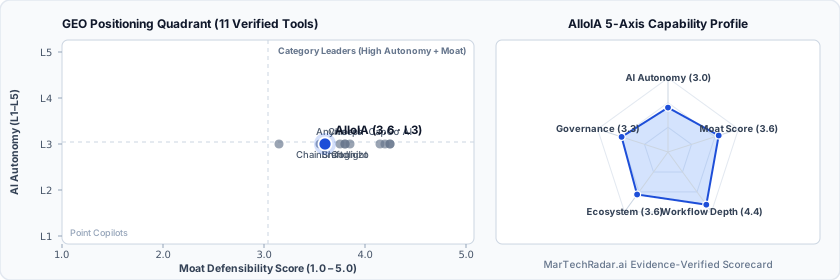
AlloIA is a Web SaaS tool for GEO (GEO Brand Tracking & LLM Rank Tracking) in GEO & AI SEO. Pricing: Custom / enterprise pricing. Best suited to SEO Directors, Brand Strategy Leaders and Growth Marketers. Editor ratings: AI autonomy L3 (conditional automation); moat score 3.6/5.0 (Proprietary moat). Fact-checked by Julie Brot on Oct 14, 2026.
AI commerce infrastructure engineered to translate product catalogs into structured semantic entities for discovery and execution across agentic networks.
AlloIA buyer fit verdict: when to choose vs. when to walk away
Choose AlloIA if (Best Fit)
- Target ICP & Stack Fit: You operate as SEO Directors, Brand Strategy Leaders and Growth Marketers requiring a Web SaaS deployment for GEO, with verified ecosystem connectivity for Twilio Segment.
- L3 Architecture & Defensibility: Proprietary catalog-to-context transformation engines and multi-model query tracking pipelines that monitor brand entity representation across commercial generative interfaces without requiring frontend architectural overhauls.
- Commercial Model Fit: Your procurement budget aligns with Custom / enterprise pricing.
Walk away from AlloIA if (Deal-Breakers)
- Walk away if you require transparent self-serve monthly billing or your budget ceiling is under $1,000/mo (AlloIA requires sales-gated custom quoting).
- Walk away if your workflow cannot tolerate catalog synchronization lag: High-velocity inventory fluctuations can cause momentary discrepancies between live warehouse stock levels and the cached semantic representations ingested by downstream generative models.
- Walk away if black-box retrieval instability is a deal-breaker for your team: Because third-party LLM vendors frequently iterate on core weights and retrieval heuristics, synthetic rank tracking reflects non-deterministic shifts outside programmatic control.
AlloIA key facts & scorecard
| Pricing | Custom / enterprise pricing |
|---|---|
| Free plan | No / not disclosed |
| Delivery | Web SaaS |
| Audience | SEO Directors, Brand Strategy Leaders, Growth Marketers |
| AI autonomy level | L3 · Conditional automationEditor-verified |
| Moat tier & score | 3.6 / 5.0 · Proprietary moatEditor-verified |
| Funding | Pre-seed |
| Company size | 2-10 employees |
| Ecosystem integrations | Twilio Segment |
| Governance & docs | Terms ↗ · Privacy ↗ |
| Headquarters | Sherbrooke, QC |
| Founded | 2024 |
| Last verified |
AlloIA pros & cons: strengths vs. operational limitations
Pros: core strengths & capabilities
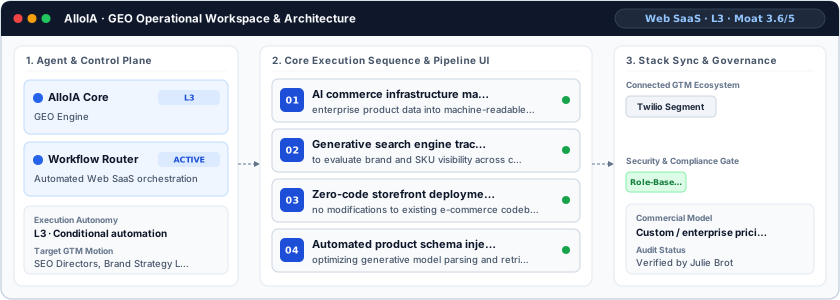
- AI commerce infrastructure mapping: enterprise product data into machine-readable knowledge representations
- Generative search engine tracking: to evaluate brand and SKU visibility across conversational interfaces
- Zero-code storefront deployment requiring: no modifications to existing e-commerce codebases
- Automated product schema injection: optimizing generative model parsing and retrieval-augmented purchase journeys
Cons: operational limitations & risks
- Catalog Synchronization Lag: High-velocity inventory fluctuations can cause momentary discrepancies between live warehouse stock levels and the cached semantic representations ingested by downstream generative models.
- Black-Box Retrieval Instability: Because third-party LLM vendors frequently iterate on core weights and retrieval heuristics, synthetic rank tracking reflects non-deterministic shifts outside programmatic control.
- Attribution Telemetry Gaps: Closed conversational engines do not expose granular referer headers, limiting precise tracking between conversational product recommendations and downstream conversion events.
AlloIA TCO & deal-breaker stress test
Simulate 12-month stepped TCO, hidden cost multipliers, contract lock-in exposure, and stack failure modes using only facts verified by Julie Brot on · Capture SHA 933681bc.
AlloIA triggers high-severity friction under your 5-seat / $800/mo constraints. Benchmark the verified subtrack alternatives below before committing.
| Plan / Tier | Verified Rate | Scale Fit | Scope & Quota Notes |
|---|---|---|---|
| Enterprise / Custom | Custom quote | 15–50+ seats (Enterprise SLA) | Sales-negotiated annual contract for custom volume, SSO/RBAC governance, and dedicated SLA. |
- Moat Score
- 3.6 / 5.0
- AI Autonomy
- L3
- Free Tier / Trial
- None disclosed
Triggered audit signals & failure modes
- Opaque Enterprise Quoting vs. SMB/Mid-Market BudgetVerified Pricing Ledger
AlloIA does not disclose a public self-serve floor (Custom / enterprise pricing). Buyers with a $800/mo cap face high sales-qualification friction.
- Sales-Gated Contract TermsFact-checked by Julie Brot
Commercial procurement operates entirely through direct contract negotiation. Pricing is available on request through tailored enterprise sales quotes based on catalog complexity, SKU volume, and the breadth of generative monitoring targets.
- Primary Operational Bottleneck: Catalog Synchronization LagAudit by Julie Brot
High-velocity inventory fluctuations can cause momentary discrepancies between live warehouse stock levels and the cached semantic representations ingested by downstream generative models.
Hidden TCO Multipliers & Quota Gates
- Catalog Synchronization Lag: High-velocity inventory fluctuations can cause momentary discrepancies between live warehouse stock levels and the cached semantic representations ingested by downstream generative models.
- Black-Box Retrieval Instability: Because third-party LLM vendors frequently iterate on core weights and retrieval heuristics, synthetic rank tracking reflects non-deterministic shifts outside programmatic control.
When to Walk Away & Negotiation Levers
- Walk away if you require transparent self-serve monthly billing or your budget ceiling is under $1,000/mo (AlloIA requires sales-gated custom quoting).
- Walk away if your workflow cannot tolerate catalog synchronization lag: High-velocity inventory fluctuations can cause momentary discrepancies between live warehouse stock levels and the cached semantic representations ingested by downstream generative models.
- Walk away if black-box retrieval instability is a deal-breaker for your team: Because third-party LLM vendors frequently iterate on core weights and retrieval heuristics, synthetic rank tracking reflects non-deterministic shifts outside programmatic control.
- Demand a 30- to 60-day paid pilot opt-out clause in the AlloIA order form before signing a 12-month enterprise commitment.
- Require a sandbox proof-of-concept testing catalog synchronization lag against your live CRM/data schema before annual sign-off.
Ask a custom procurement or TCO stress-test question about AlloIA
Lower 5-seat floor (~$24/mo vs. Custom Quote) · Transparent self-serve entry without mandatory annual lock-in
Lower 5-seat floor (~$49/mo vs. Custom Quote) · Transparent self-serve entry without mandatory annual lock-in
AlloIA key entities, modules & ecosystem stack
AlloIA moat & subtrack positioning
Proprietary catalog-to-context transformation engines and multi-model query tracking pipelines that monitor brand entity representation across commercial generative interfaces without requiring frontend architectural overhauls.
Editorial review
Fact-checked by Julie Brot (Enterprise SaaS Governance & Procurement Editor) on .
Background
Architectural decoupling between traditional storefronts and autonomous search interfaces drives the core proposition of AlloIA. Established in 2024 and headquartered in Sherbrooke, QC, the vendor engineers specialized AI commerce infrastructure designed to bridge legacy product catalogs with conversational interfaces. Target buyers include digital commerce architects, enterprise merchandising leads, and growth marketers who need to ensure their product catalogs are discoverable and transaction-ready within generative language models.
How AlloIA works
At the architectural layer, the system autonomy, AlloIA functions via an external ingestion and semantic enrichment layer that indexes dynamic catalog data without requiring changes to existing storefront codebases. The platform ingests SKU metadata, inventories, and pricing tables, mapping them into structured knowledge representations tuned for retrieval-augmented generation pipelines. It continuously runs synthetic search queries across commercial foundation models to measure product attribution, visibility cadence, and answer placement accuracy across conversational recommendation flows.
Limitations
Operational considerations and platform boundaries include:
- Catalog Synchronization Lag: High-velocity inventory fluctuations can cause momentary discrepancies between live warehouse stock levels and the cached semantic representations ingested by downstream generative models.
- Black-Box Retrieval Instability: Because third-party LLM vendors frequently iterate on core weights and retrieval heuristics, synthetic rank tracking reflects non-deterministic shifts outside programmatic control.
- Attribution Telemetry Gaps: Closed conversational engines do not expose granular referer headers, limiting precise tracking between conversational product recommendations and downstream conversion events.
AlloIA pricing
Commercial procurement operates entirely through direct contract negotiation. Pricing is available on request through tailored enterprise sales quotes based on catalog complexity, SKU volume, and the breadth of generative monitoring targets. Engagements are structured as annual enterprise software subscriptions encompassing custom technical onboarding, service-level agreements, and dedicated support for catalog synchronization.
How AlloIA compares
Within the generative engine optimization landscape, AlloIA differentiates by emphasizing programmatic commerce readiness alongside rank tracking within the GEO segment. Whereas AthenaHQ and Brandlight focus primarily on qualitative sentiment and conversational brand positioning, AlloIA prioritizes transactional catalog data ingestion. Compared to Anymorph, which concentrates on broad multi-engine search visibility analytics, AlloIA serves enterprise retailers requiring immediate product parsing without engineering redesigns.
Frequently asked questions about AlloIA
How much does AlloIA cost and does it require a custom enterprise quote?
Published pricing summary for AlloIA: Custom / enterprise pricing. A permanent free plan is not disclosed for AlloIA. Commercial procurement operates entirely through direct contract negotiation. Pricing is available on request through tailored enterprise sales quotes based on catalog complexity, SKU volume, and the breadth of generative monitoring targets.
How does AlloIA work and how autonomous is its AI architecture?
AI commerce infrastructure engineered to translate product catalogs into structured semantic entities for discovery and execution across agentic networks. Within GEO (GEO Brand Tracking & LLM Rank Tracking), MarTechRadar rates its execution architecture at L3 · Conditional automation with a verified Moat Score of 3.6 / 5.0 (Proprietary moat). Proprietary catalog-to-context transformation engines and multi-model query tracking pipelines that monitor brand entity representation across commercial generative interfaces without requiring frontend architectural overhauls. Corporate profile: operating at 2-10 employees scale.
What are the main limitations of AlloIA and when should buyers walk away?
Based on our editorial technical audit, key operational considerations and boundaries for AlloIA include: (1) Catalog Synchronization Lag: High-velocity inventory fluctuations can cause momentary discrepancies between live warehouse stock levels and the cached semantic representations ingested by downstream generative models. (2) Black-Box Retrieval Instability: Because third-party LLM vendors frequently iterate on core weights and retrieval heuristics, synthetic rank tracking reflects non-deterministic shifts outside programmatic control. (3) Attribution Telemetry Gaps: Closed conversational engines do not expose granular referer headers, limiting precise tracking between conversational product recommendations and downstream conversion events. Primary procurement walk-away rule: Walk away if you require transparent self-serve monthly billing or your budget ceiling is under $1,000/mo (AlloIA requires sales-gated custom quoting).
What integrations, compliance certifications, and contract terms apply to AlloIA?
Verified ecosystem and stack integrations include Twilio Segment. Key TCO multiplier to watch: Catalog Synchronization Lag (High-velocity inventory fluctuations can cause momentary discrepancies between live warehouse stock levels and the cached semantic representations ingested by downstream generative models.) Before signing a contract, procurement teams should demand a 30- to 60-day paid pilot opt-out clause in the AlloIA order form before signing a 12-month enterprise commitment.
What are the best AlloIA alternatives and head-to-head competitors in 2026?
Top fact-checked alternatives to AlloIA in GEO (GEO Brand Tracking & LLM Rank Tracking) include GeoRankers (From $24/mo), Kollavo ($49/mo), HeyAmos (Custom / enterprise pricing), Second Wind (Custom / enterprise pricing). Within the generative engine optimization landscape, AlloIA differentiates by emphasizing programmatic commerce readiness alongside rank tracking within the GEO segment.
Verified sources & evidence trail
- Official product domain: https://alloia.ai/
- Commercial pricing verification: Verified against official vendor pricing policy (Custom / enterprise pricing)
- Verified corporate entity profiles (
sameAs): LinkedIn Company Profile · Crunchbase Entity Record - First-party governance & documentation links: Terms · Privacy
- Editorial audit sign-off: Fact-checked by Julie Brot on under the MarTechRadar Evidence-Ledger Protocol.