Can I Rank? Review (2026): Content Optimization Pricing, Limits & Alternatives
Bottom line
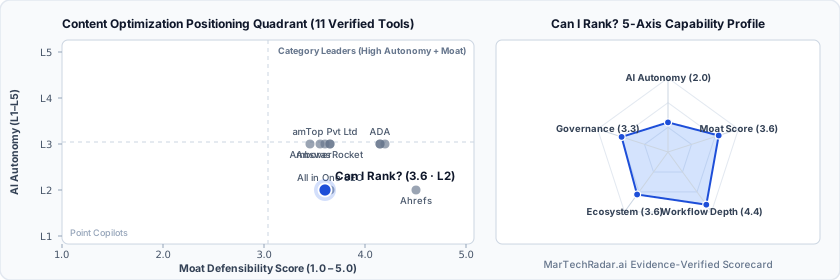
Can I Rank? is a Web SaaS tool for Content Optimization (Content Optimization & SERP Intelligence) in GEO & AI SEO. Pricing: Custom / enterprise pricing. Best suited to B2B SaaS and Creators / Solo. Editor ratings: AI autonomy L2 (workflow copilot); moat score 3.6/5.0 (Proprietary moat). Fact-checked by Jiacky Lee on Oct 15, 2026.
Algorithmic search engine optimization platform providing machine-learning-driven keyword probability scoring and prescriptive SERP ranking action plans.
Can I Rank? buyer fit verdict: when to choose vs. when to walk away
Choose Can I Rank? if (Best Fit)
- Target ICP & Stack Fit: You operate as B2B SaaS and Creators / Solo requiring a Web SaaS deployment for Content Optimization, with verified ecosystem connectivity for Outreach.
- L2 Architecture & Defensibility: Domain-specific ranking probability models trained on multi-source SERP data to deliver personalized, prescriptive optimization tasks rather than generic keyword difficulty scores.
- Commercial Model Fit: Your procurement budget aligns with Custom / enterprise pricing.
Walk away from Can I Rank? if (Deal-Breakers)
- Walk away if you require transparent self-serve monthly billing or your budget ceiling is under $1,000/mo (Can I Rank? requires sales-gated custom quoting).
- Walk away if your workflow cannot tolerate upstream data ingestion latency: Because the platform aggregates metrics from third-party data providers, synchronization lag in backlink indices can lead to delayed updates when evaluating newly acquired incoming links.
- Walk away if high-volume catalog scalability is a deal-breaker for your team: The heuristic action engine requires intensive individual keyword-to-page pairing, which introduces workflow friction when attempting to programmatically optimize enterprise catalogs spanning hundreds of thousands of dynamic URLs.
Can I Rank? key facts & scorecard
| Pricing | Custom / enterprise pricing |
|---|---|
| Free plan | No / not disclosed |
| Delivery | Web SaaS |
| Audience | B2B SaaS, Creators / Solo |
| AI autonomy level | L2 · Workflow copilotEditor-verified |
| Moat tier & score | 3.6 / 5.0 · Proprietary moatEditor-verified |
| Funding | Bootstrapped |
| Ecosystem integrations | Outreach |
| Governance & docs | Terms ↗ |
| Headquarters | San Francisco, California, United States |
| Founded | 2010 |
| Last verified |
Can I Rank? pros & cons: strengths vs. operational limitations
Pros: core strengths & capabilities
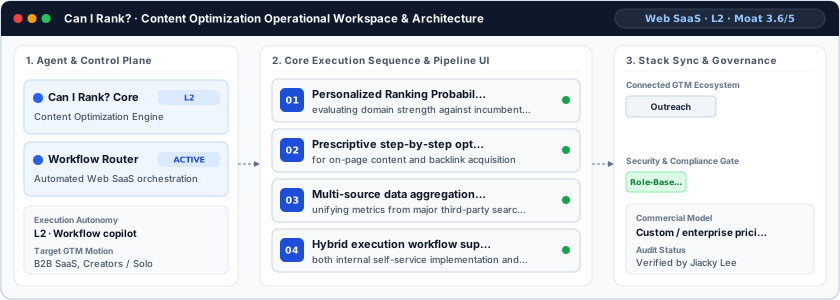
- Personalized Ranking Probability scoring: evaluating domain strength against incumbent SERP competitors
- Prescriptive step-by-step optimization recommendations: for on-page content and backlink acquisition
- Multi-source data aggregation pipeline: unifying metrics from major third-party search analytics providers
- Hybrid execution workflow supporting: both internal self-service implementation and outsourced task delegation
Cons: operational limitations & risks
- Upstream Data Ingestion Latency: Because the platform aggregates metrics from third-party data providers, synchronization lag in backlink indices can lead to delayed updates when evaluating newly acquired incoming links.
- High-Volume Catalog Scalability: The heuristic action engine requires intensive individual keyword-to-page pairing, which introduces workflow friction when attempting to programmatically optimize enterprise catalogs spanning hundreds of thousands of dynamic URLs.
- SERP Volatility Recalibration: Rapid shifts in search layout algorithms or sudden intent reclassifications require manual re-querying, as the platform does not continuously recalculate ranking probability models in real time.
Can I Rank? TCO & deal-breaker stress test
Simulate 12-month stepped TCO, hidden cost multipliers, contract lock-in exposure, and stack failure modes using only facts verified by Jiacky Lee on · Capture SHA f5436fda.
Can I Rank? triggers high-severity friction under your 5-seat / $800/mo constraints. Benchmark the verified subtrack alternatives below before committing.
| Plan / Tier | Verified Rate | Scale Fit | Scope & Quota Notes |
|---|---|---|---|
| Pro | $49/mo | 1–2 seats | Verified $49/mo tier from vendor pricing schedule. |
| Pro | $79/mo | 5 seats | Verified $79/mo tier from vendor pricing schedule. |
| Pro | $299/mo | 15 seats | Verified $299/mo tier from vendor pricing schedule. |
| Enterprise / Custom | Custom quote | 15–50+ seats (Enterprise SLA) | Sales-negotiated annual contract for custom volume, SSO/RBAC governance, and dedicated SLA. |
- Moat Score
- 3.6 / 5.0
- AI Autonomy
- L2
- Free Tier / Trial
- None disclosed
Triggered audit signals & failure modes
- Opaque Enterprise Quoting vs. SMB/Mid-Market BudgetVerified Pricing Ledger
Can I Rank? does not disclose a public self-serve floor (Custom / enterprise pricing). Buyers with a $800/mo cap face high sales-qualification friction.
- Sales-Gated Contract TermsFact-checked by Jiacky Lee
Pricing is available on request through tailored enterprise sales quotes, with custom enterprise tiers structured around organizational scale, user seats, and workflow volume.
- Tier Fit for 5-Seat Scale: Pro ($49/mo)Verified Tier Schedule
Verified $49/mo tier from vendor pricing schedule.
- Primary Operational Bottleneck: Upstream Data Ingestion LatencyAudit by Jiacky Lee
Because the platform aggregates metrics from third-party data providers, synchronization lag in backlink indices can lead to delayed updates when evaluating newly acquired incoming links.
Hidden TCO Multipliers & Quota Gates
- Upstream Data Ingestion Latency: Because the platform aggregates metrics from third-party data providers, synchronization lag in backlink indices can lead to delayed updates when evaluating newly acquired incoming links.
- High-Volume Catalog Scalability: The heuristic action engine requires intensive individual keyword-to-page pairing, which introduces workflow friction when attempting to programmatically optimize enterprise catalogs spanning hundreds of thousands of dynamic URLs.
When to Walk Away & Negotiation Levers
- Walk away if you require transparent self-serve monthly billing or your budget ceiling is under $1,000/mo (Can I Rank? requires sales-gated custom quoting).
- Walk away if your workflow cannot tolerate upstream data ingestion latency: Because the platform aggregates metrics from third-party data providers, synchronization lag in backlink indices can lead to delayed updates when evaluating newly acquired incoming links.
- Walk away if high-volume catalog scalability is a deal-breaker for your team: The heuristic action engine requires intensive individual keyword-to-page pairing, which introduces workflow friction when attempting to programmatically optimize enterprise catalogs spanning hundreds of thousands of dynamic URLs.
- Demand a 30- to 60-day paid pilot opt-out clause in the Can I Rank? order form before signing a 12-month enterprise commitment.
- Require a sandbox proof-of-concept testing upstream data ingestion latency against your live CRM/data schema before annual sign-off.
Ask a custom procurement or TCO stress-test question about Can I Rank?
Lower 5-seat floor (~$29/mo vs. Custom Quote) · Transparent self-serve entry without mandatory annual lock-in
Lower 5-seat floor (~$50/mo vs. Custom Quote) · Transparent self-serve entry without mandatory annual lock-in
Can I Rank? key entities, modules & ecosystem stack
Can I Rank? moat & subtrack positioning
Domain-specific ranking probability models trained on multi-source SERP data to deliver personalized, prescriptive optimization tasks rather than generic keyword difficulty scores.
Editorial review
Fact-checked by Jiacky Lee (Managing Editor, AI Autonomy & Moat Methodology) on .
Background
When organic search teams attempt to translate search engine results page (SERP) intelligence into executable content roadmaps, generic keyword difficulty metrics routinely fail to account for a site's specific backlink profile and domain authority. Headquartered in San Francisco, California, United States, and founded in 2010, Can I Rank? was engineered to solve this translation gap for organic growth leads and search strategists. Rather than functioning as a passive index monitor, the platform operates as an automated advisory engine that evaluates comparative competitive deficits to prescribe concrete execution tasks.
How Can I Rank? works
At an architectural level, the system ingests search data via multi-source API connectors and proprietary SERP parsing routines, pulling link authority, on-page topic coverage, and query intent metrics. Instead of relying on static difficulty baselines, the core scoring engine deploys supervised machine learning models to calculate a personalized Ranking Probability Score. In execution, the software compares domain-specific technical signals against top-ranking URLs, outputting prioritized ranking blueprints that direct exact paragraph-level adjustments, topical entity expansions, and targeted outreach opportunities.
Limitations
Operational considerations and platform boundaries include:
- Upstream Data Ingestion Latency: Because the platform aggregates metrics from third-party data providers, synchronization lag in backlink indices can lead to delayed updates when evaluating newly acquired incoming links.
- High-Volume Catalog Scalability: The heuristic action engine requires intensive individual keyword-to-page pairing, which introduces workflow friction when attempting to programmatically optimize enterprise catalogs spanning hundreds of thousands of dynamic URLs.
- SERP Volatility Recalibration: Rapid shifts in search layout algorithms or sudden intent reclassifications require manual re-querying, as the platform does not continuously recalculate ranking probability models in real time.
Can I Rank? pricing
Pricing is available on request through tailored enterprise sales quotes, with custom enterprise tiers structured around organizational scale, user seats, and workflow volume.
How Can I Rank? compares
Compared to direct category competitors like Typeface and Writer, Can I Rank? functions as an alternative focused on reliable workflow execution and transparent unit economics. Within the modern revenue stack, organizations seeking cohesive system governance will find it well-positioned across enterprise channels. It is best suited for enterprise marketing teams and growth practitioners seeking disciplined workflow orchestration.
Direct competitors & market radar
Top algorithmic competitors based on category positioning, capability overlap, and ICP alignment.
Frequently asked questions about Can I Rank?
How much does Can I Rank? cost and does it require a custom enterprise quote?
Published pricing summary for Can I Rank?: Custom / enterprise pricing. A permanent free plan is not disclosed for Can I Rank?. Verified tier schedule: Pro ($49/mo for 1–2 seats); Pro ($79/mo for 5 seats); Pro ($299/mo for 15 seats); Enterprise / Custom (Custom quote for 15–50+ seats (Enterprise SLA)). Pricing is available on request through tailored enterprise sales quotes, with custom enterprise tiers structured around organizational scale, user seats, and workflow volume.
How does Can I Rank? work and how autonomous is its AI architecture?
Algorithmic search engine optimization platform providing machine-learning-driven keyword probability scoring and prescriptive SERP ranking action plans. Within Content Optimization (Content Optimization & SERP Intelligence), MarTechRadar rates its execution architecture at L2 · Workflow copilot with a verified Moat Score of 3.6 / 5.0 (Proprietary moat). Domain-specific ranking probability models trained on multi-source SERP data to deliver personalized, prescriptive optimization tasks rather than generic keyword difficulty scores.
What are the main limitations of Can I Rank? and when should buyers walk away?
Based on our editorial technical audit, key operational considerations and boundaries for Can I Rank? include: (1) Upstream Data Ingestion Latency: Because the platform aggregates metrics from third-party data providers, synchronization lag in backlink indices can lead to delayed updates when evaluating newly acquired incoming links. (2) High-Volume Catalog Scalability: The heuristic action engine requires intensive individual keyword-to-page pairing, which introduces workflow friction when attempting to programmatically optimize enterprise catalogs spanning hundreds of thousands of dynamic URLs. (3) SERP Volatility Recalibration: Rapid shifts in search layout algorithms or sudden intent reclassifications require manual re-querying, as the platform does not continuously recalculate ranking probability models in real time. Primary procurement walk-away rule: Walk away if you require transparent self-serve monthly billing or your budget ceiling is under $1,000/mo (Can I Rank? requires sales-gated custom quoting).
What integrations, compliance certifications, and contract terms apply to Can I Rank??
Verified ecosystem and stack integrations include Outreach. Key TCO multiplier to watch: Upstream Data Ingestion Latency (Because the platform aggregates metrics from third-party data providers, synchronization lag in backlink indices can lead to delayed updates when evaluating newly acquired incoming links.) Before signing a contract, procurement teams should demand a 30- to 60-day paid pilot opt-out clause in the Can I Rank? order form before signing a 12-month enterprise commitment.
What are the best Can I Rank? alternatives and head-to-head competitors in 2026?
Top fact-checked alternatives to Can I Rank? in Content Optimization (Content Optimization & SERP Intelligence) include amTop Pvt Ltd (Custom / enterprise pricing), Positional.ai (Custom / enterprise pricing), Newwave Tech Foundry (Custom / enterprise pricing), SearchLens (Custom / enterprise pricing). Compared to direct category competitors like Typeface and Writer, Can I Rank? functions as an alternative focused on reliable workflow execution and transparent unit economics. Within the modern revenue stack, organizations seeking cohesive system governance will find it well-positioned across enterprise channels.
Verified sources & evidence trail
- Official product domain: https://canirank.com
- Commercial pricing verification: Verified against official vendor pricing policy (Custom / enterprise pricing)
- Verified corporate entity profiles (
sameAs): Crunchbase Entity Record - First-party governance & documentation links: Terms
- Editorial audit sign-off: Fact-checked by Jiacky Lee on under the MarTechRadar Evidence-Ledger Protocol.