ADA Review (2026): Content Optimization Pricing, Limits & Alternatives
Bottom line
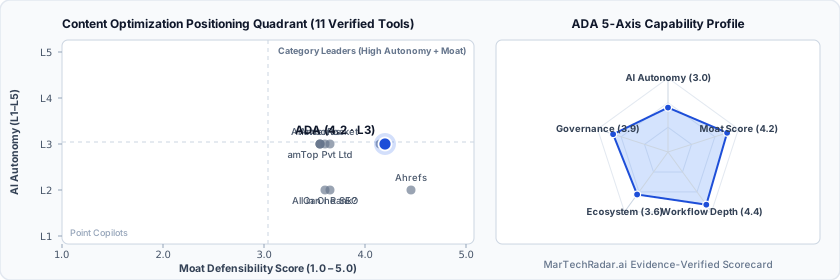
ADA is a Web SaaS tool for Content Optimization (Content Optimization & SERP Intelligence) in GEO & AI SEO. Pricing: Custom / enterprise pricing. Best suited to SEO Directors, Brand Strategy Leaders and Growth Marketers. Editor ratings: AI autonomy L3 (conditional automation); moat score 4.2/5.0 (Proprietary moat). Fact-checked by Tim Fenolz on Oct 14, 2026.
Data and AI platform delivering enterprise content optimization, SERP intelligence, omnichannel personalization, and digital retail experience infrastructure.
ADA buyer fit verdict: when to choose vs. when to walk away
Choose ADA if (Best Fit)
- Target ICP & Stack Fit: You operate as SEO Directors, Brand Strategy Leaders and Growth Marketers requiring a Web SaaS deployment for Content Optimization, with verified ecosystem connectivity for Snowflake.
- L3 Architecture & Defensibility: Proprietary behavioral analytics engines derived from integrated retail assets, paired with extensive APAC omnichannel identity graphs and significant venture backing.
- Commercial Model Fit: Your procurement budget aligns with Custom / enterprise pricing.
Walk away from ADA if (Deal-Breakers)
- Walk away if you require transparent self-serve monthly billing or your budget ceiling is under $1,000/mo (ADA requires sales-gated custom quoting).
- Walk away if your workflow cannot tolerate algorithmic drift and retraining overhead: Heavily modified retail entity graphs require continuous re-indexing against sudden search engine algorithm updates, creating periodic divergence between SERP signals and content recommendations.
- Walk away if multi-system data ingestion latency is a deal-breaker for your team: Aggregating distributed omnichannel touchpoints and search telemetry creates synchronization lag across substantial enterprise product schemas, delaying real-time execution.
ADA key facts & scorecard
| Pricing | Custom / enterprise pricing |
|---|---|
| Free plan | No / not disclosed |
| Delivery | Web SaaS |
| Audience | SEO Directors, Brand Strategy Leaders, Growth Marketers |
| AI autonomy level | L3 · Conditional automationEditor-verified |
| Moat tier & score | 4.2 / 5.0 · Proprietary moatEditor-verified |
| Funding | Series B |
| Total funding | $138M |
| Founders | Miriam Meckel |
| Company size | 1,001-5,000 employees |
| Ecosystem integrations | Snowflake |
| Governance & docs | Terms ↗ · Privacy ↗ |
| Headquarters | Singapore |
| Founded | 2018 |
| Last verified |
ADA pros & cons: strengths vs. operational limitations
Pros: core strengths & capabilities
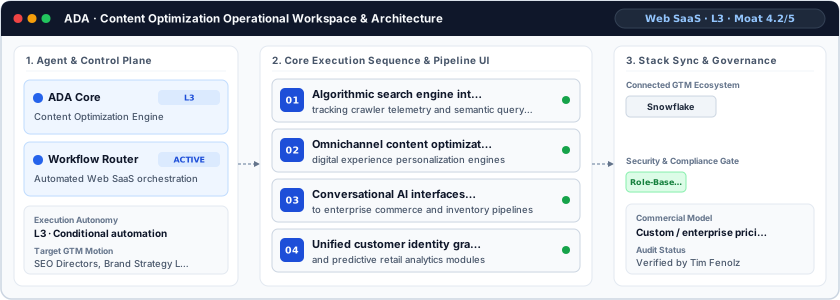
- Algorithmic search engine intelligence: tracking crawler telemetry and semantic query shifts
- Omnichannel content optimization and: digital experience personalization engines
- Conversational AI interfaces linked: to enterprise commerce and inventory pipelines
- Unified customer identity graphs: and predictive retail analytics modules
Cons: operational limitations & risks
- Algorithmic Drift and Retraining Overhead: Heavily modified retail entity graphs require continuous re-indexing against sudden search engine algorithm updates, creating periodic divergence between SERP signals and content recommendations.
- Multi-System Data Ingestion Latency: Aggregating distributed omnichannel touchpoints and search telemetry creates synchronization lag across substantial enterprise product schemas, delaying real-time execution.
- Catalog Schema Dependency: Automated content adjustments depend strictly on standardized enterprise taxonomy; unstructured or missing catalog metadata causes programmatic optimization routines to fail.
ADA TCO & deal-breaker stress test
Simulate 12-month stepped TCO, hidden cost multipliers, contract lock-in exposure, and stack failure modes using only facts verified by Tim Fenolz on · Capture SHA 533b0265.
ADA triggers high-severity friction under your 5-seat / $800/mo constraints. Benchmark the verified subtrack alternatives below before committing.
| Plan / Tier | Verified Rate | Scale Fit | Scope & Quota Notes |
|---|---|---|---|
| Enterprise / Custom | Custom quote | 15–50+ seats (Enterprise SLA) | Sales-negotiated annual contract for custom volume, SSO/RBAC governance, and dedicated SLA. |
- Moat Score
- 4.2 / 5.0
- AI Autonomy
- L3
- Free Tier / Trial
- None disclosed
Triggered audit signals & failure modes
- Opaque Enterprise Quoting vs. SMB/Mid-Market BudgetVerified Pricing Ledger
ADA does not disclose a public self-serve floor (Custom / enterprise pricing). Buyers with a $800/mo cap face high sales-qualification friction.
- Sales-Gated Contract TermsFact-checked by Tim Fenolz
ADA operates on an enterprise licensing framework where commercial pricing is available on request through tailored enterprise sales quotes based on organizational scale and seats.
- Primary Operational Bottleneck: Algorithmic Drift and Retraining OverheadAudit by Tim Fenolz
Heavily modified retail entity graphs require continuous re-indexing against sudden search engine algorithm updates, creating periodic divergence between SERP signals and content recommendations.
Hidden TCO Multipliers & Quota Gates
- Algorithmic Drift and Retraining Overhead: Heavily modified retail entity graphs require continuous re-indexing against sudden search engine algorithm updates, creating periodic divergence between SERP signals and content recommendations.
- Multi-System Data Ingestion Latency: Aggregating distributed omnichannel touchpoints and search telemetry creates synchronization lag across substantial enterprise product schemas, delaying real-time execution.
When to Walk Away & Negotiation Levers
- Walk away if you require transparent self-serve monthly billing or your budget ceiling is under $1,000/mo (ADA requires sales-gated custom quoting).
- Walk away if your workflow cannot tolerate algorithmic drift and retraining overhead: Heavily modified retail entity graphs require continuous re-indexing against sudden search engine algorithm updates, creating periodic divergence between SERP signals and content recommendations.
- Walk away if multi-system data ingestion latency is a deal-breaker for your team: Aggregating distributed omnichannel touchpoints and search telemetry creates synchronization lag across substantial enterprise product schemas, delaying real-time execution.
- Demand a 30- to 60-day paid pilot opt-out clause in the ADA order form before signing a 12-month enterprise commitment.
- Require a sandbox proof-of-concept testing algorithmic drift and retraining overhead against your live CRM/data schema before annual sign-off.
Ask a custom procurement or TCO stress-test question about ADA
Lower 5-seat floor (~$39/mo vs. Custom Quote) · Transparent self-serve entry without mandatory annual lock-in
Lower 5-seat floor (~$29/mo vs. Custom Quote) · Transparent self-serve entry without mandatory annual lock-in
ADA key entities, modules & ecosystem stack
ADA moat & subtrack positioning
Proprietary behavioral analytics engines derived from integrated retail assets, paired with extensive APAC omnichannel identity graphs and significant venture backing.
Editorial review
Fact-checked by Tim Fenolz (Lead AdTech, Programmatic & Attribution Analyst) on .
Background
Backed by $138M in venture funding, ADA was established in 2018 in Singapore to institutionalize large-scale data and artificial intelligence infrastructure across enterprise digital operations. Positioning itself as a unified data and AI experience provider following acquisitions such as Algonomy, the organization serves Chief Marketing Officers, enterprise digital merchandising leads, and regional growth heads across complex commerce environments. The platform synthesizes organic search performance, customer identity graphs, and digital retail merchandising into unified algorithmic workflows.
How ADA works
Operating with L3 conditional autonomy, ADA coordinates an algorithmic search and content intelligence engine that continuously analyzes crawler telemetry, SERP movements, and semantic entity correlations. The platform ingests external search indices alongside first-party consumer transaction feeds, calculating programmatic content tuning adjustments and technical hygiene actions. By mapping user query intent against retail product catalogs, the system generates targeted content directives and on-page optimization scripts that execute within preconfigured governance parameters, alongside native workflow integrations for Snowflake.
Limitations
Operational considerations and platform boundaries include:
- Algorithmic Drift and Retraining Overhead: Heavily modified retail entity graphs require continuous re-indexing against sudden search engine algorithm updates, creating periodic divergence between SERP signals and content recommendations.
- Multi-System Data Ingestion Latency: Aggregating distributed omnichannel touchpoints and search telemetry creates synchronization lag across substantial enterprise product schemas, delaying real-time execution.
- Catalog Schema Dependency: Automated content adjustments depend strictly on standardized enterprise taxonomy; unstructured or missing catalog metadata causes programmatic optimization routines to fail.
ADA pricing
ADA operates on an enterprise licensing framework where commercial pricing is available on request through tailored enterprise sales quotes based on organizational scale and seats. Contracts reflect deployment scope, computational usage across data pipelines, regional entity volume, and integrated digital retail modules. Ongoing customer agreements incorporate tiered service level packages, custom schema engineering, and dedicated enterprise account governance.
How ADA compares
While pure-play SEO providers like Ahrefs focus on deep backlink analytics and organic crawler intelligence, ADA differentiates by embedding SERP telemetry directly into omnichannel personalization and commerce architectures. Point tools like Amboras or Clearscope focus narrowly on boutique consulting or standalone editorial grading workflows, whereas ADA operates as an enterprise-wide retail and marketing automation ecosystem. The platform remains ideal for multinational retail conglomerates and high-SKU brands requiring consolidated search performance and personalized digital commerce execution.
Direct competitors & market radar
Top algorithmic competitors based on category positioning, capability overlap, and ICP alignment.
Frequently asked questions about ADA
How much does ADA cost and does it require a custom enterprise quote?
Published pricing summary for ADA: Custom / enterprise pricing. A permanent free plan is not disclosed for ADA. ADA operates on an enterprise licensing framework where commercial pricing is available on request through tailored enterprise sales quotes based on organizational scale and seats.
How does ADA work and how autonomous is its AI architecture?
Data and AI platform delivering enterprise content optimization, SERP intelligence, omnichannel personalization, and digital retail experience infrastructure. Within Content Optimization (Content Optimization & SERP Intelligence), MarTechRadar rates its execution architecture at L3 · Conditional automation with a verified Moat Score of 4.2 / 5.0 (Proprietary moat). Proprietary behavioral analytics engines derived from integrated retail assets, paired with extensive APAC omnichannel identity graphs and significant venture backing. Corporate profile: Founded by Miriam Meckel, operating at 1,001-5,000 employees scale.
What are the main limitations of ADA and when should buyers walk away?
Based on our editorial technical audit, key operational considerations and boundaries for ADA include: (1) Algorithmic Drift and Retraining Overhead: Heavily modified retail entity graphs require continuous re-indexing against sudden search engine algorithm updates, creating periodic divergence between SERP signals and content recommendations. (2) Multi-System Data Ingestion Latency: Aggregating distributed omnichannel touchpoints and search telemetry creates synchronization lag across substantial enterprise product schemas, delaying real-time execution. (3) Catalog Schema Dependency: Automated content adjustments depend strictly on standardized enterprise taxonomy; unstructured or missing catalog metadata causes programmatic optimization routines to fail. Primary procurement walk-away rule: Walk away if you require transparent self-serve monthly billing or your budget ceiling is under $1,000/mo (ADA requires sales-gated custom quoting).
What integrations, compliance certifications, and contract terms apply to ADA?
Verified ecosystem and stack integrations include Snowflake. Key TCO multiplier to watch: Algorithmic Drift and Retraining Overhead (Heavily modified retail entity graphs require continuous re-indexing against sudden search engine algorithm updates, creating periodic divergence between SERP signals and content recommendations.) Before signing a contract, procurement teams should demand a 30- to 60-day paid pilot opt-out clause in the ADA order form before signing a 12-month enterprise commitment.
What are the best ADA alternatives and head-to-head competitors in 2026?
Top fact-checked alternatives to ADA in Content Optimization (Content Optimization & SERP Intelligence) include Amboras ($39–$299/mo), AnswerRocket (Custom / enterprise pricing), Digital Udyami (Custom / enterprise pricing), InLinks (Custom / enterprise pricing). While pure-play SEO providers like Ahrefs focus on deep backlink analytics and organic crawler intelligence, ADA differentiates by embedding SERP telemetry directly into omnichannel personalization and commerce architectures.
Verified sources & evidence trail
- Official product domain: https://adaglobal.com
- Commercial pricing verification: Verified against official vendor pricing policy (Custom / enterprise pricing)
- Verified corporate entity profiles (
sameAs): LinkedIn Company Profile · Crunchbase Entity Record - First-party governance & documentation links: Terms · Privacy
- Editorial audit sign-off: Fact-checked by Tim Fenolz on under the MarTechRadar Evidence-Ledger Protocol.