ContentBot Review (2026): AI Content Marketing Pricing, Limits & Alternatives
Bottom line
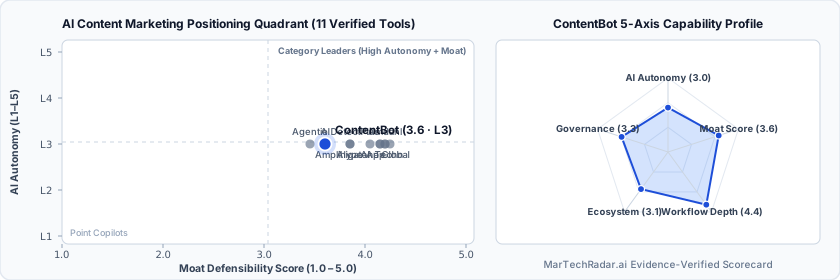
ContentBot is a Web SaaS tool for AI Content Marketing (Enterprise & Long-Form Brand Content) in Copy & Content. Pricing: Custom / enterprise pricing. Best suited to Creators / Solo. Editor ratings: AI autonomy L3 (conditional automation); moat score 3.6/5.0 (Proprietary moat). Fact-checked by Anthony Hay on Oct 14, 2026.
Autonomous content operations and workflow automation engine orchestrating programmatic long-form editorial generation and structured batch publishing.
ContentBot buyer fit verdict: when to choose vs. when to walk away
Choose ContentBot if (Best Fit)
- Target ICP & Stack Fit: You operate as Creators / Solo requiring a Web SaaS deployment for AI Content Marketing.
- L3 Architecture & Defensibility: Defensibility centers on its proprietary programmatic workflow builder that links multi-step LLM chains with programmatic import ingestion, though moat durability is constrained by reliance on foundational LLM model providers.
- Commercial Model Fit: Your procurement budget aligns with Custom / enterprise pricing.
Walk away from ContentBot if (Deal-Breakers)
- Walk away if you require transparent self-serve monthly billing or your budget ceiling is under $1,000/mo (ContentBot requires sales-gated custom quoting).
- Walk away if your workflow cannot tolerate context window drift: During extended multi-thousand-word long-form generations, recursive section prompts occasionally cause context drift, requiring manual realignment of narrative subtopics across deep workflow nodes.
- Walk away if batch data schema brittleness is a deal-breaker for your team: Programmatic generation executed via bulk file imports depends on rigid column formatting, where unvalidated syntax errors or malformed payload fields immediately break mid-flight workflow executions.
ContentBot key facts & scorecard
| Pricing | Custom / enterprise pricing |
|---|---|
| Free plan | No / not disclosed |
| Delivery | Web SaaS |
| Audience | Creators / Solo |
| AI autonomy level | L3 · Conditional automationEditor-verified |
| Moat tier & score | 3.6 / 5.0 · Proprietary moatEditor-verified |
| Funding | Bootstrapped |
| Company size | 2-10 employees |
| Governance & docs | System Status ↗ |
| Headquarters | Miami, Florida, United States |
| Founded | 2021 |
| Last verified |
ContentBot pros & cons: strengths vs. operational limitations
Pros: core strengths & capabilities
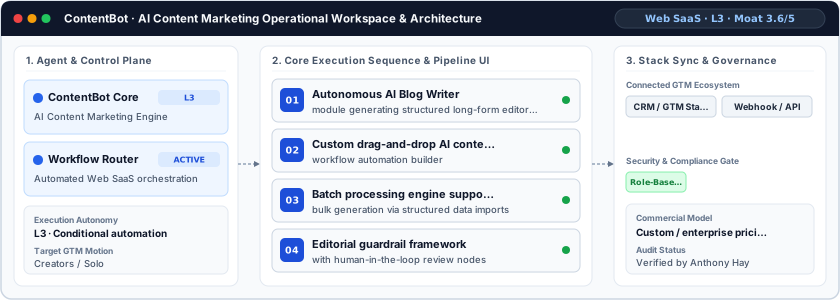
- Autonomous AI Blog Writer: module generating structured long-form editorial drafts
- Custom drag-and-drop AI content: workflow automation builder
- Batch processing engine supporting: bulk generation via structured data imports
- Editorial guardrail framework: with human-in-the-loop review nodes
Cons: operational limitations & risks
- Context Window Drift: During extended multi-thousand-word long-form generations, recursive section prompts occasionally cause context drift, requiring manual realignment of narrative subtopics across deep workflow nodes.
- Batch Data Schema Brittleness: Programmatic generation executed via bulk file imports depends on rigid column formatting, where unvalidated syntax errors or malformed payload fields immediately break mid-flight workflow executions.
- Third-Party Rate Throttling: Heavy enterprise workloads running concurrent automated pipelines encounter downstream LLM inference rate limits, triggering latency spikes and queued pipeline delays during peak production cycles.
ContentBot TCO & deal-breaker stress test
Simulate 12-month stepped TCO, hidden cost multipliers, contract lock-in exposure, and stack failure modes using only facts verified by Anthony Hay on · Capture SHA 31df4817.
ContentBot triggers high-severity friction under your 5-seat / $800/mo constraints. Benchmark the verified subtrack alternatives below before committing.
| Plan / Tier | Verified Rate | Scale Fit | Scope & Quota Notes |
|---|---|---|---|
| Enterprise / Custom | Custom quote | 15–50+ seats (Enterprise SLA) | Sales-negotiated annual contract for custom volume, SSO/RBAC governance, and dedicated SLA. |
- Moat Score
- 3.6 / 5.0
- AI Autonomy
- L3
- Free Tier / Trial
- None disclosed
Triggered audit signals & failure modes
- Opaque Enterprise Quoting vs. SMB/Mid-Market BudgetVerified Pricing Ledger
ContentBot does not disclose a public self-serve floor (Custom / enterprise pricing). Buyers with a $800/mo cap face high sales-qualification friction.
- Sales-Gated Contract TermsFact-checked by Anthony Hay
ContentBot delivers its platform through an enterprise software licensing structure where commercial pricing is available on request through tailored enterprise sales quotes based on organizational scale and seats.
- Primary Operational Bottleneck: Context Window DriftAudit by Anthony Hay
During extended multi-thousand-word long-form generations, recursive section prompts occasionally cause context drift, requiring manual realignment of narrative subtopics across deep workflow nodes.
Hidden TCO Multipliers & Quota Gates
- Context Window Drift: During extended multi-thousand-word long-form generations, recursive section prompts occasionally cause context drift, requiring manual realignment of narrative subtopics across deep workflow nodes.
- Batch Data Schema Brittleness: Programmatic generation executed via bulk file imports depends on rigid column formatting, where unvalidated syntax errors or malformed payload fields immediately break mid-flight workflow executions.
When to Walk Away & Negotiation Levers
- Walk away if you require transparent self-serve monthly billing or your budget ceiling is under $1,000/mo (ContentBot requires sales-gated custom quoting).
- Walk away if your workflow cannot tolerate context window drift: During extended multi-thousand-word long-form generations, recursive section prompts occasionally cause context drift, requiring manual realignment of narrative subtopics across deep workflow nodes.
- Walk away if batch data schema brittleness is a deal-breaker for your team: Programmatic generation executed via bulk file imports depends on rigid column formatting, where unvalidated syntax errors or malformed payload fields immediately break mid-flight workflow executions.
- Demand a 30- to 60-day paid pilot opt-out clause in the ContentBot order form before signing a 12-month enterprise commitment.
- Require a sandbox proof-of-concept testing context window drift against your live CRM/data schema before annual sign-off.
Ask a custom procurement or TCO stress-test question about ContentBot
Lower 5-seat floor (~$149/mo vs. Custom Quote) · Transparent self-serve entry without mandatory annual lock-in
Offers a free tier (Free plan · $0/mo · Enterprise plan) · Transparent self-serve entry without mandatory annual lock-in
ContentBot moat & subtrack positioning
Defensibility centers on its proprietary programmatic workflow builder that links multi-step LLM chains with programmatic import ingestion, though moat durability is constrained by reliance on foundational LLM model providers.
Editorial review
Fact-checked by Anthony Hay (Senior SEO, Search Intelligence & Content Operations Editor) on .
Background
Content teams operating at scale frequently encounter severe production bottlenecks when attempting to coordinate multi-stage editorial pipelines manually. Established in 2021 and headquartered in Miami, Florida, United States, ContentBot addresses this operational friction by providing dedicated infrastructure for enterprise and long-form brand content. Designed primarily for content directors, brand strategists, and demand generation teams, the platform replaces manual drafting cycles with structured, trigger-based content orchestration systems that standardize brand voice across high-volume publishing operations.
How ContentBot works
At its architectural core, ContentBot operates through a node-based workflow orchestration engine that directs transformer-based large language models across programmatic production chains. The ingestion system ingests creative parameters, CSV data imports, or predefined editorial schemas, which are parsed into distinct prompt execution graphs. These graphs execute modular tasks such as keyword clustering, outline compilation, section-by-section text generation, and metadata assembly. The system functions at an L3 autonomy profile, automating the drafting and structural assembly while routing intermediate outputs through human-in-the-loop review stages to guarantee compliance before syndication.
Limitations
Operational considerations and platform boundaries include:
- Context Window Drift: During extended multi-thousand-word long-form generations, recursive section prompts occasionally cause context drift, requiring manual realignment of narrative subtopics across deep workflow nodes.
- Batch Data Schema Brittleness: Programmatic generation executed via bulk file imports depends on rigid column formatting, where unvalidated syntax errors or malformed payload fields immediately break mid-flight workflow executions.
- Third-Party Rate Throttling: Heavy enterprise workloads running concurrent automated pipelines encounter downstream LLM inference rate limits, triggering latency spikes and queued pipeline delays during peak production cycles.
ContentBot pricing
ContentBot delivers its platform through an enterprise software licensing structure where commercial pricing is available on request through tailored enterprise sales quotes based on organizational scale and seats. Enterprise packages generally encompass custom workflow execution allowances, higher concurrent generation thresholds, dedicated API access keys, and tailored service-level agreements. Prospective enterprise buyers must contact the sales organization directly to configure custom annual commitments reflecting their volume requirements.
How ContentBot compares
Within the enterprise editorial technology ecosystem, ContentBot occupies a distinct middle ground between specialized verification suites and niche programmatic distribution engines. While platforms like AIDetectPlus focus strictly on post-generation synthetic text detection and compliance scoring, and Agentio optimizes creator ad copy networks, ContentBot concentrates on the workflow orchestration layer for end-to-end editorial creation. Unlike broader production engines such as Aha Global, ContentBot emphasizes configurable node-based automations and data imports, making it best suited for mid-market and enterprise content operations executing programmatic, template-driven content production.
Direct competitors & market radar
Top algorithmic competitors based on category positioning, capability overlap, and ICP alignment.
Frequently asked questions about ContentBot
How much does ContentBot cost and does it require a custom enterprise quote?
Published pricing summary for ContentBot: Custom / enterprise pricing. A permanent free plan is not disclosed for ContentBot. ContentBot delivers its platform through an enterprise software licensing structure where commercial pricing is available on request through tailored enterprise sales quotes based on organizational scale and seats.
How does ContentBot work and how autonomous is its AI architecture?
Autonomous content operations and workflow automation engine orchestrating programmatic long-form editorial generation and structured batch publishing. Within AI Content Marketing (Enterprise & Long-Form Brand Content), MarTechRadar rates its execution architecture at L3 · Conditional automation with a verified Moat Score of 3.6 / 5.0 (Proprietary moat). Defensibility centers on its proprietary programmatic workflow builder that links multi-step LLM chains with programmatic import ingestion, though moat durability is constrained by reliance on foundational LLM model providers. Corporate profile: operating at 2-10 employees scale.
What are the main limitations of ContentBot and when should buyers walk away?
Based on our editorial technical audit, key operational considerations and boundaries for ContentBot include: (1) Context Window Drift: During extended multi-thousand-word long-form generations, recursive section prompts occasionally cause context drift, requiring manual realignment of narrative subtopics across deep workflow nodes. (2) Batch Data Schema Brittleness: Programmatic generation executed via bulk file imports depends on rigid column formatting, where unvalidated syntax errors or malformed payload fields immediately break mid-flight workflow executions. (3) Third-Party Rate Throttling: Heavy enterprise workloads running concurrent automated pipelines encounter downstream LLM inference rate limits, triggering latency spikes and queued pipeline delays during peak production cycles. Primary procurement walk-away rule: Walk away if you require transparent self-serve monthly billing or your budget ceiling is under $1,000/mo (ContentBot requires sales-gated custom quoting).
What integrations, compliance certifications, and contract terms apply to ContentBot?
First-party governance and developer endpoints verified on domain include: Status (https://contentbot.ai/status). Key TCO multiplier to watch: Context Window Drift (During extended multi-thousand-word long-form generations, recursive section prompts occasionally cause context drift, requiring manual realignment of narrative subtopics across deep workflow nodes.) Before signing a contract, procurement teams should demand a 30- to 60-day paid pilot opt-out clause in the ContentBot order form before signing a 12-month enterprise commitment.
What are the best ContentBot alternatives and head-to-head competitors in 2026?
Top fact-checked alternatives to ContentBot in AI Content Marketing (Enterprise & Long-Form Brand Content) include Parrot Content (Free plan · $0/mo · Enterprise plan), OmniSignal AI (From $149/mo), HelloCreator (Custom / enterprise pricing), LongShot AI (Custom / enterprise pricing). Within the enterprise editorial technology ecosystem, ContentBot occupies a distinct middle ground between specialized verification suites and niche programmatic distribution engines.
Verified sources & evidence trail
- Official product domain: https://contentbot.ai
- Commercial pricing verification: Verified against official vendor pricing policy (Custom / enterprise pricing)
- Verified corporate entity profiles (
sameAs): LinkedIn Company Profile · Crunchbase Entity Record - First-party governance & documentation links: System Status
- Editorial audit sign-off: Fact-checked by Anthony Hay on under the MarTechRadar Evidence-Ledger Protocol.