OmniSignal AI Review (2026): AI Content Marketing Pricing, Limits & Alternatives
Bottom line
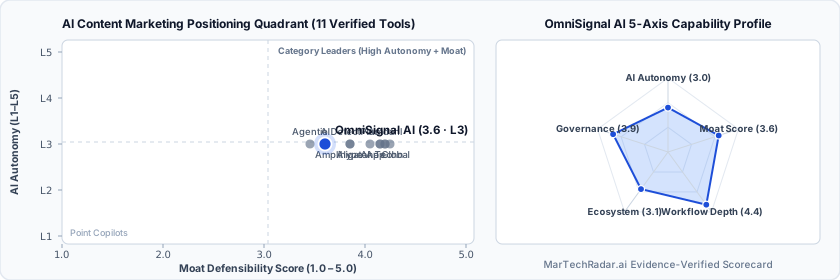
OmniSignal AI is a Web SaaS tool for AI Content Marketing (Enterprise & Long-Form Brand Content) in Copy & Content. Pricing: From $149/mo. Best suited to Enterprise Content Teams, Brand Marketers and Global Copywriters. Editor ratings: AI autonomy L3 (conditional automation); moat score 3.6/5.0 (Proprietary moat). Fact-checked by Jagmeet Sine on Oct 14, 2026.
OmniSignal AI transforms external market signals into structured 30-day editorial calendars and ready-to-publish content strategies for B2B go-to-market.
OmniSignal AI buyer fit verdict: when to choose vs. when to walk away
Choose OmniSignal AI if (Best Fit)
- Target ICP & Stack Fit: You operate as Enterprise Content Teams, Brand Marketers and Global Copywriters requiring a Web SaaS deployment for AI Content Marketing.
- L3 Architecture & Defensibility: The platform's moat relies on rapid market signal synthesis combined with industry-specific strategy playbooks, though defensibility remains moderate due to dependence on standard third-party LLM layers.
- Commercial Model Fit: Your procurement budget aligns with From $149/mo.
Walk away from OmniSignal AI if (Deal-Breakers)
- Walk away if your workflow requires uncapped enterprise volume on the From $149/mo entry plan without upgrading tiers.
- Walk away if your workflow cannot tolerate signal ingestion depth: The system relies on observable surface-level web discussions, which can create generic narrative outputs in niche technical verticals where primary conversations occur behind private communities or gated forums.
- Walk away if editorial calibration drift is a deal-breaker for your team: High-velocity calendar generation risks tone homogenization across long horizons, requiring manual prompt recalibration to prevent repetitive stylistic cadences in consecutive drafted posts.
OmniSignal AI key facts & scorecard
| Pricing | From $149/moVendor pricing page |
|---|---|
| Free plan | No / not disclosed |
| Delivery | Web SaaS |
| Audience | Enterprise Content Teams, Brand Marketers, Global Copywriters |
| AI autonomy level | L3 · Conditional automationEditor-verified |
| Moat tier & score | 3.6 / 5.0 · Proprietary moatEditor-verified |
| Funding | Seed |
| Total funding | $51K |
| Founders | Alexandr Tartachyov |
| Company size | 2-10 employees |
| Governance & docs | Terms ↗ · Privacy ↗ |
| Headquarters | Austin |
| Founded | 2025 |
| Last verified |
OmniSignal AI pros & cons: strengths vs. operational limitations
Pros: core strengths & capabilities
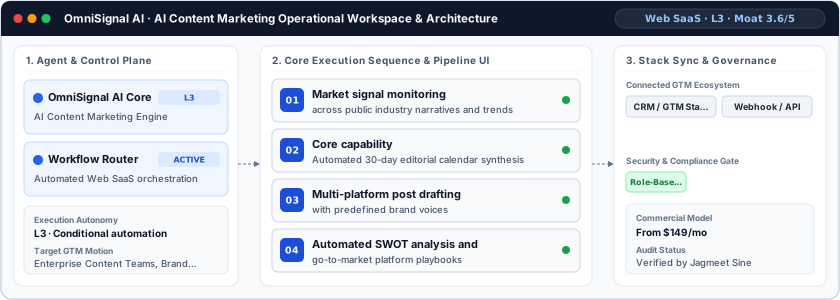
- Market signal monitoring: across public industry narratives and trends
- Core capability: Automated 30-day editorial calendar synthesis
- Multi-platform post drafting: with predefined brand voices
- Automated SWOT analysis and: go-to-market platform playbooks
Cons: operational limitations & risks
- Signal Ingestion Depth: The system relies on observable surface-level web discussions, which can create generic narrative outputs in niche technical verticals where primary conversations occur behind private communities or gated forums.
- Editorial Calibration Drift: High-velocity calendar generation risks tone homogenization across long horizons, requiring manual prompt recalibration to prevent repetitive stylistic cadences in consecutive drafted posts.
- Workflow Integration Constraints: Direct scheduling and publishing rely on standard downstream webhooks, lacking native bidirectional sync with complex enterprise content management systems or headless repositories.
OmniSignal AI TCO & deal-breaker stress test
Simulate 12-month stepped TCO, hidden cost multipliers, contract lock-in exposure, and stack failure modes using only facts verified by Jagmeet Sine on · Capture SHA 1dc257b3.
OmniSignal AI is viable for 5 seats, but requires commercial or technical verification on the flagged items below.
| Plan / Tier | Verified Rate | Scale Fit | Scope & Quota Notes |
|---|---|---|---|
| Starter | $149/mo | 1–2 seats | For founders and solo GTM operators. |
| Growth | $399/mo | 5 seats | For GTM teams scaling inbound + outbound. |
- Moat Score
- 3.6 / 5.0
- AI Autonomy
- L3
- Free Tier / Trial
- None disclosed
Triggered audit signals & failure modes
- Published Self-Serve Entry FloorVerified Pricing Ledger
OmniSignal AI publishes a transparent entry point (From $149/mo) for initial validation before committing.
- Usage / Credit Burn VolatilityCommercial Model Audit
OmniSignal AI uses credit or usage-metered billing (From $149/mo). High-volume automated workflows across 5 seats can trigger mid-cycle overage charges.
- Tier Fit for 5-Seat Scale: Growth ($399/mo)Verified Tier Schedule
For GTM teams scaling inbound + outbound.
- Primary Operational Bottleneck: Signal Ingestion DepthAudit by Jagmeet Sine
The system relies on observable surface-level web discussions, which can create generic narrative outputs in niche technical verticals where primary conversations occur behind private communities or gated forums.
Hidden TCO Multipliers & Quota Gates
- Annual Billing Headline vs. Monthly Premium: Headline entry rates reflect annual billing commitments; month-to-month flexibility carries a higher effective monthly rate or requires annual prepayment.
- Credit & Usage Burn Multiplier: Automated workflows consume metered credits/usage quotas; multi-step enrichment, voice minutes, or high-frequency agent runs can trigger mid-cycle top-up packs.
- Enterprise Governance & Add-On Gating: Advanced capabilities such as Single Sign-On (SSO), custom role permissions, or specialized analytics modules are gated behind upper tiers or paid add-ons.
When to Walk Away & Negotiation Levers
- Walk away if your workflow requires uncapped enterprise volume on the From $149/mo entry plan without upgrading tiers.
- Walk away if your workflow cannot tolerate signal ingestion depth: The system relies on observable surface-level web discussions, which can create generic narrative outputs in niche technical verticals where primary conversations occur behind private communities or gated forums.
- Walk away if editorial calibration drift is a deal-breaker for your team: High-velocity calendar generation risks tone homogenization across long horizons, requiring manual prompt recalibration to prevent repetitive stylistic cadences in consecutive drafted posts.
- Validate exact quota thresholds (seats, credits, or API calls) included in OmniSignal AI's From $149/mo tier before converting from monthly to annual billing.
- Require a sandbox proof-of-concept testing signal ingestion depth against your live CRM/data schema before annual sign-off.
Ask a custom procurement or TCO stress-test question about OmniSignal AI
Lower 5-seat floor (~$150/mo vs. $399 / mo)
Lower 5-seat floor (~$15/mo vs. $399 / mo)
OmniSignal AI moat & subtrack positioning
The platform's moat relies on rapid market signal synthesis combined with industry-specific strategy playbooks, though defensibility remains moderate due to dependence on standard third-party LLM layers.
Editorial review
Fact-checked by Jagmeet Sine (Senior MarTech Infrastructure & Agentic Workflow Architect) on .
Background
OmniSignal AI addresses the operational bottleneck of manually tracking industry trends and converting external demand indicators into cohesive editorial programs. Headquartered in Austin and founded in 2025 with $51K in pre-seed venture backing, the company targets B2B content leads, growth marketers, and go-to-market directors seeking programmatic narrative generation. Rather than forcing editorial staff to brainstorm topics in isolation, the platform continuously monitors external market conversations to formulate multi-channel marketing campaigns.
How OmniSignal AI works
Operating at an L3 conditional autonomy tier, OmniSignal AI ingests public market signals, discourse patterns, and audience engagement telemetry to uncover resonance trends. Its orchestration layer parses these inputs through structured prompt chains and domain-specific heuristics, generating automated SWOT breakdowns and platform distribution playbooks. The algorithmic engine converts these outputs into a 30-day publishing calendar populated with drafted, multi-channel copy that retains context across social networks, requiring human intervention primarily for final editorial sign-off.
Limitations
Operational considerations and platform boundaries include:
- Signal Ingestion Depth: The system relies on observable surface-level web discussions, which can create generic narrative outputs in niche technical verticals where primary conversations occur behind private communities or gated forums.
- Editorial Calibration Drift: High-velocity calendar generation risks tone homogenization across long horizons, requiring manual prompt recalibration to prevent repetitive stylistic cadences in consecutive drafted posts.
- Workflow Integration Constraints: Direct scheduling and publishing rely on standard downstream webhooks, lacking native bidirectional sync with complex enterprise content management systems or headless repositories.
OmniSignal AI pricing
Commercial access operates on a software-as-a-service model starting at $149 per month. Tiering scales based on workspace seats, active monitoring streams, and monthly generation volume, providing predictable operational expenditure without dynamic usage-based overage spikes.
How OmniSignal AI compares
OmniSignal AI competes in the enterprise and long-form brand content sector alongside platforms like Agentio, Aha Global, and AIDetectPlus. While Agentio concentrates on creator ad marketplace matching and AIDetectPlus focuses on synthetic text verification, OmniSignal AI centers strictly on narrative market-signal extraction. Mid-market B2B software organizations seeking rapid content planning cycles will extract the highest utility, whereas large enterprises requiring custom air-gapped LLM infrastructure may find the workflow lightweight.
Direct competitors & market radar
Top algorithmic competitors based on category positioning, capability overlap, and ICP alignment.
Frequently asked questions about OmniSignal AI
How much does OmniSignal AI cost and what pricing tiers are available?
Published pricing summary for OmniSignal AI: From $149/mo. A permanent free plan is not disclosed for OmniSignal AI. Verified tier schedule: Starter ($149/mo for 1–2 seats); Growth ($399/mo for 5 seats). Commercial access operates on a software-as-a-service model starting at $149 per month. Tiering scales based on workspace seats, active monitoring streams, and monthly generation volume, providing predictable operational expenditure without dynamic usage-based overage spikes.
How does OmniSignal AI work and how autonomous is its AI architecture?
OmniSignal AI transforms external market signals into structured 30-day editorial calendars and ready-to-publish content strategies for B2B go-to-market. Within AI Content Marketing (Enterprise & Long-Form Brand Content), MarTechRadar rates its execution architecture at L3 · Conditional automation with a verified Moat Score of 3.6 / 5.0 (Proprietary moat). The platform's moat relies on rapid market signal synthesis combined with industry-specific strategy playbooks, though defensibility remains moderate due to dependence on standard third-party LLM layers. Corporate profile: Founded by Alexandr Tartachyov, operating at 2-10 employees scale.
What are the main limitations of OmniSignal AI and when should buyers walk away?
Based on our editorial technical audit, key operational considerations and boundaries for OmniSignal AI include: (1) Signal Ingestion Depth: The system relies on observable surface-level web discussions, which can create generic narrative outputs in niche technical verticals where primary conversations occur behind private communities or gated forums. (2) Editorial Calibration Drift: High-velocity calendar generation risks tone homogenization across long horizons, requiring manual prompt recalibration to prevent repetitive stylistic cadences in consecutive drafted posts. (3) Workflow Integration Constraints: Direct scheduling and publishing rely on standard downstream webhooks, lacking native bidirectional sync with complex enterprise content management systems or headless repositories. Primary procurement walk-away rule: Walk away if your workflow requires uncapped enterprise volume on the From $149/mo entry plan without upgrading tiers.
What integrations, compliance certifications, and contract terms apply to OmniSignal AI?
Key TCO multiplier to watch: Annual Billing Headline vs. Monthly Premium (Headline entry rates reflect annual billing commitments; month-to-month flexibility carries a higher effective monthly rate or requires annual prepayment.) Before signing a contract, procurement teams should validate exact quota thresholds (seats, credits, or API calls) included in OmniSignal AI's From $149/mo tier before converting from monthly to annual billing.
What are the best OmniSignal AI alternatives and head-to-head competitors in 2026?
Top fact-checked alternatives to OmniSignal AI in AI Content Marketing (Enterprise & Long-Form Brand Content) include Clearscope (From $15/mo), ChatFeatured (From $150/mo), GrowthBar (From $29/mo), Wordtune (Free plan · $0/mo · Enterprise plan). OmniSignal AI competes in the enterprise and long-form brand content sector alongside platforms like Agentio, Aha Global, and AIDetectPlus.
Verified sources & evidence trail
- Official product domain: https://omnisignal.ai
- Commercial pricing verification: https://www.omnisignal.ai/pricing/
- Verified corporate entity profiles (
sameAs): LinkedIn Company Profile · Crunchbase Entity Record - First-party governance & documentation links: Terms · Privacy
- Editorial audit sign-off: Fact-checked by Jagmeet Sine on under the MarTechRadar Evidence-Ledger Protocol.