CreatorIQ AI Review (2026): Influencer Marketing Pricing, Limits & Alternatives
Bottom line
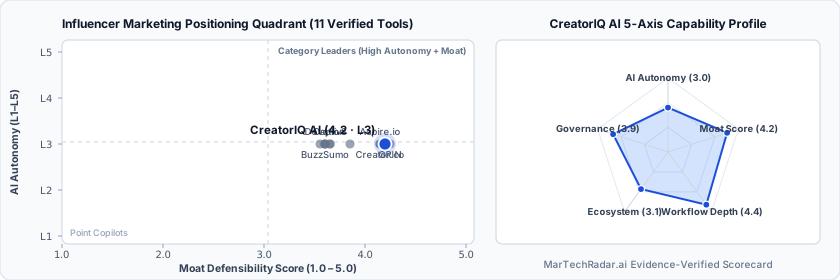
CreatorIQ AI is a Web SaaS tool for Influencer Marketing (Influencer Discovery & Campaign Management) in Social & Influencer. Pricing: Custom / enterprise pricing. Best suited to DTC / eCommerce and Enterprise Brands. Editor ratings: AI autonomy L3 (conditional automation); moat score 4.2/5.0 (Proprietary moat). Fact-checked by Julie Brot on Oct 7, 2026.
Enterprise influencer marketing operating system combining algorithmic creator discovery, brand safety evaluation, and automated cross-channel campaign.
CreatorIQ AI buyer fit verdict: when to choose vs. when to walk away
Choose CreatorIQ AI if (Best Fit)
- Target ICP & Stack Fit: You operate as DTC / eCommerce and Enterprise Brands requiring a Web SaaS deployment for Influencer Marketing.
- L3 Architecture & Defensibility: Proprietary first-party creator integrations, automated audience fraud detection models, deep agency multi-tenancy, and historical performance benchmarks across global brands.
- Commercial Model Fit: Your procurement budget aligns with Custom / enterprise pricing.
Walk away from CreatorIQ AI if (Deal-Breakers)
- Walk away if you require transparent self-serve monthly billing or your budget ceiling is under $1,000/mo (CreatorIQ AI requires sales-gated custom quoting).
- Walk away if your workflow cannot tolerate social graph API deprecation: Third-party platform API schema revisions frequently restrict audience demographic granularity and historical content ingestion rates.
- Walk away if e-commerce attribution lag is a deal-breaker for your team: Multi-touch attribution models suffer latency when correlating creator referral interactions with enterprise checkout systems across disparate attribution windows.
CreatorIQ AI key facts & scorecard
| Pricing | Custom / enterprise pricingVendor pricing page |
|---|---|
| Free plan | No / not disclosed |
| Delivery | Web SaaS |
| Audience | DTC / eCommerce, Enterprise Brands |
| AI autonomy level | L3 · Conditional automationEditor-verified |
| Moat tier & score | 4.2 / 5.0 · Proprietary moatEditor-verified |
| Funding | Series C+ |
| Total funding | $80.8MBacked by Kayne Partners, Silver Lake |
| Founders | Igor Vaks |
| Company size | 201-500 employees |
| Governance & docs | Trust & Security ↗ · Changelog ↗ · Terms ↗ · Privacy ↗ |
| Headquarters | Culver City, United States |
| Founded | 2014 |
| Last verified |
CreatorIQ AI pros & cons: strengths vs. operational limitations
Pros: core strengths & capabilities
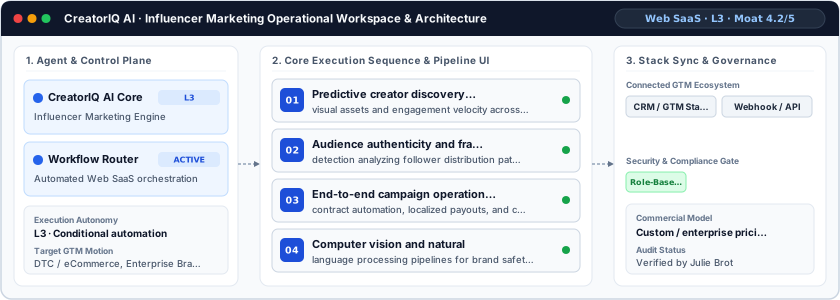
- Predictive creator discovery indexing: visual assets and engagement velocity across major social networks
- Audience authenticity and fraud: detection analyzing follower distribution patterns and suspicious interactions
- End-to-end campaign operations spanning: contract automation, localized payouts, and compliance tracking
- Computer vision and natural: language processing pipelines for brand safety classification
Cons: operational limitations & risks
- Social Graph API Deprecation: Third-party platform API schema revisions frequently restrict audience demographic granularity and historical content ingestion rates.
- E-Commerce Attribution Lag: Multi-touch attribution models suffer latency when correlating creator referral interactions with enterprise checkout systems across disparate attribution windows.
- Data Pipeline Maintenance Overhead: Tracking custom creator deliverables across unlinked private channels requires persistent manual reconciliation and metric harmonization.
CreatorIQ AI TCO & deal-breaker stress test
Simulate 12-month stepped TCO, hidden cost multipliers, contract lock-in exposure, and stack failure modes using only facts verified by Julie Brot on · Capture SHA ccdc89f2.
CreatorIQ AI triggers high-severity friction under your 5-seat / $800/mo constraints. Benchmark the verified subtrack alternatives below before committing.
| Plan / Tier | Verified Rate | Scale Fit | Scope & Quota Notes |
|---|---|---|---|
| Enterprise / Custom | Custom quote | 15–50+ seats (Enterprise SLA) | Sales-negotiated annual contract for custom volume, SSO/RBAC governance, and dedicated SLA. |
- Moat Score
- 4.2 / 5.0
- AI Autonomy
- L3
- Free Tier / Trial
- None disclosed
Triggered audit signals & failure modes
- Opaque Enterprise Quoting vs. SMB/Mid-Market BudgetVerified Pricing Ledger
CreatorIQ AI does not disclose a public self-serve floor (Custom / enterprise pricing). Buyers with a $800/mo cap face high sales-qualification friction.
- Sales-Gated Contract TermsFact-checked by Julie Brot
Commercial access operates under an enterprise SaaS subscription model without public off-the-shelf tiers. Commercial pricing is available on request through tailored enterprise sales quotes based on organizational scale and seats.
- Primary Operational Bottleneck: Social Graph API DeprecationAudit by Julie Brot
Third-party platform API schema revisions frequently restrict audience demographic granularity and historical content ingestion rates.
Hidden TCO Multipliers & Quota Gates
- Enterprise Governance & Add-On Gating: Advanced capabilities such as Single Sign-On (SSO), custom role permissions, or specialized analytics modules are gated behind upper tiers or paid add-ons.
- Social Graph API Deprecation: Third-party platform API schema revisions frequently restrict audience demographic granularity and historical content ingestion rates.
- E-Commerce Attribution Lag: Multi-touch attribution models suffer latency when correlating creator referral interactions with enterprise checkout systems across disparate attribution windows.
When to Walk Away & Negotiation Levers
- Walk away if you require transparent self-serve monthly billing or your budget ceiling is under $1,000/mo (CreatorIQ AI requires sales-gated custom quoting).
- Walk away if your workflow cannot tolerate social graph API deprecation: Third-party platform API schema revisions frequently restrict audience demographic granularity and historical content ingestion rates.
- Walk away if e-commerce attribution lag is a deal-breaker for your team: Multi-touch attribution models suffer latency when correlating creator referral interactions with enterprise checkout systems across disparate attribution windows.
- Demand a 30- to 60-day paid pilot opt-out clause in the CreatorIQ AI order form before signing a 12-month enterprise commitment.
- Require a sandbox proof-of-concept testing social graph API deprecation against your live CRM/data schema before annual sign-off.
Ask a custom procurement or TCO stress-test question about CreatorIQ AI
Lower 5-seat floor (~$200/mo vs. Custom Quote) · Transparent self-serve entry without mandatory annual lock-in
Lower 5-seat floor (~$199/mo vs. Custom Quote) · Transparent self-serve entry without mandatory annual lock-in
CreatorIQ AI moat & subtrack positioning
Proprietary first-party creator integrations, automated audience fraud detection models, deep agency multi-tenancy, and historical performance benchmarks across global brands.
Editorial review
Fact-checked by Julie Brot (Enterprise SaaS Governance & Procurement Editor) on .
Background
Architected as an enterprise operating system for influencer marketing, CreatorIQ AI centralizes cross-channel creator discovery, compliance, and measurement into a single governance framework. Headquartered in Culver City, United States, and founded in 2014, the vendor has secured $80.8M in venture capital to address campaign execution across distributed brand networks. Targeted at enterprise marketing directors, procurement leaders, and global media agencies, the platform standardizes influencer operational lifecycles from preliminary talent vetting to financial settlement.
How CreatorIQ AI works
At the architectural level, CreatorIQ AI deploys automated data ingestion pipelines against social network APIs, including Instagram, TikTok, and YouTube. Ingested creator content flows through computer vision classifiers and natural language processing models to extract brand mentions, visual aesthetic markers, and contextual sentiment. Historical post cadence and engagement velocity are scored to calculate reach credibility while filtering synthetic follower activity. The platform automates candidate ranking, contractual stage management, and performance tracking, operating at an L3 conditional autonomy tier requiring human confirmation for roster commitments and budget deployment.
Limitations
Operational considerations and platform boundaries include:
- Social Graph API Deprecation: Third-party platform API schema revisions frequently restrict audience demographic granularity and historical content ingestion rates.
- E-Commerce Attribution Lag: Multi-touch attribution models suffer latency when correlating creator referral interactions with enterprise checkout systems across disparate attribution windows.
- Data Pipeline Maintenance Overhead: Tracking custom creator deliverables across unlinked private channels requires persistent manual reconciliation and metric harmonization.
CreatorIQ AI pricing
Commercial access operates under an enterprise SaaS subscription model without public off-the-shelf tiers. Commercial pricing is available on request through tailored enterprise sales quotes based on organizational scale and seats. Contracts are customized around active managed creator capacity, integrated social endpoints, data extraction volumes, and enterprise-grade add-ons such as dedicated account management, single sign-on governance, and multi-entity agency licensing.
How CreatorIQ AI compares
CreatorIQ AI competes directly against Emplifi, GRIN, and HypeAuditor within the influencer discovery and campaign management domain. While GRIN focuses on mid-market direct-to-consumer e-commerce workflows and HypeAuditor specializes in audience authenticity diagnostics, CreatorIQ AI emphasizes agency-grade multi-brand hierarchies and enterprise compliance. Emplifi matches its broader social governance footprint, but CreatorIQ AI maintains deeper end-to-end operational capabilities for complex multi-brand enterprises managing decentralized global creator rosters.
Direct competitors & market radar
Top algorithmic competitors based on category positioning, capability overlap, and ICP alignment.
Frequently asked questions about CreatorIQ AI
How much does CreatorIQ AI cost and does it require a custom enterprise quote?
Published pricing summary for CreatorIQ AI: Custom / enterprise pricing. A permanent free plan is not disclosed for CreatorIQ AI. Commercial access operates under an enterprise SaaS subscription model without public off-the-shelf tiers. Commercial pricing is available on request through tailored enterprise sales quotes based on organizational scale and seats.
How does CreatorIQ AI work and how autonomous is its AI architecture?
Enterprise influencer marketing operating system combining algorithmic creator discovery, brand safety evaluation, and automated cross-channel campaign. Within Influencer Marketing (Influencer Discovery & Campaign Management), MarTechRadar rates its execution architecture at L3 · Conditional automation with a verified Moat Score of 4.2 / 5.0 (Proprietary moat). Proprietary first-party creator integrations, automated audience fraud detection models, deep agency multi-tenancy, and historical performance benchmarks across global brands. Corporate profile: Founded by Igor Vaks, operating at 201-500 employees scale.
What are the main limitations of CreatorIQ AI and when should buyers walk away?
Based on our editorial technical audit, key operational considerations and boundaries for CreatorIQ AI include: (1) Social Graph API Deprecation: Third-party platform API schema revisions frequently restrict audience demographic granularity and historical content ingestion rates. (2) E-Commerce Attribution Lag: Multi-touch attribution models suffer latency when correlating creator referral interactions with enterprise checkout systems across disparate attribution windows. (3) Data Pipeline Maintenance Overhead: Tracking custom creator deliverables across unlinked private channels requires persistent manual reconciliation and metric harmonization. Primary procurement walk-away rule: Walk away if you require transparent self-serve monthly billing or your budget ceiling is under $1,000/mo (CreatorIQ AI requires sales-gated custom quoting).
What integrations, compliance certifications, and contract terms apply to CreatorIQ AI?
First-party governance and developer endpoints verified on domain include: Trust/Security (https://www.creatoriq.com/trust). Key TCO multiplier to watch: Enterprise Governance & Add-On Gating (Advanced capabilities such as Single Sign-On (SSO), custom role permissions, or specialized analytics modules are gated behind upper tiers or paid add-ons.) Before signing a contract, procurement teams should demand a 30- to 60-day paid pilot opt-out clause in the CreatorIQ AI order form before signing a 12-month enterprise commitment.
What are the best CreatorIQ AI alternatives and head-to-head competitors in 2026?
Top fact-checked alternatives to CreatorIQ AI in Influencer Marketing (Influencer Discovery & Campaign Management) include GRIN (From $200/mo), HypeAuditor (Custom / enterprise pricing), Emplifi ($1,249–$2,499/mo), Devotion (Custom / enterprise pricing). CreatorIQ AI competes directly against Emplifi, GRIN, and HypeAuditor within the influencer discovery and campaign management domain.
Verified sources & evidence trail
- Official product domain: https://creatoriq.com
- Commercial pricing verification: https://creatoriq.com/pricing
- Verified corporate entity profiles (
sameAs): LinkedIn Company Profile · Crunchbase Entity Record - First-party governance & documentation links: Trust & Security · Changelog · Terms · Privacy
- Editorial audit sign-off: Fact-checked by Julie Brot on under the MarTechRadar Evidence-Ledger Protocol.