GRIN Review (2026): Influencer Marketing Pricing, Limits & Alternatives
Bottom line
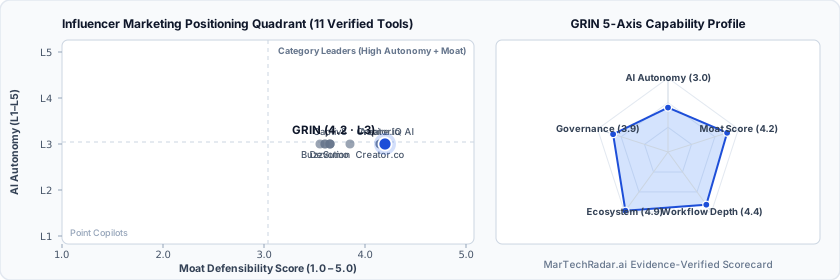
GRIN is a Web SaaS tool for Influencer Marketing (Influencer Discovery & Campaign Management) in Social & Influencer. Pricing: From $200/mo. Best suited to DTC / eCommerce and Enterprise Brands. Editor ratings: AI autonomy L3 (conditional automation); moat score 4.2/5.0 (Proprietary moat). Fact-checked by Jagmeet Sine on Oct 6, 2026.
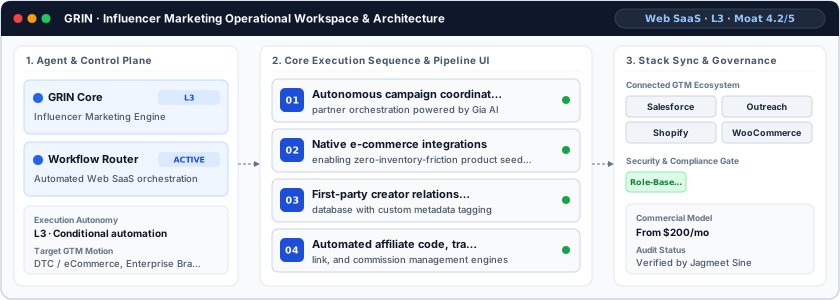
Creator management CRM integrating e-commerce storefronts with automated creator recruitment, seeding logistics, and affiliate tracking via Gia AI.
GRIN buyer fit verdict: when to choose vs. when to walk away
Choose GRIN if (Best Fit)
- Target ICP & Stack Fit: You operate as DTC / eCommerce and Enterprise Brands requiring a Web SaaS deployment for Influencer Marketing, with verified ecosystem connectivity for Salesforce, Outreach, Shopify, WooCommerce.
- L3 Architecture & Defensibility: GRIN anchors its moat in deep native e-commerce store integrations (Shopify, WooCommerce, SFCC) tied to direct product seeding and fulfillment workflows, augmented by an autonomous AI agent layer (Gia) running end-to-end campaign automation.
- Commercial Model Fit: Your procurement budget aligns with From $200/mo.
Walk away from GRIN if (Deal-Breakers)
- Walk away if your team is at early validation stage with a <$250/mo tool budget (GRIN starts at From $200/mo before seat or usage expansion).
- Walk away if your workflow cannot tolerate social network API volatility: GRIN relies on third-party platform graph endpoints; policy revisions or sudden token expirations across Meta or TikTok disrupt social analytics ingestion and story metric scraping.
- Walk away if inventory synchronization lag is a deal-breaker for your team: High-volume product seeding workflows depend on asynchronous inventory sync with merchant ERPs, causing fulfillment bottlenecks or backorder delays when warehouse stock fluctuates rapidly.
GRIN key facts & scorecard
| Pricing | From $200/moVendor pricing page |
|---|---|
| Free plan | No / not disclosed |
| Delivery | Web SaaS |
| Audience | DTC / eCommerce, Enterprise Brands |
| AI autonomy level | L3 · Conditional automationEditor-verified |
| Moat tier & score | 4.2 / 5.0 · Proprietary moatEditor-verified |
| Funding | Series B |
| Total funding | $145.3MBacked by BOND, e.ventures |
| Founders | Brandon Brown, Brian Mechem |
| Company size | 201-500 employees |
| Ecosystem integrations | Salesforce, Outreach, Shopify, WooCommerce |
| Governance & docs | Trust & Security ↗ · System Status ↗ · Terms ↗ · Privacy ↗ |
| Headquarters | Sacramento, United States |
| Founded | 2014 |
| Last verified |
GRIN pros & cons: strengths vs. operational limitations
Pros: core strengths & capabilities
- Autonomous campaign coordination and: partner orchestration powered by Gia AI
- Native e-commerce integrations: enabling zero-inventory-friction product seeding
- First-party creator relationship management: database with custom metadata tagging
- Automated affiliate code, tracking: link, and commission management engines
Cons: operational limitations & risks
- Social Network API Volatility: GRIN relies on third-party platform graph endpoints; policy revisions or sudden token expirations across Meta or TikTok disrupt social analytics ingestion and story metric scraping.
- Inventory Synchronization Lag: High-volume product seeding workflows depend on asynchronous inventory sync with merchant ERPs, causing fulfillment bottlenecks or backorder delays when warehouse stock fluctuates rapidly.
- Affiliate Attribution Windows: Attribution accuracy degrades when multi-touch consumer purchase paths conflict with platform-specific last-click affiliate parameter lifespans, requiring continuous manual ledger reconciliation.
GRIN TCO & deal-breaker stress test
Simulate 12-month stepped TCO, hidden cost multipliers, contract lock-in exposure, and stack failure modes using only facts verified by Jagmeet Sine on · Capture SHA 61eae276.
GRIN aligns with your 5-seat / $800/mo profile. Review the walk-away triggers and contract levers below before deployment.
| Plan / Tier | Verified Rate | Scale Fit | Scope & Quota Notes |
|---|---|---|---|
| Free | $200/mo | 1–2 seats | FOCUSED PROGRAMS |
| Growth | $500/mo | 5 seats | Manage multiple brands with Gia's Desk and a larger monthly credit allowance. |
- Moat Score
- 4.2 / 5.0
- AI Autonomy
- L3
- Free Tier / Trial
- None disclosed
Triggered audit signals & failure modes
- Published Self-Serve Entry FloorVerified Pricing Ledger
GRIN publishes a transparent entry point (From $200/mo) for initial validation before committing.
- Tier Fit for 5-Seat Scale: Growth ($500/mo)Verified Tier Schedule
Manage multiple brands with Gia's Desk and a larger monthly credit allowance.
- Primary Operational Bottleneck: Social Network API VolatilityAudit by Jagmeet Sine
GRIN relies on third-party platform graph endpoints; policy revisions or sudden token expirations across Meta or TikTok disrupt social analytics ingestion and story metric scraping.
Hidden TCO Multipliers & Quota Gates
- Per-Seat Linear Scaling: GRIN prices licenses on a per-user/seat basis (From $200/mo); expanding from 2 to 15+ operators multiplies base recurring spend linearly.
- Credit & Usage Burn Multiplier: Automated workflows consume metered credits/usage quotas; multi-step enrichment, voice minutes, or high-frequency agent runs can trigger mid-cycle top-up packs.
When to Walk Away & Negotiation Levers
- Walk away if your team is at early validation stage with a <$250/mo tool budget (GRIN starts at From $200/mo before seat or usage expansion).
- Walk away if your workflow cannot tolerate social network API volatility: GRIN relies on third-party platform graph endpoints; policy revisions or sudden token expirations across Meta or TikTok disrupt social analytics ingestion and story metric scraping.
- Walk away if inventory synchronization lag is a deal-breaker for your team: High-volume product seeding workflows depend on asynchronous inventory sync with merchant ERPs, causing fulfillment bottlenecks or backorder delays when warehouse stock fluctuates rapidly.
- Negotiate price-lock protection on additional seats and overage credits above the From $200/mo entry tier.
- Require a sandbox proof-of-concept testing social network API volatility against your live CRM/data schema before annual sign-off.
Ask a custom procurement or TCO stress-test question about GRIN
Lower 5-seat floor (~$199/mo vs. $500 / mo)
Lower 5-seat floor (~$99/mo vs. $500 / mo)
GRIN key entities, modules & ecosystem stack
GRIN moat & subtrack positioning
GRIN anchors its moat in deep native e-commerce store integrations (Shopify, WooCommerce, SFCC) tied to direct product seeding and fulfillment workflows, augmented by an autonomous AI agent layer (Gia) running end-to-end campaign automation.
Editorial review
Fact-checked by Jagmeet Sine (Senior MarTech Infrastructure & Agentic Workflow Architect) on .
Background
Backed by $145.3M in venture funding, GRIN was founded in 2014 in Sacramento, United States, to transition creator marketing from manual sponsorship spreadsheets to programmatic customer relationship management. Designed specifically for direct-to-consumer digital marketing directors and e-commerce growth leads, the platform positions creators not as one-off advertising inventory, but as permanent direct brand relationships deeply embedded within retail fulfillment infrastructure.
How GRIN works
Architecturally, GRIN operates at Level 3 autonomy by coupling social data ingestion with native merchant storefront APIs, including Shopify, WooCommerce, and Salesforce Commerce Cloud. Its autonomous AI agent, Gia, ingests campaign parameters to parse target demographics, coordinate creator communication, and execute product seeding logistics directly through the brand's enterprise fulfillment pipelines. When an outreach sequence converts, the system provisions unique discount identifiers, generates dynamic affiliate tracking links, and aggregates authenticated social performance telemetry through downstream webhooks.
Limitations
Operational considerations and platform boundaries include:
- Social Network API Volatility: GRIN relies on third-party platform graph endpoints; policy revisions or sudden token expirations across Meta or TikTok disrupt social analytics ingestion and story metric scraping.
- Inventory Synchronization Lag: High-volume product seeding workflows depend on asynchronous inventory sync with merchant ERPs, causing fulfillment bottlenecks or backorder delays when warehouse stock fluctuates rapidly.
- Affiliate Attribution Windows: Attribution accuracy degrades when multi-touch consumer purchase paths conflict with platform-specific last-click affiliate parameter lifespans, requiring continuous manual ledger reconciliation.
GRIN pricing
GRIN structures its software licensing around usage tiers and automation depth, offering initial access from $200 per month for core creator management workflows. The commercial model incorporates tiered tiers scaling into higher monthly software fees, with variable allocations for AI credits, multi-brand workspace management, managed recruiting access, and enterprise OMS integrations.
How GRIN compares
While CreatorIQ AI emphasizes global enterprise compliance governance and HypeAuditor targets fraud detection scoring, GRIN isolates its technical differentiation within operational e-commerce execution and merchant ERP integration. Conversely, platforms like Emplifi focus broadly on unified social listening and omnichannel customer care. Consequently, GRIN remains optimal for direct-to-consumer consumer packaged goods and retail merchants whose primary growth strategy demands automated physical product seeding paired with performance affiliate tracking.
Direct competitors & market radar
Top algorithmic competitors based on category positioning, capability overlap, and ICP alignment.
Frequently asked questions about GRIN
How much does GRIN cost and what pricing tiers are available?
Published pricing summary for GRIN: From $200/mo. A permanent free plan is not disclosed for GRIN. Verified tier schedule: Free ($200/mo for 1–2 seats); Growth ($500/mo for 5 seats). GRIN structures its software licensing around usage tiers and automation depth, offering initial access from $200 per month for core creator management workflows.
How does GRIN work and how autonomous is its AI architecture?
Creator management CRM integrating e-commerce storefronts with automated creator recruitment, seeding logistics, and affiliate tracking via Gia AI. Within Influencer Marketing (Influencer Discovery & Campaign Management), MarTechRadar rates its execution architecture at L3 · Conditional automation with a verified Moat Score of 4.2 / 5.0 (Proprietary moat). GRIN anchors its moat in deep native e-commerce store integrations (Shopify, WooCommerce, SFCC) tied to direct product seeding and fulfillment workflows, augmented by an autonomous AI agent layer (Gia) running end-to-end campaign automation. Corporate profile: Founded by Brandon Brown, Brian Mechem, operating at 201-500 employees scale.
What are the main limitations of GRIN and when should buyers walk away?
Based on our editorial technical audit, key operational considerations and boundaries for GRIN include: (1) Social Network API Volatility: GRIN relies on third-party platform graph endpoints; policy revisions or sudden token expirations across Meta or TikTok disrupt social analytics ingestion and story metric scraping. (2) Inventory Synchronization Lag: High-volume product seeding workflows depend on asynchronous inventory sync with merchant ERPs, causing fulfillment bottlenecks or backorder delays when warehouse stock fluctuates rapidly. (3) Affiliate Attribution Windows: Attribution accuracy degrades when multi-touch consumer purchase paths conflict with platform-specific last-click affiliate parameter lifespans, requiring continuous manual ledger reconciliation. Primary procurement walk-away rule: Walk away if your team is at early validation stage with a <$250/mo tool budget (GRIN starts at From $200/mo before seat or usage expansion).
What integrations, compliance certifications, and contract terms apply to GRIN?
Verified ecosystem and stack integrations include Salesforce, Outreach, Shopify, WooCommerce. First-party governance and developer endpoints verified on domain include: Trust/Security (https://grin.co/security), Status (https://status.grin.co). Key TCO multiplier to watch: Per-Seat Linear Scaling (GRIN prices licenses on a per-user/seat basis (From $200/mo); expanding from 2 to 15+ operators multiplies base recurring spend linearly.) Before signing a contract, procurement teams should negotiate price-lock protection on additional seats and overage credits above the From $200/mo entry tier.
What are the best GRIN alternatives and head-to-head competitors in 2026?
Top fact-checked alternatives to GRIN in Influencer Marketing (Influencer Discovery & Campaign Management) include HypeAuditor (Custom / enterprise pricing), CreatorIQ AI (Custom / enterprise pricing), Emplifi ($1,249–$2,499/mo), Janney AI (Free plan · $0/mo · Enterprise plan). While CreatorIQ AI emphasizes global enterprise compliance governance and HypeAuditor targets fraud detection scoring, GRIN isolates its technical differentiation within operational e-commerce execution and merchant ERP integration.
Verified sources & evidence trail
- Official product domain: https://grin.co
- Commercial pricing verification: https://grin.co/pricing
- Verified corporate entity profiles (
sameAs): LinkedIn Company Profile · Crunchbase Entity Record - First-party governance & documentation links: Trust & Security · System Status · Terms · Privacy
- Editorial audit sign-off: Fact-checked by Jagmeet Sine on under the MarTechRadar Evidence-Ledger Protocol.