DaisySocial Review (2026): Social Media Scheduling Pricing, Limits & Alternatives
Bottom line
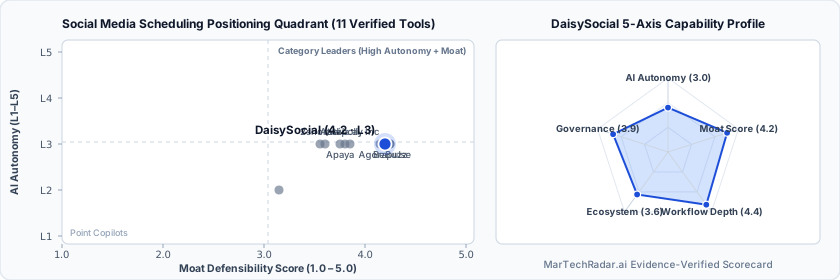
DaisySocial is a Web SaaS tool for Social Media Scheduling (Social Media Scheduling & Auto-Publishing) in Social & Influencer. Pricing: Custom / enterprise pricing. Best suited to Social Media Managers, Creator & Influencer Agencies and Brand Community Ops. Editor ratings: AI autonomy L3 (conditional automation); moat score 4.2/5.0 (Proprietary moat). Fact-checked by Anthony Hay on Oct 12, 2026.
Autonomous social media management platform generating brand-aligned visual assets, channel-specific copy, and structured auto-publishing schedules.
DaisySocial buyer fit verdict: when to choose vs. when to walk away
Choose DaisySocial if (Best Fit)
- Target ICP & Stack Fit: You operate as Social Media Managers, Creator & Influencer Agencies and Brand Community Ops requiring a Web SaaS deployment for Social Media Scheduling, with verified ecosystem connectivity for LinkedIn.
- L3 Architecture & Defensibility: Defensibility centers on automated multi-channel content scheduling algorithms linked to context-aware prompt orchestration engines, supported by early seed capital.
- Commercial Model Fit: Your procurement budget aligns with Custom / enterprise pricing.
Walk away from DaisySocial if (Deal-Breakers)
- Walk away if you require transparent self-serve monthly billing or your budget ceiling is under $1,000/mo (DaisySocial requires sales-gated custom quoting).
- Walk away if your workflow cannot tolerate API rate limits and token depreciation: Automated publishing pipelines remain bound by upstream social network rate restrictions, leading to queue desynchronization when external platform auth tokens expire unexpectedly.
- Walk away if brand governance drift is a deal-breaker for your team: L3 semi-autonomous asset generation requires ongoing human validation to prevent tonal discrepancies, repetitive copy structures, and factual drift across prolonged posting schedules.
DaisySocial key facts & scorecard
| Pricing | Custom / enterprise pricing |
|---|---|
| Free plan | No / not disclosed |
| Delivery | Web SaaS |
| Audience | Social Media Managers, Creator & Influencer Agencies, Brand Community Ops |
| AI autonomy level | L3 · Conditional automationEditor-verified |
| Moat tier & score | 4.2 / 5.0 · Proprietary moatEditor-verified |
| Funding | Seed |
| Total funding | $3.9M |
| Company size | 1-10 employees |
| Ecosystem integrations | |
| Governance & docs | Terms ↗ · Privacy ↗ |
| Headquarters | Wyoming, Michigan, United States |
| Founded | 2024 |
| Last verified |
DaisySocial pros & cons: strengths vs. operational limitations
Pros: core strengths & capabilities
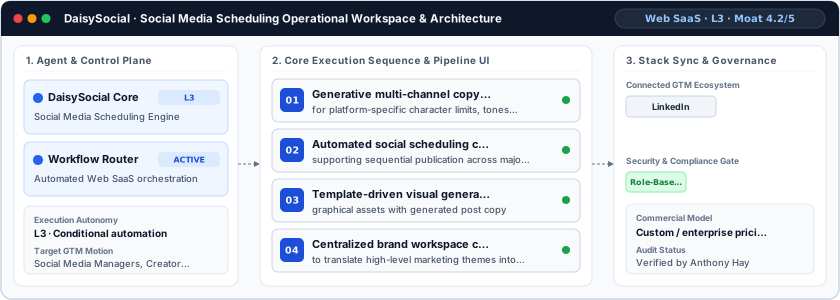
- Generative multi-channel copywriting calibrated: for platform-specific character limits, tones, and hashtag distribution
- Automated social scheduling calendars: supporting sequential publication across major social networks
- Template-driven visual generation coordinating: graphical assets with generated post copy
- Centralized brand workspace configured: to translate high-level marketing themes into multi-week editorial cadence
Cons: operational limitations & risks
- API Rate Limits and Token Depreciation: Automated publishing pipelines remain bound by upstream social network rate restrictions, leading to queue desynchronization when external platform auth tokens expire unexpectedly.
- Brand Governance Drift: L3 semi-autonomous asset generation requires ongoing human validation to prevent tonal discrepancies, repetitive copy structures, and factual drift across prolonged posting schedules.
- Analytics Attribution Latency: Performance feedback ingestion suffers from delayed platform analytics synchronization, limiting the speed at which autonomous scheduling workflows can iterate based on engagement signals.
DaisySocial TCO & deal-breaker stress test
Simulate 12-month stepped TCO, hidden cost multipliers, contract lock-in exposure, and stack failure modes using only facts verified by Anthony Hay on · Capture SHA 5f6c7eb4.
DaisySocial triggers high-severity friction under your 5-seat / $800/mo constraints. Benchmark the verified subtrack alternatives below before committing.
| Plan / Tier | Verified Rate | Scale Fit | Scope & Quota Notes |
|---|---|---|---|
| Enterprise / Custom | Custom quote | 15–50+ seats (Enterprise SLA) | Sales-negotiated annual contract for custom volume, SSO/RBAC governance, and dedicated SLA. |
- Moat Score
- 4.2 / 5.0
- AI Autonomy
- L3
- Free Tier / Trial
- None disclosed
Triggered audit signals & failure modes
- Opaque Enterprise Quoting vs. SMB/Mid-Market BudgetVerified Pricing Ledger
DaisySocial does not disclose a public self-serve floor (Custom / enterprise pricing). Buyers with a $800/mo cap face high sales-qualification friction.
- Sales-Gated Contract TermsFact-checked by Anthony Hay
DaisySocial delivers its software through custom enterprise contracts structured around organizational requirements. Commercial pricing is available on request through tailored enterprise sales quotes based on organizational scale and seats.
- Primary Operational Bottleneck: API Rate Limits and Token DepreciationAudit by Anthony Hay
Automated publishing pipelines remain bound by upstream social network rate restrictions, leading to queue desynchronization when external platform auth tokens expire unexpectedly.
Hidden TCO Multipliers & Quota Gates
- Credit & Usage Burn Multiplier: Automated workflows consume metered credits/usage quotas; multi-step enrichment, voice minutes, or high-frequency agent runs can trigger mid-cycle top-up packs.
- API Rate Limits and Token Depreciation: Automated publishing pipelines remain bound by upstream social network rate restrictions, leading to queue desynchronization when external platform auth tokens expire unexpectedly.
- Brand Governance Drift: L3 semi-autonomous asset generation requires ongoing human validation to prevent tonal discrepancies, repetitive copy structures, and factual drift across prolonged posting schedules.
When to Walk Away & Negotiation Levers
- Walk away if you require transparent self-serve monthly billing or your budget ceiling is under $1,000/mo (DaisySocial requires sales-gated custom quoting).
- Walk away if your workflow cannot tolerate API rate limits and token depreciation: Automated publishing pipelines remain bound by upstream social network rate restrictions, leading to queue desynchronization when external platform auth tokens expire unexpectedly.
- Walk away if brand governance drift is a deal-breaker for your team: L3 semi-autonomous asset generation requires ongoing human validation to prevent tonal discrepancies, repetitive copy structures, and factual drift across prolonged posting schedules.
- Demand a 30- to 60-day paid pilot opt-out clause in the DaisySocial order form before signing a 12-month enterprise commitment.
- Require a sandbox proof-of-concept testing API rate limits and token depreciation against your live CRM/data schema before annual sign-off.
Ask a custom procurement or TCO stress-test question about DaisySocial
Lower 5-seat floor (~$10/mo vs. Custom Quote) · Transparent self-serve entry without mandatory annual lock-in
Lower 5-seat floor (~$5/mo vs. Custom Quote) · Transparent self-serve entry without mandatory annual lock-in
DaisySocial key entities, modules & ecosystem stack
DaisySocial moat & subtrack positioning
Defensibility centers on automated multi-channel content scheduling algorithms linked to context-aware prompt orchestration engines, supported by early seed capital.
Editorial review
Fact-checked by Anthony Hay (Senior SEO, Search Intelligence & Content Operations Editor) on .
Background
To execute consistent digital distribution without ballooning headcount, social media managers require automated orchestration between asset generation and publishing cadences. Established in 2024 and headquartered in Wyoming, Michigan, United States, DaisySocial addresses this operational demand backed by $3.9M in seed funding. The platform targets growth-stage marketing teams, boutique marketing agencies, and mid-market commercial brands requiring structured social generation. DaisySocial automates the creation of copy, creative assets, and cross-channel calendars within a unified environment.
How DaisySocial works
Operating at an L3 conditional autonomy level, DaisySocial accepts baseline business objectives, seasonal campaign themes, or product specifications to produce complete publishing calendars. The platform directs input prompts through fine-tuned language models that format copy specifically for networks such as LinkedIn, Instagram, Facebook, and X. This process calculates appropriate character constraints, tone profiles, and algorithmic hashtag density per channel. Simultaneously, the platform synchronizes these linguistic payloads with automated visual assets and schedules publication events through direct REST API connectors.
Limitations
Operational considerations and platform boundaries include:
- API Rate Limits and Token Depreciation: Automated publishing pipelines remain bound by upstream social network rate restrictions, leading to queue desynchronization when external platform auth tokens expire unexpectedly.
- Brand Governance Drift: L3 semi-autonomous asset generation requires ongoing human validation to prevent tonal discrepancies, repetitive copy structures, and factual drift across prolonged posting schedules.
- Analytics Attribution Latency: Performance feedback ingestion suffers from delayed platform analytics synchronization, limiting the speed at which autonomous scheduling workflows can iterate based on engagement signals.
DaisySocial pricing
DaisySocial delivers its software through custom enterprise contracts structured around organizational requirements. Commercial pricing is available on request through tailored enterprise sales quotes based on organizational scale and seats. Contracts typically account for active brand workspaces, seat allocations for internal reviewers, and connected social media publishing destinations, backed by enterprise service level commitments.
How DaisySocial compares
Within social automation, DaisySocial competes with conventional publishing suites like Agorapulse and newer entrants like Antela.ai, Inc. and Apaya. While Agorapulse prioritizes multi-user social inbox workflows and historical engagement governance, DaisySocial focuses on generative content assembly. Conversely, solutions like Apaya emphasize lean analytics over cross-channel generation. DaisySocial best serves resource-constrained marketing departments and mid-market organizations requiring automated asset generation and calendar management without maintaining sprawling manual editorial infrastructure.
Direct competitors & market radar
Top algorithmic competitors based on category positioning, capability overlap, and ICP alignment.
Frequently asked questions about DaisySocial
How much does DaisySocial cost and does it require a custom enterprise quote?
Published pricing summary for DaisySocial: Custom / enterprise pricing. A permanent free plan is not disclosed for DaisySocial. DaisySocial delivers its software through custom enterprise contracts structured around organizational requirements. Commercial pricing is available on request through tailored enterprise sales quotes based on organizational scale and seats.
How does DaisySocial work and how autonomous is its AI architecture?
Autonomous social media management platform generating brand-aligned visual assets, channel-specific copy, and structured auto-publishing schedules. Within Social Media Scheduling (Social Media Scheduling & Auto-Publishing), MarTechRadar rates its execution architecture at L3 · Conditional automation with a verified Moat Score of 4.2 / 5.0 (Proprietary moat). Defensibility centers on automated multi-channel content scheduling algorithms linked to context-aware prompt orchestration engines, supported by early seed capital. Corporate profile: operating at 1-10 employees scale.
What are the main limitations of DaisySocial and when should buyers walk away?
Based on our editorial technical audit, key operational considerations and boundaries for DaisySocial include: (1) API Rate Limits and Token Depreciation: Automated publishing pipelines remain bound by upstream social network rate restrictions, leading to queue desynchronization when external platform auth tokens expire unexpectedly. (2) Brand Governance Drift: L3 semi-autonomous asset generation requires ongoing human validation to prevent tonal discrepancies, repetitive copy structures, and factual drift across prolonged posting schedules. (3) Analytics Attribution Latency: Performance feedback ingestion suffers from delayed platform analytics synchronization, limiting the speed at which autonomous scheduling workflows can iterate based on engagement signals. Primary procurement walk-away rule: Walk away if you require transparent self-serve monthly billing or your budget ceiling is under $1,000/mo (DaisySocial requires sales-gated custom quoting).
What integrations, compliance certifications, and contract terms apply to DaisySocial?
Verified ecosystem and stack integrations include LinkedIn. Key TCO multiplier to watch: Credit & Usage Burn Multiplier (Automated workflows consume metered credits/usage quotas; multi-step enrichment, voice minutes, or high-frequency agent runs can trigger mid-cycle top-up packs.) Before signing a contract, procurement teams should demand a 30- to 60-day paid pilot opt-out clause in the DaisySocial order form before signing a 12-month enterprise commitment.
What are the best DaisySocial alternatives and head-to-head competitors in 2026?
Top fact-checked alternatives to DaisySocial in Social Media Scheduling (Social Media Scheduling & Auto-Publishing) include Rytr (Free plan · $7.50–$24.16/mo), Hypotenuse AI (Custom / enterprise pricing), Buffer AI Assistant (Free plan · $5–$10/mo), Metricool (Free plan · $10–$45/mo). Within social automation, DaisySocial competes with conventional publishing suites like Agorapulse and newer entrants like Antela.ai, Inc. and Apaya. While Agorapulse prioritizes multi-user social inbox workflows and historical engagement governance, DaisySocial focuses on generative content assembly.
Verified sources & evidence trail
- Official product domain: https://daisysocial.com
- Commercial pricing verification: Verified against official vendor pricing policy (Custom / enterprise pricing)
- Verified corporate entity profiles (
sameAs): LinkedIn Company Profile · Crunchbase Entity Record - First-party governance & documentation links: Terms · Privacy
- Editorial audit sign-off: Fact-checked by Anthony Hay on under the MarTechRadar Evidence-Ledger Protocol.