Draft Review (2026): AI Content Marketing Pricing, Limits & Alternatives
Bottom line
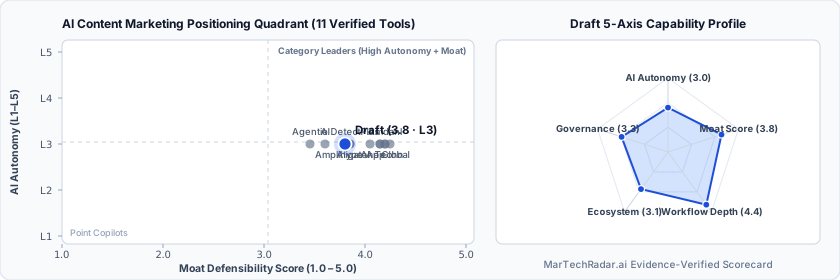
Draft is a Web SaaS tool for AI Content Marketing (Enterprise & Long-Form Brand Content) in Copy & Content. Pricing: Custom / enterprise pricing. Best suited to Enterprise Content Teams, Brand Marketers and Global Copywriters. Editor ratings: AI autonomy L3 (conditional automation); moat score 3.8/5.0 (Proprietary moat). Fact-checked by Jagmeet Sine on Oct 11, 2026.
Human-in-the-loop content operations platform pairing automated brief generation and editorial intelligence with vetted marketplace writers to deliver.
Draft buyer fit verdict: when to choose vs. when to walk away
Choose Draft if (Best Fit)
- Target ICP & Stack Fit: You operate as Enterprise Content Teams, Brand Marketers and Global Copywriters requiring a Web SaaS deployment for AI Content Marketing.
- L3 Architecture & Defensibility: Defensibility stemmed from a closed marketplace of vetted domain writers integrated with structured editorial governance workflows, though vulnerability to unassisted generative LLM models limited its long-term defensibility.
- Commercial Model Fit: Your procurement budget aligns with Custom / enterprise pricing.
Walk away from Draft if (Deal-Breakers)
- Walk away if you require transparent self-serve monthly billing or your budget ceiling is under $1,000/mo (Draft requires sales-gated custom quoting).
- Walk away if your workflow cannot tolerate editorial latency: Human dependency created inherent multi-day turnaround bottlenecks, preventing real-time, high-velocity publishing cadences required for agile newsjacking or rapid content updates.
- Walk away if quality variance is a deal-breaker for your team: Subjective marketplace writer output introduced inconsistent quality across complex technical niches, demanding continued intervention from in-house corporate editors.
Draft key facts & scorecard
| Pricing | Custom / enterprise pricing |
|---|---|
| Free plan | No / not disclosed |
| Delivery | Web SaaS |
| Audience | Enterprise Content Teams, Brand Marketers, Global Copywriters |
| AI autonomy level | L3 · Conditional automationEditor-verified |
| Moat tier & score | 3.8 / 5.0 · Proprietary moatEditor-verified |
| Funding | Series B |
| Total funding | Series BBacked by Y Combinator |
| Company size | 51-200 employees |
| Governance & docs | Terms ↗ · Privacy ↗ |
| Headquarters | Toronto, Ontario |
| Founded | 2018 |
| Last verified |
Draft pros & cons: strengths vs. operational limitations
Pros: core strengths & capabilities
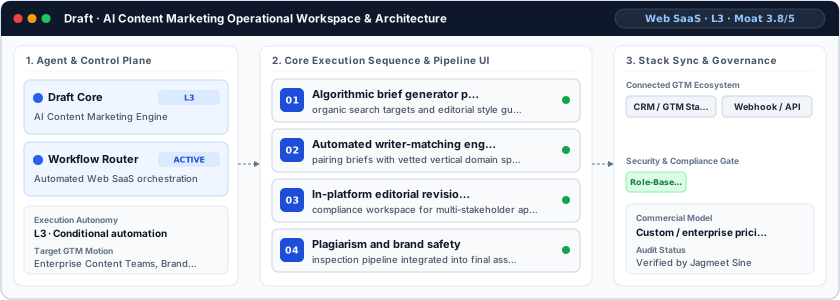
- Algorithmic brief generator parsing: organic search targets and editorial style guides
- Automated writer-matching engine: pairing briefs with vetted vertical domain specialists
- In-platform editorial revision and: compliance workspace for multi-stakeholder approvals
- Plagiarism and brand safety: inspection pipeline integrated into final asset delivery
Cons: operational limitations & risks
- Editorial Latency: Human dependency created inherent multi-day turnaround bottlenecks, preventing real-time, high-velocity publishing cadences required for agile newsjacking or rapid content updates.
- Quality Variance: Subjective marketplace writer output introduced inconsistent quality across complex technical niches, demanding continued intervention from in-house corporate editors.
- Platform Viability Risk: Ceasing active operational service abruptly ended API access, writer dispatch, and ongoing account support for organizations relying on its infrastructure.
Draft TCO & deal-breaker stress test
Simulate 12-month stepped TCO, hidden cost multipliers, contract lock-in exposure, and stack failure modes using only facts verified by Jagmeet Sine on · Capture SHA b81f9711.
Draft triggers high-severity friction under your 5-seat / $800/mo constraints. Benchmark the verified subtrack alternatives below before committing.
| Plan / Tier | Verified Rate | Scale Fit | Scope & Quota Notes |
|---|---|---|---|
| Enterprise / Custom | Custom quote | 15–50+ seats (Enterprise SLA) | Sales-negotiated annual contract for custom volume, SSO/RBAC governance, and dedicated SLA. |
- Moat Score
- 3.8 / 5.0
- AI Autonomy
- L3
- Free Tier / Trial
- None disclosed
Triggered audit signals & failure modes
- Opaque Enterprise Quoting vs. SMB/Mid-Market BudgetVerified Pricing Ledger
Draft does not disclose a public self-serve floor (Custom / enterprise pricing). Buyers with a $800/mo cap face high sales-qualification friction.
- Sales-Gated Contract TermsFact-checked by Jagmeet Sine
Draft operated under an enterprise licensing framework where commercial pricing was available on request through tailored enterprise sales quotes based on organizational scale and seats.
- Primary Operational Bottleneck: Editorial LatencyAudit by Jagmeet Sine
Human dependency created inherent multi-day turnaround bottlenecks, preventing real-time, high-velocity publishing cadences required for agile newsjacking or rapid content updates.
Hidden TCO Multipliers & Quota Gates
- Editorial Latency: Human dependency created inherent multi-day turnaround bottlenecks, preventing real-time, high-velocity publishing cadences required for agile newsjacking or rapid content updates.
- Quality Variance: Subjective marketplace writer output introduced inconsistent quality across complex technical niches, demanding continued intervention from in-house corporate editors.
When to Walk Away & Negotiation Levers
- Walk away if you require transparent self-serve monthly billing or your budget ceiling is under $1,000/mo (Draft requires sales-gated custom quoting).
- Walk away if your workflow cannot tolerate editorial latency: Human dependency created inherent multi-day turnaround bottlenecks, preventing real-time, high-velocity publishing cadences required for agile newsjacking or rapid content updates.
- Walk away if quality variance is a deal-breaker for your team: Subjective marketplace writer output introduced inconsistent quality across complex technical niches, demanding continued intervention from in-house corporate editors.
- Demand a 30- to 60-day paid pilot opt-out clause in the Draft order form before signing a 12-month enterprise commitment.
- Require a sandbox proof-of-concept testing editorial latency against your live CRM/data schema before annual sign-off.
Ask a custom procurement or TCO stress-test question about Draft
Lower 5-seat floor (~$42/mo vs. Custom Quote)
Lower 5-seat floor (~$13/mo vs. Custom Quote) · Transparent self-serve entry without mandatory annual lock-in
Draft moat & subtrack positioning
Defensibility stemmed from a closed marketplace of vetted domain writers integrated with structured editorial governance workflows, though vulnerability to unassisted generative LLM models limited its long-term defensibility.
Editorial review
Fact-checked by Jagmeet Sine (Senior MarTech Infrastructure & Agentic Workflow Architect) on .
Background
Draft was established in 2018 in Toronto, Ontario, to address a fundamental job-to-be-done for marketing leadership: scaling high-fidelity, long-form corporate editorial assets without sacrificing domain authenticity. Operating within enterprise content creation, the platform targeted brand marketing directors, editorial leads, and search engine optimization practitioners. Rather than leaning strictly on raw algorithmic copy generation, the platform served as a structured bridge between automated strategy execution and human editorial rigor, coordinating end-to-end production pipelines across corporate go-to-market teams.
How Draft works
Operating at an L3 autonomy profile, Draft deployed a human-in-the-loop content orchestration pipeline. Corporate users ingested style guidelines, keyword clusters, and product messaging taxonomies into the core workspace. The system synthesized these parameters into structured editorial briefs via natural language processing heuristics. An automated routing engine then matched briefs to vetted marketplace writers based on subject-matter relevance and historic quality scores. Draft managed drafting, internal review loops, and style governance natively, utilizing rules-based validation to maintain brand voice integrity prior to asset export.
Limitations
Operational considerations and platform boundaries include:
- Editorial Latency: Human dependency created inherent multi-day turnaround bottlenecks, preventing real-time, high-velocity publishing cadences required for agile newsjacking or rapid content updates.
- Quality Variance: Subjective marketplace writer output introduced inconsistent quality across complex technical niches, demanding continued intervention from in-house corporate editors.
- Platform Viability Risk: Ceasing active operational service abruptly ended API access, writer dispatch, and ongoing account support for organizations relying on its infrastructure.
Draft pricing
Draft operated under an enterprise licensing framework where commercial pricing was available on request through tailored enterprise sales quotes based on organizational scale and seats. Contracts were typically structured around committed monthly editorial volumes, platform seat allocations, and managed service tiers. Enterprise plans bundled dedicated account oversight, rigorous service-level agreements for asset delivery, and customized writer onboarding workflows.
How Draft compares
Within long-form enterprise content infrastructure, Draft held a distinct posture against automated tooling ecosystems. While Agentio targets algorithmic creator ad placements and AIDetectPlus serves as an adversarial text-verification layer, Draft operated as an asset-creation clearinghouse. Compared to Aha Global, Draft leaned heavily on human marketplace expertise rather than pure machine orchestration. The service was optimal for mid-market and enterprise editorial teams requiring human polish, though pure-play generative platforms subsequently superseded its unit economics.
Direct competitors & market radar
Top algorithmic competitors based on category positioning, capability overlap, and ICP alignment.
Frequently asked questions about Draft
How much does Draft cost and does it require a custom enterprise quote?
Published pricing summary for Draft: Custom / enterprise pricing. A permanent free plan is not disclosed for Draft. Draft operated under an enterprise licensing framework where commercial pricing was available on request through tailored enterprise sales quotes based on organizational scale and seats. Contracts were typically structured around committed monthly editorial volumes, platform seat allocations, and managed service tiers.
How does Draft work and how autonomous is its AI architecture?
Human-in-the-loop content operations platform pairing automated brief generation and editorial intelligence with vetted marketplace writers to deliver. Within AI Content Marketing (Enterprise & Long-Form Brand Content), MarTechRadar rates its execution architecture at L3 · Conditional automation with a verified Moat Score of 3.8 / 5.0 (Proprietary moat). Defensibility stemmed from a closed marketplace of vetted domain writers integrated with structured editorial governance workflows, though vulnerability to unassisted generative LLM models limited its long-term defensibility. Corporate profile: operating at 51-200 employees scale.
What are the main limitations of Draft and when should buyers walk away?
Based on our editorial technical audit, key operational considerations and boundaries for Draft include: (1) Editorial Latency: Human dependency created inherent multi-day turnaround bottlenecks, preventing real-time, high-velocity publishing cadences required for agile newsjacking or rapid content updates. (2) Quality Variance: Subjective marketplace writer output introduced inconsistent quality across complex technical niches, demanding continued intervention from in-house corporate editors. (3) Platform Viability Risk: Ceasing active operational service abruptly ended API access, writer dispatch, and ongoing account support for organizations relying on its infrastructure. Primary procurement walk-away rule: Walk away if you require transparent self-serve monthly billing or your budget ceiling is under $1,000/mo (Draft requires sales-gated custom quoting).
What integrations, compliance certifications, and contract terms apply to Draft?
Key TCO multiplier to watch: Editorial Latency (Human dependency created inherent multi-day turnaround bottlenecks, preventing real-time, high-velocity publishing cadences required for agile newsjacking or rapid content updates.) Before signing a contract, procurement teams should demand a 30- to 60-day paid pilot opt-out clause in the Draft order form before signing a 12-month enterprise commitment.
What are the best Draft alternatives and head-to-head competitors in 2026?
Top fact-checked alternatives to Draft in AI Content Marketing (Enterprise & Long-Form Brand Content) include Contently (Custom / enterprise pricing), AIDetectPlus (Custom / enterprise pricing), Amplihype App (Custom / enterprise pricing), Applanga (From $500/yr). Within long-form enterprise content infrastructure, Draft held a distinct posture against automated tooling ecosystems. While Agentio targets algorithmic creator ad placements and AIDetectPlus serves as an adversarial text-verification layer, Draft operated as an asset-creation clearinghouse.
Verified sources & evidence trail
- Official product domain: https://draft.co/
- Commercial pricing verification: Verified against official vendor pricing policy (Custom / enterprise pricing)
- Verified corporate entity profiles (
sameAs): LinkedIn Company Profile - First-party governance & documentation links: Terms · Privacy
- Editorial audit sign-off: Fact-checked by Jagmeet Sine on under the MarTechRadar Evidence-Ledger Protocol.