Applanga Review (2026): AI Translation Pricing, Limits & Alternatives
Bottom line
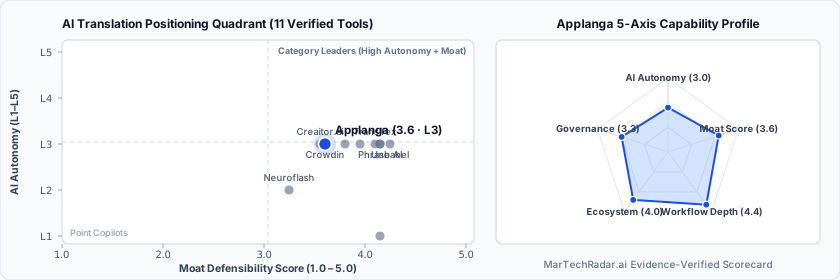
Applanga is a Web SaaS tool for AI Translation (Multilingual & Global Localization) in Copy & Content. Pricing: From $500/yr. Best suited to B2B SaaS, DTC / eCommerce and Enterprise Brands. Editor ratings: AI autonomy L3 (conditional automation); moat score 3.6/5.0 (Proprietary moat). Fact-checked by Anthony Hay on Oct 14, 2026.
Developer-centric software localization platform providing native mobile SDKs, dynamic string streaming, automated screenshot management, and in-context.
Applanga buyer fit verdict: when to choose vs. when to walk away
Choose Applanga if (Best Fit)
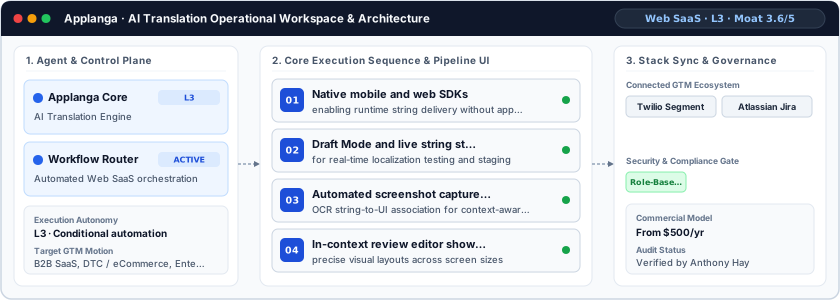
- Target ICP & Stack Fit: You operate as B2B SaaS, DTC / eCommerce and Enterprise Brands requiring a Web SaaS deployment for AI Translation, with verified ecosystem connectivity for Twilio Segment, Atlassian Jira.
- L3 Architecture & Defensibility: Tight integration into native mobile runtime environments via dynamic string streaming SDKs coupled with TransPerfect's GlobalLink ecosystem and human linguist network.
- Commercial Model Fit: Your procurement budget aligns with From $500/yr.
Walk away from Applanga if (Deal-Breakers)
- Walk away if your team is at early validation stage with a <$250/mo tool budget (Applanga starts at From $500/yr before seat or usage expansion).
- Walk away if your workflow cannot tolerate client binary overhead: Embedding runtime SDKs introduces binary size increases and network dependency considerations for mobile applications subject to strict performance budgets.
- Walk away if screenshot mapping brittleness is a deal-breaker for your team: Dynamic UI components, scroll views, and conditional rendering can cause automated screenshot generation to fail or misalign keys against runtime states.
Applanga key facts & scorecard
| Pricing | From $500/yrVendor pricing page |
|---|---|
| Free plan | No / not disclosed |
| Delivery | Web SaaS |
| Audience | B2B SaaS, DTC / eCommerce, Enterprise Brands |
| AI autonomy level | L3 · Conditional automationEditor-verified |
| Moat tier & score | 3.6 / 5.0 · Proprietary moatEditor-verified |
| Funding | AcquiredAcquired by TransPerfect |
| Founders | Christian Stanke, Steffen Roemer |
| Company size | 1-10 employees |
| Ecosystem integrations | Twilio Segment, Atlassian Jira |
| Governance & docs | Trust & Security ↗ · API & Docs ↗ · Terms ↗ · Privacy ↗ |
| Headquarters | Berlin, Germany |
| Founded | 2013 |
| Last verified |
Applanga pros & cons: strengths vs. operational limitations
Pros: core strengths & capabilities
- Native mobile and web SDKs: enabling runtime string delivery without app store redeployments
- Draft Mode and live string streaming: for real-time localization testing and staging
- Automated screenshot capture and: OCR string-to-UI association for context-aware translation
- In-context review editor showing: precise visual layouts across screen sizes
Cons: operational limitations & risks
- Client Binary Overhead: Embedding runtime SDKs introduces binary size increases and network dependency considerations for mobile applications subject to strict performance budgets.
- Screenshot Mapping Brittleness: Dynamic UI components, scroll views, and conditional rendering can cause automated screenshot generation to fail or misalign keys against runtime states.
- Offline String Fallbacks: Network failure during string streaming requires precise local resource bundling to prevent applications from displaying unlocalized keys or empty labels.
Applanga TCO & deal-breaker stress test
Simulate 12-month stepped TCO, hidden cost multipliers, contract lock-in exposure, and stack failure modes using only facts verified by Anthony Hay on · Capture SHA 9b1d0d81.
Applanga is viable for 5 seats, but requires commercial or technical verification on the flagged items below.
| Plan / Tier | Verified Rate | Scale Fit | Scope & Quota Notes |
|---|---|---|---|
| Entry / Starter | $500/yr | 1–2 seats | Verified $500/yr published rate on vendor pricing schedule. |
- Moat Score
- 3.6 / 5.0
- AI Autonomy
- L3
- Free Tier / Trial
- None disclosed
Triggered audit signals & failure modes
- Annual Contract Lock-in Risk DetectedFact-checked by Anthony Hay
Applanga delivers its platform via a tiered annual software-as-a-service model starting from $500 per year. Pricing tiers scale based on active string counts, tracked applications, team seat allocations, and SDK request volumes.
- Primary Operational Bottleneck: Client Binary OverheadAudit by Anthony Hay
Embedding runtime SDKs introduces binary size increases and network dependency considerations for mobile applications subject to strict performance budgets.
Hidden TCO Multipliers & Quota Gates
- Credit & Usage Burn Multiplier: Automated workflows consume metered credits/usage quotas; multi-step enrichment, voice minutes, or high-frequency agent runs can trigger mid-cycle top-up packs.
- Enterprise Governance & Add-On Gating: Advanced capabilities such as Single Sign-On (SSO), custom role permissions, or specialized analytics modules are gated behind upper tiers or paid add-ons.
When to Walk Away & Negotiation Levers
- Walk away if your team is at early validation stage with a <$250/mo tool budget (Applanga starts at From $500/yr before seat or usage expansion).
- Walk away if your workflow cannot tolerate client binary overhead: Embedding runtime SDKs introduces binary size increases and network dependency considerations for mobile applications subject to strict performance budgets.
- Walk away if screenshot mapping brittleness is a deal-breaker for your team: Dynamic UI components, scroll views, and conditional rendering can cause automated screenshot generation to fail or misalign keys against runtime states.
- Negotiate price-lock protection on additional seats and overage credits above the From $500/yr entry tier.
- Require a sandbox proof-of-concept testing client binary overhead against your live CRM/data schema before annual sign-off.
Ask a custom procurement or TCO stress-test question about Applanga
Fits within $800/mo budget (From $69/mo) · Transparent self-serve entry without mandatory annual lock-in
Offers a free tier (Free plan · $0/mo) · Transparent self-serve entry without mandatory annual lock-in
Applanga key entities, modules & ecosystem stack
Applanga moat & subtrack positioning
Tight integration into native mobile runtime environments via dynamic string streaming SDKs coupled with TransPerfect's GlobalLink ecosystem and human linguist network.
Editorial review
Fact-checked by Anthony Hay (Senior SEO, Search Intelligence & Content Operations Editor) on .
Background
Decoupling native application release cycles from string internationalization requires dedicated synchronization middleware at the runtime layer. Established in 2013 in Berlin, Germany, and later acquired by TransPerfect, Applanga functions as a continuous software localization engine engineered for mobile product managers, internationalization engineers, and localization leads. Rather than treating translations as static resource files packaged at build time, the platform embeds localization directly into operational app deployment architectures.
How Applanga works
Applanga operates at an L3 autonomy level by integrating native SDKs into iOS, Android, and web codebases to decouple UI strings from binary distributions. When integrated, the client SDK uses dynamic string streaming and a dedicated Draft Mode to fetch updated linguistic resources over the air. The system captures application screenshots automatically via runtime triggers, mapping string keys to visual layouts through optical character recognition and metadata parsing. Translations migrate across structured workflow stages, combining machine translation passes, automated format validation, and in-context linguistic review, with direct handoffs to TransPerfect services, alongside native workflow integrations for Jira.
Limitations
Operational considerations and platform boundaries include:
- Client Binary Overhead: Embedding runtime SDKs introduces binary size increases and network dependency considerations for mobile applications subject to strict performance budgets.
- Screenshot Mapping Brittleness: Dynamic UI components, scroll views, and conditional rendering can cause automated screenshot generation to fail or misalign keys against runtime states.
- Offline String Fallbacks: Network failure during string streaming requires precise local resource bundling to prevent applications from displaying unlocalized keys or empty labels.
Applanga pricing
Applanga delivers its platform via a tiered annual software-as-a-service model starting from $500 per year. Pricing tiers scale based on active string counts, tracked applications, team seat allocations, and SDK request volumes. Linguistic translation services managed through TransPerfect are billed separately based on per-word or per-project human review volumes.
How Applanga compares
While Transifex addresses broad continuous localization across cloud-native web repositories, Applanga specializes in mobile application architectures via live SDK string streaming within the AI Translation segment. Pure generative tools like DeepL Write or Neuroflash provide isolated copy enhancement rather than an integrated localization management pipeline. Consequently, Applanga suits mobile-first product engineering teams requiring continuous UI updates across multi-language releases without repeated app store submissions.
Frequently asked questions about Applanga
How much does Applanga cost and what pricing tiers are available?
Published pricing summary for Applanga: From $500/yr. A permanent free plan is not disclosed for Applanga. Applanga delivers its platform via a tiered annual software-as-a-service model starting from $500 per year. Pricing tiers scale based on active string counts, tracked applications, team seat allocations, and SDK request volumes.
How does Applanga work and how autonomous is its AI architecture?
Developer-centric software localization platform providing native mobile SDKs, dynamic string streaming, automated screenshot management, and in-context. Within AI Translation (Multilingual & Global Localization), MarTechRadar rates its execution architecture at L3 · Conditional automation with a verified Moat Score of 3.6 / 5.0 (Proprietary moat). Tight integration into native mobile runtime environments via dynamic string streaming SDKs coupled with TransPerfect's GlobalLink ecosystem and human linguist network. Corporate profile: Founded by Christian Stanke, Steffen Roemer, operating at 1-10 employees scale, acquired by TransPerfect.
What are the main limitations of Applanga and when should buyers walk away?
Based on our editorial technical audit, key operational considerations and boundaries for Applanga include: (1) Client Binary Overhead: Embedding runtime SDKs introduces binary size increases and network dependency considerations for mobile applications subject to strict performance budgets. (2) Screenshot Mapping Brittleness: Dynamic UI components, scroll views, and conditional rendering can cause automated screenshot generation to fail or misalign keys against runtime states. (3) Offline String Fallbacks: Network failure during string streaming requires precise local resource bundling to prevent applications from displaying unlocalized keys or empty labels. Primary procurement walk-away rule: Walk away if your team is at early validation stage with a <$250/mo tool budget (Applanga starts at From $500/yr before seat or usage expansion).
What integrations, compliance certifications, and contract terms apply to Applanga?
Verified ecosystem and stack integrations include Twilio Segment, Atlassian Jira. First-party governance and developer endpoints verified on domain include: Trust/Security (https://www.applanga.com/security), API Docs (https://www.applanga.com/users/developers). Key TCO multiplier to watch: Credit & Usage Burn Multiplier (Automated workflows consume metered credits/usage quotas; multi-step enrichment, voice minutes, or high-frequency agent runs can trigger mid-cycle top-up packs.) Before signing a contract, procurement teams should negotiate price-lock protection on additional seats and overage credits above the From $500/yr entry tier.
What are the best Applanga alternatives and head-to-head competitors in 2026?
Top fact-checked alternatives to Applanga in AI Translation (Multilingual & Global Localization) include Draft (Custom / enterprise pricing), Bureau Works ($980/mo · Enterprise plan), CAMB.AI (Free plan · $0/mo), Creaitor.ai (From $69/mo). While Transifex addresses broad continuous localization across cloud-native web repositories, Applanga specializes in mobile application architectures via live SDK string streaming within the AI Translation segment.
Verified sources & evidence trail
- Official product domain: https://applanga.com
- Commercial pricing verification: https://www.applanga.com/pricing
- Verified corporate entity profiles (
sameAs): Crunchbase Entity Record - First-party governance & documentation links: Trust & Security · API & Docs · Terms · Privacy
- Editorial audit sign-off: Fact-checked by Anthony Hay on under the MarTechRadar Evidence-Ledger Protocol.