Crowdin Review (2026): AI Translation Pricing, Limits & Alternatives
Bottom line
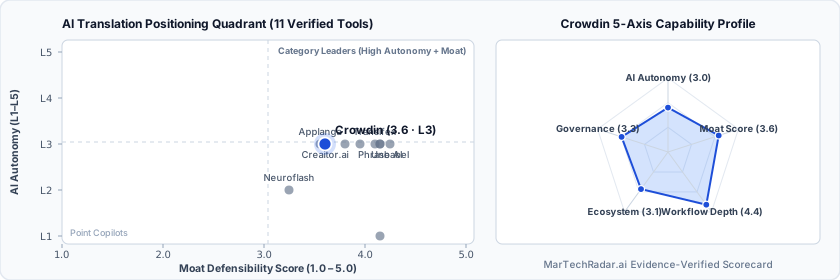
Crowdin is a Web SaaS tool for AI Translation (Multilingual & Global Localization) in Copy & Content. Pricing: Free plan · $0/mo · Enterprise plan. Best suited to B2B SaaS, DTC / eCommerce and Enterprise Brands. Editor ratings: AI autonomy L3 (conditional automation); moat score 3.6/5.0 (Proprietary moat). Fact-checked by Anthony Hay on Oct 14, 2026.
Continuous localization and translation management platform integrating software repositories, marketing collateral, and machine translation engines.
Crowdin buyer fit verdict: when to choose vs. when to walk away
Choose Crowdin if (Best Fit)
- Target ICP & Stack Fit: You operate as B2B SaaS, DTC / eCommerce and Enterprise Brands requiring a Web SaaS deployment for AI Translation.
- L3 Architecture & Defensibility: Deep ecosystem lock-in driven by 700+ app integrations, bidirectional version control sync, and hybrid workflows bridging neural machine translation with human review.
- Commercial Model Fit: Your procurement budget aligns with Free plan · $0/mo · Enterprise plan and want a self-serve free tier for zero-cost initial validation.
Walk away from Crowdin if (Deal-Breakers)
- Walk away if your workflow requires uncapped enterprise volume on the Free plan · $0/mo · Enterprise plan entry plan without upgrading tiers.
- Walk away if your workflow cannot tolerate branch merging overhead: Handling complex branching strategies in Git repos occasionally results in string ID divergence and manual merge reconciliation during concurrent multi-branch translations.
- Walk away if API rate limiting is a deal-breaker for your team: Large-scale batch exports containing hundreds of thousands of keys across multiple projects can throttle upstream API pipelines during continuous integration cycles.
Crowdin key facts & scorecard
| Pricing | Free plan · $0/mo · Enterprise planVendor pricing page |
|---|---|
| Free plan | Yes |
| Delivery | Web SaaS |
| Audience | B2B SaaS, DTC / eCommerce, Enterprise Brands |
| AI autonomy level | L3 · Conditional automationEditor-verified |
| Moat tier & score | 3.6 / 5.0 · Proprietary moatEditor-verified |
| Funding | Venture-backed |
| Founders | Serhiy Dmytryshyn |
| Company size | 51-200 employees |
| Governance & docs | Trust & Security ↗ · System Status ↗ · API & Docs ↗ · DPA ↗ · Terms ↗ · Privacy ↗ |
| Headquarters | Tallinn, Harju maakond |
| Founded | 2008 |
| Last verified |
Crowdin pros & cons: strengths vs. operational limitations
Pros: core strengths & capabilities
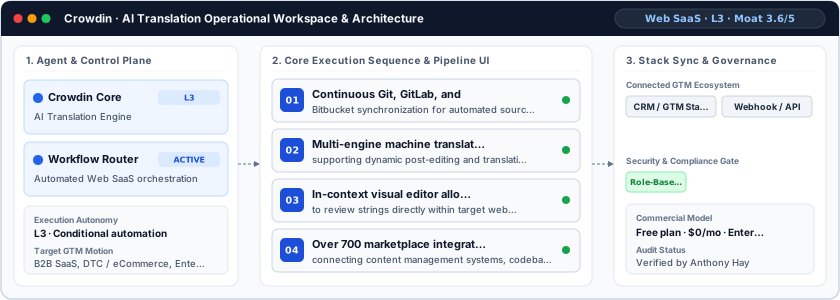
- Continuous Git, GitLab, and: Bitbucket synchronization for automated source string extraction and localized PR generation
- Multi-engine machine translation aggregation: supporting dynamic post-editing and translation memory reuse
- In-context visual editor allowing translators: to review strings directly within target web and mobile UI layouts
- Over 700 marketplace integrations: connecting content management systems, codebases, and help desks
Cons: operational limitations & risks
- Branch Merging Overhead: Handling complex branching strategies in Git repos occasionally results in string ID divergence and manual merge reconciliation during concurrent multi-branch translations.
- API Rate Limiting: Large-scale batch exports containing hundreds of thousands of keys across multiple projects can throttle upstream API pipelines during continuous integration cycles.
- In-Context Render Friction: Dynamic single-page web applications and proprietary mobile UI layouts often require non-trivial SDK integration to achieve accurate visual in-context editing.
Crowdin TCO & deal-breaker stress test
Simulate 12-month stepped TCO, hidden cost multipliers, contract lock-in exposure, and stack failure modes using only facts verified by Anthony Hay on · Capture SHA d21644d0.
Crowdin is viable for 5 seats, but requires commercial or technical verification on the flagged items below.
| Plan / Tier | Verified Rate | Scale Fit | Scope & Quota Notes |
|---|---|---|---|
| Free / Sandbox | $0 | 1–2 seats (Evaluation) | Entry free tier with capped usage or feature quotas for initial workflow testing. |
| Entry / Starter | $1.85/mo | 1–2 seats | Verified $1.85/mo published rate on vendor pricing schedule. |
| Growth / Professional | $2.77/mo | 5 seats | Verified $2.77/mo published rate on vendor pricing schedule. |
| Scale / Advanced | $46/mo | 15 seats | Verified $46/mo published rate on vendor pricing schedule. |
- Moat Score
- 3.6 / 5.0
- AI Autonomy
- L3
- Free Tier / Trial
- Free plan
Triggered audit signals & failure modes
- Opaque Enterprise Quoting vs. SMB/Mid-Market BudgetVerified Pricing Ledger
Crowdin does not disclose a public self-serve floor (Free plan · $0/mo · Enterprise plan). Buyers with a $800/mo cap face high sales-qualification friction.
- Published Self-Serve Entry FloorVerified Pricing Ledger
Crowdin publishes a transparent entry point (Free plan · $0/mo · Enterprise plan) with a free tier for initial validation before committing.
- Tier Fit for 5-Seat Scale: Entry / Starter ($1.85/mo)Verified Tier Schedule
Verified $1.85/mo published rate on vendor pricing schedule.
- Primary Operational Bottleneck: Branch Merging OverheadAudit by Anthony Hay
Handling complex branching strategies in Git repos occasionally results in string ID divergence and manual merge reconciliation during concurrent multi-branch translations.
Hidden TCO Multipliers & Quota Gates
- Annual Billing Headline vs. Monthly Premium: Headline entry rates reflect annual billing commitments (Save 15%); month-to-month flexibility carries a higher effective monthly rate or requires annual prepayment.
- Enterprise Governance & Add-On Gating: Advanced capabilities such as Single Sign-On (SSO), custom role permissions, or specialized analytics modules are gated behind upper tiers or paid add-ons.
When to Walk Away & Negotiation Levers
- Walk away if your workflow requires uncapped enterprise volume on the Free plan · $0/mo · Enterprise plan entry plan without upgrading tiers.
- Walk away if your workflow cannot tolerate branch merging overhead: Handling complex branching strategies in Git repos occasionally results in string ID divergence and manual merge reconciliation during concurrent multi-branch translations.
- Walk away if API rate limiting is a deal-breaker for your team: Large-scale batch exports containing hundreds of thousands of keys across multiple projects can throttle upstream API pipelines during continuous integration cycles.
- Validate exact quota thresholds (seats, credits, or API calls) included in Crowdin's Free plan · $0/mo · Enterprise plan tier before converting from monthly to annual billing.
- Require a sandbox proof-of-concept testing branch merging overhead against your live CRM/data schema before annual sign-off.
Ask a custom procurement or TCO stress-test question about Crowdin
Lower 5-seat floor (~$69/mo vs. Custom Quote)
Lower 5-seat floor (~$42/mo vs. Custom Quote)
Crowdin moat & subtrack positioning
Deep ecosystem lock-in driven by 700+ app integrations, bidirectional version control sync, and hybrid workflows bridging neural machine translation with human review.
Editorial review
Fact-checked by Anthony Hay (Senior SEO, Search Intelligence & Content Operations Editor) on .
Background
Modern software engineering and global product teams require continuous translation delivery integrated directly into release cycles without manual spreadsheet exports. Headquartered in Tallinn, Harju maakond and founded in 2008, Crowdin addresses this operational bottleneck by delivering a continuous localization management platform. Targeted at product localization managers, internationalization engineers, and cross-border marketing teams, the platform synchronizes multilingual content across distributed codebases and digital asset repositories.
How Crowdin works
Crowdin operates at Level 3 autonomy by pairing automated source-file ingestion with translation memory propagation and hybrid machine translation models. Code repositories and content systems push localized strings into Crowdin via webhooks and CLI tools, triggering programmatic parsing into normalized key-value data structures. These parsed strings pass through automated pre-translation sequences that match existing glossaries and translation memories before routing differentiated phrases to preconfigured neural engines or human linguists. Bidirectional sync mechanisms automatically commit approved translations back into target development branches.
Limitations
Operational considerations and platform boundaries include:
- Branch Merging Overhead: Handling complex branching strategies in Git repos occasionally results in string ID divergence and manual merge reconciliation during concurrent multi-branch translations.
- API Rate Limiting: Large-scale batch exports containing hundreds of thousands of keys across multiple projects can throttle upstream API pipelines during continuous integration cycles.
- In-Context Render Friction: Dynamic single-page web applications and proprietary mobile UI layouts often require non-trivial SDK integration to achieve accurate visual in-context editing.
Crowdin pricing
Crowdin provides a tiered subscription model indexed against hosted word volume, manager seats, and integration depth. Entry-level usage is supported on a Free tier ($0/month), which accommodates initial projects with core translation functionality. Growing organizations and large-scale enterprises negotiate custom enterprise contracts based on dedicated infrastructure requirements, bespoke security governance, custom single sign-on configurations, and advanced continuous integration limits.
How Crowdin compares
Within the localization domain, Crowdin competes against developer-centric systems like Transifex, as well as AI drafting tools such as DeepL Write and Neuroflash. While DeepL Write and Neuroflash focus primarily on sentence-level linguistic refinement and creative copy generation, Crowdin provides systemic repository synchronization, translation memory governance, and file-format parsing. Against Transifex, Crowdin distinguishes itself through an extensive marketplace of over 700 connectors, making it suited for engineering-heavy development organizations seeking automated localization pipelines.
Direct competitors & market radar
Top algorithmic competitors based on category positioning, capability overlap, and ICP alignment.
Frequently asked questions about Crowdin
How much does Crowdin cost and what pricing tiers are available?
Published pricing summary for Crowdin: Free plan · $0/mo · Enterprise plan. Crowdin includes a free tier or sandbox entry point. Verified tier schedule: Free / Sandbox ($0 for 1–2 seats (Evaluation)); Entry / Starter ($1.85/mo for 1–2 seats); Growth / Professional ($2.77/mo for 5 seats); Scale / Advanced ($46/mo for 15 seats). Crowdin provides a tiered subscription model indexed against hosted word volume, manager seats, and integration depth. Entry-level usage is supported on a Free tier ($0/month), which accommodates initial projects with core translation functionality.
How does Crowdin work and how autonomous is its AI architecture?
Continuous localization and translation management platform integrating software repositories, marketing collateral, and machine translation engines. Within AI Translation (Multilingual & Global Localization), MarTechRadar rates its execution architecture at L3 · Conditional automation with a verified Moat Score of 3.6 / 5.0 (Proprietary moat). Deep ecosystem lock-in driven by 700+ app integrations, bidirectional version control sync, and hybrid workflows bridging neural machine translation with human review. Corporate profile: Founded by Serhiy Dmytryshyn, operating at 51-200 employees scale.
What are the main limitations of Crowdin and when should buyers walk away?
Based on our editorial technical audit, key operational considerations and boundaries for Crowdin include: (1) Branch Merging Overhead: Handling complex branching strategies in Git repos occasionally results in string ID divergence and manual merge reconciliation during concurrent multi-branch translations. (2) API Rate Limiting: Large-scale batch exports containing hundreds of thousands of keys across multiple projects can throttle upstream API pipelines during continuous integration cycles. (3) In-Context Render Friction: Dynamic single-page web applications and proprietary mobile UI layouts often require non-trivial SDK integration to achieve accurate visual in-context editing. Primary procurement walk-away rule: Walk away if your workflow requires uncapped enterprise volume on the Free plan · $0/mo · Enterprise plan entry plan without upgrading tiers.
What integrations, compliance certifications, and contract terms apply to Crowdin?
First-party governance and developer endpoints verified on domain include: Trust/Security (https://crowdin.com/security), Status (https://status.crowdin.com), API Docs (https://support.crowdin.com/developer/crowdin-apps-about), DPA (https://support.crowdin.com/sub-processors). Key TCO multiplier to watch: Annual Billing Headline vs. Monthly Premium (Headline entry rates reflect annual billing commitments (Save 15%); month-to-month flexibility carries a higher effective monthly rate or requires annual prepayment.) Before signing a contract, procurement teams should validate exact quota thresholds (seats, credits, or API calls) included in Crowdin's Free plan · $0/mo · Enterprise plan tier before converting from monthly to annual billing.
What are the best Crowdin alternatives and head-to-head competitors in 2026?
Top fact-checked alternatives to Crowdin in AI Translation (Multilingual & Global Localization) include Transifex (Custom / enterprise pricing), DeepL Write (Custom / enterprise pricing), Weglot AI (Custom / enterprise pricing), Phrase AI (Custom / enterprise pricing). Within the localization domain, Crowdin competes against developer-centric systems like Transifex, as well as AI drafting tools such as DeepL Write and Neuroflash.
Verified sources & evidence trail
- Official product domain: https://crowdin.com
- Commercial pricing verification: https://crowdin.com/pricing
- Verified corporate entity profiles (
sameAs): LinkedIn Company Profile · Crunchbase Entity Record - First-party governance & documentation links: Trust & Security · System Status · API & Docs · DPA · Terms · Privacy
- Editorial audit sign-off: Fact-checked by Anthony Hay on under the MarTechRadar Evidence-Ledger Protocol.