Phrase AI Review (2026): AI Translation Pricing, Limits & Alternatives
Bottom line
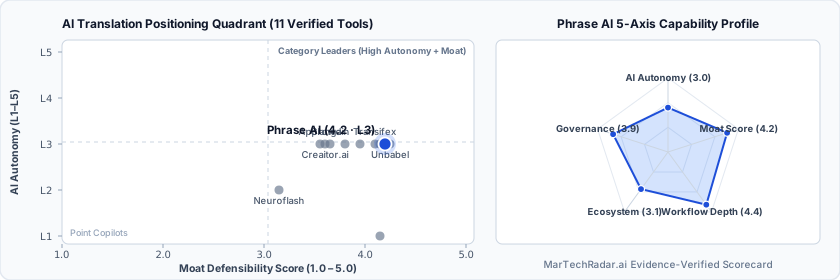
Phrase AI is a Web SaaS tool for AI Translation (Multilingual & Global Localization) in Copy & Content. Pricing: Custom / enterprise pricing. Best suited to DTC / eCommerce and Enterprise Brands. Editor ratings: AI autonomy L3 (conditional automation); moat score 4.2/5.0 (Proprietary moat). Fact-checked by Jagmeet Sine on Oct 15, 2026.
Enterprise language intelligence platform combining translation memory, neural machine translation, and automated localization workflows across software.
Phrase AI buyer fit verdict: when to choose vs. when to walk away
Choose Phrase AI if (Best Fit)
- Target ICP & Stack Fit: You operate as DTC / eCommerce and Enterprise Brands requiring a Web SaaS deployment for AI Translation.
- L3 Architecture & Defensibility: Deep workflow orchestration coupled with consolidated enterprise translation memory, extensive developer-focused repository connectors, and backing from Memsource.
- Commercial Model Fit: Your procurement budget aligns with Custom / enterprise pricing.
Walk away from Phrase AI if (Deal-Breakers)
- Walk away if you require transparent self-serve monthly billing or your budget ceiling is under $1,000/mo (Phrase AI requires sales-gated custom quoting).
- Walk away if your workflow cannot tolerate contextual ui string truncation: Automated translations frequently exceed target layout constraints, requiring manual reviewer intervention when dynamic front-end views break due to expanded linguistic character lengths.
- Walk away if schema and key-value drift is a deal-breaker for your team: Complex nested localization files occasionally encounter parsing failures or syntax corruption during automated bidirectional syncs across disparate developer codebases and content systems.
Phrase AI key facts & scorecard
| Pricing | Custom / enterprise pricing |
|---|---|
| Free plan | No / not disclosed |
| Delivery | Web SaaS |
| Audience | DTC / eCommerce, Enterprise Brands |
| AI autonomy level | L3 · Conditional automationEditor-verified |
| Moat tier & score | 4.2 / 5.0 · Proprietary moatEditor-verified |
| Funding | AcquiredAcquired by Memsource |
| Total funding | €12M |
| Founders | Frederik Vollert, Tobias Schwab, Wolfram Graetz |
| Company size | 201-500 employees |
| Governance & docs | Trust & Security ↗ · System Status ↗ · API & Docs ↗ · Privacy ↗ |
| Headquarters | Hamburg, Germany |
| Founded | 2010 |
| Last verified |
Phrase AI pros & cons: strengths vs. operational limitations
Pros: core strengths & capabilities
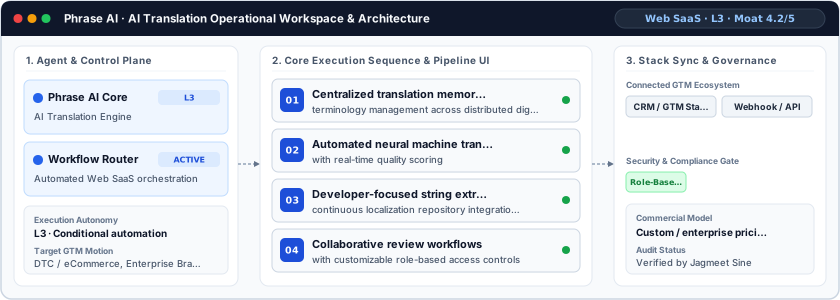
- Centralized translation memory and: terminology management across distributed digital assets
- Automated neural machine translation routing: with real-time quality scoring
- Developer-focused string extraction and: continuous localization repository integrations
- Collaborative review workflows: with customizable role-based access controls
Cons: operational limitations & risks
- Contextual UI String Truncation: Automated translations frequently exceed target layout constraints, requiring manual reviewer intervention when dynamic front-end views break due to expanded linguistic character lengths.
- Schema and Key-Value Drift: Complex nested localization files occasionally encounter parsing failures or syntax corruption during automated bidirectional syncs across disparate developer codebases and content systems.
- Engine Adaptation Latency: Aligning neural translation engines to highly specialized brand vernacular requires substantial historical corpora, causing initial quality dips on niche enterprise nomenclature without pre-existing translation memories.
Phrase AI TCO & deal-breaker stress test
Simulate 12-month stepped TCO, hidden cost multipliers, contract lock-in exposure, and stack failure modes using only facts verified by Jagmeet Sine on · Capture SHA 16697571.
Phrase AI triggers high-severity friction under your 5-seat / $800/mo constraints. Benchmark the verified subtrack alternatives below before committing.
| Plan / Tier | Verified Rate | Scale Fit | Scope & Quota Notes |
|---|---|---|---|
| Enterprise / Custom | Custom quote | 15–50+ seats (Enterprise SLA) | Sales-negotiated annual contract for custom volume, SSO/RBAC governance, and dedicated SLA. |
- Moat Score
- 4.2 / 5.0
- AI Autonomy
- L3
- Free Tier / Trial
- None disclosed
Triggered audit signals & failure modes
- Opaque Enterprise Quoting vs. SMB/Mid-Market BudgetVerified Pricing Ledger
Phrase AI does not disclose a public self-serve floor (Custom / enterprise pricing). Buyers with a $800/mo cap face high sales-qualification friction.
- Sales-Gated Contract TermsFact-checked by Jagmeet Sine
Commercial pricing is available on request through tailored enterprise sales quotes based on organizational scale and seats.
- Primary Operational Bottleneck: Contextual UI String TruncationAudit by Jagmeet Sine
Automated translations frequently exceed target layout constraints, requiring manual reviewer intervention when dynamic front-end views break due to expanded linguistic character lengths.
Hidden TCO Multipliers & Quota Gates
- Annual Billing Headline vs. Monthly Premium: Headline entry rates reflect annual billing commitments; month-to-month flexibility carries a higher effective monthly rate or requires annual prepayment.
- Enterprise Governance & Add-On Gating: Advanced capabilities such as Single Sign-On (SSO), custom role permissions, or specialized analytics modules are gated behind upper tiers or paid add-ons.
When to Walk Away & Negotiation Levers
- Walk away if you require transparent self-serve monthly billing or your budget ceiling is under $1,000/mo (Phrase AI requires sales-gated custom quoting).
- Walk away if your workflow cannot tolerate contextual ui string truncation: Automated translations frequently exceed target layout constraints, requiring manual reviewer intervention when dynamic front-end views break due to expanded linguistic character lengths.
- Walk away if schema and key-value drift is a deal-breaker for your team: Complex nested localization files occasionally encounter parsing failures or syntax corruption during automated bidirectional syncs across disparate developer codebases and content systems.
- Demand a 30- to 60-day paid pilot opt-out clause in the Phrase AI order form before signing a 12-month enterprise commitment.
- Require a sandbox proof-of-concept testing contextual ui string truncation against your live CRM/data schema before annual sign-off.
Ask a custom procurement or TCO stress-test question about Phrase AI
Lower 5-seat floor (~$69/mo vs. Custom Quote) · Transparent self-serve entry without mandatory annual lock-in
Offers a free tier (Free plan · $0/mo · Enterprise plan) · Transparent self-serve entry without mandatory annual lock-in
Phrase AI moat & subtrack positioning
Deep workflow orchestration coupled with consolidated enterprise translation memory, extensive developer-focused repository connectors, and backing from Memsource.
Editorial review
Fact-checked by Jagmeet Sine (Senior MarTech Infrastructure & Agentic Workflow Architect) on .
Background
Established in 2010 in Hamburg, Germany, Phrase AI built its foundation within continuous software localization before raising €12M in funding and executing a strategic merger with Memsource. Operating within the multilingual and global localization category, the platform targets localization directors, global product managers, and enterprise marketing operations teams. Phrase AI reframes internationalization from an ad-hoc linguistic service into an integrated digital supply chain, addressing the operational complexity of synchronizing multilingual software strings, marketing assets, and documentation across global releases.
How Phrase AI works
Phrase AI operates as an L3 automated localization system by coordinating neural machine translation engines with centralized translation memory and glossary databases. Source strings and marketing copy are ingested via developer APIs, CLI tools, and content management webhooks into a normalized localization repository. The engine evaluates incoming text against historic translation units to minimize redundant translation steps, then routes differentiated segments through domain-specific machine translation models. Automated quality checks, glossary adherence verification, and contextual UI previews run programmatically before delivering approved target strings back to staging branches.
Limitations
Operational considerations and platform boundaries include:
- Contextual UI String Truncation: Automated translations frequently exceed target layout constraints, requiring manual reviewer intervention when dynamic front-end views break due to expanded linguistic character lengths.
- Schema and Key-Value Drift: Complex nested localization files occasionally encounter parsing failures or syntax corruption during automated bidirectional syncs across disparate developer codebases and content systems.
- Engine Adaptation Latency: Aligning neural translation engines to highly specialized brand vernacular requires substantial historical corpora, causing initial quality dips on niche enterprise nomenclature without pre-existing translation memories.
Phrase AI pricing
Commercial pricing is available on request through tailored enterprise sales quotes based on organizational scale and seats. Contracts reflect tier-based capacity allotments encompassing tracked word volume, concurrent seats, and integrated project spaces, with evaluation access supported via enterprise trial agreements.
How Phrase AI compares
Compared to direct category competitors like Typeface and Writer, Phrase AI functions as an alternative focused on reliable workflow execution and transparent unit economics. Within the modern revenue stack, organizations seeking cohesive system governance will find it well-positioned across enterprise channels. It is best suited for enterprise marketing teams and growth practitioners seeking disciplined workflow orchestration.
Direct competitors & market radar
Top algorithmic competitors based on category positioning, capability overlap, and ICP alignment.
Frequently asked questions about Phrase AI
How much does Phrase AI cost and does it require a custom enterprise quote?
Published pricing summary for Phrase AI: Custom / enterprise pricing. A permanent free plan is not disclosed for Phrase AI. Commercial pricing is available on request through tailored enterprise sales quotes based on organizational scale and seats.
How does Phrase AI work and how autonomous is its AI architecture?
Enterprise language intelligence platform combining translation memory, neural machine translation, and automated localization workflows across software. Within AI Translation (Multilingual & Global Localization), MarTechRadar rates its execution architecture at L3 · Conditional automation with a verified Moat Score of 4.2 / 5.0 (Proprietary moat). Deep workflow orchestration coupled with consolidated enterprise translation memory, extensive developer-focused repository connectors, and backing from Memsource. Corporate profile: Founded by Frederik Vollert, Tobias Schwab, Wolfram Graetz, operating at 201-500 employees scale, acquired by Memsource.
What are the main limitations of Phrase AI and when should buyers walk away?
Based on our editorial technical audit, key operational considerations and boundaries for Phrase AI include: (1) Contextual UI String Truncation: Automated translations frequently exceed target layout constraints, requiring manual reviewer intervention when dynamic front-end views break due to expanded linguistic character lengths. (2) Schema and Key-Value Drift: Complex nested localization files occasionally encounter parsing failures or syntax corruption during automated bidirectional syncs across disparate developer codebases and content systems. (3) Engine Adaptation Latency: Aligning neural translation engines to highly specialized brand vernacular requires substantial historical corpora, causing initial quality dips on niche enterprise nomenclature without pre-existing translation memories. Primary procurement walk-away rule: Walk away if you require transparent self-serve monthly billing or your budget ceiling is under $1,000/mo (Phrase AI requires sales-gated custom quoting).
What integrations, compliance certifications, and contract terms apply to Phrase AI?
First-party governance and developer endpoints verified on domain include: Trust/Security (https://trust.phrase.com), Status (https://status.phrase.com), API Docs (https://phrase.com/roles/developers). Key TCO multiplier to watch: Annual Billing Headline vs. Monthly Premium (Headline entry rates reflect annual billing commitments; month-to-month flexibility carries a higher effective monthly rate or requires annual prepayment.) Before signing a contract, procurement teams should demand a 30- to 60-day paid pilot opt-out clause in the Phrase AI order form before signing a 12-month enterprise commitment.
What are the best Phrase AI alternatives and head-to-head competitors in 2026?
Top fact-checked alternatives to Phrase AI in AI Translation (Multilingual & Global Localization) include MultiLipi (Free plan · $0/mo · Enterprise plan), FlyRank Space (Custom / enterprise pricing), Weglot AI (Custom / enterprise pricing), Crowdin (Free plan · $0/mo · Enterprise plan). Compared to direct category competitors like Typeface and Writer, Phrase AI functions as an alternative focused on reliable workflow execution and transparent unit economics. Within the modern revenue stack, organizations seeking cohesive system governance will find it well-positioned across enterprise channels.
Verified sources & evidence trail
- Official product domain: https://phrase.com
- Commercial pricing verification: Verified against official vendor pricing policy (Custom / enterprise pricing)
- Verified corporate entity profiles (
sameAs): LinkedIn Company Profile · Crunchbase Entity Record - First-party governance & documentation links: Trust & Security · System Status · API & Docs · Privacy
- Editorial audit sign-off: Fact-checked by Jagmeet Sine on under the MarTechRadar Evidence-Ledger Protocol.