Honeyjar Review (2026): PR Pricing, Limits & Alternatives
Bottom line
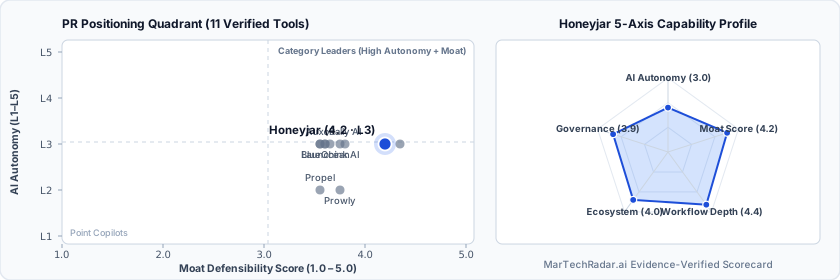
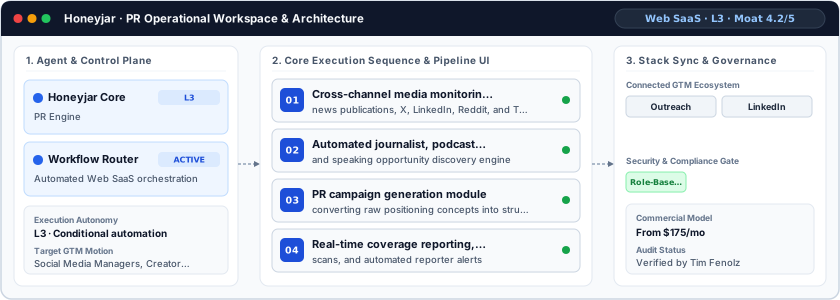
Honeyjar is a Web SaaS tool for PR (PR Intelligence & Media Relations) in Social & Influencer. Pricing: From $175/mo. Best suited to Social Media Managers, Creator & Influencer Agencies and Brand Community Ops. Editor ratings: AI autonomy L3 (conditional automation); moat score 4.2/5.0 (Proprietary moat). Fact-checked by Tim Fenolz on Oct 11, 2026.
Autonomous AI communications partner orchestrating media monitoring, journalist discovery, and PR campaign workflows for corporate communications teams.
Honeyjar buyer fit verdict: when to choose vs. when to walk away
Choose Honeyjar if (Best Fit)
- Target ICP & Stack Fit: You operate as Social Media Managers, Creator & Influencer Agencies and Brand Community Ops requiring a Web SaaS deployment for PR, with verified ecosystem connectivity for Outreach, LinkedIn.
- L3 Architecture & Defensibility: Integrates multi-channel social listening with generative PR campaign synthesis, maintaining proprietary relationship graphs across traditional journalists and creator media.
- Commercial Model Fit: Your procurement budget aligns with From $175/mo.
Walk away from Honeyjar if (Deal-Breakers)
- Walk away if your workflow requires uncapped enterprise volume on the From $175/mo entry plan without upgrading tiers.
- Walk away if your workflow cannot tolerate multi-platform scrape rate limiting: Aggregating conversational data across third-party social APIs like Reddit, LinkedIn, and X exposes monitoring pipelines to unpredictable rate throttling and coverage blind spots during high-volume breaking news.
- Walk away if pitch personalization hallucination is a deal-breaker for your team: LLM-generated reporter angles risk synthesizing outdated beats or misinterpreting a journalist's recent sentiment if vector indexes of past articles lag behind fast-moving editorial rotations.
Honeyjar key facts & scorecard
| Pricing | From $175/moVendor pricing page |
|---|---|
| Free plan | No / not disclosed |
| Delivery | Web SaaS |
| Audience | Social Media Managers, Creator & Influencer Agencies, Brand Community Ops |
| AI autonomy level | L3 · Conditional automationEditor-verified |
| Moat tier & score | 4.2 / 5.0 · Proprietary moatEditor-verified |
| Funding | Pre-seed |
| Total funding | $2MBacked by Angel Investors |
| Founders | Michelle Masek |
| Company size | 2-10 employees |
| Ecosystem integrations | Outreach, LinkedIn |
| Governance & docs | Terms ↗ · Privacy ↗ |
| Headquarters | San Francisco, California, United States |
| Founded | 2025 |
| Last verified |
Honeyjar pros & cons: strengths vs. operational limitations
Pros: core strengths & capabilities
- Cross-channel media monitoring spanning: news publications, X, LinkedIn, Reddit, and TikTok
- Automated journalist, podcast, Substack,: and speaking opportunity discovery engine
- PR campaign generation module: converting raw positioning concepts into structured launch workflows
- Real-time coverage reporting, news: scans, and automated reporter alerts
Cons: operational limitations & risks
- Multi-Platform Scrape Rate Limiting: Aggregating conversational data across third-party social APIs like Reddit, LinkedIn, and X exposes monitoring pipelines to unpredictable rate throttling and coverage blind spots during high-volume breaking news.
- Pitch Personalization Hallucination: LLM-generated reporter angles risk synthesizing outdated beats or misinterpreting a journalist's recent sentiment if vector indexes of past articles lag behind fast-moving editorial rotations.
- Outbound Delivery Degradation: Automated campaign generation increases cold pitch volume, exposing operational domains to mailbox reputation damage and spam-filtering penalties without deliberate domain warm-up and cadence governance.
Honeyjar TCO & deal-breaker stress test
Simulate 12-month stepped TCO, hidden cost multipliers, contract lock-in exposure, and stack failure modes using only facts verified by Tim Fenolz on · Capture SHA 9d02e67d.
Honeyjar aligns with your 5-seat / $800/mo profile. Review the walk-away triggers and contract levers below before deployment.
| Plan / Tier | Verified Rate | Scale Fit | Scope & Quota Notes |
|---|---|---|---|
| Professional | $175/mo | 1–2 seats | For solo pros and teams who need communications & PR support. |
| Growth / Professional | $250/mo | 5 seats | Find journalists, podcasts, Substacks, and speaking opportunities — and build lists in minutes |
- Moat Score
- 4.2 / 5.0
- AI Autonomy
- L3
- Free Tier / Trial
- None disclosed
Triggered audit signals & failure modes
- Published Self-Serve Entry FloorVerified Pricing Ledger
Honeyjar publishes a transparent entry point (From $175/mo) for initial validation before committing.
- Tier Fit for 5-Seat Scale: Growth / Professional ($250/mo)Verified Tier Schedule
Find journalists, podcasts, Substacks, and speaking opportunities — and build lists in minutes
- Primary Operational Bottleneck: Multi-Platform Scrape Rate LimitingAudit by Tim Fenolz
Aggregating conversational data across third-party social APIs like Reddit, LinkedIn, and X exposes monitoring pipelines to unpredictable rate throttling and coverage blind spots during high-volume breaking news.
Hidden TCO Multipliers & Quota Gates
- Per-Seat Linear Scaling: Honeyjar prices licenses on a per-user/seat basis (From $175/mo); expanding from 2 to 15+ operators multiplies base recurring spend linearly.
- Annual Billing Headline vs. Monthly Premium: Headline entry rates reflect annual billing commitments; month-to-month flexibility carries a higher effective monthly rate or requires annual prepayment.
When to Walk Away & Negotiation Levers
- Walk away if your workflow requires uncapped enterprise volume on the From $175/mo entry plan without upgrading tiers.
- Walk away if your workflow cannot tolerate multi-platform scrape rate limiting: Aggregating conversational data across third-party social APIs like Reddit, LinkedIn, and X exposes monitoring pipelines to unpredictable rate throttling and coverage blind spots during high-volume breaking news.
- Walk away if pitch personalization hallucination is a deal-breaker for your team: LLM-generated reporter angles risk synthesizing outdated beats or misinterpreting a journalist's recent sentiment if vector indexes of past articles lag behind fast-moving editorial rotations.
- Validate exact quota thresholds (seats, credits, or API calls) included in Honeyjar's From $175/mo tier before converting from monthly to annual billing.
- Require a sandbox proof-of-concept testing multi-platform scrape rate limiting against your live CRM/data schema before annual sign-off.
Ask a custom procurement or TCO stress-test question about Honeyjar
Fits within $800/mo budget ($149/seat/mo)
Offers a free tier (Free plan · $0/mo · Enterprise plan)
Honeyjar key entities, modules & ecosystem stack
Honeyjar moat & subtrack positioning
Integrates multi-channel social listening with generative PR campaign synthesis, maintaining proprietary relationship graphs across traditional journalists and creator media.
Editorial review
Fact-checked by Tim Fenolz (Lead AdTech, Programmatic & Attribution Analyst) on .
Background
Corporate communications leads and PR strategists frequently struggle with fragmented media discovery, manual news tracking, and slow campaign generation. Established in 2025 and headquartered in San Francisco, California, United States, Honeyjar operates as an agentic public relations system backed by $2M in venture funding. Engineered primarily for in-house communications directors, solo PR professionals, and agency teams, the platform consolidates media intelligence, editorial tracking, and pitch drafting into a unified operational hub. Honeyjar automates the initial research and narrative-structuring phases of high-stakes corporate launches.
How Honeyjar works
Operating at an L3 autonomy profile, Honeyjar combines ingestion pipelines with domain-tuned generative models to handle PR execution. The architecture continuously parses editorial feeds alongside social channels including X, LinkedIn, Reddit, and TikTok to surface real-time brand mentions and reporter trends. For outreach planning, its retrieval engine queries indexed journalist beats, newsletters, and podcasts, cross-referencing contact data against internal company positioning documents. The system then drafts tailored pitches, automated coverage reports, and campaign launch sequences with human-in-the-loop review.
Limitations
Operational considerations and platform boundaries include:
- Multi-Platform Scrape Rate Limiting: Aggregating conversational data across third-party social APIs like Reddit, LinkedIn, and X exposes monitoring pipelines to unpredictable rate throttling and coverage blind spots during high-volume breaking news.
- Pitch Personalization Hallucination: LLM-generated reporter angles risk synthesizing outdated beats or misinterpreting a journalist's recent sentiment if vector indexes of past articles lag behind fast-moving editorial rotations.
- Outbound Delivery Degradation: Automated campaign generation increases cold pitch volume, exposing operational domains to mailbox reputation damage and spam-filtering penalties without deliberate domain warm-up and cadence governance.
Honeyjar pricing
Commercial access is offered via a seat-based subscription model. The Professional tier is priced from $175 per user per month when billed annually, with a flexible monthly commitment available at $250 per user per month. This licensing tier unlocks full PR discovery across podcasts, Substacks, and journalists, continuous social listening across social and news networks, automated coverage summaries, and end-to-end campaign builders.
How Honeyjar compares
Honeyjar competes against established media databases and outreach suites such as Muck Rack, Propel, and Prowly. While Muck Rack and Prowly rely on human-verified media graphs and traditional CRM structures, Honeyjar focuses on generative launch workflows and non-traditional media targets like Substacks. Propel provides deep CRM email telemetry, whereas Honeyjar prioritizes cross-platform narrative monitoring and pitch ideation. The platform is best suited for agile corporate communications teams seeking faster campaign turnaround without maintaining legacy PR software overhead.
Direct competitors & market radar
Top algorithmic competitors based on category positioning, capability overlap, and ICP alignment.
Frequently asked questions about Honeyjar
How much does Honeyjar cost and what pricing tiers are available?
Published pricing summary for Honeyjar: From $175/mo. A permanent free plan is not disclosed for Honeyjar. Verified tier schedule: Professional ($175/mo for 1–2 seats); Growth / Professional ($250/mo for 5 seats). Commercial access is offered via a seat-based subscription model. The Professional tier is priced from $175 per user per month when billed annually, with a flexible monthly commitment available at $250 per user per month.
How does Honeyjar work and how autonomous is its AI architecture?
Autonomous AI communications partner orchestrating media monitoring, journalist discovery, and PR campaign workflows for corporate communications teams. Within PR (PR Intelligence & Media Relations), MarTechRadar rates its execution architecture at L3 · Conditional automation with a verified Moat Score of 4.2 / 5.0 (Proprietary moat). Integrates multi-channel social listening with generative PR campaign synthesis, maintaining proprietary relationship graphs across traditional journalists and creator media. Corporate profile: Founded by Michelle Masek, operating at 2-10 employees scale.
What are the main limitations of Honeyjar and when should buyers walk away?
Based on our editorial technical audit, key operational considerations and boundaries for Honeyjar include: (1) Multi-Platform Scrape Rate Limiting: Aggregating conversational data across third-party social APIs like Reddit, LinkedIn, and X exposes monitoring pipelines to unpredictable rate throttling and coverage blind spots during high-volume breaking news. (2) Pitch Personalization Hallucination: LLM-generated reporter angles risk synthesizing outdated beats or misinterpreting a journalist's recent sentiment if vector indexes of past articles lag behind fast-moving editorial rotations. (3) Outbound Delivery Degradation: Automated campaign generation increases cold pitch volume, exposing operational domains to mailbox reputation damage and spam-filtering penalties without deliberate domain warm-up and cadence governance. Primary procurement walk-away rule: Walk away if your workflow requires uncapped enterprise volume on the From $175/mo entry plan without upgrading tiers.
What integrations, compliance certifications, and contract terms apply to Honeyjar?
Verified ecosystem and stack integrations include Outreach, LinkedIn. Key TCO multiplier to watch: Per-Seat Linear Scaling (Honeyjar prices licenses on a per-user/seat basis (From $175/mo); expanding from 2 to 15+ operators multiplies base recurring spend linearly.) Before signing a contract, procurement teams should validate exact quota thresholds (seats, credits, or API calls) included in Honeyjar's From $175/mo tier before converting from monthly to annual billing.
What are the best Honeyjar alternatives and head-to-head competitors in 2026?
Top fact-checked alternatives to Honeyjar in PR (PR Intelligence & Media Relations) include Muck Rack (Custom / enterprise pricing), Prowly (Custom / enterprise pricing), Propel (Custom / enterprise pricing), Auxos (Custom / enterprise pricing). Honeyjar competes against established media databases and outreach suites such as Muck Rack, Propel, and Prowly. While Muck Rack and Prowly rely on human-verified media graphs and traditional CRM structures, Honeyjar focuses on generative launch workflows and non-traditional media targets like Substacks.
Verified sources & evidence trail
- Official product domain: https://www.honeyjar.ai
- Commercial pricing verification: https://honeyjar.ai/pricing
- Verified corporate entity profiles (
sameAs): LinkedIn Company Profile · Crunchbase Entity Record - First-party governance & documentation links: Terms · Privacy
- Editorial audit sign-off: Fact-checked by Tim Fenolz on under the MarTechRadar Evidence-Ledger Protocol.