HUMAN PROMPT Review (2026): AI Content Marketing Pricing, Limits & Alternatives
Bottom line
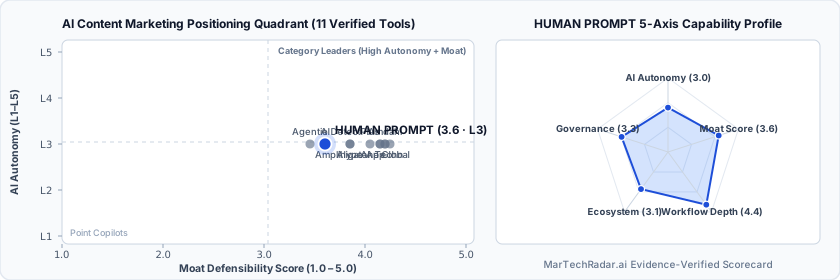
HUMAN PROMPT is a Web SaaS tool for AI Content Marketing (Enterprise & Long-Form Brand Content) in Copy & Content. Pricing: Custom / enterprise pricing. Best suited to Enterprise Content Teams, Brand Marketers and Global Copywriters. Editor ratings: AI autonomy L3 (conditional automation); moat score 3.6/5.0 (Proprietary moat). Fact-checked by Jagmeet Sine on Oct 14, 2026.
Unified multi-modal generative AI engine converting single text prompts into synchronized cross-format brand assets spanning copy, imagery, audio, and video.
HUMAN PROMPT buyer fit verdict: when to choose vs. when to walk away
Choose HUMAN PROMPT if (Best Fit)
- Target ICP & Stack Fit: You operate as Enterprise Content Teams, Brand Marketers and Global Copywriters requiring a Web SaaS deployment for AI Content Marketing.
- L3 Architecture & Defensibility: Proprietary prompt orchestration router and unified multi-modal parameter alignment engine designed to coordinate heterogeneous foundational models into coherent asset bundles.
- Commercial Model Fit: Your procurement budget aligns with Custom / enterprise pricing.
Walk away from HUMAN PROMPT if (Deal-Breakers)
- Walk away if you require transparent self-serve monthly billing or your budget ceiling is under $1,000/mo (HUMAN PROMPT requires sales-gated custom quoting).
- Walk away if your workflow cannot tolerate cross-modal style drift: Disparate underlying foundation models frequently exhibit aesthetic desynchronization, requiring human-in-the-loop intervention to maintain strict visual and tonal coherence between simultaneous image and video outputs.
- Walk away if third-party latency compounding is a deal-breaker for your team: Because the platform federates tasks across external generative APIs, pipeline throughput degrades whenever upstream model providers experience queuing bottlenecks or processing latency spikes.
HUMAN PROMPT key facts & scorecard
| Pricing | Custom / enterprise pricing |
|---|---|
| Free plan | No / not disclosed |
| Delivery | Web SaaS |
| Audience | Enterprise Content Teams, Brand Marketers, Global Copywriters |
| AI autonomy level | L3 · Conditional automationEditor-verified |
| Moat tier & score | 3.6 / 5.0 · Proprietary moatEditor-verified |
| Funding | Pre-seed |
| Company size | 2-10 employees |
| Headquarters | London, England |
| Founded | 2024 |
| Last verified |
HUMAN PROMPT pros & cons: strengths vs. operational limitations
Pros: core strengths & capabilities
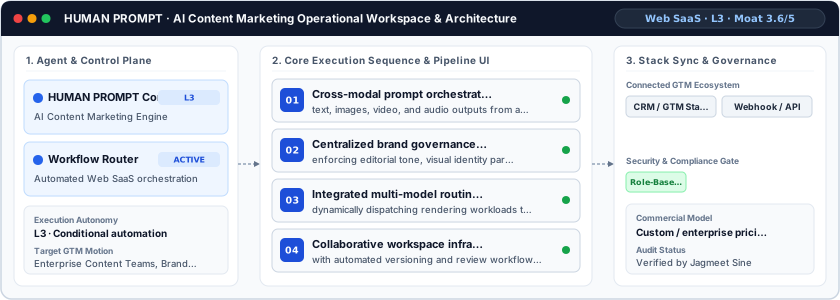
- Cross-modal prompt orchestration synthesizing: text, images, video, and audio outputs from a unified input pipeline
- Centralized brand governance engine: enforcing editorial tone, visual identity parameters, and compliance guardrails
- Integrated multi-model routing fabric: dynamically dispatching rendering workloads to optimal domain-specific models
- Collaborative workspace infrastructure: with automated versioning and review workflows for enterprise content teams
Cons: operational limitations & risks
- Cross-Modal Style Drift: Disparate underlying foundation models frequently exhibit aesthetic desynchronization, requiring human-in-the-loop intervention to maintain strict visual and tonal coherence between simultaneous image and video outputs.
- Third-Party Latency Compounding: Because the platform federates tasks across external generative APIs, pipeline throughput degrades whenever upstream model providers experience queuing bottlenecks or processing latency spikes.
- Schema Fragility in Prompt Parsing: Complex multi-step creative prompts can trigger downstream parameter parsing errors, leading to missing asset modalities or incomplete rendering bundles across heavily constrained production briefs.
HUMAN PROMPT TCO & deal-breaker stress test
Simulate 12-month stepped TCO, hidden cost multipliers, contract lock-in exposure, and stack failure modes using only facts verified by Jagmeet Sine on · Capture SHA 15c46502.
HUMAN PROMPT triggers high-severity friction under your 5-seat / $800/mo constraints. Benchmark the verified subtrack alternatives below before committing.
| Plan / Tier | Verified Rate | Scale Fit | Scope & Quota Notes |
|---|---|---|---|
| Enterprise / Custom | Custom quote | 15–50+ seats (Enterprise SLA) | Sales-negotiated annual contract for custom volume, SSO/RBAC governance, and dedicated SLA. |
- Moat Score
- 3.6 / 5.0
- AI Autonomy
- L3
- Free Tier / Trial
- None disclosed
Triggered audit signals & failure modes
- Opaque Enterprise Quoting vs. SMB/Mid-Market BudgetVerified Pricing Ledger
HUMAN PROMPT does not disclose a public self-serve floor (Custom / enterprise pricing). Buyers with a $800/mo cap face high sales-qualification friction.
- Sales-Gated Contract TermsFact-checked by Jagmeet Sine
The commercial licensing structure for HUMAN PROMPT is available on request through tailored enterprise sales quotes based on organizational scale, compute capacity, and user seats.
- Primary Operational Bottleneck: Cross-Modal Style DriftAudit by Jagmeet Sine
Disparate underlying foundation models frequently exhibit aesthetic desynchronization, requiring human-in-the-loop intervention to maintain strict visual and tonal coherence between simultaneous image and video outputs.
Hidden TCO Multipliers & Quota Gates
- Cross-Modal Style Drift: Disparate underlying foundation models frequently exhibit aesthetic desynchronization, requiring human-in-the-loop intervention to maintain strict visual and tonal coherence between simultaneous image and video outputs.
- Third-Party Latency Compounding: Because the platform federates tasks across external generative APIs, pipeline throughput degrades whenever upstream model providers experience queuing bottlenecks or processing latency spikes.
When to Walk Away & Negotiation Levers
- Walk away if you require transparent self-serve monthly billing or your budget ceiling is under $1,000/mo (HUMAN PROMPT requires sales-gated custom quoting).
- Walk away if your workflow cannot tolerate cross-modal style drift: Disparate underlying foundation models frequently exhibit aesthetic desynchronization, requiring human-in-the-loop intervention to maintain strict visual and tonal coherence between simultaneous image and video outputs.
- Walk away if third-party latency compounding is a deal-breaker for your team: Because the platform federates tasks across external generative APIs, pipeline throughput degrades whenever upstream model providers experience queuing bottlenecks or processing latency spikes.
- Demand a 30- to 60-day paid pilot opt-out clause in the HUMAN PROMPT order form before signing a 12-month enterprise commitment.
- Require a sandbox proof-of-concept testing cross-modal style drift against your live CRM/data schema before annual sign-off.
Ask a custom procurement or TCO stress-test question about HUMAN PROMPT
Verified AI Content Marketing peer (Custom / enterprise pricing · Moat 3.6/5.0)
Verified AI Content Marketing peer (Custom / enterprise pricing · Moat 3.6/5.0)
HUMAN PROMPT moat & subtrack positioning
Proprietary prompt orchestration router and unified multi-modal parameter alignment engine designed to coordinate heterogeneous foundational models into coherent asset bundles.
Editorial review
Fact-checked by Jagmeet Sine (Senior MarTech Infrastructure & Agentic Workflow Architect) on .
Background
To scale marketing output without fragmenting cross-functional toolsets, content teams require centralized systems that translate raw strategic intent into production-ready cross-channel collateral. Headquartered in London, England, HUMAN PROMPT develops a unified multi-modal generation engine engineered for creative directors, brand strategists, and enterprise marketing operators. The platform replaces disjointed individual generative utilities by consolidating text, image, audio, and video generation into a single coordinated operational layer.
How HUMAN PROMPT works
At the architectural level, HUMAN PROMPT operates as a multi-model orchestration fabric that parses high-level input prompts through an internal translation layer. The platform deconstructs strategic inputs into domain-specific parameters, simultaneously routing text generation tasks to advanced large language models, visual tasks to diffusion pipelines, and sonic assets to specialized audio synthesis networks. Assets are programmatically aligned against predefined brand style schemas, maintaining semantic and visual continuity across formats through a governed, automated production pipeline.
Limitations
Operational considerations and platform boundaries include:
- Cross-Modal Style Drift: Disparate underlying foundation models frequently exhibit aesthetic desynchronization, requiring human-in-the-loop intervention to maintain strict visual and tonal coherence between simultaneous image and video outputs.
- Third-Party Latency Compounding: Because the platform federates tasks across external generative APIs, pipeline throughput degrades whenever upstream model providers experience queuing bottlenecks or processing latency spikes.
- Schema Fragility in Prompt Parsing: Complex multi-step creative prompts can trigger downstream parameter parsing errors, leading to missing asset modalities or incomplete rendering bundles across heavily constrained production briefs.
HUMAN PROMPT pricing
The commercial licensing structure for HUMAN PROMPT is available on request through tailored enterprise sales quotes based on organizational scale, compute capacity, and user seats. Enterprise contracts typically encompass direct customer support, dedicated API throughput quotas, and custom brand model alignments governed by formal service level agreements.
How HUMAN PROMPT compares
Within enterprise content ecosystems, HUMAN PROMPT competes alongside platforms such as Agentio, Aha Global, and AIDetectPlus. While Agentio targets performance creator orchestration and AIDetectPlus specializes in synthetic text verification, HUMAN PROMPT distinguishes itself by combining disparate generative mediums into a singular production pipeline. The platform is best matched for distributed brand marketing organizations that require high-velocity, multi-modal asset creation while mitigating the operational overhead of fragmented point solutions.
Frequently asked questions about HUMAN PROMPT
How much does HUMAN PROMPT cost and does it require a custom enterprise quote?
Published pricing summary for HUMAN PROMPT: Custom / enterprise pricing. A permanent free plan is not disclosed for HUMAN PROMPT. The commercial licensing structure for HUMAN PROMPT is available on request through tailored enterprise sales quotes based on organizational scale, compute capacity, and user seats.
How does HUMAN PROMPT work and how autonomous is its AI architecture?
Unified multi-modal generative AI engine converting single text prompts into synchronized cross-format brand assets spanning copy, imagery, audio, and video. Within AI Content Marketing (Enterprise & Long-Form Brand Content), MarTechRadar rates its execution architecture at L3 · Conditional automation with a verified Moat Score of 3.6 / 5.0 (Proprietary moat). Proprietary prompt orchestration router and unified multi-modal parameter alignment engine designed to coordinate heterogeneous foundational models into coherent asset bundles. Corporate profile: operating at 2-10 employees scale.
What are the main limitations of HUMAN PROMPT and when should buyers walk away?
Based on our editorial technical audit, key operational considerations and boundaries for HUMAN PROMPT include: (1) Cross-Modal Style Drift: Disparate underlying foundation models frequently exhibit aesthetic desynchronization, requiring human-in-the-loop intervention to maintain strict visual and tonal coherence between simultaneous image and video outputs. (2) Third-Party Latency Compounding: Because the platform federates tasks across external generative APIs, pipeline throughput degrades whenever upstream model providers experience queuing bottlenecks or processing latency spikes. (3) Schema Fragility in Prompt Parsing: Complex multi-step creative prompts can trigger downstream parameter parsing errors, leading to missing asset modalities or incomplete rendering bundles across heavily constrained production briefs. Primary procurement walk-away rule: Walk away if you require transparent self-serve monthly billing or your budget ceiling is under $1,000/mo (HUMAN PROMPT requires sales-gated custom quoting).
What integrations, compliance certifications, and contract terms apply to HUMAN PROMPT?
Key TCO multiplier to watch: Cross-Modal Style Drift (Disparate underlying foundation models frequently exhibit aesthetic desynchronization, requiring human-in-the-loop intervention to maintain strict visual and tonal coherence between simultaneous image and video outputs.) Before signing a contract, procurement teams should demand a 30- to 60-day paid pilot opt-out clause in the HUMAN PROMPT order form before signing a 12-month enterprise commitment.
What are the best HUMAN PROMPT alternatives and head-to-head competitors in 2026?
Top fact-checked alternatives to HUMAN PROMPT in AI Content Marketing (Enterprise & Long-Form Brand Content) include RankIQ (Custom / enterprise pricing), Soona (Custom / enterprise pricing), Moda (Custom / enterprise pricing), INK for All (Custom / enterprise pricing). Within enterprise content ecosystems, HUMAN PROMPT competes alongside platforms such as Agentio, Aha Global, and AIDetectPlus.
Verified sources & evidence trail
- Official product domain: https://humanprompt.ai
- Commercial pricing verification: Verified against official vendor pricing policy (Custom / enterprise pricing)
- Verified corporate entity profiles (
sameAs): LinkedIn Company Profile - Editorial audit sign-off: Fact-checked by Jagmeet Sine on under the MarTechRadar Evidence-Ledger Protocol.