Mark OS Review (2026): AI Content Marketing Pricing, Limits & Alternatives
Bottom line
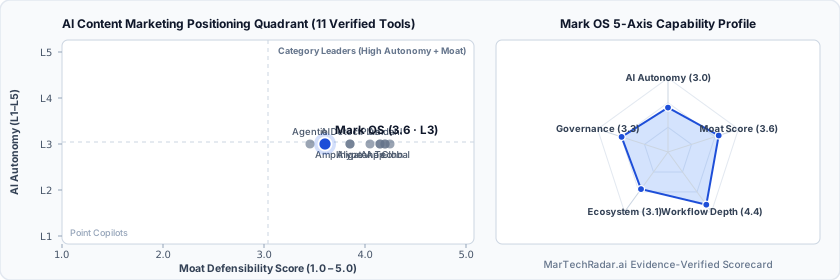
Mark OS is a Web SaaS tool for AI Content Marketing (Enterprise & Long-Form Brand Content) in Copy & Content. Pricing: Custom / enterprise pricing. Best suited to Enterprise Content Teams, Brand Marketers and Global Copywriters. Editor ratings: AI autonomy L3 (conditional automation); moat score 3.6/5.0 (Proprietary moat). Fact-checked by Julie Brot on Oct 14, 2026.
Enterprise brand content governance and review engine applying domain-adapted LLMs to automate brand compliance and editorial workflows.
Mark OS buyer fit verdict: when to choose vs. when to walk away
Choose Mark OS if (Best Fit)
- Target ICP & Stack Fit: You operate as Enterprise Content Teams, Brand Marketers and Global Copywriters requiring a Web SaaS deployment for AI Content Marketing.
- L3 Architecture & Defensibility: Mark OS relies on structured compliance rule-parsing and editorial linting models tuned for brand voice fidelity, though sustained enterprise defensibility depends on embedding deeply into multi-stakeholder creative approval loops.
- Commercial Model Fit: Your procurement budget aligns with Custom / enterprise pricing.
Walk away from Mark OS if (Deal-Breakers)
- Walk away if you require transparent self-serve monthly billing or your budget ceiling is under $1,000/mo (Mark OS requires sales-gated custom quoting).
- Walk away if your workflow cannot tolerate nuance detection in complex copy: The semantic evaluation models struggle with highly contextual sarcasm, cultural idioms, or nuanced narrative tone, occasionally generating false positives on deliberate creative liberties.
- Walk away if taxonomy ingestion overhead is a deal-breaker for your team: Configuring bespoke corporate rubrics requires substantial upfront prompt calibration and schema alignment before review recommendations achieve production-grade precision.
Mark OS key facts & scorecard
| Pricing | Custom / enterprise pricing |
|---|---|
| Free plan | No / not disclosed |
| Delivery | Web SaaS |
| Audience | Enterprise Content Teams, Brand Marketers, Global Copywriters |
| AI autonomy level | L3 · Conditional automationEditor-verified |
| Moat tier & score | 3.6 / 5.0 · Proprietary moatEditor-verified |
| Funding | Pre-seed |
| Company size | 2-10 employees |
| Governance & docs | Trust & Security ↗ · Privacy ↗ |
| Headquarters | Seattle, WA |
| Founded | 2024 |
| Last verified |
Mark OS pros & cons: strengths vs. operational limitations
Pros: core strengths & capabilities
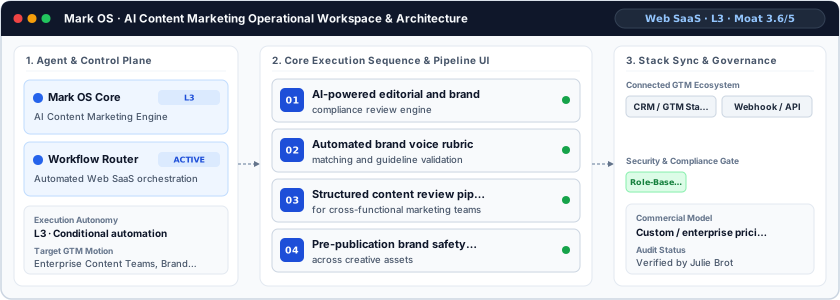
- AI-powered editorial and brand: compliance review engine
- Automated brand voice rubric: matching and guideline validation
- Structured content review pipelines: for cross-functional marketing teams
- Pre-publication brand safety checks: across creative assets
Cons: operational limitations & risks
- Nuance Detection in Complex Copy: The semantic evaluation models struggle with highly contextual sarcasm, cultural idioms, or nuanced narrative tone, occasionally generating false positives on deliberate creative liberties.
- Taxonomy Ingestion Overhead: Configuring bespoke corporate rubrics requires substantial upfront prompt calibration and schema alignment before review recommendations achieve production-grade precision.
- Ecosystem API Extensibility: The platform offers constrained out-of-the-box connectors for specialized digital asset management systems, demanding manual upload workflows or custom middleware for asset ingestion.
Mark OS TCO & deal-breaker stress test
Simulate 12-month stepped TCO, hidden cost multipliers, contract lock-in exposure, and stack failure modes using only facts verified by Julie Brot on · Capture SHA 0262571f.
Mark OS triggers high-severity friction under your 5-seat / $800/mo constraints. Benchmark the verified subtrack alternatives below before committing.
| Plan / Tier | Verified Rate | Scale Fit | Scope & Quota Notes |
|---|---|---|---|
| Enterprise / Custom | Custom quote | 15–50+ seats (Enterprise SLA) | Sales-negotiated annual contract for custom volume, SSO/RBAC governance, and dedicated SLA. |
- Moat Score
- 3.6 / 5.0
- AI Autonomy
- L3
- Free Tier / Trial
- None disclosed
Triggered audit signals & failure modes
- Opaque Enterprise Quoting vs. SMB/Mid-Market BudgetVerified Pricing Ledger
Mark OS does not disclose a public self-serve floor (Custom / enterprise pricing). Buyers with a $800/mo cap face high sales-qualification friction.
- Sales-Gated Contract TermsFact-checked by Julie Brot
Commercial procurement for the platform is available on request through tailored enterprise sales quotes based on organizational scale, content throughput, and seat requirements.
- Primary Operational Bottleneck: Nuance Detection in Complex CopyAudit by Julie Brot
The semantic evaluation models struggle with highly contextual sarcasm, cultural idioms, or nuanced narrative tone, occasionally generating false positives on deliberate creative liberties.
Hidden TCO Multipliers & Quota Gates
- Nuance Detection in Complex Copy: The semantic evaluation models struggle with highly contextual sarcasm, cultural idioms, or nuanced narrative tone, occasionally generating false positives on deliberate creative liberties.
- Taxonomy Ingestion Overhead: Configuring bespoke corporate rubrics requires substantial upfront prompt calibration and schema alignment before review recommendations achieve production-grade precision.
When to Walk Away & Negotiation Levers
- Walk away if you require transparent self-serve monthly billing or your budget ceiling is under $1,000/mo (Mark OS requires sales-gated custom quoting).
- Walk away if your workflow cannot tolerate nuance detection in complex copy: The semantic evaluation models struggle with highly contextual sarcasm, cultural idioms, or nuanced narrative tone, occasionally generating false positives on deliberate creative liberties.
- Walk away if taxonomy ingestion overhead is a deal-breaker for your team: Configuring bespoke corporate rubrics requires substantial upfront prompt calibration and schema alignment before review recommendations achieve production-grade precision.
- Demand a 30- to 60-day paid pilot opt-out clause in the Mark OS order form before signing a 12-month enterprise commitment.
- Require a sandbox proof-of-concept testing nuance detection in complex copy against your live CRM/data schema before annual sign-off.
Ask a custom procurement or TCO stress-test question about Mark OS
Verified AI Content Marketing peer (Custom / enterprise pricing · Moat 3.6/5.0)
Verified AI Content Marketing peer (Custom / enterprise pricing · Moat 3.6/5.0)
Mark OS moat & subtrack positioning
Mark OS relies on structured compliance rule-parsing and editorial linting models tuned for brand voice fidelity, though sustained enterprise defensibility depends on embedding deeply into multi-stakeholder creative approval loops.
Editorial review
Fact-checked by Julie Brot (Enterprise SaaS Governance & Procurement Editor) on .
Background
Modern enterprise marketing organizations frequently struggle to balance high-volume content production with rigorous brand governance and regulatory consistency. Headquartered in Seattle, WA, Mark OS provides an automated brand content governance engine built to streamline pre-publication quality assurance. Designed for creative directors, brand operations leads, and corporate editorial teams, the platform replaces manual multi-stakeholder review chains with algorithmic brand compliance pipelines.
How Mark OS works
At its technical core, the platform operates as a governed content workflow orchestrator that ingests unstructured marketing copy alongside structured brand guidelines. The engine applies domain-adapted large language models paired with deterministic rule parsers to analyze tone, syntax, factual assertions, and regulatory positioning. By parsing drafts against corporate voice schemas, the system flags style drift, highlights non-compliant claims, and surfaces editorial corrections before publication.
Limitations
Operational considerations and platform boundaries include:
- Nuance Detection in Complex Copy: The semantic evaluation models struggle with highly contextual sarcasm, cultural idioms, or nuanced narrative tone, occasionally generating false positives on deliberate creative liberties.
- Taxonomy Ingestion Overhead: Configuring bespoke corporate rubrics requires substantial upfront prompt calibration and schema alignment before review recommendations achieve production-grade precision.
- Ecosystem API Extensibility: The platform offers constrained out-of-the-box connectors for specialized digital asset management systems, demanding manual upload workflows or custom middleware for asset ingestion.
Mark OS pricing
Commercial procurement for the platform is available on request through tailored enterprise sales quotes based on organizational scale, content throughput, and seat requirements. The vendor delivers customized annual contracts that bundle governance rule customization, administrative controls, and dedicated implementation assistance without publishing standard commercial tiers.
How Mark OS compares
Within the enterprise brand and creative content ecosystem, Mark OS occupies a specialized editorial governance position. While Agentio targets algorithmic creator ad placements, Aha Global manages expansive localization pipelines, and AIDetectPlus focuses primarily on synthetic text detection, Mark OS centers directly on deterministic brand linting. The platform is best suited for regulated corporate brands seeking programmatic editorial oversight across distributed creative teams.
Direct competitors & market radar
Top algorithmic competitors based on category positioning, capability overlap, and ICP alignment.
Frequently asked questions about Mark OS
How much does Mark OS cost and does it require a custom enterprise quote?
Published pricing summary for Mark OS: Custom / enterprise pricing. A permanent free plan is not disclosed for Mark OS. Commercial procurement for the platform is available on request through tailored enterprise sales quotes based on organizational scale, content throughput, and seat requirements.
How does Mark OS work and how autonomous is its AI architecture?
Enterprise brand content governance and review engine applying domain-adapted LLMs to automate brand compliance and editorial workflows. Within AI Content Marketing (Enterprise & Long-Form Brand Content), MarTechRadar rates its execution architecture at L3 · Conditional automation with a verified Moat Score of 3.6 / 5.0 (Proprietary moat). Mark OS relies on structured compliance rule-parsing and editorial linting models tuned for brand voice fidelity, though sustained enterprise defensibility depends on embedding deeply into multi-stakeholder creative approval loops. Corporate profile: operating at 2-10 employees scale.
What are the main limitations of Mark OS and when should buyers walk away?
Based on our editorial technical audit, key operational considerations and boundaries for Mark OS include: (1) Nuance Detection in Complex Copy: The semantic evaluation models struggle with highly contextual sarcasm, cultural idioms, or nuanced narrative tone, occasionally generating false positives on deliberate creative liberties. (2) Taxonomy Ingestion Overhead: Configuring bespoke corporate rubrics requires substantial upfront prompt calibration and schema alignment before review recommendations achieve production-grade precision. (3) Ecosystem API Extensibility: The platform offers constrained out-of-the-box connectors for specialized digital asset management systems, demanding manual upload workflows or custom middleware for asset ingestion. Primary procurement walk-away rule: Walk away if you require transparent self-serve monthly billing or your budget ceiling is under $1,000/mo (Mark OS requires sales-gated custom quoting).
What integrations, compliance certifications, and contract terms apply to Mark OS?
First-party governance and developer endpoints verified on domain include: Trust/Security (https://trust.markos.ai). Key TCO multiplier to watch: Nuance Detection in Complex Copy (The semantic evaluation models struggle with highly contextual sarcasm, cultural idioms, or nuanced narrative tone, occasionally generating false positives on deliberate creative liberties.) Before signing a contract, procurement teams should demand a 30- to 60-day paid pilot opt-out clause in the Mark OS order form before signing a 12-month enterprise commitment.
What are the best Mark OS alternatives and head-to-head competitors in 2026?
Top fact-checked alternatives to Mark OS in AI Content Marketing (Enterprise & Long-Form Brand Content) include Copymatic (Custom / enterprise pricing), Dreamlit AI (Custom / enterprise pricing), MedullaAI (Custom / enterprise pricing), NACTORE TECHNOLOGIES (Custom / enterprise pricing). Within the enterprise brand and creative content ecosystem, Mark OS occupies a specialized editorial governance position.
Verified sources & evidence trail
- Official product domain: https://markos.ai/
- Commercial pricing verification: Verified against official vendor pricing policy (Custom / enterprise pricing)
- Verified corporate entity profiles (
sameAs): LinkedIn Company Profile - First-party governance & documentation links: Trust & Security · Privacy
- Editorial audit sign-off: Fact-checked by Julie Brot on under the MarTechRadar Evidence-Ledger Protocol.