Neuronwriter Review (2026): AI Content Marketing Pricing, Limits & Alternatives
Bottom line
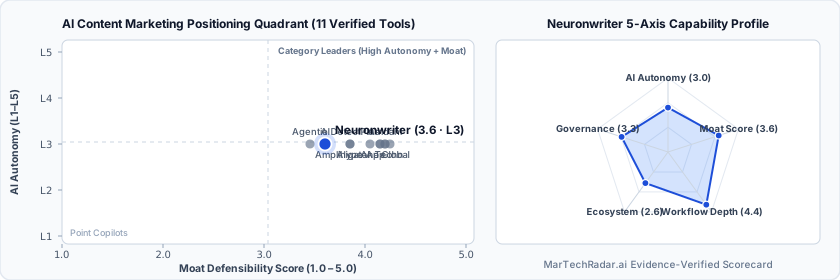
Neuronwriter is a Web SaaS tool for AI Content Marketing (Enterprise & Long-Form Brand Content) in Copy & Content. Pricing: Custom / enterprise pricing. Best suited to Creators / Solo. Editor ratings: AI autonomy L3 (conditional automation); moat score 3.6/5.0 (Proprietary moat). Fact-checked by Tim Fenolz on Oct 15, 2026.
Semantic SEO and AI search optimization platform providing programmatic competitive SERP analysis, NLP-guided content scoring, and generative drafting.
Neuronwriter buyer fit verdict: when to choose vs. when to walk away
Choose Neuronwriter if (Best Fit)
- Target ICP & Stack Fit: You operate as Creators / Solo requiring a Web SaaS deployment for AI Content Marketing.
- L3 Architecture & Defensibility: Proprietary natural language processing recommendation engine trained on real-time search engine result page entities, coupled with lexical graph mapping tailored for answer engine optimization.
- Commercial Model Fit: Your procurement budget aligns with Custom / enterprise pricing.
Walk away from Neuronwriter if (Deal-Breakers)
- Walk away if you require transparent self-serve monthly billing or your budget ceiling is under $1,000/mo (Neuronwriter requires sales-gated custom quoting).
- Walk away if your workflow cannot tolerate corpus volatility: Users encounter operational friction and integration bottlenecks, as the pipeline struggles with Real-time algorithmic re-ranking by search providers can cause rapid shifts in semantic recommendations, requiring continuous manual recalculation of target keyword models.
- Walk away if token exhaustion is a deal-breaker for your team: Users encounter operational friction and integration bottlenecks, as the pipeline struggles with Extensive enterprise drafting workflows face computational credit constraints when processing deep entity graphs across high volumes of concurrent long-form assets.
Neuronwriter key facts & scorecard
| Pricing | Custom / enterprise pricing |
|---|---|
| Free plan | No / not disclosed |
| Delivery | Web SaaS |
| Audience | Creators / Solo |
| AI autonomy level | L3 · Conditional automationEditor-verified |
| Moat tier & score | 3.6 / 5.0 · Proprietary moatEditor-verified |
| Funding | Bootstrapped |
| Governance & docs | Terms ↗ · Privacy ↗ |
| Headquarters | Poland |
| Founded | 2021 |
| Last verified |
Neuronwriter pros & cons: strengths vs. operational limitations
Pros: core strengths & capabilities
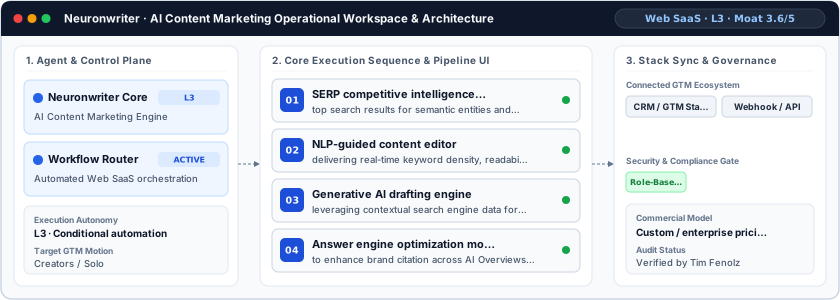
- SERP competitive intelligence parsing: top search results for semantic entities and topical coverage
- NLP-guided content editor: delivering real-time keyword density, readability, and structural scoring
- Generative AI drafting engine: leveraging contextual search engine data for structured long-form copy
- Answer engine optimization modeling: to enhance brand citation across AI Overviews and conversational search
Cons: operational limitations & risks
- Corpus Volatility: Users encounter operational friction and integration bottlenecks, as the pipeline struggles with Real-time algorithmic re-ranking by search providers can cause rapid shifts in semantic recommendations, requiring continuous manual recalculation of target keyword models.
- Token Exhaustion: Users encounter operational friction and integration bottlenecks, as the pipeline struggles with Extensive enterprise drafting workflows face computational credit constraints when processing deep entity graphs across high volumes of concurrent long-form assets.
- Contextual Nuance Failure: Users encounter operational friction and integration bottlenecks, as the pipeline struggles with Over-indexing on statistical entity coverage can generate syntactically dense text that dilutes proprietary corporate positioning without manual editorial oversight.
Neuronwriter TCO & deal-breaker stress test
Simulate 12-month stepped TCO, hidden cost multipliers, contract lock-in exposure, and stack failure modes using only facts verified by Tim Fenolz on · Capture SHA 56ba0de4.
Neuronwriter triggers high-severity friction under your 5-seat / $800/mo constraints. Benchmark the verified subtrack alternatives below before committing.
| Plan / Tier | Verified Rate | Scale Fit | Scope & Quota Notes |
|---|---|---|---|
| Entry / Starter | $23/mo | 1–2 seats | Verified $23/mo published rate on vendor pricing schedule. |
| Growth / Professional | $45/mo | 5 seats | Verified $45/mo published rate on vendor pricing schedule. |
| Scale / Advanced | $69/mo | 15 seats | Verified $69/mo published rate on vendor pricing schedule. |
| Enterprise / Custom | Custom quote | 15–50+ seats (Enterprise SLA) | Sales-negotiated annual contract for custom volume, SSO/RBAC governance, and dedicated SLA. |
- Moat Score
- 3.6 / 5.0
- AI Autonomy
- L3
- Free Tier / Trial
- None disclosed
Triggered audit signals & failure modes
- Opaque Enterprise Quoting vs. SMB/Mid-Market BudgetVerified Pricing Ledger
Neuronwriter does not disclose a public self-serve floor (Custom / enterprise pricing). Buyers with a $800/mo cap face high sales-qualification friction.
- Sales-Gated Contract TermsFact-checked by Tim Fenolz
Neuronwriter delivers its commercial licensing via customized enterprise sales tiers configured around organizational scale, content analysis volume, and team seat requirements.
- Tier Fit for 5-Seat Scale: Entry / Starter ($23/mo)Verified Tier Schedule
Verified $23/mo published rate on vendor pricing schedule.
- Primary Operational Bottleneck: Token ExhaustionAudit by Tim Fenolz
Users encounter operational friction and integration bottlenecks, as the pipeline struggles with Extensive enterprise drafting workflows face computational credit constraints when processing deep entity graphs across high volumes of concurrent long-form assets.
Hidden TCO Multipliers & Quota Gates
- Credit & Usage Burn Multiplier: Automated workflows consume metered credits/usage quotas; multi-step enrichment, voice minutes, or high-frequency agent runs can trigger mid-cycle top-up packs.
- Corpus Volatility: Users encounter operational friction and integration bottlenecks, as the pipeline struggles with Real-time algorithmic re-ranking by search providers can cause rapid shifts in semantic recommendations, requiring continuous manual recalculation of target keyword models.
- Token Exhaustion: Users encounter operational friction and integration bottlenecks, as the pipeline struggles with Extensive enterprise drafting workflows face computational credit constraints when processing deep entity graphs across high volumes of concurrent long-form assets.
When to Walk Away & Negotiation Levers
- Walk away if you require transparent self-serve monthly billing or your budget ceiling is under $1,000/mo (Neuronwriter requires sales-gated custom quoting).
- Walk away if your workflow cannot tolerate corpus volatility: Users encounter operational friction and integration bottlenecks, as the pipeline struggles with Real-time algorithmic re-ranking by search providers can cause rapid shifts in semantic recommendations, requiring continuous manual recalculation of target keyword models.
- Walk away if token exhaustion is a deal-breaker for your team: Users encounter operational friction and integration bottlenecks, as the pipeline struggles with Extensive enterprise drafting workflows face computational credit constraints when processing deep entity graphs across high volumes of concurrent long-form assets.
- Demand a 30- to 60-day paid pilot opt-out clause in the Neuronwriter order form before signing a 12-month enterprise commitment.
- Require a sandbox proof-of-concept testing corpus volatility against your live CRM/data schema before annual sign-off.
Ask a custom procurement or TCO stress-test question about Neuronwriter
Verified AI Content Marketing peer (Custom / enterprise pricing · Moat 3.6/5.0)
Verified AI Content Marketing peer (Custom / enterprise pricing · Moat 3.6/5.0)
Neuronwriter moat & subtrack positioning
Proprietary natural language processing recommendation engine trained on real-time search engine result page entities, coupled with lexical graph mapping tailored for answer engine optimization.
Editorial review
Fact-checked by Tim Fenolz (Lead AdTech, Programmatic & Attribution Analyst) on .
Background
Content marketing teams and technical search strategists face increasing complexity as generative engine optimization and conventional search algorithms converge. Headquartered in Poland, Neuronwriter addresses this functional requirement by providing semantic content optimization infrastructure engineered for enterprise visibility across conventional search indices and generative answer engines. Built specifically for organic growth directors and digital editorial teams, the platform systematizes competitive search intelligence, transforming raw query data into governed lexical recommendations for sustained search citation.
How Neuronwriter works
Neuronwriter operates via an L3 semi-autonomous pipeline that ingests top-ranking search engine result pages for targeted commercial queries. The system deconstructs competitor pages using natural language processing to extract high-salience semantic entities, topical clusters, and micro-intent structures. It benchmarks draft text against these extracted corpus entities using vector similarity and term-distribution heuristics, providing real-time lexical scoring. Generative models then draft structured content sections directly mapped to these semantic baselines, maintaining programmatic alignment with target search parameters.
Limitations
Operational considerations and platform boundaries include:
- Corpus Volatility: Users encounter operational friction and integration bottlenecks, as the pipeline struggles with Real-time algorithmic re-ranking by search providers can cause rapid shifts in semantic recommendations, requiring continuous manual recalculation of target keyword models.
- Token Exhaustion: Users encounter operational friction and integration bottlenecks, as the pipeline struggles with Extensive enterprise drafting workflows face computational credit constraints when processing deep entity graphs across high volumes of concurrent long-form assets.
- Contextual Nuance Failure: Users encounter operational friction and integration bottlenecks, as the pipeline struggles with Over-indexing on statistical entity coverage can generate syntactically dense text that dilutes proprietary corporate positioning without manual editorial oversight.
Neuronwriter pricing
Neuronwriter delivers its commercial licensing via customized enterprise sales tiers configured around organizational scale, content analysis volume, and team seat requirements. Prospective buyers obtain commercial contracts by contacting sales directly for customized enterprise quotes based on specific operational parameters. Pricing is available on request through tailored enterprise sales quotes, with custom enterprise tiers, subscription plans, and seat licenses structured around organizational scale and monthly workflow volume.
How Neuronwriter compares
Compared to direct category competitors like Typeface and Writer, Neuronwriter functions as an alternative focused on specialized workflow execution. Within the enterprise editorial landscape, Neuronwriter differentiates by pairing natural language processing entity models with emergent AI search retrieval optimization. While Agentio centers on creator-led programmatic sponsorship workflows, Aha Global targets broader digital channel distribution, and AIDetectPlus focuses on synthetic text verification. Neuronwriter provides depth for content marketing teams requiring algorithmic semantic alignment and structured organic search indexing, accepting trade-offs in automated omni-channel publishing orchestration. It is best suited for enterprise marketing teams and growth practitioners seeking disciplined workflow orchestration.
Frequently asked questions about Neuronwriter
How much does Neuronwriter cost and does it require a custom enterprise quote?
Published pricing summary for Neuronwriter: Custom / enterprise pricing. A permanent free plan is not disclosed for Neuronwriter. Verified tier schedule: Entry / Starter ($23/mo for 1–2 seats); Growth / Professional ($45/mo for 5 seats); Scale / Advanced ($69/mo for 15 seats); Enterprise / Custom (Custom quote for 15–50+ seats (Enterprise SLA)). Neuronwriter delivers its commercial licensing via customized enterprise sales tiers configured around organizational scale, content analysis volume, and team seat requirements.
How does Neuronwriter work and how autonomous is its AI architecture?
Semantic SEO and AI search optimization platform providing programmatic competitive SERP analysis, NLP-guided content scoring, and generative drafting. Within AI Content Marketing (Enterprise & Long-Form Brand Content), MarTechRadar rates its execution architecture at L3 · Conditional automation with a verified Moat Score of 3.6 / 5.0 (Proprietary moat). Proprietary natural language processing recommendation engine trained on real-time search engine result page entities, coupled with lexical graph mapping tailored for answer engine optimization.
What are the main limitations of Neuronwriter and when should buyers walk away?
Based on our editorial technical audit, key operational considerations and boundaries for Neuronwriter include: (1) Corpus Volatility: Users encounter operational friction and integration bottlenecks, as the pipeline struggles with Real-time algorithmic re-ranking by search providers can cause rapid shifts in semantic recommendations, requiring continuous manual recalculation of target keyword models. (2) Token Exhaustion: Users encounter operational friction and integration bottlenecks, as the pipeline struggles with Extensive enterprise drafting workflows face computational credit constraints when processing deep entity graphs across high volumes of concurrent long-form assets. (3) Contextual Nuance Failure: Users encounter operational friction and integration bottlenecks, as the pipeline struggles with Over-indexing on statistical entity coverage can generate syntactically dense text that dilutes proprietary corporate positioning without manual editorial oversight. Primary procurement walk-away rule: Walk away if you require transparent self-serve monthly billing or your budget ceiling is under $1,000/mo (Neuronwriter requires sales-gated custom quoting).
What integrations, compliance certifications, and contract terms apply to Neuronwriter?
Key TCO multiplier to watch: Credit & Usage Burn Multiplier (Automated workflows consume metered credits/usage quotas; multi-step enrichment, voice minutes, or high-frequency agent runs can trigger mid-cycle top-up packs.) Before signing a contract, procurement teams should demand a 30- to 60-day paid pilot opt-out clause in the Neuronwriter order form before signing a 12-month enterprise commitment.
What are the best Neuronwriter alternatives and head-to-head competitors in 2026?
Top fact-checked alternatives to Neuronwriter in AI Content Marketing (Enterprise & Long-Form Brand Content) include Axcels (Custom / enterprise pricing), ManyPeak (Custom / enterprise pricing), VA Corporation (Custom / enterprise pricing), Voisso (Custom / enterprise pricing). Compared to direct category competitors like Typeface and Writer, Neuronwriter functions as an alternative focused on specialized workflow execution.
Verified sources & evidence trail
- Official product domain: https://neuronwriter.com
- Commercial pricing verification: Verified against official vendor pricing policy (Custom / enterprise pricing)
- First-party governance & documentation links: Terms · Privacy
- Editorial audit sign-off: Fact-checked by Tim Fenolz on under the MarTechRadar Evidence-Ledger Protocol.