PostCraft Review (2026): AI Content Marketing Pricing, Limits & Alternatives
Bottom line
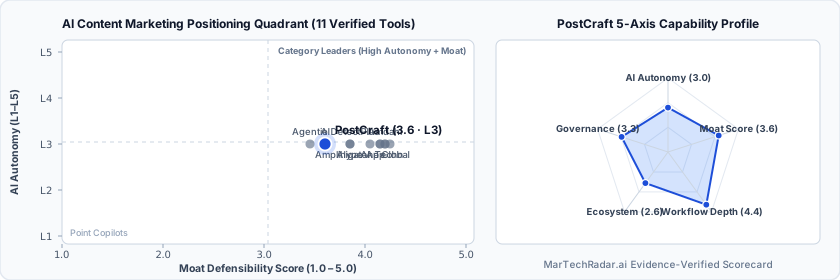
PostCraft is a Web SaaS tool for AI Content Marketing (Enterprise & Long-Form Brand Content) in Copy & Content. Pricing: Custom / enterprise pricing. Best suited to B2B SaaS and Creators / Solo. Editor ratings: AI autonomy L3 (conditional automation); moat score 3.6/5.0 (Proprietary moat). Fact-checked by Julie Brot on Oct 16, 2026.
Enterprise editorial platform that automates multi-channel long-form brand content generation using governed style guidelines and structured production.
PostCraft buyer fit verdict: when to choose vs. when to walk away
Choose PostCraft if (Best Fit)
- Target ICP & Stack Fit: You operate as B2B SaaS and Creators / Solo requiring a Web SaaS deployment for AI Content Marketing.
- L3 Architecture & Defensibility: Defensibility relies on domain-adapted prompt architecture, brand compliance rules, and structured editorial governance pipelines, though vulnerability persists against general-purpose foundation models.
- Commercial Model Fit: Your procurement budget aligns with Custom / enterprise pricing.
Walk away from PostCraft if (Deal-Breakers)
- Walk away if you require transparent self-serve monthly billing or your budget ceiling is under $1,000/mo (PostCraft requires sales-gated custom quoting).
- Walk away if your workflow cannot tolerate domain vocabulary drift: Fine-grained industry jargon and highly technical vertical positioning require recurrent rule maintenance to prevent stylistic drift across lengthy multi-chapter documents.
- Walk away if upstream LLM latency is a deal-breaker for your team: Multi-stage validation and sequential chapter generation introduce substantial processing latency, rendering the platform unsuitable for immediate, sub-second publishing requirements.
PostCraft key facts & scorecard
| Pricing | Custom / enterprise pricing |
|---|---|
| Free plan | No / not disclosed |
| Delivery | Web SaaS |
| Audience | B2B SaaS, Creators / Solo |
| AI autonomy level | L3 · Conditional automationEditor-verified |
| Moat tier & score | 3.6 / 5.0 · Proprietary moatEditor-verified |
| Funding | Bootstrapped |
| Headquarters | United States |
| Last verified |
PostCraft pros & cons: strengths vs. operational limitations
Pros: core strengths & capabilities
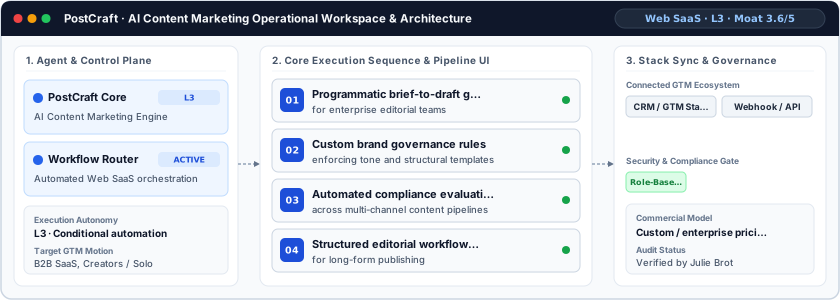
- Programmatic brief-to-draft generation: for enterprise editorial teams
- Custom brand governance rules: enforcing tone and structural templates
- Automated compliance evaluation: across multi-channel content pipelines
- Structured editorial workflow orchestration: for long-form publishing
Cons: operational limitations & risks
- Domain Vocabulary Drift: Fine-grained industry jargon and highly technical vertical positioning require recurrent rule maintenance to prevent stylistic drift across lengthy multi-chapter documents.
- Upstream LLM Latency: Multi-stage validation and sequential chapter generation introduce substantial processing latency, rendering the platform unsuitable for immediate, sub-second publishing requirements.
- Context Window Compounding: Complex briefs containing extensive reference corpora occasionally exceed token context partitions, requiring manual brief chunking to maintain structural coherence.
PostCraft TCO & deal-breaker stress test
Simulate 12-month stepped TCO, hidden cost multipliers, contract lock-in exposure, and stack failure modes using only facts verified by Julie Brot on · Capture SHA 526f9cad.
PostCraft triggers high-severity friction under your 5-seat / $800/mo constraints. Benchmark the verified subtrack alternatives below before committing.
| Plan / Tier | Verified Rate | Scale Fit | Scope & Quota Notes |
|---|---|---|---|
| Enterprise / Custom | Custom quote | 15–50+ seats (Enterprise SLA) | Sales-negotiated annual contract for custom volume, SSO/RBAC governance, and dedicated SLA. |
- Moat Score
- 3.6 / 5.0
- AI Autonomy
- L3
- Free Tier / Trial
- None disclosed
Triggered audit signals & failure modes
- Opaque Enterprise Quoting vs. SMB/Mid-Market BudgetVerified Pricing Ledger
PostCraft does not disclose a public self-serve floor (Custom / enterprise pricing). Buyers with a $800/mo cap face high sales-qualification friction.
- Sales-Gated Contract TermsFact-checked by Julie Brot
PostCraft provides commercial licensing through custom enterprise agreements available on request.
- Primary Operational Bottleneck: Domain Vocabulary DriftAudit by Julie Brot
Fine-grained industry jargon and highly technical vertical positioning require recurrent rule maintenance to prevent stylistic drift across lengthy multi-chapter documents.
Hidden TCO Multipliers & Quota Gates
- Credit & Usage Burn Multiplier: Automated workflows consume metered credits/usage quotas; multi-step enrichment, voice minutes, or high-frequency agent runs can trigger mid-cycle top-up packs.
- Domain Vocabulary Drift: Fine-grained industry jargon and highly technical vertical positioning require recurrent rule maintenance to prevent stylistic drift across lengthy multi-chapter documents.
- Upstream LLM Latency: Multi-stage validation and sequential chapter generation introduce substantial processing latency, rendering the platform unsuitable for immediate, sub-second publishing requirements.
When to Walk Away & Negotiation Levers
- Walk away if you require transparent self-serve monthly billing or your budget ceiling is under $1,000/mo (PostCraft requires sales-gated custom quoting).
- Walk away if your workflow cannot tolerate domain vocabulary drift: Fine-grained industry jargon and highly technical vertical positioning require recurrent rule maintenance to prevent stylistic drift across lengthy multi-chapter documents.
- Walk away if upstream LLM latency is a deal-breaker for your team: Multi-stage validation and sequential chapter generation introduce substantial processing latency, rendering the platform unsuitable for immediate, sub-second publishing requirements.
- Demand a 30- to 60-day paid pilot opt-out clause in the PostCraft order form before signing a 12-month enterprise commitment.
- Require a sandbox proof-of-concept testing domain vocabulary drift against your live CRM/data schema before annual sign-off.
Ask a custom procurement or TCO stress-test question about PostCraft
Lower 5-seat floor (~$13/mo vs. Custom Quote) · Transparent self-serve entry without mandatory annual lock-in
Verified AI Content Marketing peer (Pricing not disclosed · Moat 3.8/5.0)
PostCraft moat & subtrack positioning
Defensibility relies on domain-adapted prompt architecture, brand compliance rules, and structured editorial governance pipelines, though vulnerability persists against general-purpose foundation models.
Editorial review
Fact-checked by Julie Brot (Enterprise SaaS Governance & Procurement Editor) on .
Background
Headquartered in the United States, PostCraft addresses the core operational requirement of scaling structured editorial production without degrading narrative cohesion. Designed specifically for content marketing leads and corporate communications directors, the system manages the end-to-end transformation of creative briefs into multi-channel enterprise assets. PostCraft focuses directly on enterprise and long-form brand content generation, operating within governed corporate publishing pipelines to bridge high-level brand messaging with tactical execution.
How PostCraft works
Under the hood, PostCraft functions at an L3 autonomy profile by orchestrating domain-adapted language models inside an enterprise workflow harness. The ingestion pipeline accepts raw campaign outlines, messaging pillars, and established voice criteria, which are parsed against preconfigured editorial schemas. The system generates long-form drafts iteratively, applying automated heuristic evaluations for tone adherence, vocabulary compliance, and structural alignment. By enforcing step-wise generation rather than single-shot prompting, the platform preserves programmatic control across extensive narrative sequences.
Limitations
Operational considerations and platform boundaries include:
- Domain Vocabulary Drift: Fine-grained industry jargon and highly technical vertical positioning require recurrent rule maintenance to prevent stylistic drift across lengthy multi-chapter documents.
- Upstream LLM Latency: Multi-stage validation and sequential chapter generation introduce substantial processing latency, rendering the platform unsuitable for immediate, sub-second publishing requirements.
- Context Window Compounding: Complex briefs containing extensive reference corpora occasionally exceed token context partitions, requiring manual brief chunking to maintain structural coherence.
PostCraft pricing
PostCraft provides commercial licensing through custom enterprise agreements available on request. Commercial pricing is available on request through tailored enterprise sales quotes based on organizational scale and seats, reflecting dedicated compute allocation, brand rule customization, and team provisioning requirements. Contracts typically follow annual commitments accompanied by enterprise onboarding services rather than self-service public tiers.
How PostCraft compares
Within the enterprise editorial landscape, PostCraft competes against disparate specialized architectures. While Agentio structures creator-led sponsored ad copy and AIDetectPlus focuses on synthetic text verification and watermarking analysis, PostCraft maintains its focus on internal long-form narrative production. Conversely, broad agency platforms like Aha Global rely on human-assisted campaign execution rather than deterministic L3 autonomous drafting. PostCraft fits mid-market and enterprise marketing departments requiring continuous, brief-driven content production under strict brand governance. It is best suited for enterprise marketing teams and growth practitioners seeking disciplined workflow orchestration.
Frequently asked questions about PostCraft
How much does PostCraft cost and does it require a custom enterprise quote?
Published pricing summary for PostCraft: Custom / enterprise pricing. A permanent free plan is not disclosed for PostCraft. PostCraft provides commercial licensing through custom enterprise agreements available on request.
How does PostCraft work and how autonomous is its AI architecture?
Enterprise editorial platform that automates multi-channel long-form brand content generation using governed style guidelines and structured production. Within AI Content Marketing (Enterprise & Long-Form Brand Content), MarTechRadar rates its execution architecture at L3 · Conditional automation with a verified Moat Score of 3.6 / 5.0 (Proprietary moat). Defensibility relies on domain-adapted prompt architecture, brand compliance rules, and structured editorial governance pipelines, though vulnerability persists against general-purpose foundation models.
What are the main limitations of PostCraft and when should buyers walk away?
Based on our editorial technical audit, key operational considerations and boundaries for PostCraft include: (1) Domain Vocabulary Drift: Fine-grained industry jargon and highly technical vertical positioning require recurrent rule maintenance to prevent stylistic drift across lengthy multi-chapter documents. (2) Upstream LLM Latency: Multi-stage validation and sequential chapter generation introduce substantial processing latency, rendering the platform unsuitable for immediate, sub-second publishing requirements. (3) Context Window Compounding: Complex briefs containing extensive reference corpora occasionally exceed token context partitions, requiring manual brief chunking to maintain structural coherence. Primary procurement walk-away rule: Walk away if you require transparent self-serve monthly billing or your budget ceiling is under $1,000/mo (PostCraft requires sales-gated custom quoting).
What integrations, compliance certifications, and contract terms apply to PostCraft?
Key TCO multiplier to watch: Credit & Usage Burn Multiplier (Automated workflows consume metered credits/usage quotas; multi-step enrichment, voice minutes, or high-frequency agent runs can trigger mid-cycle top-up packs.) Before signing a contract, procurement teams should demand a 30- to 60-day paid pilot opt-out clause in the PostCraft order form before signing a 12-month enterprise commitment.
What are the best PostCraft alternatives and head-to-head competitors in 2026?
Top fact-checked alternatives to PostCraft in AI Content Marketing (Enterprise & Long-Form Brand Content) include PerformLine (Pricing not disclosed), Jasper (Enterprise) ($49–$69/seat/mo), Writesonic (From $50/mo), Copy.ai (Workflows) ($49–$249/mo). Within the enterprise editorial landscape, PostCraft competes against disparate specialized architectures. While Agentio structures creator-led sponsored ad copy and AIDetectPlus focuses on synthetic text verification and watermarking analysis, PostCraft maintains its focus on internal long-form narrative production.
Verified sources & evidence trail
- Official product domain: https://postcraft.ai
- Commercial pricing verification: Verified against official vendor pricing policy (Custom / enterprise pricing)
- Editorial audit sign-off: Fact-checked by Julie Brot on under the MarTechRadar Evidence-Ledger Protocol.