Semji Review (2026): AI Content Marketing Pricing, Limits & Alternatives
Bottom line
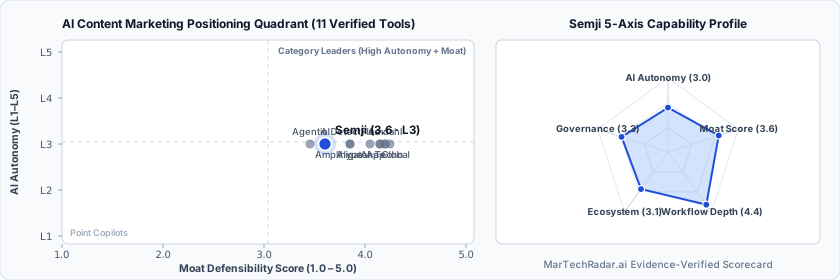
Semji is a Web SaaS tool for AI Content Marketing (Enterprise & Long-Form Brand Content) in Copy & Content. Pricing: Custom / enterprise pricing. Best suited to DTC / eCommerce and Enterprise Brands. Editor ratings: AI autonomy L3 (conditional automation); moat score 3.6/5.0 (Proprietary moat). Fact-checked by Jagmeet Sine on Oct 15, 2026.
Agentic content optimization platform orchestrating generative engine optimization (GEO) and search visibility workflows prioritized by revenue impact.
Semji buyer fit verdict: when to choose vs. when to walk away
Choose Semji if (Best Fit)
- Target ICP & Stack Fit: You operate as DTC / eCommerce and Enterprise Brands requiring a Web SaaS deployment for AI Content Marketing.
- L3 Architecture & Defensibility: Semji pairs legacy search intent intelligence with proprietary generative engine optimization (GEO) diagnostic models, scoring enterprise content against LLM synthesis engines and traditional search indexers simultaneously.
- Commercial Model Fit: Your procurement budget aligns with Custom / enterprise pricing.
Walk away from Semji if (Deal-Breakers)
- Walk away if you require transparent self-serve monthly billing or your budget ceiling is under $1,000/mo (Semji requires sales-gated custom quoting).
- Walk away if your workflow cannot tolerate generative search telemetry volatility: Third-party LLM response stochasticity complicates deterministic attribution, causing generative visibility scores to fluctuate unpredictably between model update cycles.
- Walk away if CMS ingestion and synchronization latency is a deal-breaker for your team: Complex headless content architectures encounter synchronization delays when pushing structured text updates directly from the optimization editor into production environments.
Semji key facts & scorecard
| Pricing | Custom / enterprise pricing |
|---|---|
| Free plan | No / not disclosed |
| Delivery | Web SaaS |
| Audience | DTC / eCommerce, Enterprise Brands |
| AI autonomy level | L3 · Conditional automationEditor-verified |
| Moat tier & score | 3.6 / 5.0 · Proprietary moatEditor-verified |
| Funding | Venture-backed |
| Company size | 51-200 employees |
| Governance & docs | Trust & Security ↗ · System Status ↗ · API & Docs ↗ · Changelog ↗ · Terms ↗ · Privacy ↗ |
| Headquarters | Lyon, Rhone-Alpes, France |
| Founded | 2012 |
| Last verified |
Semji pros & cons: strengths vs. operational limitations
Pros: core strengths & capabilities
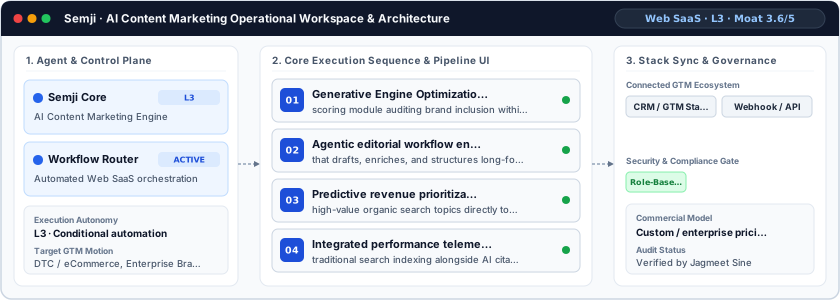
- Generative Engine Optimization (GEO): scoring module auditing brand inclusion within conversational AI search responses
- Agentic editorial workflow engine: that drafts, enriches, and structures long-form content briefs
- Predictive revenue prioritization mapping: high-value organic search topics directly to commercial pipeline outcomes
- Integrated performance telemetry tracking: traditional search indexing alongside AI citation metrics
Cons: operational limitations & risks
- Generative Search Telemetry Volatility: Third-party LLM response stochasticity complicates deterministic attribution, causing generative visibility scores to fluctuate unpredictably between model update cycles.
- CMS Ingestion and Synchronization Latency: Complex headless content architectures encounter synchronization delays when pushing structured text updates directly from the optimization editor into production environments.
- Domain-Specific Technical Vocabulary Gaps: Highly regulated niche B2B industries require significant manual brief adjustments, as semantic scoring models prioritize broad search consensus over proprietary nomenclature.
Semji TCO & deal-breaker stress test
Simulate 12-month stepped TCO, hidden cost multipliers, contract lock-in exposure, and stack failure modes using only facts verified by Jagmeet Sine on · Capture SHA 7db81aad.
Semji triggers high-severity friction under your 5-seat / $800/mo constraints. Benchmark the verified subtrack alternatives below before committing.
| Plan / Tier | Verified Rate | Scale Fit | Scope & Quota Notes |
|---|---|---|---|
| Enterprise / Custom | Custom quote | 15–50+ seats (Enterprise SLA) | Sales-negotiated annual contract for custom volume, SSO/RBAC governance, and dedicated SLA. |
- Moat Score
- 3.6 / 5.0
- AI Autonomy
- L3
- Free Tier / Trial
- None disclosed
Triggered audit signals & failure modes
- Opaque Enterprise Quoting vs. SMB/Mid-Market BudgetVerified Pricing Ledger
Semji does not disclose a public self-serve floor (Custom / enterprise pricing). Buyers with a $800/mo cap face high sales-qualification friction.
- Sales-Gated Contract TermsFact-checked by Jagmeet Sine
Pricing is available on request through tailored enterprise sales quotes, with custom enterprise tiers structured around organizational scale, user seats, and workflow volume.
- Primary Operational Bottleneck: Generative Search Telemetry VolatilityAudit by Jagmeet Sine
Third-party LLM response stochasticity complicates deterministic attribution, causing generative visibility scores to fluctuate unpredictably between model update cycles.
Hidden TCO Multipliers & Quota Gates
- Per-Seat Linear Scaling: Semji prices licenses on a per-user/seat basis (Custom / enterprise pricing); expanding from 2 to 15+ operators multiplies base recurring spend linearly.
- Generative Search Telemetry Volatility: Third-party LLM response stochasticity complicates deterministic attribution, causing generative visibility scores to fluctuate unpredictably between model update cycles.
- CMS Ingestion and Synchronization Latency: Complex headless content architectures encounter synchronization delays when pushing structured text updates directly from the optimization editor into production environments.
When to Walk Away & Negotiation Levers
- Walk away if you require transparent self-serve monthly billing or your budget ceiling is under $1,000/mo (Semji requires sales-gated custom quoting).
- Walk away if your workflow cannot tolerate generative search telemetry volatility: Third-party LLM response stochasticity complicates deterministic attribution, causing generative visibility scores to fluctuate unpredictably between model update cycles.
- Walk away if CMS ingestion and synchronization latency is a deal-breaker for your team: Complex headless content architectures encounter synchronization delays when pushing structured text updates directly from the optimization editor into production environments.
- Demand a 30- to 60-day paid pilot opt-out clause in the Semji order form before signing a 12-month enterprise commitment.
- Require a sandbox proof-of-concept testing generative search telemetry volatility against your live CRM/data schema before annual sign-off.
Ask a custom procurement or TCO stress-test question about Semji
Lower 5-seat floor (~$125/mo vs. Custom Quote) · Transparent self-serve entry without mandatory annual lock-in
Verified AI Content Marketing peer (Custom / enterprise pricing · Moat 4.2/5.0)
Semji moat & subtrack positioning
Semji pairs legacy search intent intelligence with proprietary generative engine optimization (GEO) diagnostic models, scoring enterprise content against LLM synthesis engines and traditional search indexers simultaneously.
Editorial review
Fact-checked by Jagmeet Sine (Senior MarTech Infrastructure & Agentic Workflow Architect) on .
Background
Engineered as an agentic content intelligence architecture, Semji bridges technical search optimization and generative engine visibility for corporate digital marketing organizations. Established in 2012 in Lyon, Rhone-Alpes, France, the software equips content directors, SEO leads, and brand strategists with systematic editorial guidance. Semji expands traditional organic search operations by optimizing long-form digital assets for both standard search engines and emerging conversational retrieval models, establishing algorithmic recommendations anchored in commercial impact.
How Semji works
Semji operates at Level 3 autonomy through an analytical pipeline that ingests domain performance metrics, search intent signals, and LLM synthesis patterns. The platform runs automated site audits to identify visibility deficits across traditional search engines and conversational AI engines. Its agentic workflow parses target keyword clusters, analyzes top-ranking competitor structures, and computes real-time optimization scores. Editorial teams receive structured briefs, automated drafting recommendations, and contextual internal linking suggestions calibrated to maximize citation probability across generative models.
Limitations
Operational considerations and platform boundaries include:
- Generative Search Telemetry Volatility: Third-party LLM response stochasticity complicates deterministic attribution, causing generative visibility scores to fluctuate unpredictably between model update cycles.
- CMS Ingestion and Synchronization Latency: Complex headless content architectures encounter synchronization delays when pushing structured text updates directly from the optimization editor into production environments.
- Domain-Specific Technical Vocabulary Gaps: Highly regulated niche B2B industries require significant manual brief adjustments, as semantic scoring models prioritize broad search consensus over proprietary nomenclature.
Semji pricing
Pricing is available on request through tailored enterprise sales quotes, with custom enterprise tiers structured around organizational scale, user seats, and workflow volume.
How Semji compares
Within the enterprise editorial space, Semji differentiates itself through integrated generative engine optimization diagnostics rather than purely transactional text generation. While Agentio automates creator ad placements and AIDetectPlus focuses strictly on synthetic text provenance and AI watermarking, Semji provides end-to-end editorial intelligence. Compared to Aha Global's strategic brand positioning tools, Semji provides granular, real-time editorial scoring suitable for mid-market and enterprise marketing groups demanding quantifiable organic traffic retention. It is best suited for enterprise marketing teams and growth practitioners seeking disciplined workflow orchestration.
Frequently asked questions about Semji
How much does Semji cost and does it require a custom enterprise quote?
Published pricing summary for Semji: Custom / enterprise pricing. A permanent free plan is not disclosed for Semji. Pricing is available on request through tailored enterprise sales quotes, with custom enterprise tiers structured around organizational scale, user seats, and workflow volume.
How does Semji work and how autonomous is its AI architecture?
Agentic content optimization platform orchestrating generative engine optimization (GEO) and search visibility workflows prioritized by revenue impact. Within AI Content Marketing (Enterprise & Long-Form Brand Content), MarTechRadar rates its execution architecture at L3 · Conditional automation with a verified Moat Score of 3.6 / 5.0 (Proprietary moat). Semji pairs legacy search intent intelligence with proprietary generative engine optimization (GEO) diagnostic models, scoring enterprise content against LLM synthesis engines and traditional search indexers simultaneously. Corporate profile: operating at 51-200 employees scale.
What are the main limitations of Semji and when should buyers walk away?
Based on our editorial technical audit, key operational considerations and boundaries for Semji include: (1) Generative Search Telemetry Volatility: Third-party LLM response stochasticity complicates deterministic attribution, causing generative visibility scores to fluctuate unpredictably between model update cycles. (2) CMS Ingestion and Synchronization Latency: Complex headless content architectures encounter synchronization delays when pushing structured text updates directly from the optimization editor into production environments. (3) Domain-Specific Technical Vocabulary Gaps: Highly regulated niche B2B industries require significant manual brief adjustments, as semantic scoring models prioritize broad search consensus over proprietary nomenclature. Primary procurement walk-away rule: Walk away if you require transparent self-serve monthly billing or your budget ceiling is under $1,000/mo (Semji requires sales-gated custom quoting).
What integrations, compliance certifications, and contract terms apply to Semji?
First-party governance and developer endpoints verified on domain include: Trust/Security (https://trust.semji.com), Status (https://status.semji.com), API Docs (https://developers.semji.com). Key TCO multiplier to watch: Per-Seat Linear Scaling (Semji prices licenses on a per-user/seat basis (Custom / enterprise pricing); expanding from 2 to 15+ operators multiplies base recurring spend linearly.) Before signing a contract, procurement teams should demand a 30- to 60-day paid pilot opt-out clause in the Semji order form before signing a 12-month enterprise commitment.
What are the best Semji alternatives and head-to-head competitors in 2026?
Top fact-checked alternatives to Semji in AI Content Marketing (Enterprise & Long-Form Brand Content) include Searchable ($125–$400/mo), Sett (Custom / enterprise pricing), MedullaAI (Custom / enterprise pricing), NACTORE TECHNOLOGIES (Custom / enterprise pricing). Within the enterprise editorial space, Semji differentiates itself through integrated generative engine optimization diagnostics rather than purely transactional text generation.
Verified sources & evidence trail
- Official product domain: https://semji.com
- Commercial pricing verification: Verified against official vendor pricing policy (Custom / enterprise pricing)
- Verified corporate entity profiles (
sameAs): LinkedIn Company Profile · Crunchbase Entity Record - First-party governance & documentation links: Trust & Security · System Status · API & Docs · Changelog · Terms · Privacy
- Editorial audit sign-off: Fact-checked by Jagmeet Sine on under the MarTechRadar Evidence-Ledger Protocol.