AdPlexity Review (2026): Marketing Attribution Pricing, Limits & Alternatives
Bottom line
AdPlexity is a Web SaaS tool for Marketing Attribution (Multi-Touch Attribution & eCommerce Dashboards) in Analytics & Attribution. Pricing: From $79/mo. Best suited to Creators / Solo. Editor ratings: AI autonomy L3 (conditional automation); moat score 3.6/5.0 (Proprietary moat). Fact-checked by Tim Fenolz on Oct 14, 2026.
Competitive ad intelligence and programmatic ad-spying engine monitoring real-time creative deployments across social, native, push, and mobile channels.
AdPlexity buyer fit verdict: when to choose vs. when to walk away
Choose AdPlexity if (Best Fit)
- Target ICP & Stack Fit: You operate as Creators / Solo requiring a Web SaaS deployment for Marketing Attribution, with verified ecosystem connectivity for Slack, Shopify.
- L3 Architecture & Defensibility: Large-scale historical creative index paired with distributed proxy parsing networks across dozens of affiliate and programmatic display networks.
- Commercial Model Fit: Your procurement budget aligns with From $79/mo.
Walk away from AdPlexity if (Deal-Breakers)
- Walk away if your workflow requires uncapped enterprise volume on the From $79/mo entry plan without upgrading tiers.
- Walk away if your workflow cannot tolerate attribution and conversion blindspots: The system monitors visible front-end ad delivery and placement metadata, lacking first-party post-click conversion or revenue telemetry.
- Walk away if crawler evasion and regional cloaking is a deal-breaker for your team: Aggressive IP cloaking and bot-detection scripts deployed by target advertisers occasionally prevent accurate landing page capture.
AdPlexity key facts & scorecard
| Pricing | From $79/moVendor pricing page |
|---|---|
| Free plan | No / not disclosed |
| Delivery | Web SaaS |
| Audience | Creators / Solo |
| AI autonomy level | L3 · Conditional automationEditor-verified |
| Moat tier & score | 3.6 / 5.0 · Proprietary moatEditor-verified |
| Funding | Venture-backed |
| Company size | 11-50 employees |
| Ecosystem integrations | Slack, Shopify |
| Governance & docs | Terms ↗ · Privacy ↗ |
| Headquarters | Kwun Tong, Central |
| Founded | 2015 |
| Last verified |
AdPlexity pros & cons: strengths vs. operational limitations
Pros: core strengths & capabilities
- Cross-network competitive ad monitoring: across social, native, and push channels
- Automated scraping and archival: of active competitor landing pages and conversion flows
- Publisher and ad-network placement: breakdown including device and carrier targeting telemetry
- Search and filtering engine: indexing 100M+ creatives by engagement and run-duration
Cons: operational limitations & risks
- Attribution and Conversion Blindspots: The system monitors visible front-end ad delivery and placement metadata, lacking first-party post-click conversion or revenue telemetry.
- Crawler Evasion and Regional Cloaking: Aggressive IP cloaking and bot-detection scripts deployed by target advertisers occasionally prevent accurate landing page capture.
- Siloed Product Architecture: Data indexing remains segmented across distinct traffic channel products rather than unifying cross-network competitor trajectories into a single analytical pipeline.
AdPlexity TCO & deal-breaker stress test
Simulate 12-month stepped TCO, hidden cost multipliers, contract lock-in exposure, and stack failure modes using only facts verified by Tim Fenolz on · Capture SHA c41fc6e8.
AdPlexity aligns with your 5-seat / $800/mo profile. Review the walk-away triggers and contract levers below before deployment.
| Plan / Tier | Verified Rate | Scale Fit | Scope & Quota Notes |
|---|---|---|---|
| Entry / Starter | $79/mo | 1–2 seats | Billed yearly · you save $238 a year |
| Growth / Professional | $99/mo | 5 seats | Billed yearly · you save $238 a year |
| Scale / Advanced | $208/mo | 15 seats | Billed yearly · you save $492 a year |
- Moat Score
- 3.6 / 5.0
- AI Autonomy
- L3
- Free Tier / Trial
- None disclosed
Triggered audit signals & failure modes
- Published Self-Serve Entry FloorVerified Pricing Ledger
AdPlexity publishes a transparent entry point (From $79/mo) for initial validation before committing.
- Tier Fit for 5-Seat Scale: Growth / Professional ($99/mo)Verified Tier Schedule
Billed yearly · you save $238 a year
- Primary Operational Bottleneck: Attribution and Conversion BlindspotsAudit by Tim Fenolz
The system monitors visible front-end ad delivery and placement metadata, lacking first-party post-click conversion or revenue telemetry.
Hidden TCO Multipliers & Quota Gates
- Annual Billing Headline vs. Monthly Premium: Headline entry rates reflect annual billing commitments (Save up to 20%); month-to-month flexibility carries a higher effective monthly rate or requires annual prepayment.
- Credit & Usage Burn Multiplier: Automated workflows consume metered credits/usage quotas; multi-step enrichment, voice minutes, or high-frequency agent runs can trigger mid-cycle top-up packs.
When to Walk Away & Negotiation Levers
- Walk away if your workflow requires uncapped enterprise volume on the From $79/mo entry plan without upgrading tiers.
- Walk away if your workflow cannot tolerate attribution and conversion blindspots: The system monitors visible front-end ad delivery and placement metadata, lacking first-party post-click conversion or revenue telemetry.
- Walk away if crawler evasion and regional cloaking is a deal-breaker for your team: Aggressive IP cloaking and bot-detection scripts deployed by target advertisers occasionally prevent accurate landing page capture.
- Validate exact quota thresholds (seats, credits, or API calls) included in AdPlexity's From $79/mo tier before converting from monthly to annual billing.
- Require a sandbox proof-of-concept testing attribution and conversion blindspots against your live CRM/data schema before annual sign-off.
Ask a custom procurement or TCO stress-test question about AdPlexity
Lower 5-seat floor (~$29/mo vs. $99 / mo)
Lower 5-seat floor (~$20/mo vs. $99 / mo)
AdPlexity key entities, modules & ecosystem stack
AdPlexity moat & subtrack positioning
Large-scale historical creative index paired with distributed proxy parsing networks across dozens of affiliate and programmatic display networks.
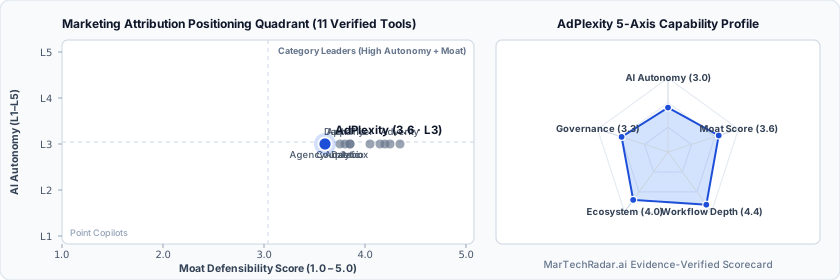
Editorial review
Fact-checked by Tim Fenolz (Lead AdTech, Programmatic & Attribution Analyst) on .
Background
Performance marketing teams and digital media buyers require systematic visibility into live competitor campaigns to optimize return on ad spend. Headquartered in Kwun Tong, Central, AdPlexity delivers dedicated competitive ad intelligence across programmatic display, social, native, and push networks. Rather than relying on static industry benchmarks, growth leads use the software to monitor competitor creative trends, destination URLs, and audience targeting parameters across global ad exchanges.
How AdPlexity works
At an architectural level, AdPlexity operates continuous web crawlers and residential proxy networks that ingest ad telemetry across networks such as Taboola, Outbrain, MGID, Facebook, and Instagram. Ingestion engines decode dynamic ad tags, archive creative assets, and record downstream landing page redirects. The platform indexes campaign run duration, device distribution, geographic coverage, and publisher placements into a centralized search interface, functioning at an L3 autonomy profile for automated creative discovery, alongside native workflow integrations for Slack and Shopify.
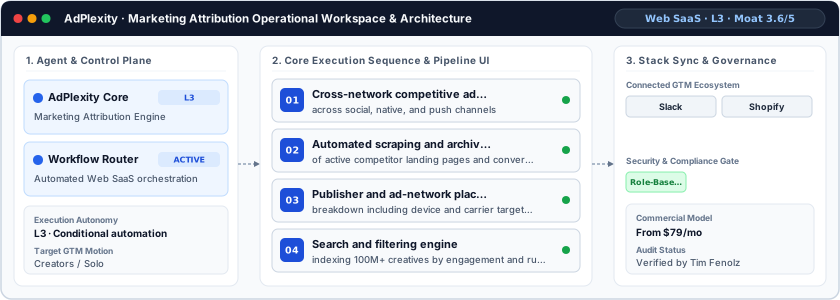
Limitations
Operational considerations and platform boundaries include:
- Attribution and Conversion Blindspots: The system monitors visible front-end ad delivery and placement metadata, lacking first-party post-click conversion or revenue telemetry.
- Crawler Evasion and Regional Cloaking: Aggressive IP cloaking and bot-detection scripts deployed by target advertisers occasionally prevent accurate landing page capture.
- Siloed Product Architecture: Data indexing remains segmented across distinct traffic channel products rather than unifying cross-network competitor trajectories into a single analytical pipeline.
AdPlexity pricing
AdPlexity licenses its platform via modular, channel-specific monthly subscriptions starting from $79 per month. For example, AdPlexity Social is priced at $79 per month when billed annually, which saves $238 per year against its $99 monthly rate. The Native intelligence tier lists at $208 per month on an annual billing schedule, saving $492 per year against its $249 standard monthly rate.
How AdPlexity compares
In the Marketing Attribution landscape, in contrast to end-to-end attribution engines like AppsFlyer and Adjust, which focus on mobile measurement partner SDK telemetry and downstream user attribution, AdPlexity operates purely on external competitive reconnaissance. While platforms like Adverity specialize in enterprise marketing data integration, AdPlexity targets affiliate media buyers and direct-to-consumer acquisition teams needing granular intelligence on active creative executions.
Frequently asked questions about AdPlexity
How much does AdPlexity cost and what pricing tiers are available?
Published pricing summary for AdPlexity: From $79/mo. A permanent free plan is not disclosed for AdPlexity. Verified tier schedule: Entry / Starter ($79/mo for 1–2 seats); Growth / Professional ($99/mo for 5 seats); Scale / Advanced ($208/mo for 15 seats). AdPlexity licenses its platform via modular, channel-specific monthly subscriptions starting from $79 per month. For example, AdPlexity Social is priced at $79 per month when billed annually, which saves $238 per year against its $99 monthly rate.
How does AdPlexity work and how autonomous is its AI architecture?
Competitive ad intelligence and programmatic ad-spying engine monitoring real-time creative deployments across social, native, push, and mobile channels. Within Marketing Attribution (Multi-Touch Attribution & eCommerce Dashboards), MarTechRadar rates its execution architecture at L3 · Conditional automation with a verified Moat Score of 3.6 / 5.0 (Proprietary moat). Large-scale historical creative index paired with distributed proxy parsing networks across dozens of affiliate and programmatic display networks. Corporate profile: operating at 11-50 employees scale.
What are the main limitations of AdPlexity and when should buyers walk away?
Based on our editorial technical audit, key operational considerations and boundaries for AdPlexity include: (1) Attribution and Conversion Blindspots: The system monitors visible front-end ad delivery and placement metadata, lacking first-party post-click conversion or revenue telemetry. (2) Crawler Evasion and Regional Cloaking: Aggressive IP cloaking and bot-detection scripts deployed by target advertisers occasionally prevent accurate landing page capture. (3) Siloed Product Architecture: Data indexing remains segmented across distinct traffic channel products rather than unifying cross-network competitor trajectories into a single analytical pipeline. Primary procurement walk-away rule: Walk away if your workflow requires uncapped enterprise volume on the From $79/mo entry plan without upgrading tiers.
What integrations, compliance certifications, and contract terms apply to AdPlexity?
Verified ecosystem and stack integrations include Slack, Shopify. Key TCO multiplier to watch: Annual Billing Headline vs. Monthly Premium (Headline entry rates reflect annual billing commitments (Save up to 20%); month-to-month flexibility carries a higher effective monthly rate or requires annual prepayment.) Before signing a contract, procurement teams should validate exact quota thresholds (seats, credits, or API calls) included in AdPlexity's From $79/mo tier before converting from monthly to annual billing.
What are the best AdPlexity alternatives and head-to-head competitors in 2026?
Top fact-checked alternatives to AdPlexity in Marketing Attribution (Multi-Touch Attribution & eCommerce Dashboards) include Adverity (Custom / enterprise pricing), Shoplazza AI (From $29.25/mo), Swydo (From $2/mo), AgencyAnalytics (From $20/mo). In the Marketing Attribution landscape, in contrast to end-to-end attribution engines like AppsFlyer and Adjust, which focus on mobile measurement partner SDK telemetry and downstream user attribution, AdPlexity operates purely on external competitive reconnaissance.
Verified sources & evidence trail
- Official product domain: https://adplexity.com
- Commercial pricing verification: https://adplexity.com/pricing
- Verified corporate entity profiles (
sameAs): LinkedIn Company Profile · Crunchbase Entity Record - First-party governance & documentation links: Terms · Privacy
- Editorial audit sign-off: Fact-checked by Tim Fenolz on under the MarTechRadar Evidence-Ledger Protocol.