Shoplazza AI Review (2026): Marketing Attribution Pricing, Limits & Alternatives
Bottom line
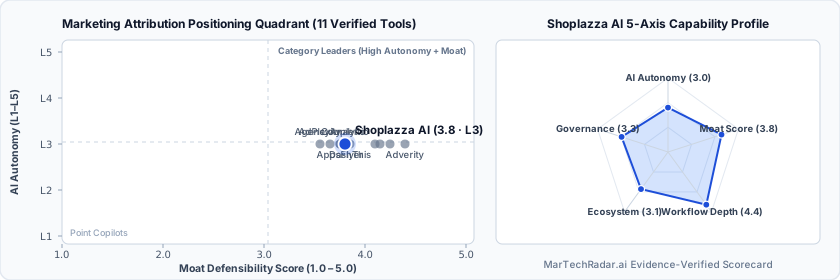
Shoplazza AI is a Web SaaS tool for Marketing Attribution (Multi-Touch Attribution & eCommerce Dashboards) in Analytics & Attribution. Pricing: From $29.25/mo. Best suited to DTC / eCommerce. Editor ratings: AI autonomy L3 (conditional automation); moat score 3.8/5.0 (Proprietary moat). Fact-checked by Vasilia Xia on Oct 12, 2026.
AI-powered e-commerce platform and storefront builder designed for cross-border merchants, combining automated site generation, global payment processing.
Shoplazza AI buyer fit verdict: when to choose vs. when to walk away
Choose Shoplazza AI if (Best Fit)
- Target ICP & Stack Fit: You operate as DTC / eCommerce requiring a Web SaaS deployment for Marketing Attribution.
- L3 Architecture & Defensibility: Shoplazza's technical defensibility centers on its integrated cross-border infrastructure, coupling automated localization across up to 50 regional markets with 180+ localized payment rails and direct server-side advertising attribution integrations.
- Commercial Model Fit: Your procurement budget aligns with From $29.25/mo.
Walk away from Shoplazza AI if (Deal-Breakers)
- Walk away if your workflow requires uncapped enterprise volume on the From $29.25/mo entry plan without upgrading tiers.
- Walk away if your workflow cannot tolerate attribution granularity: The internal analytics dashboard relies on baseline ad-network pixel syncs rather than custom algorithmic multi-touch attribution, limiting insights into cross-channel user journeys.
- Walk away if transaction fee overhead is a deal-breaker for your team: Lower-tier subscriptions impose a 2% platform transaction surcharge on sales, creating margin compression for high-volume, low-margin inventory catalogs.
Shoplazza AI key facts & scorecard
| Pricing | From $29.25/moVendor pricing page |
|---|---|
| Free plan | No / not disclosed |
| Delivery | Web SaaS |
| Audience | DTC / eCommerce |
| AI autonomy level | L3 · Conditional automationEditor-verified |
| Moat tier & score | 3.8 / 5.0 · Proprietary moatEditor-verified |
| Funding | Venture-backed |
| Founders | Jeff li |
| Company size | 201-500 employees |
| Governance & docs | Trust & Security ↗ · Terms ↗ · Privacy ↗ |
| Headquarters | Toronto, Ontario, Canada |
| Founded | 2017 |
| Last verified |
Shoplazza AI pros & cons: strengths vs. operational limitations
Pros: core strengths & capabilities
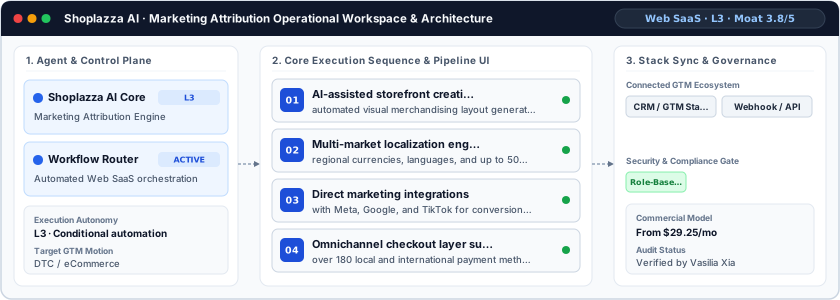
- AI-assisted storefront creation and: automated visual merchandising layout generator
- Multi-market localization engine supporting: regional currencies, languages, and up to 50 target regions
- Direct marketing integrations: with Meta, Google, and TikTok for conversion tracking and product feed syncing
- Omnichannel checkout layer supporting: over 180 local and international payment methods
Cons: operational limitations & risks
- Attribution Granularity: The internal analytics dashboard relies on baseline ad-network pixel syncs rather than custom algorithmic multi-touch attribution, limiting insights into cross-channel user journeys.
- Transaction Fee Overhead: Lower-tier subscriptions impose a 2% platform transaction surcharge on sales, creating margin compression for high-volume, low-margin inventory catalogs.
- Enterprise Extensibility: Staff account caps on entry tiers restrict role-based governance for complex marketing organizations requiring distributed, granular team permissions.
Shoplazza AI TCO & deal-breaker stress test
Simulate 12-month stepped TCO, hidden cost multipliers, contract lock-in exposure, and stack failure modes using only facts verified by Vasilia Xia on · Capture SHA b6dfcf16.
Shoplazza AI aligns with your 5-seat / $800/mo profile. Review the walk-away triggers and contract levers below before deployment.
| Plan / Tier | Verified Rate | Scale Fit | Scope & Quota Notes |
|---|---|---|---|
| Entry / Starter | $29.25/mo | 1–2 seats | Verified $29.25/mo published rate on vendor pricing schedule. |
| Growth / Professional | $78.75/mo | 5 seats | Verified $78.75/mo published rate on vendor pricing schedule. |
| Scale / Advanced | $299.25/mo | 15 seats | Verified $299.25/mo published rate on vendor pricing schedule. |
- Moat Score
- 3.8 / 5.0
- AI Autonomy
- L3
- Free Tier / Trial
- None disclosed
Triggered audit signals & failure modes
- Published Self-Serve Entry FloorVerified Pricing Ledger
Shoplazza AI publishes a transparent entry point (From $29.25/mo) for initial validation before committing.
- Tier Fit for 5-Seat Scale: Growth / Professional ($78.75/mo)Verified Tier Schedule
Verified $78.75/mo published rate on vendor pricing schedule.
- Primary Operational Bottleneck: Transaction Fee OverheadAudit by Vasilia Xia
Lower-tier subscriptions impose a 2% platform transaction surcharge on sales, creating margin compression for high-volume, low-margin inventory catalogs.
Hidden TCO Multipliers & Quota Gates
- Annual Billing Headline vs. Monthly Premium: Headline entry rates reflect annual billing commitments; month-to-month flexibility carries a higher effective monthly rate or requires annual prepayment.
- Enterprise Governance & Add-On Gating: Advanced capabilities such as Single Sign-On (SSO), custom role permissions, or specialized analytics modules are gated behind upper tiers or paid add-ons.
When to Walk Away & Negotiation Levers
- Walk away if your workflow requires uncapped enterprise volume on the From $29.25/mo entry plan without upgrading tiers.
- Walk away if your workflow cannot tolerate attribution granularity: The internal analytics dashboard relies on baseline ad-network pixel syncs rather than custom algorithmic multi-touch attribution, limiting insights into cross-channel user journeys.
- Walk away if transaction fee overhead is a deal-breaker for your team: Lower-tier subscriptions impose a 2% platform transaction surcharge on sales, creating margin compression for high-volume, low-margin inventory catalogs.
- Validate exact quota thresholds (seats, credits, or API calls) included in Shoplazza AI's From $29.25/mo tier before converting from monthly to annual billing.
- Require a sandbox proof-of-concept testing attribution granularity against your live CRM/data schema before annual sign-off.
Ask a custom procurement or TCO stress-test question about Shoplazza AI
Fits within $800/mo budget (From $79/mo)
Lower 5-seat floor (~$15/mo vs. $79 / mo)
Shoplazza AI moat & subtrack positioning
Shoplazza's technical defensibility centers on its integrated cross-border infrastructure, coupling automated localization across up to 50 regional markets with 180+ localized payment rails and direct server-side advertising attribution integrations.
Editorial review
Fact-checked by Vasilia Xia (E-Commerce, Lifecycle & Retention Marketing Analyst) on .
Background
Architected as an all-in-one commercial infrastructure stack, Shoplazza AI was established in 2017 in Toronto, Ontario, Canada, to address operational bottlenecks encountered by cross-border direct-to-consumer merchants. The platform serves digital commerce teams, cross-border retailers, and growth operators who require rapid international catalog deployments without building decoupled microservices. By combining storefront rendering, catalog management, and integrated digital marketing tracking, Shoplazza positions its platform as a unified deployment layer for merchants navigating fragmented international selling environments.
How Shoplazza AI works
At its functional core, Shoplazza AI operates an automated storefront synthesis pipeline that ingests raw product feeds, brand parameters, and localized market settings. The system compiles these inputs into responsive, multi-region frontends through an automated theme engine. Operating with Level 3 autonomy, the platform handles multi-market routing, dynamically switching currency presentations across up to 50 regional storefronts. For channel attribution and campaign telemetry, the backend orchestrates direct integrations with Google, Meta, and TikTok ad APIs, streaming client and server-side conversion signals into a consolidated merchant reporting dashboard.
Limitations
Operational considerations and platform boundaries include:
- Attribution Granularity: The internal analytics dashboard relies on baseline ad-network pixel syncs rather than custom algorithmic multi-touch attribution, limiting insights into cross-channel user journeys.
- Transaction Fee Overhead: Lower-tier subscriptions impose a 2% platform transaction surcharge on sales, creating margin compression for high-volume, low-margin inventory catalogs.
- Enterprise Extensibility: Staff account caps on entry tiers restrict role-based governance for complex marketing organizations requiring distributed, granular team permissions.
Shoplazza AI pricing
Shoplazza AI distributes its software through a multi-tier recurring subscription framework with variable transaction fees. Entry-level deployment begins at a verified rate of $29.25 per month billed on an annual cycle, which includes three staff seats, unlimited product listings, access to 180+ payment methods, and marketing integrations across primary ad channels. Platform monetization scales via higher monthly subscription tiers alongside a 2% platform transaction fee on entry-tier processing volume.
How Shoplazza AI compares
Within the tracking and e-commerce measurement ecosystem, Shoplazza AI differs fundamentally from dedicated multi-touch attribution solutions like Adjust, Adverity, and AppsFlyer. While Adjust and AppsFlyer deliver deep mobile attribution pipelines, and Adverity provides enterprise-grade ETL data orchestration, Shoplazza AI functions primarily as an execution-oriented storefront platform with native operational reporting. The solution is best suited for small-to-midmarket cross-border merchants seeking integrated store hosting and built-in tracking, whereas enterprise organizations requiring deterministic cohort modeling and complex multi-touch attribution require dedicated data infrastructure.
Frequently asked questions about Shoplazza AI
How much does Shoplazza AI cost and what pricing tiers are available?
Published pricing summary for Shoplazza AI: From $29.25/mo. A permanent free plan is not disclosed for Shoplazza AI. Verified tier schedule: Entry / Starter ($29.25/mo for 1–2 seats); Growth / Professional ($78.75/mo for 5 seats); Scale / Advanced ($299.25/mo for 15 seats). Shoplazza AI distributes its software through a multi-tier recurring subscription framework with variable transaction fees.
How does Shoplazza AI work and how autonomous is its AI architecture?
AI-powered e-commerce platform and storefront builder designed for cross-border merchants, combining automated site generation, global payment processing. Within Marketing Attribution (Multi-Touch Attribution & eCommerce Dashboards), MarTechRadar rates its execution architecture at L3 · Conditional automation with a verified Moat Score of 3.8 / 5.0 (Proprietary moat). Shoplazza's technical defensibility centers on its integrated cross-border infrastructure, coupling automated localization across up to 50 regional markets with 180+ localized payment rails and direct server-side advertising attribution integrations. Corporate profile: Founded by Jeff li, operating at 201-500 employees scale.
What are the main limitations of Shoplazza AI and when should buyers walk away?
Based on our editorial technical audit, key operational considerations and boundaries for Shoplazza AI include: (1) Attribution Granularity: The internal analytics dashboard relies on baseline ad-network pixel syncs rather than custom algorithmic multi-touch attribution, limiting insights into cross-channel user journeys. (2) Transaction Fee Overhead: Lower-tier subscriptions impose a 2% platform transaction surcharge on sales, creating margin compression for high-volume, low-margin inventory catalogs. (3) Enterprise Extensibility: Staff account caps on entry tiers restrict role-based governance for complex marketing organizations requiring distributed, granular team permissions. Primary procurement walk-away rule: Walk away if your workflow requires uncapped enterprise volume on the From $29.25/mo entry plan without upgrading tiers.
What integrations, compliance certifications, and contract terms apply to Shoplazza AI?
First-party governance and developer endpoints verified on domain include: Trust/Security (https://www.shoplazza.com/compliance). Key TCO multiplier to watch: Annual Billing Headline vs. Monthly Premium (Headline entry rates reflect annual billing commitments; month-to-month flexibility carries a higher effective monthly rate or requires annual prepayment.) Before signing a contract, procurement teams should validate exact quota thresholds (seats, credits, or API calls) included in Shoplazza AI's From $29.25/mo tier before converting from monthly to annual billing.
What are the best Shoplazza AI alternatives and head-to-head competitors in 2026?
Top fact-checked alternatives to Shoplazza AI in Marketing Attribution (Multi-Touch Attribution & eCommerce Dashboards) include Databox (Free plan · $0/mo · Enterprise plan), Podscribe (From $1.05/mo), Swydo (From $2/mo), AdPlexity (From $79/mo). Within the tracking and e-commerce measurement ecosystem, Shoplazza AI differs fundamentally from dedicated multi-touch attribution solutions like Adjust, Adverity, and AppsFlyer.
Verified sources & evidence trail
- Official product domain: https://shoplazza.com
- Commercial pricing verification: https://www.shoplazza.com/pricing
- Verified corporate entity profiles (
sameAs): LinkedIn Company Profile · Crunchbase Entity Record - First-party governance & documentation links: Trust & Security · Terms · Privacy
- Editorial audit sign-off: Fact-checked by Vasilia Xia on under the MarTechRadar Evidence-Ledger Protocol.