Triple Whale Review (2026): Marketing Attribution Pricing, Limits & Alternatives
Bottom line
Triple Whale is a Web SaaS tool for Marketing Attribution (Multi-Touch Attribution & eCommerce Dashboards) in Analytics & Attribution. Pricing: Custom / enterprise pricing. Best suited to DTC / eCommerce. Editor ratings: AI autonomy L3 (conditional automation); moat score 4.0/5.0 (Proprietary moat). Fact-checked by Vasilia Xia on Oct 7, 2026.
Multi-touch attribution and eCommerce analytics platform utilizing server-side tracking to unify ad metrics and store profitability.
Triple Whale buyer fit verdict: when to choose vs. when to walk away
Choose Triple Whale if (Best Fit)
- Target ICP & Stack Fit: You operate as DTC / eCommerce requiring a Web SaaS deployment for Marketing Attribution, with verified ecosystem connectivity for Shopify.
- L3 Architecture & Defensibility: First-party data capture through its proprietary Triple Pixel combined with direct connectors to core eCommerce platforms and advertising networks.
- Commercial Model Fit: Your procurement budget aligns with Custom / enterprise pricing.
Walk away from Triple Whale if (Deal-Breakers)
- Walk away if you require transparent self-serve monthly billing or your budget ceiling is under $1,000/mo (Triple Whale requires sales-gated custom quoting).
- Walk away if your workflow cannot tolerate ecosystem coupling: The data ingestion architecture is deeply coupled with standard eCommerce platforms like Shopify, requiring extensive custom engineering when applied to non-standard or headless checkout systems.
- Walk away if attribution latency and window drift is a deal-breaker for your team: Multi-channel reconciliation suffers from reporting latency due to ad network API rate limits and post-conversion window adjustments that alter trailing ROAS metrics retroactively.
Triple Whale key facts & scorecard
| Pricing | Custom / enterprise pricing |
|---|---|
| Free plan | No / not disclosed |
| Delivery | Web SaaS |
| Audience | DTC / eCommerce |
| AI autonomy level | L3 · Conditional automationEditor-verified |
| Moat tier & score | 4.0 / 5.0 · Proprietary moatEditor-verified |
| Funding | Venture-backed |
| Founders | AJ Orbach, Ivan Chernykh, Maxx Blank |
| Company size | 51-200 employees |
| Ecosystem integrations | Shopify |
| Governance & docs | Trust & Security ↗ · Changelog ↗ · Terms ↗ · Privacy ↗ |
| Headquarters | Columbus, United States |
| Founded | 2021 |
| Last verified |
Triple Whale pros & cons: strengths vs. operational limitations
Pros: core strengths & capabilities
- Core capability: Triple Pixel first-party server-side tracking
- Core capability: Centralized real-time multi-channel marketing dashboard
- Moby AI conversational intelligence: and anomaly detection
- Multi-touch attribution modeling: across paid and organic touchpoints
Cons: operational limitations & risks
- Ecosystem Coupling: The data ingestion architecture is deeply coupled with standard eCommerce platforms like Shopify, requiring extensive custom engineering when applied to non-standard or headless checkout systems.
- Attribution Latency and Window Drift: Multi-channel reconciliation suffers from reporting latency due to ad network API rate limits and post-conversion window adjustments that alter trailing ROAS metrics retroactively.
- Click-Path Coverage Deficits: Deterministic pixel matching degrades when user journeys span private mobile browsers and app-to-web transitions where UTM parameters are stripped.
Triple Whale TCO & deal-breaker stress test
Simulate 12-month stepped TCO, hidden cost multipliers, contract lock-in exposure, and stack failure modes using only facts verified by Vasilia Xia on · Capture SHA c5be9133.
Triple Whale triggers high-severity friction under your 5-seat / $800/mo constraints. Benchmark the verified subtrack alternatives below before committing.
| Plan / Tier | Verified Rate | Scale Fit | Scope & Quota Notes |
|---|---|---|---|
| Enterprise / Custom | Custom quote | 15–50+ seats (Enterprise SLA) | Sales-negotiated annual contract for custom volume, SSO/RBAC governance, and dedicated SLA. |
- Moat Score
- 4.0 / 5.0
- AI Autonomy
- L3
- Free Tier / Trial
- None disclosed
Triggered audit signals & failure modes
- Opaque Enterprise Quoting vs. SMB/Mid-Market BudgetVerified Pricing Ledger
Triple Whale does not disclose a public self-serve floor (Custom / enterprise pricing). Buyers with a $800/mo cap face high sales-qualification friction.
- Sales-Gated Contract TermsFact-checked by Vasilia Xia
The vendor structures commercial access via tiered subscriptions alongside custom enterprise pricing based on organizational scale and seats.
- Primary Operational Bottleneck: Ecosystem CouplingAudit by Vasilia Xia
The data ingestion architecture is deeply coupled with standard eCommerce platforms like Shopify, requiring extensive custom engineering when applied to non-standard or headless checkout systems.
Hidden TCO Multipliers & Quota Gates
- Credit & Usage Burn Multiplier: Automated workflows consume metered credits/usage quotas; multi-step enrichment, voice minutes, or high-frequency agent runs can trigger mid-cycle top-up packs.
- Enterprise Governance & Add-On Gating: Advanced capabilities such as Single Sign-On (SSO), custom role permissions, or specialized analytics modules are gated behind upper tiers or paid add-ons.
When to Walk Away & Negotiation Levers
- Walk away if you require transparent self-serve monthly billing or your budget ceiling is under $1,000/mo (Triple Whale requires sales-gated custom quoting).
- Walk away if your workflow cannot tolerate ecosystem coupling: The data ingestion architecture is deeply coupled with standard eCommerce platforms like Shopify, requiring extensive custom engineering when applied to non-standard or headless checkout systems.
- Walk away if attribution latency and window drift is a deal-breaker for your team: Multi-channel reconciliation suffers from reporting latency due to ad network API rate limits and post-conversion window adjustments that alter trailing ROAS metrics retroactively.
- Demand a 30- to 60-day paid pilot opt-out clause in the Triple Whale order form before signing a 12-month enterprise commitment.
- Require a sandbox proof-of-concept testing ecosystem coupling against your live CRM/data schema before annual sign-off.
Ask a custom procurement or TCO stress-test question about Triple Whale
Lower 5-seat floor (~$79/mo vs. Custom Quote) · Transparent self-serve entry without mandatory annual lock-in
Lower 5-seat floor (~$20/mo vs. Custom Quote)
Triple Whale key entities, modules & ecosystem stack
Triple Whale moat & subtrack positioning
First-party data capture through its proprietary Triple Pixel combined with direct connectors to core eCommerce platforms and advertising networks.
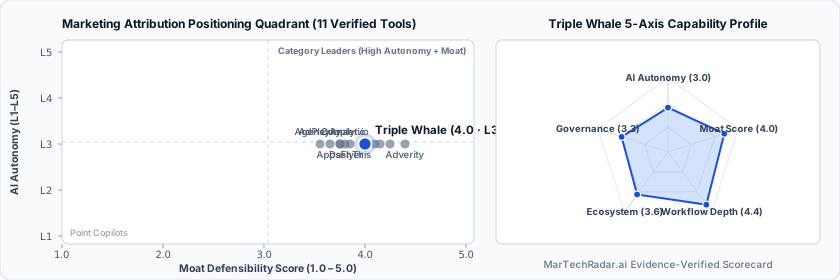
Editorial review
Fact-checked by Vasilia Xia (E-Commerce, Lifecycle & Retention Marketing Analyst) on .
Background
To diagnose true unit economics in direct-to-consumer commerce, marketing leaders require an integrated attribution pipeline rather than fragmented ad network dashboards. Triple Whale was established in 2021 in Columbus, United States, to serve direct-to-consumer brand operators, media buyers, and eCommerce data leaders. The platform functions as a centralized intelligence system that consolidates acquisition spend, attribution telemetry, and real-time storefront revenue into a unified operating view.
How Triple Whale works
At the foundational layer, Triple Whale deploys a server-side first-party tracking mechanism called the Triple Pixel. This pixel captures customer journeys across devices, bypassing browser-level tracking constraints and third-party cookie degradation. The ingestion engine reconciles click-level parameters, UTM data, and order IDs from platforms like Shopify against programmatic APIs from Meta, Google, and TikTok. Through deterministic and probabilistic attribution modeling, the system maps conversion paths and evaluates Marketing Efficiency Ratio. Operational queries and performance anomalies are managed through Moby AI, functioning at an L3 conditional automation tier by generating analytical summaries and rule-based workflow actions.
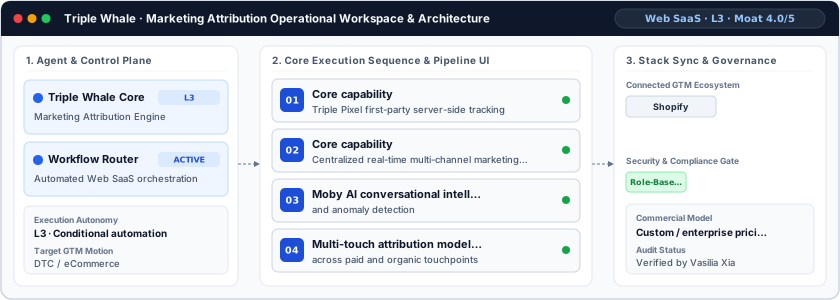
Limitations
Operational considerations and platform boundaries include:
- Ecosystem Coupling: The data ingestion architecture is deeply coupled with standard eCommerce platforms like Shopify, requiring extensive custom engineering when applied to non-standard or headless checkout systems.
- Attribution Latency and Window Drift: Multi-channel reconciliation suffers from reporting latency due to ad network API rate limits and post-conversion window adjustments that alter trailing ROAS metrics retroactively.
- Click-Path Coverage Deficits: Deterministic pixel matching degrades when user journeys span private mobile browsers and app-to-web transitions where UTM parameters are stripped.
Triple Whale pricing
The vendor structures commercial access via tiered subscriptions alongside custom enterprise pricing based on organizational scale and seats. High-volume brands access extended data retention, elevated API call volumes, and customized reporting configurations through tailored enterprise sales quotes upon request.
How Triple Whale compares
Within multi-touch attribution, Triple Whale competes with mobile measurement partners like AppsFlyer and Adjust, as well as enterprise data orchestration suites like Adverity. While AppsFlyer and Adjust focus on native mobile app SDK telemetry, Triple Whale prioritizes web-based commerce transactions and storefront profitability. Unlike Adverity, which offers generalized ETL infrastructure for data engineers, Triple Whale delivers pre-configured attribution models purpose-built for mid-market and enterprise eCommerce operators.
Direct competitors & market radar
Top algorithmic competitors based on category positioning, capability overlap, and ICP alignment.
Frequently asked questions about Triple Whale
How much does Triple Whale cost and does it require a custom enterprise quote?
Published pricing summary for Triple Whale: Custom / enterprise pricing. A permanent free plan is not disclosed for Triple Whale. The vendor structures commercial access via tiered subscriptions alongside custom enterprise pricing based on organizational scale and seats. High-volume brands access extended data retention, elevated API call volumes, and customized reporting configurations through tailored enterprise sales quotes upon request.
How does Triple Whale work and how autonomous is its AI architecture?
Multi-touch attribution and eCommerce analytics platform utilizing server-side tracking to unify ad metrics and store profitability. Within Marketing Attribution (Multi-Touch Attribution & eCommerce Dashboards), MarTechRadar rates its execution architecture at L3 · Conditional automation with a verified Moat Score of 4.0 / 5.0 (Proprietary moat). First-party data capture through its proprietary Triple Pixel combined with direct connectors to core eCommerce platforms and advertising networks. Corporate profile: Founded by AJ Orbach, Ivan Chernykh, Maxx Blank, operating at 51-200 employees scale.
What are the main limitations of Triple Whale and when should buyers walk away?
Based on our editorial technical audit, key operational considerations and boundaries for Triple Whale include: (1) Ecosystem Coupling: The data ingestion architecture is deeply coupled with standard eCommerce platforms like Shopify, requiring extensive custom engineering when applied to non-standard or headless checkout systems. (2) Attribution Latency and Window Drift: Multi-channel reconciliation suffers from reporting latency due to ad network API rate limits and post-conversion window adjustments that alter trailing ROAS metrics retroactively. (3) Click-Path Coverage Deficits: Deterministic pixel matching degrades when user journeys span private mobile browsers and app-to-web transitions where UTM parameters are stripped. Primary procurement walk-away rule: Walk away if you require transparent self-serve monthly billing or your budget ceiling is under $1,000/mo (Triple Whale requires sales-gated custom quoting).
What integrations, compliance certifications, and contract terms apply to Triple Whale?
Verified ecosystem and stack integrations include Shopify. First-party governance and developer endpoints verified on domain include: Trust/Security (https://trust.triplewhale.com). Key TCO multiplier to watch: Credit & Usage Burn Multiplier (Automated workflows consume metered credits/usage quotas; multi-step enrichment, voice minutes, or high-frequency agent runs can trigger mid-cycle top-up packs.) Before signing a contract, procurement teams should demand a 30- to 60-day paid pilot opt-out clause in the Triple Whale order form before signing a 12-month enterprise commitment.
What are the best Triple Whale alternatives and head-to-head competitors in 2026?
Top fact-checked alternatives to Triple Whale in Marketing Attribution (Multi-Touch Attribution & eCommerce Dashboards) include Roadway (Custom / enterprise pricing), Adverity (Custom / enterprise pricing), Similarweb AI (Custom / enterprise pricing), FullStory (Custom / enterprise pricing). Within multi-touch attribution, Triple Whale competes with mobile measurement partners like AppsFlyer and Adjust, as well as enterprise data orchestration suites like Adverity.
Verified sources & evidence trail
- Official product domain: https://triplewhale.com
- Commercial pricing verification: Verified against official vendor pricing policy (Custom / enterprise pricing)
- Verified corporate entity profiles (
sameAs): LinkedIn Company Profile · Crunchbase Entity Record - First-party governance & documentation links: Trust & Security · Changelog · Terms · Privacy
- Editorial audit sign-off: Fact-checked by Vasilia Xia on under the MarTechRadar Evidence-Ledger Protocol.