Databox Review (2026): Marketing Attribution Pricing, Limits & Alternatives
Bottom line
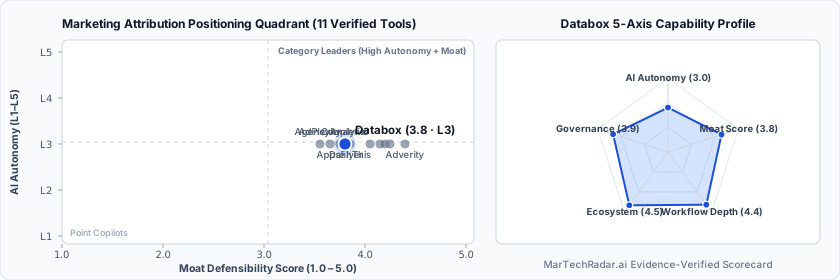
Databox is a Web SaaS tool for Marketing Attribution (Multi-Touch Attribution & eCommerce Dashboards) in Analytics & Attribution. Pricing: Free plan · $0/mo · Enterprise plan. Best suited to B2B SaaS. Editor ratings: AI autonomy L3 (conditional automation); moat score 3.8/5.0 (Proprietary moat). Fact-checked by Julie Brot on Oct 11, 2026.
Agentic business intelligence and performance dashboard platform automating cross-channel metric aggregation, automated reporting, and conversational.
Databox buyer fit verdict: when to choose vs. when to walk away
Choose Databox if (Best Fit)
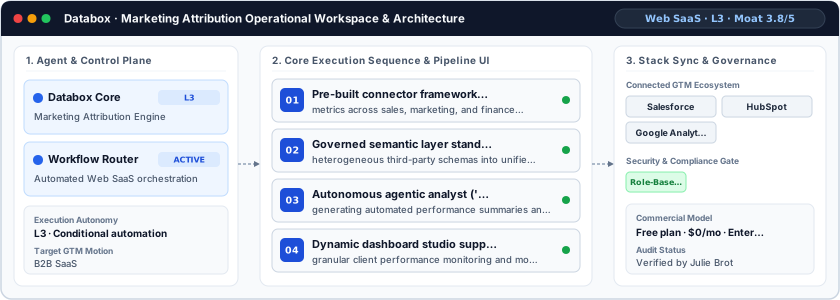
- Target ICP & Stack Fit: You operate as B2B SaaS requiring a Web SaaS deployment for Marketing Attribution, with verified ecosystem connectivity for Salesforce, HubSpot, Google Analytics 4 (GA4).
- L3 Architecture & Defensibility: Deep catalog of 100+ native business application connectors paired with a governed semantic layer and embedded agentic copilot ('Genie') delivering automated root-cause metric diagnostics.
- Commercial Model Fit: Your procurement budget aligns with Free plan · $0/mo · Enterprise plan and want a self-serve free tier for zero-cost initial validation.
Walk away from Databox if (Deal-Breakers)
- Walk away if your workflow requires uncapped enterprise volume on the Free plan · $0/mo · Enterprise plan entry plan without upgrading tiers.
- Walk away if your workflow cannot tolerate API sync frequency and granularity: Data synchronization is constrained by third-party API rate limits, restricting mid-tier pipelines to scheduled hourly polling rather than raw event streaming.
- Walk away if attribution modeling boundaries is a deal-breaker for your team: The engine aggregates top-level reporting metrics rather than running native deterministic or probabilistic multi-touch attribution on raw server-side log files.
Databox key facts & scorecard
| Pricing | Free plan · $0/mo · Enterprise planVendor pricing page |
|---|---|
| Free plan | Yes |
| Delivery | Web SaaS |
| Audience | B2B SaaS |
| AI autonomy level | L3 · Conditional automationEditor-verified |
| Moat tier & score | 3.8 / 5.0 · Proprietary moatEditor-verified |
| Funding | Venture-backed |
| Total funding | $4.8MBacked by Techstars, Founder Collective |
| Founders | Andrej Zitnik, Davorin Gabrovec, Vlada Petrovic |
| Company size | 51-200 employees |
| Ecosystem integrations | Salesforce, HubSpot, Google Analytics 4 (GA4) |
| Governance & docs | Trust & Security ↗ · System Status ↗ · API & Docs ↗ · Changelog ↗ · Terms ↗ · Privacy ↗ |
| Headquarters | Boston, Massachusetts |
| Founded | 2012 |
| Last verified |
Databox pros & cons: strengths vs. operational limitations
Pros: core strengths & capabilities
- Pre-built connector framework extracting: metrics across sales, marketing, and finance platforms
- Governed semantic layer standardizing: heterogeneous third-party schemas into unified KPIs
- Autonomous agentic analyst ('Genie'): generating automated performance summaries and queries
- Dynamic dashboard studio supporting: granular client performance monitoring and mobile alerting
Cons: operational limitations & risks
- API Sync Frequency and Granularity: Data synchronization is constrained by third-party API rate limits, restricting mid-tier pipelines to scheduled hourly polling rather than raw event streaming.
- Attribution Modeling Boundaries: The engine aggregates top-level reporting metrics rather than running native deterministic or probabilistic multi-touch attribution on raw server-side log files.
- Credit Throttling on Agentic Queries: Generative analytics workflows depend on monthly AI credit allocations, which stall automatic insight extraction during high-volume exploratory data auditing.
Databox TCO & deal-breaker stress test
Simulate 12-month stepped TCO, hidden cost multipliers, contract lock-in exposure, and stack failure modes using only facts verified by Julie Brot on · Capture SHA c9c5babc.
Databox is viable for 5 seats, but requires commercial or technical verification on the flagged items below.
| Plan / Tier | Verified Rate | Scale Fit | Scope & Quota Notes |
|---|---|---|---|
| Free / Sandbox | $0 | Unlimited seats (capped credits) | Entry free tier with capped usage or feature quotas for initial workflow testing. |
| Entry / Starter | $20/mo | Unlimited seats (Entry credits) | 1 account · 5 data sources · 50 AI credits/mo |
| Growth / Professional | $25/mo | Unlimited seats (Growth credits) | The Custom plan is for organizations that need more than software. We audit your setup, design |
| Enterprise / Custom | Custom quote | Unlimited seats (Enterprise SLA) | Sales-negotiated annual contract for custom volume, SSO/RBAC governance, and dedicated SLA. |
- Moat Score
- 3.8 / 5.0
- AI Autonomy
- L3
- Free Tier / Trial
- Free plan
Triggered audit signals & failure modes
- Opaque Enterprise Quoting vs. SMB/Mid-Market BudgetVerified Pricing Ledger
Databox does not disclose a public self-serve floor (Free plan · $0/mo · Enterprise plan). Buyers with a $800/mo cap face high sales-qualification friction.
- Published Self-Serve Entry FloorVerified Pricing Ledger
Databox publishes a transparent entry point (Free plan · $0/mo · Enterprise plan) with a free tier for initial validation before committing.
- Tier Fit for 5-Seat Scale: Entry / Starter ($20/mo)Verified Tier Schedule
1 account · 5 data sources · 50 AI credits/mo
- Primary Operational Bottleneck: API Sync Frequency and GranularityAudit by Julie Brot
Data synchronization is constrained by third-party API rate limits, restricting mid-tier pipelines to scheduled hourly polling rather than raw event streaming.
Hidden TCO Multipliers & Quota Gates
- Per-Seat Linear Scaling: Databox prices licenses on a per-user/seat basis (Free plan · $0/mo · Enterprise plan); expanding from 2 to 15+ operators multiplies base recurring spend linearly.
- Annual Billing Headline vs. Monthly Premium: Headline entry rates reflect annual billing commitments (Save 20%); month-to-month flexibility carries a higher effective monthly rate or requires annual prepayment.
- Credit & Usage Burn Multiplier: Automated workflows consume metered credits/usage quotas; multi-step enrichment, voice minutes, or high-frequency agent runs can trigger mid-cycle top-up packs.
When to Walk Away & Negotiation Levers
- Walk away if your workflow requires uncapped enterprise volume on the Free plan · $0/mo · Enterprise plan entry plan without upgrading tiers.
- Walk away if your workflow cannot tolerate API sync frequency and granularity: Data synchronization is constrained by third-party API rate limits, restricting mid-tier pipelines to scheduled hourly polling rather than raw event streaming.
- Walk away if attribution modeling boundaries is a deal-breaker for your team: The engine aggregates top-level reporting metrics rather than running native deterministic or probabilistic multi-touch attribution on raw server-side log files.
- Validate exact quota thresholds (seats, credits, or API calls) included in Databox's Free plan · $0/mo · Enterprise plan tier before converting from monthly to annual billing.
- Require a sandbox proof-of-concept testing API sync frequency and granularity against your live CRM/data schema before annual sign-off.
Ask a custom procurement or TCO stress-test question about Databox
Lower 5-seat floor (~$15/mo vs. Custom Quote)
Lower 5-seat floor (~$29/mo vs. Custom Quote)
Databox key entities, modules & ecosystem stack
Databox moat & subtrack positioning
Deep catalog of 100+ native business application connectors paired with a governed semantic layer and embedded agentic copilot ('Genie') delivering automated root-cause metric diagnostics.
Editorial review
Fact-checked by Julie Brot (Enterprise SaaS Governance & Procurement Editor) on .
Background
Architected as a centralized performance monitoring ecosystem, Databox bridges fragmented software stacks by aggregating disparate operational metrics into unified visualizations. Headquartered in Boston, Massachusetts, and founded in 2012, the firm raised $4.8M in venture funding to streamline analytics infrastructure for agency leaders and growth marketing operators. The system relieves technical teams from manual report generation by centralizing performance measurement across multi-channel customer journeys.
How Databox works
Databox deploys pre-configured API connectors that poll third-party platforms such as HubSpot, Salesforce, Google Analytics 4, and Stripe on scheduled intervals. Ingested payloads pass into a governed semantic layer that normalizes disparate time-series schemas into standardized key performance indicators. Layered on this infrastructure, Databox incorporates an agentic analytics engine named Genie, which interprets natural-language prompts, analyzes anomaly variance across revenue streams, and generates contextual performance briefs without requiring manual query construction.
Limitations
Operational considerations and platform boundaries include:
- API Sync Frequency and Granularity: Data synchronization is constrained by third-party API rate limits, restricting mid-tier pipelines to scheduled hourly polling rather than raw event streaming.
- Attribution Modeling Boundaries: The engine aggregates top-level reporting metrics rather than running native deterministic or probabilistic multi-touch attribution on raw server-side log files.
- Credit Throttling on Agentic Queries: Generative analytics workflows depend on monthly AI credit allocations, which stall automatic insight extraction during high-volume exploratory data auditing.
Databox pricing
Commercial access is organized via a multi-tiered subscription framework starting with a Free tier at $0 per month that supports one user, three data sources, and basic AI analyst credits. Commercial scaling begins with the paid Analyst tier billed at $71 per month for single users needing five data connections, while larger agency deployments scale into custom enterprise pricing tiers based on account volume and connector density.
How Databox compares
While mobile measurement platforms like Adjust and AppsFlyer specialize in deterministic SDK attribution and app install validation, Databox operates at the dashboard aggregation layer. Unlike enterprise data transformation engines like Adverity that handle complex ETL pipelines for enterprise warehouses, Databox delivers rapid out-of-the-box reporting for marketing service agencies and mid-market revenue teams seeking operational visibility without managing data engineering infrastructure.
Direct competitors & market radar
Top algorithmic competitors based on category positioning, capability overlap, and ICP alignment.
Frequently asked questions about Databox
How much does Databox cost and what pricing tiers are available?
Published pricing summary for Databox: Free plan · $0/mo · Enterprise plan. Databox includes a free tier or sandbox entry point. Verified tier schedule: Free / Sandbox ($0 for Unlimited seats (capped credits)); Entry / Starter ($20/mo for Unlimited seats (Entry credits)); Growth / Professional ($25/mo for Unlimited seats (Growth credits)); Enterprise / Custom (Custom quote for Unlimited seats (Enterprise SLA)). Commercial access is organized via a multi-tiered subscription framework starting with a Free tier at $0 per month that supports one user, three data sources, and basic AI analyst credits.
How does Databox work and how autonomous is its AI architecture?
Agentic business intelligence and performance dashboard platform automating cross-channel metric aggregation, automated reporting, and conversational. Within Marketing Attribution (Multi-Touch Attribution & eCommerce Dashboards), MarTechRadar rates its execution architecture at L3 · Conditional automation with a verified Moat Score of 3.8 / 5.0 (Proprietary moat). Deep catalog of 100+ native business application connectors paired with a governed semantic layer and embedded agentic copilot ('Genie') delivering automated root-cause metric diagnostics. Corporate profile: Founded by Andrej Zitnik, Davorin Gabrovec, Vlada Petrovic, operating at 51-200 employees scale.
What are the main limitations of Databox and when should buyers walk away?
Based on our editorial technical audit, key operational considerations and boundaries for Databox include: (1) API Sync Frequency and Granularity: Data synchronization is constrained by third-party API rate limits, restricting mid-tier pipelines to scheduled hourly polling rather than raw event streaming. (2) Attribution Modeling Boundaries: The engine aggregates top-level reporting metrics rather than running native deterministic or probabilistic multi-touch attribution on raw server-side log files. (3) Credit Throttling on Agentic Queries: Generative analytics workflows depend on monthly AI credit allocations, which stall automatic insight extraction during high-volume exploratory data auditing. Primary procurement walk-away rule: Walk away if your workflow requires uncapped enterprise volume on the Free plan · $0/mo · Enterprise plan entry plan without upgrading tiers.
What integrations, compliance certifications, and contract terms apply to Databox?
Verified ecosystem and stack integrations include Salesforce, HubSpot, Google Analytics 4 (GA4). First-party governance and developer endpoints verified on domain include: Trust/Security (https://trust.databox.com), Status (https://status.databox.com), API Docs (https://developers.databox.com). Key TCO multiplier to watch: Per-Seat Linear Scaling (Databox prices licenses on a per-user/seat basis (Free plan · $0/mo · Enterprise plan); expanding from 2 to 15+ operators multiplies base recurring spend linearly.) Before signing a contract, procurement teams should validate exact quota thresholds (seats, credits, or API calls) included in Databox's Free plan · $0/mo · Enterprise plan tier before converting from monthly to annual billing.
What are the best Databox alternatives and head-to-head competitors in 2026?
Top fact-checked alternatives to Databox in Marketing Attribution (Multi-Touch Attribution & eCommerce Dashboards) include Coupler.io (Free plan · $0/mo · Enterprise plan), DashThis (From $15/mo), Podscribe (From $1.05/mo), Shoplazza AI (From $29.25/mo). While mobile measurement platforms like Adjust and AppsFlyer specialize in deterministic SDK attribution and app install validation, Databox operates at the dashboard aggregation layer.
Verified sources & evidence trail
- Official product domain: https://databox.com
- Commercial pricing verification: https://databox.com/pricing
- Verified corporate entity profiles (
sameAs): LinkedIn Company Profile · Crunchbase Entity Record - First-party governance & documentation links: Trust & Security · System Status · API & Docs · Changelog · Terms · Privacy
- Editorial audit sign-off: Fact-checked by Julie Brot on under the MarTechRadar Evidence-Ledger Protocol.