AdScale Review (2026): DCO Pricing, Limits & Alternatives
Bottom line
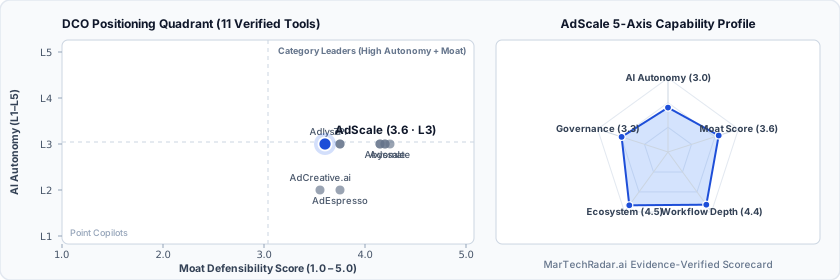
AdScale is a Web SaaS tool for DCO (Dynamic Creative Optimization / DCO) in AdTech & Paid Media. Pricing: From $169/mo. Best suited to DTC / eCommerce. Editor ratings: AI autonomy L3 (conditional automation); moat score 3.6/5.0 (Proprietary moat). Fact-checked by Vasilia Xia on Oct 14, 2026.
Autonomous e-commerce ad optimization engine that unifies Google and Meta campaign generation, budget allocation, and creative variation from catalog data.
AdScale buyer fit verdict: when to choose vs. when to walk away
Choose AdScale if (Best Fit)
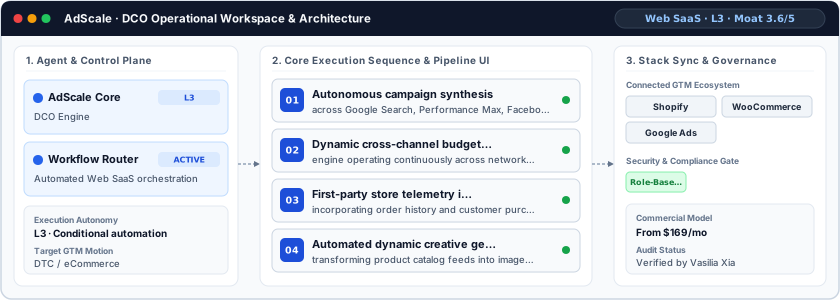
- Target ICP & Stack Fit: You operate as DTC / eCommerce requiring a Web SaaS deployment for DCO, with verified ecosystem connectivity for Shopify, WooCommerce, Google Ads.
- L3 Architecture & Defensibility: Proprietary cross-network bid allocation algorithms integrated directly into e-commerce store telemetry, coupling order-level data with autonomous multi-channel creative generation.
- Commercial Model Fit: Your procurement budget aligns with From $169/mo.
Walk away from AdScale if (Deal-Breakers)
- Walk away if your workflow requires uncapped enterprise volume on the From $169/mo entry plan without upgrading tiers.
- Walk away if your workflow cannot tolerate attribution signal drift: Discrepancies between browser-side tracking pixels and platform APIs can skew cross-network budget reallocations during volatile seasonal demand spikes.
- Walk away if creative homogenization is a deal-breaker for your team: Automated asset synthesis relies strictly on existing product feed metadata, yielding rigid template designs when raw product imagery lacks contextual styling.
AdScale key facts & scorecard
| Pricing | From $169/moVendor pricing page |
|---|---|
| Free plan | No / not disclosed |
| Delivery | Web SaaS |
| Audience | DTC / eCommerce |
| AI autonomy level | L3 · Conditional automationEditor-verified |
| Moat tier & score | 3.6 / 5.0 · Proprietary moatEditor-verified |
| Funding | Public company |
| Founders | Diederik Klaassen, Ron van der Lee |
| Company size | 11-50 employees |
| Ecosystem integrations | Shopify, WooCommerce, Google Ads |
| Governance & docs | Privacy ↗ |
| Headquarters | Manhattan New York, NY |
| Founded | 2016 |
| Last verified |
AdScale pros & cons: strengths vs. operational limitations
Pros: core strengths & capabilities
- Autonomous campaign synthesis: across Google Search, Performance Max, Facebook, and Instagram
- Dynamic cross-channel budget allocation: engine operating continuously across network boundaries
- First-party store telemetry ingestion: incorporating order history and customer purchase cycles
- Automated dynamic creative generation: transforming product catalog feeds into image and video assets
Cons: operational limitations & risks
- Attribution Signal Drift: Discrepancies between browser-side tracking pixels and platform APIs can skew cross-network budget reallocations during volatile seasonal demand spikes.
- Creative Homogenization: Automated asset synthesis relies strictly on existing product feed metadata, yielding rigid template designs when raw product imagery lacks contextual styling.
- Catalog Schema Dependency: Unstructured feed parameters or missing inventory variants can trigger broken dynamic ads or cause out-of-stock product promotions before sync cycles finish.
AdScale TCO & deal-breaker stress test
Simulate 12-month stepped TCO, hidden cost multipliers, contract lock-in exposure, and stack failure modes using only facts verified by Vasilia Xia on · Capture SHA 3f73489b.
AdScale aligns with your 5-seat / $800/mo profile. Review the walk-away triggers and contract levers below before deployment.
| Plan / Tier | Verified Rate | Scale Fit | Scope & Quota Notes |
|---|---|---|---|
| Business | $169/mo | 1–2 seats | From early stage to industry leaders |
- Moat Score
- 3.6 / 5.0
- AI Autonomy
- L3
- Free Tier / Trial
- None disclosed
Triggered audit signals & failure modes
- Published Self-Serve Entry FloorVerified Pricing Ledger
AdScale publishes a transparent entry point (From $169/mo) for initial validation before committing.
- Primary Operational Bottleneck: Attribution Signal DriftAudit by Vasilia Xia
Discrepancies between browser-side tracking pixels and platform APIs can skew cross-network budget reallocations during volatile seasonal demand spikes.
Hidden TCO Multipliers & Quota Gates
- Attribution Signal Drift: Discrepancies between browser-side tracking pixels and platform APIs can skew cross-network budget reallocations during volatile seasonal demand spikes.
- Creative Homogenization: Automated asset synthesis relies strictly on existing product feed metadata, yielding rigid template designs when raw product imagery lacks contextual styling.
When to Walk Away & Negotiation Levers
- Walk away if your workflow requires uncapped enterprise volume on the From $169/mo entry plan without upgrading tiers.
- Walk away if your workflow cannot tolerate attribution signal drift: Discrepancies between browser-side tracking pixels and platform APIs can skew cross-network budget reallocations during volatile seasonal demand spikes.
- Walk away if creative homogenization is a deal-breaker for your team: Automated asset synthesis relies strictly on existing product feed metadata, yielding rigid template designs when raw product imagery lacks contextual styling.
- Validate exact quota thresholds (seats, credits, or API calls) included in AdScale's From $169/mo tier before converting from monthly to annual billing.
- Require a sandbox proof-of-concept testing attribution signal drift against your live CRM/data schema before annual sign-off.
Ask a custom procurement or TCO stress-test question about AdScale
Lower 5-seat floor (~$39/mo vs. From $169 / mo)
Lower 5-seat floor (~$125/mo vs. From $169 / mo)
AdScale key entities, modules & ecosystem stack
AdScale moat & subtrack positioning
Proprietary cross-network bid allocation algorithms integrated directly into e-commerce store telemetry, coupling order-level data with autonomous multi-channel creative generation.
Editorial review
Fact-checked by Vasilia Xia (E-Commerce, Lifecycle & Retention Marketing Analyst) on .
Background
Headquartered in Manhattan New York, NY, AdScale develops algorithmic advertising infrastructure designed to automate multi-channel paid acquisition for e-commerce brands. The platform targets online retailers seeking to unify creative execution and performance management across search and social channels without retaining manual media-buying teams. Operating within the dynamic creative optimization and autonomous ad management space, AdScale treats store catalogs, customer transaction histories, and real-time ad performance data as direct inputs for algorithmic campaign assembly.
How AdScale works
AdScale operates as an L3 conditional automation framework bridging store platforms like Shopify or WooCommerce with the Meta and Google Ads APIs. The ingestion pipeline extracts first-party customer records, repurchase cadence metrics, average order value, and inventory levels. An internal rules-and-optimization layer synthesizes target audiences, sets bidding parameters, and generates image or video creatives dynamically from catalog metadata. The engine reallocates budget shares between Google Performance Max and Meta placements based on cross-network attribution feedback without requiring manual bid adjustments.
Limitations
Operational considerations and platform boundaries include:
- Attribution Signal Drift: Discrepancies between browser-side tracking pixels and platform APIs can skew cross-network budget reallocations during volatile seasonal demand spikes.
- Creative Homogenization: Automated asset synthesis relies strictly on existing product feed metadata, yielding rigid template designs when raw product imagery lacks contextual styling.
- Catalog Schema Dependency: Unstructured feed parameters or missing inventory variants can trigger broken dynamic ads or cause out-of-stock product promotions before sync cycles finish.
AdScale pricing
AdScale enforces a tiered subscription model indexed to total monthly advertising spend, beginning at $169/month for accounts deploying up to $1000 in spend. Upgraded tiers unlock expanded optimization capabilities, cross-network tracking limits, and advanced attribution modules as transaction volumes increase across connected retail channels.
How AdScale compares
In the DCO landscape, compared to creative-focused rendering suites like Abyssale and AdCreative.ai, AdScale integrates creative generation directly with bi-directional bid execution and budget distribution. While 7Pi and AdCreative.ai prioritize ad design iterations and copy variations, AdScale targets end-to-end media automation, shifting ad spend programmatically based on real-time margin thresholds. Consequently, AdScale is best suited for direct-to-consumer storefronts needing hands-off campaign governance across Google and Meta rather than design-intensive enterprise creative production teams.
Direct competitors & market radar
Top algorithmic competitors based on category positioning, capability overlap, and ICP alignment.
Frequently asked questions about AdScale
How much does AdScale cost and what pricing tiers are available?
Published pricing summary for AdScale: From $169/mo. A permanent free plan is not disclosed for AdScale. AdScale enforces a tiered subscription model indexed to total monthly advertising spend, beginning at $169/month for accounts deploying up to $1000 in spend.
How does AdScale work and how autonomous is its AI architecture?
Autonomous e-commerce ad optimization engine that unifies Google and Meta campaign generation, budget allocation, and creative variation from catalog data. Within DCO (Dynamic Creative Optimization / DCO), MarTechRadar rates its execution architecture at L3 · Conditional automation with a verified Moat Score of 3.6 / 5.0 (Proprietary moat). Proprietary cross-network bid allocation algorithms integrated directly into e-commerce store telemetry, coupling order-level data with autonomous multi-channel creative generation. Corporate profile: Founded by Diederik Klaassen, Ron van der Lee, operating at 11-50 employees scale.
What are the main limitations of AdScale and when should buyers walk away?
Based on our editorial technical audit, key operational considerations and boundaries for AdScale include: (1) Attribution Signal Drift: Discrepancies between browser-side tracking pixels and platform APIs can skew cross-network budget reallocations during volatile seasonal demand spikes. (2) Creative Homogenization: Automated asset synthesis relies strictly on existing product feed metadata, yielding rigid template designs when raw product imagery lacks contextual styling. (3) Catalog Schema Dependency: Unstructured feed parameters or missing inventory variants can trigger broken dynamic ads or cause out-of-stock product promotions before sync cycles finish. Primary procurement walk-away rule: Walk away if your workflow requires uncapped enterprise volume on the From $169/mo entry plan without upgrading tiers.
What integrations, compliance certifications, and contract terms apply to AdScale?
Verified ecosystem and stack integrations include Shopify, WooCommerce, Google Ads. Key TCO multiplier to watch: Attribution Signal Drift (Discrepancies between browser-side tracking pixels and platform APIs can skew cross-network budget reallocations during volatile seasonal demand spikes.) Before signing a contract, procurement teams should validate exact quota thresholds (seats, credits, or API calls) included in AdScale's From $169/mo tier before converting from monthly to annual billing.
What are the best AdScale alternatives and head-to-head competitors in 2026?
Top fact-checked alternatives to AdScale in DCO (Dynamic Creative Optimization / DCO) include Metric (Custom / enterprise pricing), Advolve AI (Custom / enterprise pricing), Topsort (Custom / enterprise pricing), Playad.ai (From $39/mo). In the DCO landscape, compared to creative-focused rendering suites like Abyssale and AdCreative.ai, AdScale integrates creative generation directly with bi-directional bid execution and budget distribution.
Verified sources & evidence trail
- Official product domain: https://adscale.com
- Commercial pricing verification: https://adscale.com/pricing/
- Verified corporate entity profiles (
sameAs): LinkedIn Company Profile · Crunchbase Entity Record - First-party governance & documentation links: Privacy
- Editorial audit sign-off: Fact-checked by Vasilia Xia on under the MarTechRadar Evidence-Ledger Protocol.