Skai Review (2026): DCO Pricing, Limits & Alternatives
Bottom line
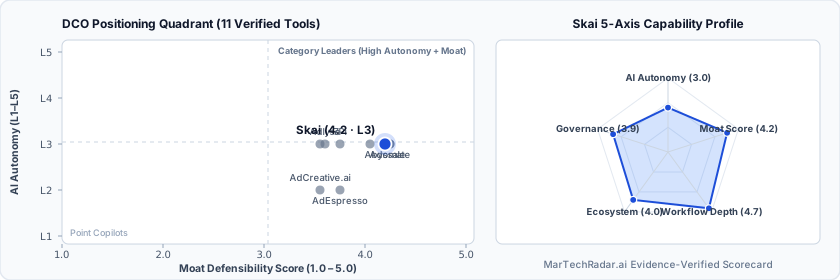
Skai is a Web SaaS tool for DCO (Dynamic Creative Optimization / DCO) in AdTech & Paid Media. Pricing: From $0/mo. Best suited to DTC / eCommerce and Enterprise Brands. Editor ratings: AI autonomy L3 (conditional automation); moat score 4.2/5.0 (Proprietary moat). Fact-checked by Sarah Per on Oct 12, 2026.
Agent-native omnichannel marketing platform unifying media execution, dynamic creative asset management, and retail media telemetry across enterprise ad.
Skai buyer fit verdict: when to choose vs. when to walk away
Choose Skai if (Best Fit)
- Target ICP & Stack Fit: You operate as DTC / eCommerce and Enterprise Brands requiring a Web SaaS deployment for DCO, with verified ecosystem connectivity for Google Ads, Amazon Ads.
- L3 Architecture & Defensibility: Deep bi-directional API integrations across major retail media networks combined with an agentic Model Context Protocol (MCP) data architecture and proprietary algorithmic bidding infrastructure.
- Commercial Model Fit: Your procurement budget aligns with From $0/mo.
Walk away from Skai if (Deal-Breakers)
- Walk away if your workflow requires uncapped enterprise volume on the From $0/mo entry plan without upgrading tiers.
- Walk away if your workflow cannot tolerate API rate limiting & network latency: Bid modifications and creative deployments are bounded by external retail media network rate limits, preventing instant real-time synchronization during rapid intraday inventory shifts.
- Walk away if autonomous agent boundary drift is a deal-breaker for your team: Agentic executions through Celeste AI require strict rule bounds; unexpected inventory stockouts can misalign automated spend shifts if catalog feeds experience ingestion delays.
Skai key facts & scorecard
| Pricing | From $0/moVendor pricing page |
|---|---|
| Free plan | No / not disclosed |
| Delivery | Web SaaS |
| Audience | DTC / eCommerce, Enterprise Brands |
| AI autonomy level | L3 · Conditional automationEditor-verified |
| Moat tier & score | 4.2 / 5.0 · Proprietary moatEditor-verified |
| Funding | Venture-backed |
| Total funding | $59MBacked by Sequoia Capital, Bain Capital Ventures, Wavecrest Growth Partners, Sequoia Capital Israel, Arts Alliance |
| Founders | Alon Sheafer, Amos Talmor, Nir Cohen, Yoav Izhar-Prato |
| Company size | 501-1,000 employees |
| Ecosystem integrations | Google Ads, Amazon Ads |
| Governance & docs | Privacy ↗ |
| Headquarters | San Francisco, CA |
| Founded | 2006 |
| Last verified |
Skai pros & cons: strengths vs. operational limitations
Pros: core strengths & capabilities
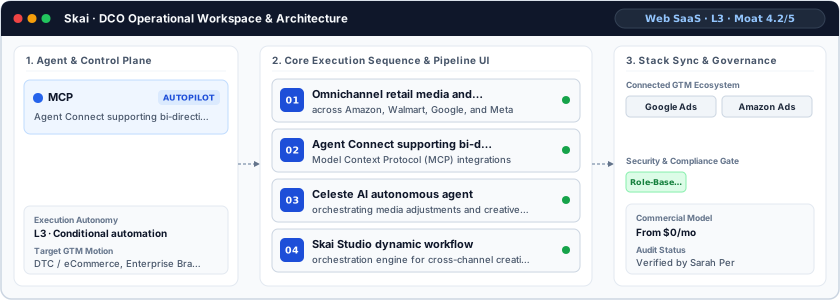
- Omnichannel retail media and search management: across Amazon, Walmart, Google, and Meta
- Agent Connect supporting bi-directional: Model Context Protocol (MCP) integrations
- Celeste AI autonomous agent: orchestrating media adjustments and creative allocation
- Skai Studio dynamic workflow: orchestration engine for cross-channel creative automation
Cons: operational limitations & risks
- API Rate Limiting & Network Latency: Bid modifications and creative deployments are bounded by external retail media network rate limits, preventing instant real-time synchronization during rapid intraday inventory shifts.
- Autonomous Agent Boundary Drift: Agentic executions through Celeste AI require strict rule bounds; unexpected inventory stockouts can misalign automated spend shifts if catalog feeds experience ingestion delays.
- Custom Creative Template Rigidity: While dynamic variations scale efficiently across supported retail networks, non-standard creative schemas demand manual mapping and recurring pipeline recalibration.
Skai TCO & deal-breaker stress test
Simulate 12-month stepped TCO, hidden cost multipliers, contract lock-in exposure, and stack failure modes using only facts verified by Sarah Per on · Capture SHA bc0926f0.
Skai is viable for 5 seats, but requires commercial or technical verification on the flagged items below.
| Plan / Tier | Verified Rate | Scale Fit | Scope & Quota Notes |
|---|---|---|---|
| Entry / Starter | $2/mo | 1–2 seats | Verified $2/mo published rate on vendor pricing schedule. |
| Growth / Professional | $4/mo | 5 seats | Verified $4/mo published rate on vendor pricing schedule. |
| Scale / Advanced | $10/mo | 15 seats | Verified $10/mo published rate on vendor pricing schedule. |
- Moat Score
- 4.2 / 5.0
- AI Autonomy
- L3
- Free Tier / Trial
- None disclosed
Triggered audit signals & failure modes
- Opaque Enterprise Quoting vs. SMB/Mid-Market BudgetVerified Pricing Ledger
Skai does not disclose a public self-serve floor (From $0/mo). Buyers with a $800/mo cap face high sales-qualification friction.
- Published Self-Serve Entry FloorVerified Pricing Ledger
Skai publishes a transparent entry point (From $0/mo) for initial validation before committing.
- Tier Fit for 5-Seat Scale: Entry / Starter ($2/mo)Verified Tier Schedule
Verified $2/mo published rate on vendor pricing schedule.
- Primary Operational Bottleneck: API Rate Limiting & Network LatencyAudit by Sarah Per
Bid modifications and creative deployments are bounded by external retail media network rate limits, preventing instant real-time synchronization during rapid intraday inventory shifts.
Hidden TCO Multipliers & Quota Gates
- API Rate Limiting & Network Latency: Bid modifications and creative deployments are bounded by external retail media network rate limits, preventing instant real-time synchronization during rapid intraday inventory shifts.
- Autonomous Agent Boundary Drift: Agentic executions through Celeste AI require strict rule bounds; unexpected inventory stockouts can misalign automated spend shifts if catalog feeds experience ingestion delays.
When to Walk Away & Negotiation Levers
- Walk away if your workflow requires uncapped enterprise volume on the From $0/mo entry plan without upgrading tiers.
- Walk away if your workflow cannot tolerate API rate limiting & network latency: Bid modifications and creative deployments are bounded by external retail media network rate limits, preventing instant real-time synchronization during rapid intraday inventory shifts.
- Walk away if autonomous agent boundary drift is a deal-breaker for your team: Agentic executions through Celeste AI require strict rule bounds; unexpected inventory stockouts can misalign automated spend shifts if catalog feeds experience ingestion delays.
- Validate exact quota thresholds (seats, credits, or API calls) included in Skai's From $0/mo tier before converting from monthly to annual billing.
- Require a sandbox proof-of-concept testing API rate limiting & network latency against your live CRM/data schema before annual sign-off.
Ask a custom procurement or TCO stress-test question about Skai
Lower 5-seat floor (~$500/mo vs. Custom Quote)
Lower 5-seat floor (~$500/mo vs. Custom Quote)
Skai key entities, modules & ecosystem stack
Agent Connect supporting bi-directional Model Context Protocol integrations
Skai moat & subtrack positioning
Deep bi-directional API integrations across major retail media networks combined with an agentic Model Context Protocol (MCP) data architecture and proprietary algorithmic bidding infrastructure.
Editorial review
Fact-checked by Sarah Per (Principal Content Systems & Generative Media Editor) on .
Background
Established in San Francisco, CA, Skai was founded in 2006 (originally launched as Kenshoo) and has secured $59M in institutional capital. The platform is designed for enterprise performance directors and agency programmatic leads who oversee high-volume omnichannel ad spend across retail media networks, search, and paid social channels.
How Skai works
Skai functions at Level 3 autonomy by pairing programmatic API connectors with Celeste AI, its agentic intelligence layer. The ingestion engine ingests telemetry across publisher endpoints—including Amazon Ads, Walmart Connect, and Google Ads—normalizing conversion signals, digital shelf metrics, and inventory counts. Media buyers build dynamic creative workflows inside Skai Studio or leverage Agent Connect via the Model Context Protocol (MCP), enabling external agents to execute real-time bidding rules and creative reallocations against changing commercial demand.
Limitations
Operational considerations and platform boundaries include:
- API Rate Limiting & Network Latency: Bid modifications and creative deployments are bounded by external retail media network rate limits, preventing instant real-time synchronization during rapid intraday inventory shifts.
- Autonomous Agent Boundary Drift: Agentic executions through Celeste AI require strict rule bounds; unexpected inventory stockouts can misalign automated spend shifts if catalog feeds experience ingestion delays.
- Custom Creative Template Rigidity: While dynamic variations scale efficiently across supported retail networks, non-standard creative schemas demand manual mapping and recurring pipeline recalibration.
Skai pricing
Skai delivers modular enterprise contracts calibrated against managed advertising volume, alongside tiered product access starting from $0 for baseline evaluation tiers. Custom programmatic agreements incorporate enterprise-grade service level agreements, dedicated MCP connector seats, and data pipeline throughput fees.
How Skai compares
While competitors like Abyssale and AdCreative.ai concentrate on template-level graphic automation and banner generation, Skai links creative orchestration directly to retail media bidding engines. 7Pi focuses on algorithmic search bids, whereas Skai unifies retail digital shelf telemetry, agentic MCP protocols, and multi-channel creative distribution. The platform serves multinational consumer brands and large agencies demanding deep cross-retailer automated campaign execution. Enterprise procurement teams evaluating deployment readiness should assess API webhook throughput, role-based access governance, and bilateral data synchronization latency against existing marketing technology infrastructure before committing to multi-year production rollouts.
Direct competitors & market radar
Top algorithmic competitors based on category positioning, capability overlap, and ICP alignment.
Frequently asked questions about Skai
How much does Skai cost and what pricing tiers are available?
Published pricing summary for Skai: From $0/mo. A permanent free plan is not disclosed for Skai. Verified tier schedule: Entry / Starter ($2/mo for 1–2 seats); Growth / Professional ($4/mo for 5 seats); Scale / Advanced ($10/mo for 15 seats). Skai delivers modular enterprise contracts calibrated against managed advertising volume, alongside tiered product access starting from $0 for baseline evaluation tiers.
How does Skai work and how autonomous is its AI architecture?
Agent-native omnichannel marketing platform unifying media execution, dynamic creative asset management, and retail media telemetry across enterprise ad. Within DCO (Dynamic Creative Optimization / DCO), MarTechRadar rates its execution architecture at L3 · Conditional automation with a verified Moat Score of 4.2 / 5.0 (Proprietary moat). Deep bi-directional API integrations across major retail media networks combined with an agentic Model Context Protocol (MCP) data architecture and proprietary algorithmic bidding infrastructure. Corporate profile: Founded by Alon Sheafer, Amos Talmor, Nir Cohen, Yoav Izhar-Prato, operating at 501-1,000 employees scale.
What are the main limitations of Skai and when should buyers walk away?
Based on our editorial technical audit, key operational considerations and boundaries for Skai include: (1) API Rate Limiting & Network Latency: Bid modifications and creative deployments are bounded by external retail media network rate limits, preventing instant real-time synchronization during rapid intraday inventory shifts. (2) Autonomous Agent Boundary Drift: Agentic executions through Celeste AI require strict rule bounds; unexpected inventory stockouts can misalign automated spend shifts if catalog feeds experience ingestion delays. (3) Custom Creative Template Rigidity: While dynamic variations scale efficiently across supported retail networks, non-standard creative schemas demand manual mapping and recurring pipeline recalibration. Primary procurement walk-away rule: Walk away if your workflow requires uncapped enterprise volume on the From $0/mo entry plan without upgrading tiers.
What integrations, compliance certifications, and contract terms apply to Skai?
Verified ecosystem and stack integrations include Google Ads, Amazon Ads. Key TCO multiplier to watch: API Rate Limiting & Network Latency (Bid modifications and creative deployments are bounded by external retail media network rate limits, preventing instant real-time synchronization during rapid intraday inventory shifts.) Before signing a contract, procurement teams should validate exact quota thresholds (seats, credits, or API calls) included in Skai's From $0/mo tier before converting from monthly to annual billing.
What are the best Skai alternatives and head-to-head competitors in 2026?
Top fact-checked alternatives to Skai in DCO (Dynamic Creative Optimization / DCO) include AdsGency AI (Free plan · $0/mo · Enterprise plan), Pepr AI (Custom / enterprise pricing), Massive Dynamic (Custom / enterprise pricing), Adriel (From $500/mo). While competitors like Abyssale and AdCreative.ai concentrate on template-level graphic automation and banner generation, Skai links creative orchestration directly to retail media bidding engines. 7Pi focuses on algorithmic search bids, whereas Skai unifies retail digital shelf telemetry, agentic MCP protocols, and multi-channel creative distribution.
Verified sources & evidence trail
- Official product domain: https://skai.io
- Commercial pricing verification: https://skai.io/pricing/
- Verified corporate entity profiles (
sameAs): LinkedIn Company Profile · Crunchbase Entity Record - First-party governance & documentation links: Privacy
- Editorial audit sign-off: Fact-checked by Sarah Per on under the MarTechRadar Evidence-Ledger Protocol.