Marin Software Review (2026): AI PPC Pricing, Limits & Alternatives
Bottom line
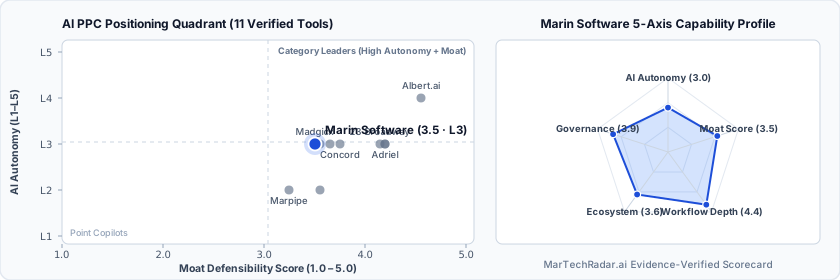
Marin Software is a Web SaaS tool for AI PPC (Autonomous Bidding & Budget Management) in AdTech & Paid Media. Pricing: From $500/mo. Best suited to DTC / eCommerce and Enterprise Brands. Editor ratings: AI autonomy L3 (conditional automation); moat score 3.5/5.0 (Proprietary moat). Fact-checked by Sarah Per on Oct 12, 2026.
Cross-channel paid media optimization platform orchestrating multi-publisher bidding, budget pacing, and conversion attribution.
Marin Software buyer fit verdict: when to choose vs. when to walk away
Choose Marin Software if (Best Fit)
- Target ICP & Stack Fit: You operate as DTC / eCommerce and Enterprise Brands requiring a Web SaaS deployment for AI PPC, with verified ecosystem connectivity for Google Ads.
- L3 Architecture & Defensibility: Moat rests on deep historical publisher API integrations, cross-channel bidding algorithms, and two decades of enterprise search telemetry.
- Commercial Model Fit: Your procurement budget aligns with From $500/mo.
Walk away from Marin Software if (Deal-Breakers)
- Walk away if your team is at early validation stage with a <$250/mo tool budget (Marin Software starts at From $500/mo before seat or usage expansion).
- Walk away if your workflow cannot tolerate publisher API latency: Bid modifications and budget updates remain subject to asynchronous third-party processing queues, introducing execution lag during volatile inventory auctions.
- Walk away if conversion attribution drift is a deal-breaker for your team: Discrepancies frequently emerge between platform-modeled attribution and publisher-reported conversions due to browser privacy frameworks and signal loss.
Marin Software key facts & scorecard
| Pricing | From $500/moVendor pricing page |
|---|---|
| Free plan | No / not disclosed |
| Delivery | Web SaaS |
| Audience | DTC / eCommerce, Enterprise Brands |
| AI autonomy level | L3 · Conditional automationEditor-verified |
| Moat tier & score | 3.5 / 5.0 · Proprietary moatEditor-verified |
| Funding | Public company |
| Total funding | $99.4M |
| Founders | Christopher Lien, Joseph Chang, Wister Walcott |
| Company size | 201-500 employees |
| Ecosystem integrations | Google Ads |
| Governance & docs | DPA ↗ · Terms ↗ · Privacy ↗ |
| Headquarters | St Louis, Missouri |
| Founded | 2006 |
| Last verified |
Marin Software pros & cons: strengths vs. operational limitations
Pros: core strengths & capabilities
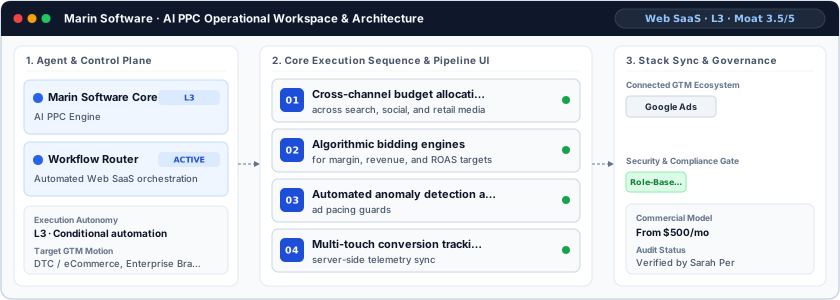
- Cross-channel budget allocation: across search, social, and retail media
- Algorithmic bidding engines: for margin, revenue, and ROAS targets
- Automated anomaly detection and: ad pacing guards
- Multi-touch conversion tracking and: server-side telemetry sync
Cons: operational limitations & risks
- Publisher API Latency: Bid modifications and budget updates remain subject to asynchronous third-party processing queues, introducing execution lag during volatile inventory auctions.
- Conversion Attribution Drift: Discrepancies frequently emerge between platform-modeled attribution and publisher-reported conversions due to browser privacy frameworks and signal loss.
- Algorithmic Cold-Start Friction: Bidding models require dense statistical conversion volume per ad group, leading to sub-optimal pacing across low-spend accounts or niche segments.
Marin Software TCO & deal-breaker stress test
Simulate 12-month stepped TCO, hidden cost multipliers, contract lock-in exposure, and stack failure modes using only facts verified by Sarah Per on · Capture SHA 6de4ce41.
Marin Software aligns with your 5-seat / $800/mo profile. Review the walk-away triggers and contract levers below before deployment.
| Plan / Tier | Verified Rate | Scale Fit | Scope & Quota Notes |
|---|---|---|---|
| Entry / Starter | $500/mo | 1–2 seats | Verified $500/mo tier from vendor pricing schedule. |
- Moat Score
- 3.5 / 5.0
- AI Autonomy
- L3
- Free Tier / Trial
- None disclosed
Triggered audit signals & failure modes
- Published Self-Serve Entry FloorVerified Pricing Ledger
Marin Software publishes a transparent entry point (From $500/mo) for initial validation before committing.
- Primary Operational Bottleneck: Publisher API LatencyAudit by Sarah Per
Bid modifications and budget updates remain subject to asynchronous third-party processing queues, introducing execution lag during volatile inventory auctions.
Hidden TCO Multipliers & Quota Gates
- Enterprise Governance & Add-On Gating: Advanced capabilities such as Single Sign-On (SSO), custom role permissions, or specialized analytics modules are gated behind upper tiers or paid add-ons.
- Publisher API Latency: Bid modifications and budget updates remain subject to asynchronous third-party processing queues, introducing execution lag during volatile inventory auctions.
- Conversion Attribution Drift: Discrepancies frequently emerge between platform-modeled attribution and publisher-reported conversions due to browser privacy frameworks and signal loss.
When to Walk Away & Negotiation Levers
- Walk away if your team is at early validation stage with a <$250/mo tool budget (Marin Software starts at From $500/mo before seat or usage expansion).
- Walk away if your workflow cannot tolerate publisher API latency: Bid modifications and budget updates remain subject to asynchronous third-party processing queues, introducing execution lag during volatile inventory auctions.
- Walk away if conversion attribution drift is a deal-breaker for your team: Discrepancies frequently emerge between platform-modeled attribution and publisher-reported conversions due to browser privacy frameworks and signal loss.
- Negotiate price-lock protection on additional seats and overage credits above the From $500/mo entry tier.
- Require a sandbox proof-of-concept testing publisher API latency against your live CRM/data schema before annual sign-off.
Ask a custom procurement or TCO stress-test question about Marin Software
Lower 5-seat floor (~$49/mo vs. From $500 / mo)
Lower 5-seat floor (~$199/mo vs. From $500 / mo)
Marin Software key entities, modules & ecosystem stack
Marin Software moat & subtrack positioning
Moat rests on deep historical publisher API integrations, cross-channel bidding algorithms, and two decades of enterprise search telemetry.
Editorial review
Fact-checked by Sarah Per (Principal Content Systems & Generative Media Editor) on .
Background
With $99.4M in total funding raised prior to its acquisition by Zax Capital, Marin Software was founded in 2006 in St Louis, Missouri. Designed for performance marketing directors and enterprise growth leaders, the platform standardizes media orchestration across paid search, paid social, and retail digital networks. Rather than managing isolated network dashboards, acquisition teams utilize the system as a centralized control plane for cross-publisher telemetry, pacing controls, and campaign performance forecasting.
How Marin Software works
Operating at an L3 autonomy profile, Marin Software ingests bid logs, conversion tracking signals, and spend telemetry via recurring publisher API connections from providers like Google Ads, Microsoft Advertising, Meta, and Amazon. Ingested events resolve into a normalized time-series data warehouse. Predictive budget algorithms evaluate continuous conversion rates, generating dynamic bid updates and pacing reallocations that dispatch back to publisher endpoints through programmatic API executions.
Limitations
Operational considerations and platform boundaries include:
- Publisher API Latency: Bid modifications and budget updates remain subject to asynchronous third-party processing queues, introducing execution lag during volatile inventory auctions.
- Conversion Attribution Drift: Discrepancies frequently emerge between platform-modeled attribution and publisher-reported conversions due to browser privacy frameworks and signal loss.
- Algorithmic Cold-Start Friction: Bidding models require dense statistical conversion volume per ad group, leading to sub-optimal pacing across low-spend accounts or niche segments.
Marin Software pricing
Marin Software structures its commercial tiering through indexed monthly subscriptions, entering the market from $500 per month on entry commitments. Platform licensing scales upward across broader organizational footprints based on connected advertising channels, contract duration terms, historical data backfill capacity, and managed media spend thresholds. Multi-channel deployment packages require annual commitments alongside upfront technical onboarding agreements.
How Marin Software compares
Relative to black-box platforms like Albert.ai, Marin Software offers programmatic rule inspection and manual oversight, whereas Albert.ai prioritizes autonomous creative and campaign generation. Compared to Adriel's focus on lightweight visual dashboards, Marin provides deep algorithmic bid dispatching. Against 23 Broadway, it targets complex multi-publisher enterprise environments rather than single-channel execution, proving most effective for mid-market and enterprise teams managing substantial multi-network portfolios.
Direct competitors & market radar
Top algorithmic competitors based on category positioning, capability overlap, and ICP alignment.
Frequently asked questions about Marin Software
How much does Marin Software cost and what pricing tiers are available?
Published pricing summary for Marin Software: From $500/mo. A permanent free plan is not disclosed for Marin Software. Marin Software structures its commercial tiering through indexed monthly subscriptions, entering the market from $500 per month on entry commitments.
How does Marin Software work and how autonomous is its AI architecture?
Cross-channel paid media optimization platform orchestrating multi-publisher bidding, budget pacing, and conversion attribution. Within AI PPC (Autonomous Bidding & Budget Management), MarTechRadar rates its execution architecture at L3 · Conditional automation with a verified Moat Score of 3.5 / 5.0 (Proprietary moat). Moat rests on deep historical publisher API integrations, cross-channel bidding algorithms, and two decades of enterprise search telemetry. Corporate profile: Founded by Christopher Lien, Joseph Chang, Wister Walcott, operating at 201-500 employees scale.
What are the main limitations of Marin Software and when should buyers walk away?
Based on our editorial technical audit, key operational considerations and boundaries for Marin Software include: (1) Publisher API Latency: Bid modifications and budget updates remain subject to asynchronous third-party processing queues, introducing execution lag during volatile inventory auctions. (2) Conversion Attribution Drift: Discrepancies frequently emerge between platform-modeled attribution and publisher-reported conversions due to browser privacy frameworks and signal loss. (3) Algorithmic Cold-Start Friction: Bidding models require dense statistical conversion volume per ad group, leading to sub-optimal pacing across low-spend accounts or niche segments. Primary procurement walk-away rule: Walk away if your team is at early validation stage with a <$250/mo tool budget (Marin Software starts at From $500/mo before seat or usage expansion).
What integrations, compliance certifications, and contract terms apply to Marin Software?
Verified ecosystem and stack integrations include Google Ads. First-party governance and developer endpoints verified on domain include: DPA (https://www.marinsoftware.com/legal/data-processing-addendum). Key TCO multiplier to watch: Enterprise Governance & Add-On Gating (Advanced capabilities such as Single Sign-On (SSO), custom role permissions, or specialized analytics modules are gated behind upper tiers or paid add-ons.) Before signing a contract, procurement teams should negotiate price-lock protection on additional seats and overage credits above the From $500/mo entry tier.
What are the best Marin Software alternatives and head-to-head competitors in 2026?
Top fact-checked alternatives to Marin Software in AI PPC (Autonomous Bidding & Budget Management) include Pepr AI (Custom / enterprise pricing), Adriel (From $500/mo), Madgicx (From $49/mo), Skai (From $0/mo). Relative to black-box platforms like Albert.ai, Marin Software offers programmatic rule inspection and manual oversight, whereas Albert.ai prioritizes autonomous creative and campaign generation. Compared to Adriel's focus on lightweight visual dashboards, Marin provides deep algorithmic bid dispatching.
Verified sources & evidence trail
- Official product domain: https://marinsoftware.com
- Commercial pricing verification: https://www.marinsoftware.com/pricing
- Verified corporate entity profiles (
sameAs): LinkedIn Company Profile · Crunchbase Entity Record - First-party governance & documentation links: DPA · Terms · Privacy
- Editorial audit sign-off: Fact-checked by Sarah Per on under the MarTechRadar Evidence-Ledger Protocol.