Marpipe Review (2026): AI PPC Pricing, Limits & Alternatives
Bottom line
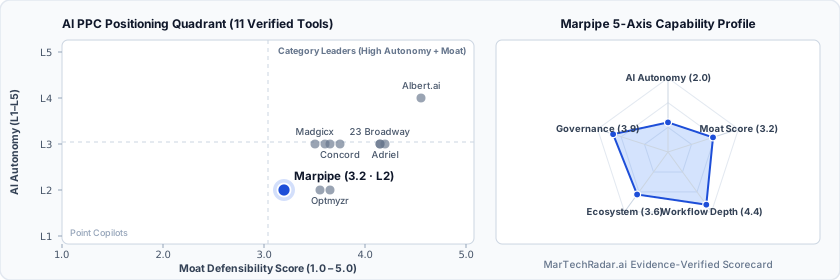
Marpipe is a Web SaaS tool for AI PPC (Autonomous Bidding & Budget Management) in AdTech & Paid Media. Pricing: Free plan · $199–$999/mo. Best suited to DTC / eCommerce. Editor ratings: AI autonomy L2 (workflow copilot); moat score 3.2/5.0 (Workflow-embedded (strong)). Fact-checked by Anna Xia on Oct 12, 2026.
Creative automation and feed management platform transforming e-commerce product catalogs into dynamic visual ad assets for paid social campaigns.
Marpipe buyer fit verdict: when to choose vs. when to walk away
Choose Marpipe if (Best Fit)
- Target ICP & Stack Fit: You operate as DTC / eCommerce requiring a Web SaaS deployment for AI PPC, with verified ecosystem connectivity for Meta Ads.
- L2 Architecture & Defensibility: Proprietary product-level creative rendering pipeline integrated with Meta catalog architecture, enabling granular dynamic visual transformation and automated underperforming SKU exclusion directly from raw product feeds.
- Commercial Model Fit: Your procurement budget aligns with Free plan · $199–$999/mo and want a self-serve free tier for zero-cost initial validation.
Walk away from Marpipe if (Deal-Breakers)
- Walk away if your workflow requires uncapped enterprise volume on the Free plan · $199–$999/mo entry plan without upgrading tiers.
- Walk away if your workflow cannot tolerate feed synchronization latency: High-frequency catalog updates can suffer from ingestion delays, causing cached creative variations to display out-of-stock items or outdated pricing before sync cycles complete.
- Walk away if platform coupling is a deal-breaker for your team: The automation architecture is heavily indexed toward Meta catalog infrastructure, constraining performance parity and feature availability when deployed on secondary channels.
Marpipe key facts & scorecard
| Pricing | Free plan · $199–$999/moVendor pricing page |
|---|---|
| Free plan | Yes |
| Delivery | Web SaaS |
| Audience | DTC / eCommerce |
| AI autonomy level | L2 · Workflow copilotEditor-verified |
| Moat tier & score | 3.2 / 5.0 · Workflow-embedded (strong)Editor-verified |
| Funding | Series A |
| Total funding | $10.9MBacked by Stage 2 Capital, Adobe |
| Founders | Dan Pantelo |
| Company size | 11-50 employees |
| Ecosystem integrations | Meta Ads |
| Governance & docs | Trust & Security ↗ · Privacy ↗ |
| Headquarters | New York |
| Founded | 2019 |
| Last verified |
Marpipe pros & cons: strengths vs. operational limitations
Pros: core strengths & capabilities
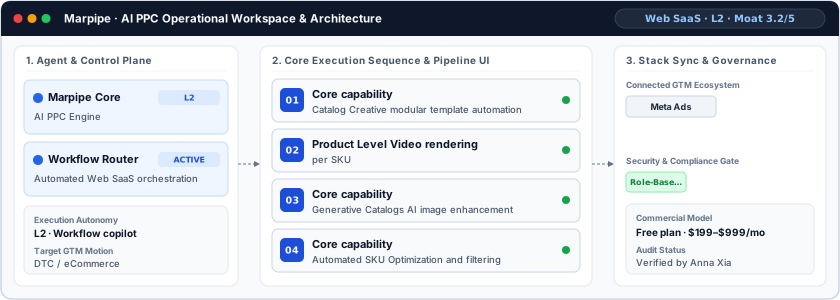
- Core capability: Catalog Creative modular template automation
- Product Level Video rendering: per SKU
- Core capability: Generative Catalogs AI image enhancement
- Core capability: Automated SKU Optimization and filtering
Cons: operational limitations & risks
- Feed Synchronization Latency: High-frequency catalog updates can suffer from ingestion delays, causing cached creative variations to display out-of-stock items or outdated pricing before sync cycles complete.
- Platform Coupling: The automation architecture is heavily indexed toward Meta catalog infrastructure, constraining performance parity and feature availability when deployed on secondary channels.
- Template Render Constrains: Algorithmic layout generation occasionally produces visual clipping or poor contrast on non-standard product aspect ratios, necessitating manual template rule maintenance.
Marpipe TCO & deal-breaker stress test
Simulate 12-month stepped TCO, hidden cost multipliers, contract lock-in exposure, and stack failure modes using only facts verified by Anna Xia on · Capture SHA 6d5cc593.
Marpipe aligns with your 5-seat / $800/mo profile. Review the walk-away triggers and contract levers below before deployment.
| Plan / Tier | Verified Rate | Scale Fit | Scope & Quota Notes |
|---|---|---|---|
| Free / Sandbox | $0 | Unlimited seats (capped credits) | Entry free tier with capped usage or feature quotas for initial workflow testing. |
| Launch | $199/mo | Unlimited seats (Entry credits) | [ START FREE ] |
| Unlimited | $299/mo | Unlimited seats (Growth credits) | Unlimited team members |
| Scale / Advanced | $400/mo | Unlimited seats (Scale credits) | Done-for-you by our dedicated Feed Experts. |
- Moat Score
- 3.2 / 5.0
- AI Autonomy
- L2
- Free Tier / Trial
- Free plan
Triggered audit signals & failure modes
- Published Self-Serve Entry FloorVerified Pricing Ledger
Marpipe publishes a transparent entry point (Free plan · $199–$999/mo) with a free tier for initial validation before committing.
- Tier Fit for 5-Seat Scale: Unlimited ($299/mo)Verified Tier Schedule
Unlimited team members
- Primary Operational Bottleneck: Feed Synchronization LatencyAudit by Anna Xia
High-frequency catalog updates can suffer from ingestion delays, causing cached creative variations to display out-of-stock items or outdated pricing before sync cycles complete.
Hidden TCO Multipliers & Quota Gates
- Enterprise Governance & Add-On Gating: Advanced capabilities such as Single Sign-On (SSO), custom role permissions, or specialized analytics modules are gated behind upper tiers or paid add-ons.
- Feed Synchronization Latency: High-frequency catalog updates can suffer from ingestion delays, causing cached creative variations to display out-of-stock items or outdated pricing before sync cycles complete.
- Platform Coupling: The automation architecture is heavily indexed toward Meta catalog infrastructure, constraining performance parity and feature availability when deployed on secondary channels.
When to Walk Away & Negotiation Levers
- Walk away if your workflow requires uncapped enterprise volume on the Free plan · $199–$999/mo entry plan without upgrading tiers.
- Walk away if your workflow cannot tolerate feed synchronization latency: High-frequency catalog updates can suffer from ingestion delays, causing cached creative variations to display out-of-stock items or outdated pricing before sync cycles complete.
- Walk away if platform coupling is a deal-breaker for your team: The automation architecture is heavily indexed toward Meta catalog infrastructure, constraining performance parity and feature availability when deployed on secondary channels.
- Validate exact quota thresholds (seats, credits, or API calls) included in Marpipe's Free plan · $199–$999/mo tier before converting from monthly to annual billing.
- Require a sandbox proof-of-concept testing feed synchronization latency against your live CRM/data schema before annual sign-off.
Ask a custom procurement or TCO stress-test question about Marpipe
Fits within $800/mo budget (From $499/mo · Enterprise plan)
Fits within $800/mo budget (From $500/mo)
Marpipe key entities, modules & ecosystem stack
Marpipe moat & subtrack positioning
Proprietary product-level creative rendering pipeline integrated with Meta catalog architecture, enabling granular dynamic visual transformation and automated underperforming SKU exclusion directly from raw product feeds.
Editorial review
Fact-checked by Anna Xia (Senior B2B GTM & Revenue Systems Analyst) on .
Background
Performance marketing teams managing extensive e-commerce catalogs regularly encounter creative fatigue and poor click-through rates from generic dynamic product ads. Established in 2019 in New York with $10.9M in venture funding, Marpipe addresses this challenge by converting raw inventory data into structured, automated ad creative. The platform serves growth marketing leaders and performance creative teams who require algorithmic control over high-volume product catalogs across paid social channels.
How Marpipe works
Marpipe operates as an L2 autonomous creative automation engine. The pipeline ingests merchant feeds via standard protocols, normalizes SKU metadata, and decouples creative templates into discrete layers such as dynamic overlays, typography, and badges. Its rendering framework programmatically compiles static and video assets per product, applying generative AI models directly to catalog imagery. It pushes updated creative bundles to Meta Ads Manager while continuously monitoring SKU-level conversions to automatically filter underperforming inventory from active delivery.
Limitations
Operational considerations and platform boundaries include:
- Feed Synchronization Latency: High-frequency catalog updates can suffer from ingestion delays, causing cached creative variations to display out-of-stock items or outdated pricing before sync cycles complete.
- Platform Coupling: The automation architecture is heavily indexed toward Meta catalog infrastructure, constraining performance parity and feature availability when deployed on secondary channels.
- Template Render Constrains: Algorithmic layout generation occasionally produces visual clipping or poor contrast on non-standard product aspect ratios, necessitating manual template rule maintenance.
Marpipe pricing
Marpipe distributes its software via a tiered subscription model structured around catalog size, rendering bandwidth, and feed management utilities. Paid tiers range from $199 to $999 per month, scaling alongside dynamic creative volume and active SKU thresholds. A free plan provides access to diagnostic utilities, including the feed auditor, allowing teams to evaluate catalog hygiene prior to provisioning paid automation tiers.
How Marpipe compares
Within algorithmic ad management, Marpipe differentiates itself by focusing on creative feed transformation rather than pure programmatic bidding. While Albert.ai delivers autonomous budget allocation across multi-channel campaigns, it treats ad assets as static inputs. Adriel centralizes cross-channel dashboard analytics and bid governance without native SKU-level rendering engines. Conversely, 23 Broadway targets bid execution rather than visual asset generation. Marpipe is best suited for direct-to-consumer retailers requiring deep creative modularity on catalog ads.
Direct competitors & market radar
Top algorithmic competitors based on category positioning, capability overlap, and ICP alignment.
Frequently asked questions about Marpipe
How much does Marpipe cost and what pricing tiers are available?
Published pricing summary for Marpipe: Free plan · $199–$999/mo. Marpipe includes a free tier or sandbox entry point. Verified tier schedule: Free / Sandbox ($0 for Unlimited seats (capped credits)); Launch ($199/mo for Unlimited seats (Entry credits)); Unlimited ($299/mo for Unlimited seats (Growth credits)); Scale / Advanced ($400/mo for Unlimited seats (Scale credits)). Marpipe distributes its software via a tiered subscription model structured around catalog size, rendering bandwidth, and feed management utilities. Paid tiers range from $199 to $999 per month, scaling alongside dynamic creative volume and active SKU thresholds.
How does Marpipe work and how autonomous is its AI architecture?
Creative automation and feed management platform transforming e-commerce product catalogs into dynamic visual ad assets for paid social campaigns. Within AI PPC (Autonomous Bidding & Budget Management), MarTechRadar rates its execution architecture at L2 · Workflow copilot with a verified Moat Score of 3.2 / 5.0 (Workflow-embedded (strong)). Proprietary product-level creative rendering pipeline integrated with Meta catalog architecture, enabling granular dynamic visual transformation and automated underperforming SKU exclusion directly from raw product feeds. Corporate profile: Founded by Dan Pantelo, operating at 11-50 employees scale.
What are the main limitations of Marpipe and when should buyers walk away?
Based on our editorial technical audit, key operational considerations and boundaries for Marpipe include: (1) Feed Synchronization Latency: High-frequency catalog updates can suffer from ingestion delays, causing cached creative variations to display out-of-stock items or outdated pricing before sync cycles complete. (2) Platform Coupling: The automation architecture is heavily indexed toward Meta catalog infrastructure, constraining performance parity and feature availability when deployed on secondary channels. (3) Template Render Constrains: Algorithmic layout generation occasionally produces visual clipping or poor contrast on non-standard product aspect ratios, necessitating manual template rule maintenance. Primary procurement walk-away rule: Walk away if your workflow requires uncapped enterprise volume on the Free plan · $199–$999/mo entry plan without upgrading tiers.
What integrations, compliance certifications, and contract terms apply to Marpipe?
Verified ecosystem and stack integrations include Meta Ads. First-party governance and developer endpoints verified on domain include: Trust/Security (https://trust.marpipe.com). Key TCO multiplier to watch: Enterprise Governance & Add-On Gating (Advanced capabilities such as Single Sign-On (SSO), custom role permissions, or specialized analytics modules are gated behind upper tiers or paid add-ons.) Before signing a contract, procurement teams should validate exact quota thresholds (seats, credits, or API calls) included in Marpipe's Free plan · $199–$999/mo tier before converting from monthly to annual billing.
What are the best Marpipe alternatives and head-to-head competitors in 2026?
Top fact-checked alternatives to Marpipe in AI PPC (Autonomous Bidding & Budget Management) include Uplane (Custom / enterprise pricing), Marin Software (From $500/mo), Alison.ai (Custom / enterprise pricing), Adle (From $499/mo · Enterprise plan). Within algorithmic ad management, Marpipe differentiates itself by focusing on creative feed transformation rather than pure programmatic bidding. While Albert.ai delivers autonomous budget allocation across multi-channel campaigns, it treats ad assets as static inputs.
Verified sources & evidence trail
- Official product domain: https://marpipe.com
- Commercial pricing verification: https://www.marpipe.com/pricing
- Verified corporate entity profiles (
sameAs): LinkedIn Company Profile · Crunchbase Entity Record - First-party governance & documentation links: Trust & Security · Privacy
- Editorial audit sign-off: Fact-checked by Anna Xia on under the MarTechRadar Evidence-Ledger Protocol.