Albert.ai Review (2026): AI PPC Pricing, Limits & Alternatives
Bottom line
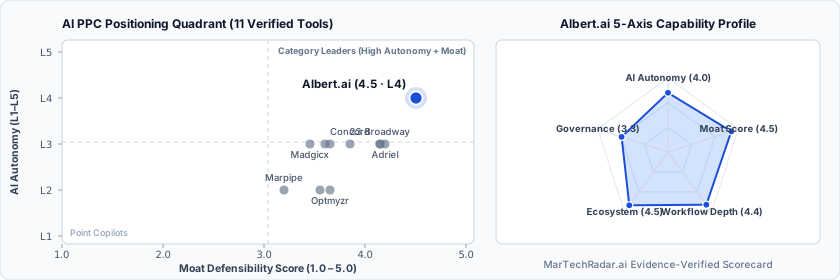
Albert.ai is a Web SaaS tool for AI PPC (Autonomous Bidding & Budget Management) in AdTech & Paid Media. Pricing: Custom / enterprise pricing. Best suited to DTC / eCommerce and Enterprise Brands. Editor ratings: AI autonomy L4 (autonomous agent); moat score 4.5/5.0 (Proprietary moat (category leader)). Fact-checked by Jiacky Lee on Oct 6, 2026.
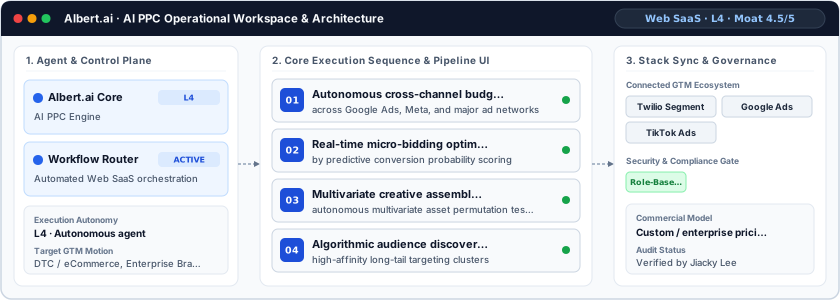
Autonomous digital marketing engine executing cross-channel programmatic bidding, budget allocation, and creative testing without human intervention.
Albert.ai buyer fit verdict: when to choose vs. when to walk away
Choose Albert.ai if (Best Fit)
- Target ICP & Stack Fit: You operate as DTC / eCommerce and Enterprise Brands requiring a Web SaaS deployment for AI PPC, with verified ecosystem connectivity for Twilio Segment, Google Ads, TikTok Ads.
- L4 Architecture & Defensibility: Deep algorithmic bidding pipeline built on proprietary heuristic feedback loops and decade-long historical performance datasets across paid search and social channels.
- Commercial Model Fit: Your procurement budget aligns with Custom / enterprise pricing.
Walk away from Albert.ai if (Deal-Breakers)
- Walk away if you require transparent self-serve monthly billing or your budget ceiling is under $1,000/mo (Albert.ai requires sales-gated custom quoting).
- Walk away if your workflow cannot tolerate data volume dependency: The autonomous decision engine requires substantial conversion volume to train its statistical models, leading to algorithmic stagnation when running low-volume or niche B2B campaigns.
- Walk away if ad network API latency is a deal-breaker for your team: Cross-channel budget reallocations remain constrained by third-party ad network reporting delays and rate limits, introducing execution lag during volatile intraday auctions.
Albert.ai key facts & scorecard
| Pricing | Custom / enterprise pricing |
|---|---|
| Free plan | No / not disclosed |
| Delivery | Web SaaS |
| Audience | DTC / eCommerce, Enterprise Brands |
| AI autonomy level | L4 · Autonomous agentEditor-verified |
| Moat tier & score | 4.5 / 5.0 · Proprietary moat (category leader)Editor-verified |
| Funding | AcquiredAcquired by Zoomd |
| Total funding | AcquiredBacked by Zoomd Technologies (acquirer, 2022) |
| Founders | Or Shani |
| Company size | 51-200 employees |
| Ecosystem integrations | Twilio Segment, Google Ads, TikTok Ads |
| Governance & docs | Privacy ↗ |
| Headquarters | New York, United States |
| Founded | 2010 |
| Last verified |
Albert.ai pros & cons: strengths vs. operational limitations
Pros: core strengths & capabilities
- Autonomous cross-channel budget shifts: across Google Ads, Meta, and major ad networks
- Real-time micro-bidding optimization driven: by predictive conversion probability scoring
- Multivariate creative assembly and: autonomous multivariate asset permutation testing
- Algorithmic audience discovery uncovering: high-affinity long-tail targeting clusters
Cons: operational limitations & risks
- Data Volume Dependency: The autonomous decision engine requires substantial conversion volume to train its statistical models, leading to algorithmic stagnation when running low-volume or niche B2B campaigns.
- Ad Network API Latency: Cross-channel budget reallocations remain constrained by third-party ad network reporting delays and rate limits, introducing execution lag during volatile intraday auctions.
- Algorithmic Black-Box Tradeoffs: Manual override controls are restricted, limiting the ability of media planners to force spend into specific exploratory segments during rapid brand repositioning efforts.
Albert.ai TCO & deal-breaker stress test
Simulate 12-month stepped TCO, hidden cost multipliers, contract lock-in exposure, and stack failure modes using only facts verified by Jiacky Lee on · Capture SHA 35bd0b24.
Albert.ai triggers high-severity friction under your 5-seat / $800/mo constraints. Benchmark the verified subtrack alternatives below before committing.
| Plan / Tier | Verified Rate | Scale Fit | Scope & Quota Notes |
|---|---|---|---|
| Enterprise / Custom | Custom quote | 15–50+ seats (Enterprise SLA) | Sales-negotiated annual contract for custom volume, SSO/RBAC governance, and dedicated SLA. |
- Moat Score
- 4.5 / 5.0
- AI Autonomy
- L4
- Free Tier / Trial
- None disclosed
Triggered audit signals & failure modes
- Opaque Enterprise Quoting vs. SMB/Mid-Market BudgetVerified Pricing Ledger
Albert.ai does not disclose a public self-serve floor (Custom / enterprise pricing). Buyers with a $800/mo cap face high sales-qualification friction.
- Sales-Gated Contract TermsFact-checked by Jiacky Lee
Commercial pricing is available on request through tailored enterprise sales quotes based on organizational scale and seats. Contracts reflect aggregate media management volume and deployment requirements rather than off-the-shelf subscriptions.
- Primary Operational Bottleneck: Ad Network API LatencyAudit by Jiacky Lee
Cross-channel budget reallocations remain constrained by third-party ad network reporting delays and rate limits, introducing execution lag during volatile intraday auctions.
Hidden TCO Multipliers & Quota Gates
- Data Volume Dependency: The autonomous decision engine requires substantial conversion volume to train its statistical models, leading to algorithmic stagnation when running low-volume or niche B2B campaigns.
- Ad Network API Latency: Cross-channel budget reallocations remain constrained by third-party ad network reporting delays and rate limits, introducing execution lag during volatile intraday auctions.
When to Walk Away & Negotiation Levers
- Walk away if you require transparent self-serve monthly billing or your budget ceiling is under $1,000/mo (Albert.ai requires sales-gated custom quoting).
- Walk away if your workflow cannot tolerate data volume dependency: The autonomous decision engine requires substantial conversion volume to train its statistical models, leading to algorithmic stagnation when running low-volume or niche B2B campaigns.
- Walk away if ad network API latency is a deal-breaker for your team: Cross-channel budget reallocations remain constrained by third-party ad network reporting delays and rate limits, introducing execution lag during volatile intraday auctions.
- Demand a 30- to 60-day paid pilot opt-out clause in the Albert.ai order form before signing a 12-month enterprise commitment.
- Require a sandbox proof-of-concept testing data volume dependency against your live CRM/data schema before annual sign-off.
Ask a custom procurement or TCO stress-test question about Albert.ai
Lower 5-seat floor (~$500/mo vs. Custom Quote) · Transparent self-serve entry without mandatory annual lock-in
Lower 5-seat floor (~$49/mo vs. Custom Quote) · Transparent self-serve entry without mandatory annual lock-in
Albert.ai key entities, modules & ecosystem stack
Albert.ai moat & subtrack positioning
Deep algorithmic bidding pipeline built on proprietary heuristic feedback loops and decade-long historical performance datasets across paid search and social channels.
Editorial review
Fact-checked by Jiacky Lee (Managing Editor, AI Autonomy & Moat Methodology) on .
Background
Headquartered in New York, United States, and founded in 2010, Albert.ai addresses the operational friction of manual media execution across paid search, programmatic display, and social channels. Following its acquisition by Zoomd Technologies, the platform targets performance marketing directors and enterprise growth teams tasked with optimizing multi-channel media portfolios. Positioned within autonomous bidding and budget management, Albert.ai replaces manual spreadsheet pacing with an algorithmic system executing real-time allocation decisions across disjointed ad networks.
How Albert.ai works
Albert.ai functions as an execution engine that operates at high operational autonomy across connected ad platforms. Users establish baseline target return on ad spend, input multivariate creative assets, and configure overall expenditure ceilings. The ingestion layer processes clickstream, conversion telemetry, and impression logs via direct ad-network application programming interfaces. Algorithmic micro-bidding loops calculate conversion probabilities for audience micro-segments, executing autonomous intraday budget shifts and bid modifications across channels like Google and Meta without requiring human approval cycles, alongside native workflow integrations for TikTok Ads and Zoho CRM.
Limitations
Operational considerations and platform boundaries include:
- Data Volume Dependency: The autonomous decision engine requires substantial conversion volume to train its statistical models, leading to algorithmic stagnation when running low-volume or niche B2B campaigns.
- Ad Network API Latency: Cross-channel budget reallocations remain constrained by third-party ad network reporting delays and rate limits, introducing execution lag during volatile intraday auctions.
- Algorithmic Black-Box Tradeoffs: Manual override controls are restricted, limiting the ability of media planners to force spend into specific exploratory segments during rapid brand repositioning efforts.
Albert.ai pricing
Commercial pricing is available on request through tailored enterprise sales quotes based on organizational scale and seats. Contracts reflect aggregate media management volume and deployment requirements rather than off-the-shelf subscriptions. Standard agreements incorporate technical onboarding, integration provisioning across enterprise ad accounts, and dedicated technical account management.
How Albert.ai compares
Albert.ai competes against platforms like Adriel, Smartly.io, and Concord within the autonomous campaign infrastructure space within the AI PPC segment. While Adriel focuses heavily on dashboard consolidation and human-in-the-loop marketing operations, Albert.ai prioritizes automated execution by removing manual bid configuration entirely. Concord and Smartly.io provide targeted workflow automations, whereas Albert.ai emphasizes end-to-end algorithmic media planning. The platform best fits enterprise consumer brands spending significant capital across fragmented channels that seek to eliminate manual media trading overhead.
Direct competitors & market radar
Top algorithmic competitors based on category positioning, capability overlap, and ICP alignment.
Frequently asked questions about Albert.ai
How much does Albert.ai cost and does it require a custom enterprise quote?
Published pricing summary for Albert.ai: Custom / enterprise pricing. A permanent free plan is not disclosed for Albert.ai. Commercial pricing is available on request through tailored enterprise sales quotes based on organizational scale and seats. Contracts reflect aggregate media management volume and deployment requirements rather than off-the-shelf subscriptions.
How does Albert.ai work and how autonomous is its AI architecture?
Autonomous digital marketing engine executing cross-channel programmatic bidding, budget allocation, and creative testing without human intervention. Within AI PPC (Autonomous Bidding & Budget Management), MarTechRadar rates its execution architecture at L4 · Autonomous agent with a verified Moat Score of 4.5 / 5.0 (Proprietary moat (category leader)). Deep algorithmic bidding pipeline built on proprietary heuristic feedback loops and decade-long historical performance datasets across paid search and social channels. Corporate profile: Founded by Or Shani, operating at 51-200 employees scale, acquired by Zoomd.
What are the main limitations of Albert.ai and when should buyers walk away?
Based on our editorial technical audit, key operational considerations and boundaries for Albert.ai include: (1) Data Volume Dependency: The autonomous decision engine requires substantial conversion volume to train its statistical models, leading to algorithmic stagnation when running low-volume or niche B2B campaigns. (2) Ad Network API Latency: Cross-channel budget reallocations remain constrained by third-party ad network reporting delays and rate limits, introducing execution lag during volatile intraday auctions. (3) Algorithmic Black-Box Tradeoffs: Manual override controls are restricted, limiting the ability of media planners to force spend into specific exploratory segments during rapid brand repositioning efforts. Primary procurement walk-away rule: Walk away if you require transparent self-serve monthly billing or your budget ceiling is under $1,000/mo (Albert.ai requires sales-gated custom quoting).
What integrations, compliance certifications, and contract terms apply to Albert.ai?
Verified ecosystem and stack integrations include Twilio Segment, Google Ads, TikTok Ads. Key TCO multiplier to watch: Data Volume Dependency (The autonomous decision engine requires substantial conversion volume to train its statistical models, leading to algorithmic stagnation when running low-volume or niche B2B campaigns.) Before signing a contract, procurement teams should demand a 30- to 60-day paid pilot opt-out clause in the Albert.ai order form before signing a 12-month enterprise commitment.
What are the best Albert.ai alternatives and head-to-head competitors in 2026?
Top fact-checked alternatives to Albert.ai in AI PPC (Autonomous Bidding & Budget Management) include Pixis (Custom / enterprise pricing), Smartly.io (Custom / enterprise pricing), MAI Agents (Free plan · $0/mo · Enterprise plan), Adriel (From $500/mo). Albert.ai competes against platforms like Adriel, Smartly.io, and Concord within the autonomous campaign infrastructure space within the AI PPC segment.
Verified sources & evidence trail
- Official product domain: https://albert.ai
- Commercial pricing verification: Verified against official vendor pricing policy (Custom / enterprise pricing)
- Verified corporate entity profiles (
sameAs): LinkedIn Company Profile · Crunchbase Entity Record - First-party governance & documentation links: Privacy
- Editorial audit sign-off: Fact-checked by Jiacky Lee on under the MarTechRadar Evidence-Ledger Protocol.