Pixis Review (2026): DCO Pricing, Limits & Alternatives
Bottom line
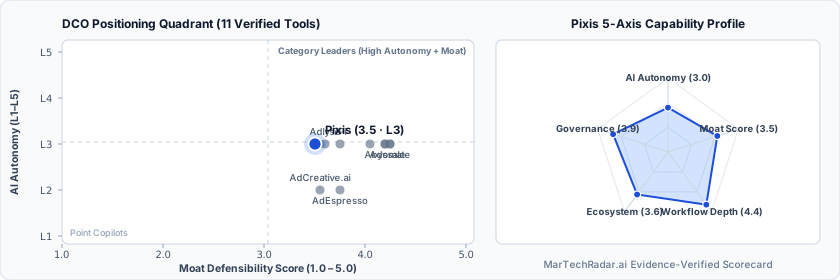
Pixis is a Web SaaS tool for DCO (Dynamic Creative Optimization / DCO) in AdTech & Paid Media. Pricing: Custom / enterprise pricing. Best suited to Performance Marketing Directors, Ad Agencies and Retail Media Advertisers. Editor ratings: AI autonomy L3 (conditional automation); moat score 3.5/5.0 (Proprietary moat). Fact-checked by Jiacky Lee on Oct 10, 2026.
AI-powered creative optimization and performance advertising platform automating cross-channel asset iteration, bid management, and targeting adjustments.
Pixis buyer fit verdict: when to choose vs. when to walk away
Choose Pixis if (Best Fit)
- Target ICP & Stack Fit: You operate as Performance Marketing Directors, Ad Agencies and Retail Media Advertisers requiring a Web SaaS deployment for DCO, with verified ecosystem connectivity for Google Ads.
- L3 Architecture & Defensibility: Pixis secures defensibility through closed-loop optimization systems pairing automated creative rendering with real-time bidding feedback, underpinned by substantial institutional venture capitalization and deep programmatic channel APIs.
- Commercial Model Fit: Your procurement budget aligns with Custom / enterprise pricing.
Walk away from Pixis if (Deal-Breakers)
- Walk away if you require transparent self-serve monthly billing or your budget ceiling is under $1,000/mo (Pixis requires sales-gated custom quoting).
- Walk away if your workflow cannot tolerate attribution signal latency: The autonomous optimization pipeline depends heavily on clean conversion data feeds, meaning delayed postback reporting or server-side tracking gaps cause misallocated budget pacing across emerging creative variants.
- Walk away if ad network API rate limits is a deal-breaker for your team: Generating and deploying hundreds of micro-variations simultaneously exposes teams to programmatic ad network query throttling and delayed approval moderation windows across social ad networks.
Pixis key facts & scorecard
| Pricing | Custom / enterprise pricing |
|---|---|
| Free plan | No / not disclosed |
| Delivery | Web SaaS |
| Audience | Performance Marketing Directors, Ad Agencies, Retail Media Advertisers |
| AI autonomy level | L3 · Conditional automationEditor-verified |
| Moat tier & score | 3.5 / 5.0 · Proprietary moatEditor-verified |
| Funding | Series C+ |
| Total funding | $209MBacked by General Atlantic, Chiratae Ventures, SoftBank Vision Fund |
| Founders | Harikrishna Valiyath, Shubham A Mishra, Vrushali Prasade |
| Company size | 201-500 employees |
| Ecosystem integrations | Google Ads |
| Governance & docs | Trust & Security ↗ · Privacy ↗ |
| Headquarters | New York |
| Founded | 2018 |
| Last verified |
Pixis pros & cons: strengths vs. operational limitations
Pros: core strengths & capabilities
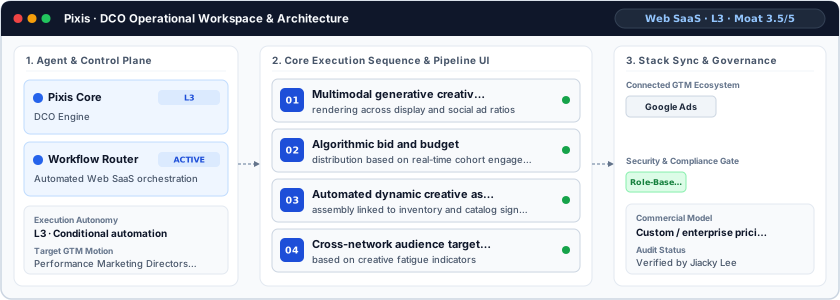
- Multimodal generative creative variant: rendering across display and social ad ratios
- Algorithmic bid and budget: distribution based on real-time cohort engagement metrics
- Automated dynamic creative asset: assembly linked to inventory and catalog signals
- Cross-network audience targeting adjustments: based on creative fatigue indicators
Cons: operational limitations & risks
- Attribution Signal Latency: The autonomous optimization pipeline depends heavily on clean conversion data feeds, meaning delayed postback reporting or server-side tracking gaps cause misallocated budget pacing across emerging creative variants.
- Ad Network API Rate Limits: Generating and deploying hundreds of micro-variations simultaneously exposes teams to programmatic ad network query throttling and delayed approval moderation windows across social ad networks.
- Brand Governance Schema Overhead: Automated variant assembly requires rigorous upfront parameter configuration to prevent algorithmic hallucinations or off-guideline font, color, and copy pairings in high-visibility enterprise placements.
Pixis TCO & deal-breaker stress test
Simulate 12-month stepped TCO, hidden cost multipliers, contract lock-in exposure, and stack failure modes using only facts verified by Jiacky Lee on · Capture SHA e3b0c442.
Pixis triggers high-severity friction under your 5-seat / $800/mo constraints. Benchmark the verified subtrack alternatives below before committing.
| Plan / Tier | Verified Rate | Scale Fit | Scope & Quota Notes |
|---|---|---|---|
| Enterprise / Custom | Custom quote | 15–50+ seats (Enterprise SLA) | Sales-negotiated annual contract for custom volume, SSO/RBAC governance, and dedicated SLA. |
- Moat Score
- 3.5 / 5.0
- AI Autonomy
- L3
- Free Tier / Trial
- None disclosed
Triggered audit signals & failure modes
- Opaque Enterprise Quoting vs. SMB/Mid-Market BudgetVerified Pricing Ledger
Pixis does not disclose a public self-serve floor (Custom / enterprise pricing). Buyers with a $800/mo cap face high sales-qualification friction.
- Sales-Gated Contract TermsFact-checked by Jiacky Lee
Commercial pricing is available on request through tailored enterprise sales quotes based on organizational scale and seats. Contracts are structured around tracked media volume, connected channels, and compute consumption for automated generative rendering.
- Primary Operational Bottleneck: Attribution Signal LatencyAudit by Jiacky Lee
The autonomous optimization pipeline depends heavily on clean conversion data feeds, meaning delayed postback reporting or server-side tracking gaps cause misallocated budget pacing across emerging creative variants.
Hidden TCO Multipliers & Quota Gates
- Attribution Signal Latency: The autonomous optimization pipeline depends heavily on clean conversion data feeds, meaning delayed postback reporting or server-side tracking gaps cause misallocated budget pacing across emerging creative variants.
- Ad Network API Rate Limits: Generating and deploying hundreds of micro-variations simultaneously exposes teams to programmatic ad network query throttling and delayed approval moderation windows across social ad networks.
When to Walk Away & Negotiation Levers
- Walk away if you require transparent self-serve monthly billing or your budget ceiling is under $1,000/mo (Pixis requires sales-gated custom quoting).
- Walk away if your workflow cannot tolerate attribution signal latency: The autonomous optimization pipeline depends heavily on clean conversion data feeds, meaning delayed postback reporting or server-side tracking gaps cause misallocated budget pacing across emerging creative variants.
- Walk away if ad network API rate limits is a deal-breaker for your team: Generating and deploying hundreds of micro-variations simultaneously exposes teams to programmatic ad network query throttling and delayed approval moderation windows across social ad networks.
- Demand a 30- to 60-day paid pilot opt-out clause in the Pixis order form before signing a 12-month enterprise commitment.
- Require a sandbox proof-of-concept testing attribution signal latency against your live CRM/data schema before annual sign-off.
Ask a custom procurement or TCO stress-test question about Pixis
Lower 5-seat floor (~$39/mo vs. Custom Quote) · Transparent self-serve entry without mandatory annual lock-in
Offers a free tier (Free plan · $0/mo · Enterprise plan) · Transparent self-serve entry without mandatory annual lock-in
Pixis key entities, modules & ecosystem stack
Pixis moat & subtrack positioning
Pixis secures defensibility through closed-loop optimization systems pairing automated creative rendering with real-time bidding feedback, underpinned by substantial institutional venture capitalization and deep programmatic channel APIs.
Editorial review
Fact-checked by Jiacky Lee (Managing Editor, AI Autonomy & Moat Methodology) on .
Background
Backed by $209M in institutional funding and headquartered in New York, Pixis was founded in 2018 to resolve margin compression and execution friction across programmatic media channels. The platform is engineered for growth marketing directors, consumer performance leads, and digital creative directors overseeing large digital ad outlays across volatile acquisition ecosystems. Pixis reorients paid media operations around continuous creative testing by combining automated generative design iteration with live bid management, allowing marketing teams to scale multivariate ad variations without expanding creative overhead.
How Pixis works
Architecturally, Pixis operates with Level 3 conditional autonomy by synchronizing generative asset pipelines with closed-loop programmatic buying APIs. Ingestion layers pull product feeds, raw creative components, and real-time conversion telemetry from platforms including Google Ads and Meta. Its neural engines evaluate downstream asset fatigue, trigger variant re-renders using multimodal layout models, and algorithmically adjust budget allocations toward high-converting creative configurations without human intervention during active campaign cycles.
Limitations
Operational considerations and platform boundaries include:
- Attribution Signal Latency: The autonomous optimization pipeline depends heavily on clean conversion data feeds, meaning delayed postback reporting or server-side tracking gaps cause misallocated budget pacing across emerging creative variants.
- Ad Network API Rate Limits: Generating and deploying hundreds of micro-variations simultaneously exposes teams to programmatic ad network query throttling and delayed approval moderation windows across social ad networks.
- Brand Governance Schema Overhead: Automated variant assembly requires rigorous upfront parameter configuration to prevent algorithmic hallucinations or off-guideline font, color, and copy pairings in high-visibility enterprise placements.
Pixis pricing
Commercial pricing is available on request through tailored enterprise sales quotes based on organizational scale and seats. Contracts are structured around tracked media volume, connected channels, and compute consumption for automated generative rendering.
How Pixis compares
Pixis addresses dynamic creative optimization through unified asset generation and automated delivery, competing against point solutions across differing capability tiers. While Abyssale focuses strictly on template-driven image generation workflows and 7Pi targets programmatic dynamic creative assembly, they require independent ad operations pipelines. AdCreative.ai delivers high-velocity generative assets for smaller operations but lacks Pixis' closed-loop media allocation engine. Consequently, Pixis aligns with enterprise multi-brand advertisers seeking unified creative synthesis and automated budget governance.
Direct competitors & market radar
Top algorithmic competitors based on category positioning, capability overlap, and ICP alignment.
Frequently asked questions about Pixis
How much does Pixis cost and does it require a custom enterprise quote?
Published pricing summary for Pixis: Custom / enterprise pricing. A permanent free plan is not disclosed for Pixis. Commercial pricing is available on request through tailored enterprise sales quotes based on organizational scale and seats. Contracts are structured around tracked media volume, connected channels, and compute consumption for automated generative rendering.
How does Pixis work and how autonomous is its AI architecture?
AI-powered creative optimization and performance advertising platform automating cross-channel asset iteration, bid management, and targeting adjustments. Within DCO (Dynamic Creative Optimization / DCO), MarTechRadar rates its execution architecture at L3 · Conditional automation with a verified Moat Score of 3.5 / 5.0 (Proprietary moat). Pixis secures defensibility through closed-loop optimization systems pairing automated creative rendering with real-time bidding feedback, underpinned by substantial institutional venture capitalization and deep programmatic channel APIs. Corporate profile: Founded by Harikrishna Valiyath, Shubham A Mishra, Vrushali Prasade, operating at 201-500 employees scale.
What are the main limitations of Pixis and when should buyers walk away?
Based on our editorial technical audit, key operational considerations and boundaries for Pixis include: (1) Attribution Signal Latency: The autonomous optimization pipeline depends heavily on clean conversion data feeds, meaning delayed postback reporting or server-side tracking gaps cause misallocated budget pacing across emerging creative variants. (2) Ad Network API Rate Limits: Generating and deploying hundreds of micro-variations simultaneously exposes teams to programmatic ad network query throttling and delayed approval moderation windows across social ad networks. (3) Brand Governance Schema Overhead: Automated variant assembly requires rigorous upfront parameter configuration to prevent algorithmic hallucinations or off-guideline font, color, and copy pairings in high-visibility enterprise placements. Primary procurement walk-away rule: Walk away if you require transparent self-serve monthly billing or your budget ceiling is under $1,000/mo (Pixis requires sales-gated custom quoting).
What integrations, compliance certifications, and contract terms apply to Pixis?
Verified ecosystem and stack integrations include Google Ads. First-party governance and developer endpoints verified on domain include: Trust/Security (https://pixis.ai/products/compliance). Key TCO multiplier to watch: Attribution Signal Latency (The autonomous optimization pipeline depends heavily on clean conversion data feeds, meaning delayed postback reporting or server-side tracking gaps cause misallocated budget pacing across emerging creative variants.) Before signing a contract, procurement teams should demand a 30- to 60-day paid pilot opt-out clause in the Pixis order form before signing a 12-month enterprise commitment.
What are the best Pixis alternatives and head-to-head competitors in 2026?
Top fact-checked alternatives to Pixis in DCO (Dynamic Creative Optimization / DCO) include Albert.ai (Custom / enterprise pricing), Smartly.io (Custom / enterprise pricing), Topsort (Custom / enterprise pricing), AdsGency AI (Free plan · $0/mo · Enterprise plan). Pixis addresses dynamic creative optimization through unified asset generation and automated delivery, competing against point solutions across differing capability tiers.
Verified sources & evidence trail
- Official product domain: https://pixis.ai
- Commercial pricing verification: Verified against official vendor pricing policy (Custom / enterprise pricing)
- Verified corporate entity profiles (
sameAs): LinkedIn Company Profile · Crunchbase Entity Record - First-party governance & documentation links: Trust & Security · Privacy
- Editorial audit sign-off: Fact-checked by Jiacky Lee on under the MarTechRadar Evidence-Ledger Protocol.