Concord Review (2026): AI PPC Pricing, Limits & Alternatives
Bottom line
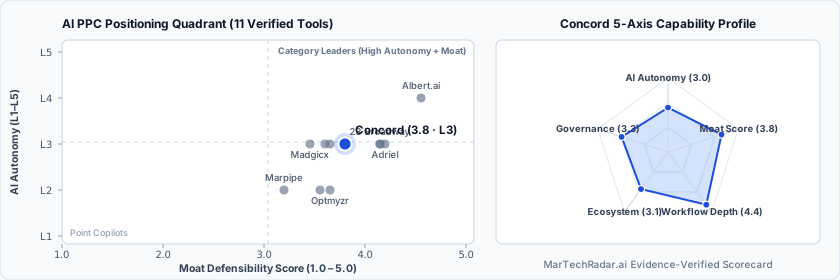
Concord is a Web SaaS tool for AI PPC (Autonomous Bidding & Budget Management) in AdTech & Paid Media. Pricing: Custom / enterprise pricing. Best suited to Performance Marketing Directors, Ad Agencies and Retail Media Advertisers. Editor ratings: AI autonomy L3 (conditional automation); moat score 3.8/5.0 (Proprietary moat). Fact-checked by Julie Brot on Oct 11, 2026.
Agentic media buying infrastructure automating multi-platform campaign execution, autonomous bidding, and cross-channel budget pacing for growth advertisers.
Concord buyer fit verdict: when to choose vs. when to walk away
Choose Concord if (Best Fit)
- Target ICP & Stack Fit: You operate as Performance Marketing Directors, Ad Agencies and Retail Media Advertisers requiring a Web SaaS deployment for AI PPC.
- L3 Architecture & Defensibility: Proprietary advertising memory layer paired with cross-network agentic execution rails that maintain persistent context across disparate programmatic buying APIs.
- Commercial Model Fit: Your procurement budget aligns with Custom / enterprise pricing.
Walk away from Concord if (Deal-Breakers)
- Walk away if you require transparent self-serve monthly billing or your budget ceiling is under $1,000/mo (Concord requires sales-gated custom quoting).
- Walk away if your workflow cannot tolerate API rate limits and sync latency: Upstream advertising network rate limits and polling quotas restrict how frequently bid states can be written back, occasionally causing execution lag during volatile traffic spikes.
- Walk away if attribution window misalignment is a deal-breaker for your team: Delayed multi-touch and server-side conversion reporting can distort immediate agentic optimization cycles, triggering premature budget throttling if conversion lag curves are improperly configured.
Concord key facts & scorecard
| Pricing | Custom / enterprise pricing |
|---|---|
| Free plan | No / not disclosed |
| Delivery | Web SaaS |
| Audience | Performance Marketing Directors, Ad Agencies, Retail Media Advertisers |
| AI autonomy level | L3 · Conditional automationEditor-verified |
| Moat tier & score | 3.8 / 5.0 · Proprietary moatEditor-verified |
| Funding | Seed |
| Company size | 2-10 employees |
| Governance & docs | Trust & Security ↗ · API & Docs ↗ · Changelog ↗ · Privacy ↗ |
| Headquarters | France |
| Founded | 2026 |
| Last verified |
Concord pros & cons: strengths vs. operational limitations
Pros: core strengths & capabilities
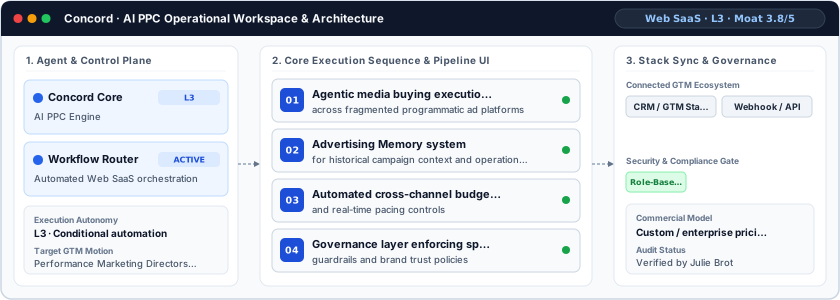
- Agentic media buying execution engine: across fragmented programmatic ad platforms
- Advertising Memory system: for historical campaign context and operational state persistence
- Automated cross-channel budget reallocation: and real-time pacing controls
- Governance layer enforcing spend: guardrails and brand trust policies
Cons: operational limitations & risks
- API Rate Limits and Sync Latency: Upstream advertising network rate limits and polling quotas restrict how frequently bid states can be written back, occasionally causing execution lag during volatile traffic spikes.
- Attribution Window Misalignment: Delayed multi-touch and server-side conversion reporting can distort immediate agentic optimization cycles, triggering premature budget throttling if conversion lag curves are improperly configured.
- Rule and Schema Maintenance: Underlying ad network metadata and campaign objective schemas update continuously, requiring persistent mapping upkeep to prevent agent task failures during structural API deprecations.
Concord TCO & deal-breaker stress test
Simulate 12-month stepped TCO, hidden cost multipliers, contract lock-in exposure, and stack failure modes using only facts verified by Julie Brot on · Capture SHA 948ec720.
Concord triggers high-severity friction under your 5-seat / $800/mo constraints. Benchmark the verified subtrack alternatives below before committing.
| Plan / Tier | Verified Rate | Scale Fit | Scope & Quota Notes |
|---|---|---|---|
| Enterprise / Custom | Custom quote | 15–50+ seats (Enterprise SLA) | Sales-negotiated annual contract for custom volume, SSO/RBAC governance, and dedicated SLA. |
- Moat Score
- 3.8 / 5.0
- AI Autonomy
- L3
- Free Tier / Trial
- None disclosed
Triggered audit signals & failure modes
- Opaque Enterprise Quoting vs. SMB/Mid-Market BudgetVerified Pricing Ledger
Concord does not disclose a public self-serve floor (Custom / enterprise pricing). Buyers with a $800/mo cap face high sales-qualification friction.
- Sales-Gated Contract TermsFact-checked by Julie Brot
Concord operates under an enterprise licensing structure where commercial pricing is available on request through tailored enterprise sales quotes based on organizational scale and seats.
- Primary Operational Bottleneck: Attribution Window MisalignmentAudit by Julie Brot
Delayed multi-touch and server-side conversion reporting can distort immediate agentic optimization cycles, triggering premature budget throttling if conversion lag curves are improperly configured.
Hidden TCO Multipliers & Quota Gates
- API Rate Limits and Sync Latency: Upstream advertising network rate limits and polling quotas restrict how frequently bid states can be written back, occasionally causing execution lag during volatile traffic spikes.
- Attribution Window Misalignment: Delayed multi-touch and server-side conversion reporting can distort immediate agentic optimization cycles, triggering premature budget throttling if conversion lag curves are improperly configured.
When to Walk Away & Negotiation Levers
- Walk away if you require transparent self-serve monthly billing or your budget ceiling is under $1,000/mo (Concord requires sales-gated custom quoting).
- Walk away if your workflow cannot tolerate API rate limits and sync latency: Upstream advertising network rate limits and polling quotas restrict how frequently bid states can be written back, occasionally causing execution lag during volatile traffic spikes.
- Walk away if attribution window misalignment is a deal-breaker for your team: Delayed multi-touch and server-side conversion reporting can distort immediate agentic optimization cycles, triggering premature budget throttling if conversion lag curves are improperly configured.
- Demand a 30- to 60-day paid pilot opt-out clause in the Concord order form before signing a 12-month enterprise commitment.
- Require a sandbox proof-of-concept testing API rate limits and sync latency against your live CRM/data schema before annual sign-off.
Ask a custom procurement or TCO stress-test question about Concord
Lower 5-seat floor (~$500/mo vs. Custom Quote) · Transparent self-serve entry without mandatory annual lock-in
Lower 5-seat floor (~$10/mo vs. Custom Quote) · Transparent self-serve entry without mandatory annual lock-in
Concord moat & subtrack positioning
Proprietary advertising memory layer paired with cross-network agentic execution rails that maintain persistent context across disparate programmatic buying APIs.
Editorial review
Fact-checked by Julie Brot (Enterprise SaaS Governance & Procurement Editor) on .
Background
Performance media buyers spend disproportionate hours adjusting bids, shifting spend between channels, and reconciling siloed ad network interfaces. Established in 2026 in France, Concord provides an agentic infrastructure layer designed to handle automated campaign execution across advertising platforms. Built primarily for enterprise performance marketing directors and media agency leads, the system automates day-to-day bidding and budget management through programmatic decision loops.
How Concord works
At an architectural level, Concord acts as an autonomous execution middleware connecting directly to digital advertising platform APIs. Its pipeline pairs an Advertising Memory system—which maintains campaign telemetry, performance historicals, and flight parameters—with agentic decision routines. Rather than relying on manual operator adjustments across siloed dashboards, the platform monitors conversion velocities, evaluates marginal yield across networks, and programmatically adjusts bids and pacing within pre-configured governance guardrails.
Limitations
Operational considerations and platform boundaries include:
- API Rate Limits and Sync Latency: Upstream advertising network rate limits and polling quotas restrict how frequently bid states can be written back, occasionally causing execution lag during volatile traffic spikes.
- Attribution Window Misalignment: Delayed multi-touch and server-side conversion reporting can distort immediate agentic optimization cycles, triggering premature budget throttling if conversion lag curves are improperly configured.
- Rule and Schema Maintenance: Underlying ad network metadata and campaign objective schemas update continuously, requiring persistent mapping upkeep to prevent agent task failures during structural API deprecations.
Concord pricing
Concord operates under an enterprise licensing structure where commercial pricing is available on request through tailored enterprise sales quotes based on organizational scale and seats. The commercial tiers are structured around aggregate media spend throughput, connected ad accounts, and dedicated governance support, dispensing with public modular billing in favor of customized service agreements.
How Concord compares
Within the autonomous bidding sector, Concord differentiates through its context-retaining agentic architecture compared to traditional rule engines. While Adriel focuses on cross-channel reporting dashboards and Albert.ai provides closed-loop enterprise algorithmic automation, 23 Broadway centers on prescriptive optimization scripts. Concord distinguishes itself by separating strategic governance from programmatic platform execution, making it best suited for mid-market to enterprise media agencies seeking multi-network autonomous execution without forfeiting policy controls.
Frequently asked questions about Concord
How much does Concord cost and does it require a custom enterprise quote?
Published pricing summary for Concord: Custom / enterprise pricing. A permanent free plan is not disclosed for Concord. Concord operates under an enterprise licensing structure where commercial pricing is available on request through tailored enterprise sales quotes based on organizational scale and seats.
How does Concord work and how autonomous is its AI architecture?
Agentic media buying infrastructure automating multi-platform campaign execution, autonomous bidding, and cross-channel budget pacing for growth advertisers. Within AI PPC (Autonomous Bidding & Budget Management), MarTechRadar rates its execution architecture at L3 · Conditional automation with a verified Moat Score of 3.8 / 5.0 (Proprietary moat). Proprietary advertising memory layer paired with cross-network agentic execution rails that maintain persistent context across disparate programmatic buying APIs. Corporate profile: operating at 2-10 employees scale.
What are the main limitations of Concord and when should buyers walk away?
Based on our editorial technical audit, key operational considerations and boundaries for Concord include: (1) API Rate Limits and Sync Latency: Upstream advertising network rate limits and polling quotas restrict how frequently bid states can be written back, occasionally causing execution lag during volatile traffic spikes. (2) Attribution Window Misalignment: Delayed multi-touch and server-side conversion reporting can distort immediate agentic optimization cycles, triggering premature budget throttling if conversion lag curves are improperly configured. (3) Rule and Schema Maintenance: Underlying ad network metadata and campaign objective schemas update continuously, requiring persistent mapping upkeep to prevent agent task failures during structural API deprecations. Primary procurement walk-away rule: Walk away if you require transparent self-serve monthly billing or your budget ceiling is under $1,000/mo (Concord requires sales-gated custom quoting).
What integrations, compliance certifications, and contract terms apply to Concord?
First-party governance and developer endpoints verified on domain include: Trust/Security (https://concord.ad/trust), API Docs (https://docs.concord.ad). Key TCO multiplier to watch: API Rate Limits and Sync Latency (Upstream advertising network rate limits and polling quotas restrict how frequently bid states can be written back, occasionally causing execution lag during volatile traffic spikes.) Before signing a contract, procurement teams should demand a 30- to 60-day paid pilot opt-out clause in the Concord order form before signing a 12-month enterprise commitment.
What are the best Concord alternatives and head-to-head competitors in 2026?
Top fact-checked alternatives to Concord in AI PPC (Autonomous Bidding & Budget Management) include Albert.ai (Custom / enterprise pricing), Adriel (From $500/mo), 23 Broadway (Custom / enterprise pricing), paretos (Custom / enterprise pricing). Within the autonomous bidding sector, Concord differentiates through its context-retaining agentic architecture compared to traditional rule engines.
Verified sources & evidence trail
- Official product domain: https://concord.ad
- Commercial pricing verification: Verified against official vendor pricing policy (Custom / enterprise pricing)
- Verified corporate entity profiles (
sameAs): LinkedIn Company Profile · Crunchbase Entity Record - First-party governance & documentation links: Trust & Security · API & Docs · Changelog · Privacy
- Editorial audit sign-off: Fact-checked by Julie Brot on under the MarTechRadar Evidence-Ledger Protocol.