Metric Review (2026): DCO Pricing, Limits & Alternatives
Bottom line
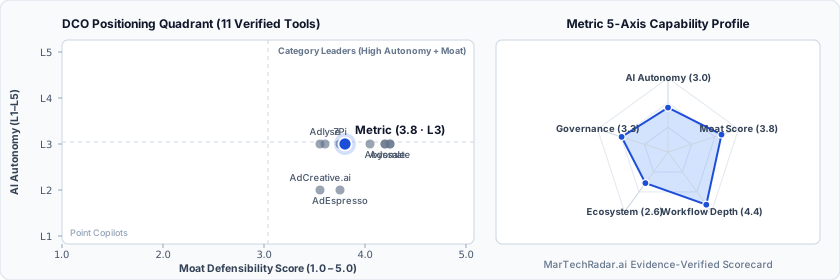
Metric is a Web SaaS tool for DCO (Dynamic Creative Optimization / DCO) in AdTech & Paid Media. Pricing: Custom / enterprise pricing. Best suited to Performance Marketing Directors, Ad Agencies and Retail Media Advertisers. Editor ratings: AI autonomy L3 (conditional automation); moat score 3.8/5.0 (Proprietary moat). Fact-checked by Anthony Hay on Oct 12, 2026.
Autonomous dynamic creative optimization engine that synthesizes ad variants, identifies high-intent buyer cohorts, and executes paid campaigns against.
Metric buyer fit verdict: when to choose vs. when to walk away
Choose Metric if (Best Fit)
- Target ICP & Stack Fit: You operate as Performance Marketing Directors, Ad Agencies and Retail Media Advertisers requiring a Web SaaS deployment for DCO.
- L3 Architecture & Defensibility: Metric combines programmatic creative generation with closed-loop audience activation across paid channels. Its defensive posture relies on direct-response performance telemetry mapped directly to revenue attribution, constraining reliance on manual media planning.
- Commercial Model Fit: Your procurement budget aligns with Custom / enterprise pricing.
Walk away from Metric if (Deal-Breakers)
- Walk away if you require transparent self-serve monthly billing or your budget ceiling is under $1,000/mo (Metric requires sales-gated custom quoting).
- Walk away if your workflow cannot tolerate API rate and ad policy volatility: Automated campaign generation remains vulnerable to external advertising network API changes and platform-level content moderation shifts that can stall scheduled launches.
- Walk away if algorithmic cold-start inefficiencies is a deal-breaker for your team: Without sufficient historical conversion volume, the discovery engine requires prolonged exploratory spend before stabilizing around profitable audience segments.
Metric key facts & scorecard
| Pricing | Custom / enterprise pricing |
|---|---|
| Free plan | No / not disclosed |
| Delivery | Web SaaS |
| Audience | Performance Marketing Directors, Ad Agencies, Retail Media Advertisers |
| AI autonomy level | L3 · Conditional automationEditor-verified |
| Moat tier & score | 3.8 / 5.0 · Proprietary moatEditor-verified |
| Funding | Series A |
| Governance & docs | Terms ↗ · Privacy ↗ |
| Headquarters | Norway |
| Founded | 2023 |
| Last verified |
Metric pros & cons: strengths vs. operational limitations
Pros: core strengths & capabilities
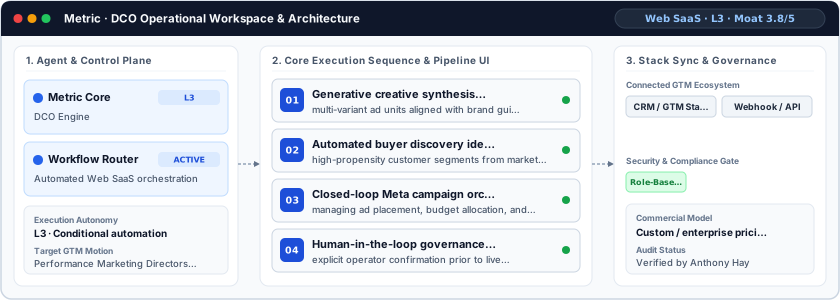
- Generative creative synthesis producing: multi-variant ad units aligned with brand guidelines
- Automated buyer discovery identifying: high-propensity customer segments from market signals
- Closed-loop Meta campaign orchestration: managing ad placement, budget allocation, and delivery schedules
- Human-in-the-loop governance interface requiring: explicit operator confirmation prior to live deployment
Cons: operational limitations & risks
- API Rate and Ad Policy Volatility: Automated campaign generation remains vulnerable to external advertising network API changes and platform-level content moderation shifts that can stall scheduled launches.
- Algorithmic Cold-Start Inefficiencies: Without sufficient historical conversion volume, the discovery engine requires prolonged exploratory spend before stabilizing around profitable audience segments.
- Creative Homogenization Risks: Repetitive algorithmic variant generation across identical product data can cause brand dilution or ad fatigue unless human operators continuously inject novel visual concepts.
Metric TCO & deal-breaker stress test
Simulate 12-month stepped TCO, hidden cost multipliers, contract lock-in exposure, and stack failure modes using only facts verified by Anthony Hay on · Capture SHA 16c0d402.
Metric triggers high-severity friction under your 5-seat / $800/mo constraints. Benchmark the verified subtrack alternatives below before committing.
| Plan / Tier | Verified Rate | Scale Fit | Scope & Quota Notes |
|---|---|---|---|
| Enterprise / Custom | Custom quote | 15–50+ seats (Enterprise SLA) | Sales-negotiated annual contract for custom volume, SSO/RBAC governance, and dedicated SLA. |
- Moat Score
- 3.8 / 5.0
- AI Autonomy
- L3
- Free Tier / Trial
- None disclosed
Triggered audit signals & failure modes
- Opaque Enterprise Quoting vs. SMB/Mid-Market BudgetVerified Pricing Ledger
Metric does not disclose a public self-serve floor (Custom / enterprise pricing). Buyers with a $800/mo cap face high sales-qualification friction.
- Sales-Gated Contract TermsFact-checked by Anthony Hay
Metric operates under a private enterprise procurement framework. The vendor does not publish fixed tier lists; commercial pricing is available on request through tailored enterprise sales quotes based on organizational scale, managed media spend, and operational scope.
- Primary Operational Bottleneck: API Rate and Ad Policy VolatilityAudit by Anthony Hay
Automated campaign generation remains vulnerable to external advertising network API changes and platform-level content moderation shifts that can stall scheduled launches.
Hidden TCO Multipliers & Quota Gates
- API Rate and Ad Policy Volatility: Automated campaign generation remains vulnerable to external advertising network API changes and platform-level content moderation shifts that can stall scheduled launches.
- Algorithmic Cold-Start Inefficiencies: Without sufficient historical conversion volume, the discovery engine requires prolonged exploratory spend before stabilizing around profitable audience segments.
When to Walk Away & Negotiation Levers
- Walk away if you require transparent self-serve monthly billing or your budget ceiling is under $1,000/mo (Metric requires sales-gated custom quoting).
- Walk away if your workflow cannot tolerate API rate and ad policy volatility: Automated campaign generation remains vulnerable to external advertising network API changes and platform-level content moderation shifts that can stall scheduled launches.
- Walk away if algorithmic cold-start inefficiencies is a deal-breaker for your team: Without sufficient historical conversion volume, the discovery engine requires prolonged exploratory spend before stabilizing around profitable audience segments.
- Demand a 30- to 60-day paid pilot opt-out clause in the Metric order form before signing a 12-month enterprise commitment.
- Require a sandbox proof-of-concept testing API rate and ad policy volatility against your live CRM/data schema before annual sign-off.
Ask a custom procurement or TCO stress-test question about Metric
Lower 5-seat floor (~$10/mo vs. Custom Quote) · Transparent self-serve entry without mandatory annual lock-in
Lower 5-seat floor (~$169/mo vs. Custom Quote) · Transparent self-serve entry without mandatory annual lock-in
Metric moat & subtrack positioning
Metric combines programmatic creative generation with closed-loop audience activation across paid channels. Its defensive posture relies on direct-response performance telemetry mapped directly to revenue attribution, constraining reliance on manual media planning.
Editorial review
Fact-checked by Anthony Hay (Senior SEO, Search Intelligence & Content Operations Editor) on .
Background
To capture paid demand without scaling headcount or third-party agency retainers, growth teams require continuous experimentation across creative variants and targeting vectors. Metric, established in 2023 and headquartered in Norway, addresses this requirement by delivering an autonomous campaign engine. Designed for growth directors, commercial marketing leaders, and performance teams, the platform targets dynamic creative optimization by handling cross-channel audience discovery, ad asset generation, and ad delivery within a governed operational workflow.
How Metric works
At its technical core, Metric functions as an L3 semi-autonomous campaign engine. The platform ingests brand parameters, catalog data, and revenue baselines to establish optimization bounds. Its generative system constructs copy and visual assets mapped to specific audience profiles, then interfaces with paid advertising networks such as Meta via programmatic APIs. Operating under an execution loop where users configure rules and confirm drafts before deployment, Metric continually monitors downstream conversion metrics to reallocate daily ad spend toward top-performing creative variations.
Limitations
Operational considerations and platform boundaries include:
- API Rate and Ad Policy Volatility: Automated campaign generation remains vulnerable to external advertising network API changes and platform-level content moderation shifts that can stall scheduled launches.
- Algorithmic Cold-Start Inefficiencies: Without sufficient historical conversion volume, the discovery engine requires prolonged exploratory spend before stabilizing around profitable audience segments.
- Creative Homogenization Risks: Repetitive algorithmic variant generation across identical product data can cause brand dilution or ad fatigue unless human operators continuously inject novel visual concepts.
Metric pricing
Metric operates under a private enterprise procurement framework. The vendor does not publish fixed tier lists; commercial pricing is available on request through tailored enterprise sales quotes based on organizational scale, managed media spend, and operational scope. Engagements range from self-serve software access to hybrid packages incorporating specialized growth and creative deployment support.
How Metric compares
Within the creative optimization space, Metric differentiates itself by blending dynamic content generation with native campaign execution. Whereas Abyssale focuses strictly on template-driven image and video generation through graphic APIs, and AdCreative.ai emphasizes conversion-scored static ad generation for external upload, Metric automates the entire delivery loop directly into ad managers. In contrast, 7Pi provides specialized testing frameworks for specific ad channels. Metric is optimal for mid-market to enterprise brands seeking closed-loop automation from asset generation to ad delivery.
Direct competitors & market radar
Top algorithmic competitors based on category positioning, capability overlap, and ICP alignment.
Frequently asked questions about Metric
How much does Metric cost and does it require a custom enterprise quote?
Published pricing summary for Metric: Custom / enterprise pricing. A permanent free plan is not disclosed for Metric. Metric operates under a private enterprise procurement framework. The vendor does not publish fixed tier lists; commercial pricing is available on request through tailored enterprise sales quotes based on organizational scale, managed media spend, and operational scope.
How does Metric work and how autonomous is its AI architecture?
Autonomous dynamic creative optimization engine that synthesizes ad variants, identifies high-intent buyer cohorts, and executes paid campaigns against. Within DCO (Dynamic Creative Optimization / DCO), MarTechRadar rates its execution architecture at L3 · Conditional automation with a verified Moat Score of 3.8 / 5.0 (Proprietary moat). Metric combines programmatic creative generation with closed-loop audience activation across paid channels. Its defensive posture relies on direct-response performance telemetry mapped directly to revenue attribution, constraining reliance on manual media planning.
What are the main limitations of Metric and when should buyers walk away?
Based on our editorial technical audit, key operational considerations and boundaries for Metric include: (1) API Rate and Ad Policy Volatility: Automated campaign generation remains vulnerable to external advertising network API changes and platform-level content moderation shifts that can stall scheduled launches. (2) Algorithmic Cold-Start Inefficiencies: Without sufficient historical conversion volume, the discovery engine requires prolonged exploratory spend before stabilizing around profitable audience segments. (3) Creative Homogenization Risks: Repetitive algorithmic variant generation across identical product data can cause brand dilution or ad fatigue unless human operators continuously inject novel visual concepts. Primary procurement walk-away rule: Walk away if you require transparent self-serve monthly billing or your budget ceiling is under $1,000/mo (Metric requires sales-gated custom quoting).
What integrations, compliance certifications, and contract terms apply to Metric?
Key TCO multiplier to watch: API Rate and Ad Policy Volatility (Automated campaign generation remains vulnerable to external advertising network API changes and platform-level content moderation shifts that can stall scheduled launches.) Before signing a contract, procurement teams should demand a 30- to 60-day paid pilot opt-out clause in the Metric order form before signing a 12-month enterprise commitment.
What are the best Metric alternatives and head-to-head competitors in 2026?
Top fact-checked alternatives to Metric in DCO (Dynamic Creative Optimization / DCO) include Albert.ai (Custom / enterprise pricing), AdScale (From $169/mo), Revealbot (From $10/mo), NativeAds (Custom / enterprise pricing). Within the creative optimization space, Metric differentiates itself by blending dynamic content generation with native campaign execution.
Verified sources & evidence trail
- Official product domain: https://www.marketer.com/
- Commercial pricing verification: Verified against official vendor pricing policy (Custom / enterprise pricing)
- First-party governance & documentation links: Terms · Privacy
- Editorial audit sign-off: Fact-checked by Anthony Hay on under the MarTechRadar Evidence-Ledger Protocol.