BlogNLP Review (2026): AI Writing Assistant Pricing, Limits & Alternatives
Bottom line
BlogNLP is a Web SaaS tool for AI Writing Assistant (Writing Assistants & Paraphrasing) in Copy & Content. Pricing: From $9.99/mo. Best suited to Creators / Solo. Editor ratings: AI autonomy L3 (conditional automation); moat score 3.6/5.0 (Proprietary moat). Fact-checked by Anthony Hay on Oct 14, 2026.
AI-powered writing and content synthesis assistant utilizing GPT-4o and DeepL to produce template-driven copy, long-form articles, and multilingual.
BlogNLP buyer fit verdict: when to choose vs. when to walk away
Choose BlogNLP if (Best Fit)
- Target ICP & Stack Fit: You operate as Creators / Solo requiring a Web SaaS deployment for AI Writing Assistant.
- L3 Architecture & Defensibility: Moat resilience is low given heavy architectural reliance on standard OpenAI GPT-4o endpoints and DeepL translation APIs without specialized proprietary model fine-tuning or deep enterprise system integrations.
- Commercial Model Fit: Your procurement budget aligns with From $9.99/mo.
Walk away from BlogNLP if (Deal-Breakers)
- Walk away if your workflow requires uncapped enterprise volume on the From $9.99/mo entry plan without upgrading tiers.
- Walk away if your workflow cannot tolerate third-party API dependency: The service relies on external upstream inference providers, leaving generation availability and latency vulnerable to third-party rate limits and model deprecation cycles.
- Walk away if editorial governance deficits is a deal-breaker for your team: The platform lacks enterprise-tier governance functions, missing programmatic role-based access controls, multi-stakeholder approval routing, and automated factual verification mechanisms.
BlogNLP key facts & scorecard
| Pricing | From $9.99/moVendor pricing page |
|---|---|
| Free plan | No / not disclosed |
| Delivery | Web SaaS |
| Audience | Creators / Solo |
| AI autonomy level | L3 · Conditional automationEditor-verified |
| Moat tier & score | 3.6 / 5.0 · Proprietary moatEditor-verified |
| Funding | Bootstrapped |
| Governance & docs | Privacy ↗ |
| Headquarters | United States |
| Last verified |
BlogNLP pros & cons: strengths vs. operational limitations
Pros: core strengths & capabilities
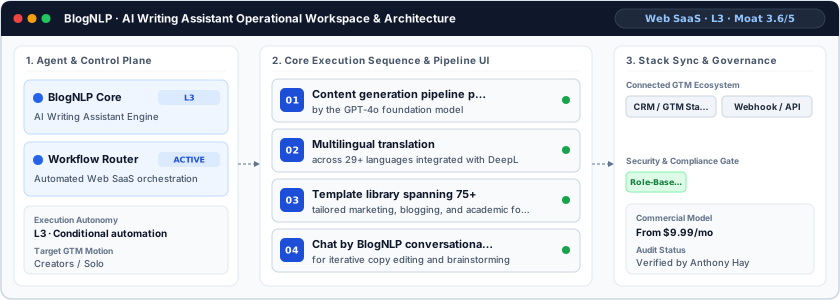
- Content generation pipeline powered: by the GPT-4o foundation model
- Multilingual translation: across 29+ languages integrated with DeepL
- Template library spanning 75+: tailored marketing, blogging, and academic formats
- Chat by BlogNLP conversational assistant: for iterative copy editing and brainstorming
Cons: operational limitations & risks
- Third-Party API Dependency: The service relies on external upstream inference providers, leaving generation availability and latency vulnerable to third-party rate limits and model deprecation cycles.
- Editorial Governance Deficits: The platform lacks enterprise-tier governance functions, missing programmatic role-based access controls, multi-stakeholder approval routing, and automated factual verification mechanisms.
- Taxonomy Drift: Prompt-based template outputs require recurring manual supervision, as the model lacks custom knowledge-graph grounding to prevent factual hallucination across complex research domains.
BlogNLP TCO & deal-breaker stress test
Simulate 12-month stepped TCO, hidden cost multipliers, contract lock-in exposure, and stack failure modes using only facts verified by Anthony Hay on · Capture SHA fd52a001.
BlogNLP aligns with your 5-seat / $800/mo profile. Review the walk-away triggers and contract levers below before deployment.
| Plan / Tier | Verified Rate | Scale Fit | Scope & Quota Notes |
|---|---|---|---|
| Entry / Starter | $9.99/mo | 1–2 seats | Unlimited generations on all features |
- Moat Score
- 3.6 / 5.0
- AI Autonomy
- L3
- Free Tier / Trial
- None disclosed
Triggered audit signals & failure modes
- Published Self-Serve Entry FloorVerified Pricing Ledger
BlogNLP publishes a transparent entry point (From $9.99/mo) for initial validation before committing.
- Primary Operational Bottleneck: Editorial Governance DeficitsAudit by Anthony Hay
The platform lacks enterprise-tier governance functions, missing programmatic role-based access controls, multi-stakeholder approval routing, and automated factual verification mechanisms.
Hidden TCO Multipliers & Quota Gates
- Third-Party API Dependency: The service relies on external upstream inference providers, leaving generation availability and latency vulnerable to third-party rate limits and model deprecation cycles.
- Editorial Governance Deficits: The platform lacks enterprise-tier governance functions, missing programmatic role-based access controls, multi-stakeholder approval routing, and automated factual verification mechanisms.
When to Walk Away & Negotiation Levers
- Walk away if your workflow requires uncapped enterprise volume on the From $9.99/mo entry plan without upgrading tiers.
- Walk away if your workflow cannot tolerate third-party API dependency: The service relies on external upstream inference providers, leaving generation availability and latency vulnerable to third-party rate limits and model deprecation cycles.
- Walk away if editorial governance deficits is a deal-breaker for your team: The platform lacks enterprise-tier governance functions, missing programmatic role-based access controls, multi-stakeholder approval routing, and automated factual verification mechanisms.
- Validate exact quota thresholds (seats, credits, or API calls) included in BlogNLP's From $9.99/mo tier before converting from monthly to annual billing.
- Require a sandbox proof-of-concept testing third-party API dependency against your live CRM/data schema before annual sign-off.
Ask a custom procurement or TCO stress-test question about BlogNLP
Fits within $800/mo budget (From $14.99/mo)
Lower 5-seat floor (~$8/mo vs. From $10 / mo)
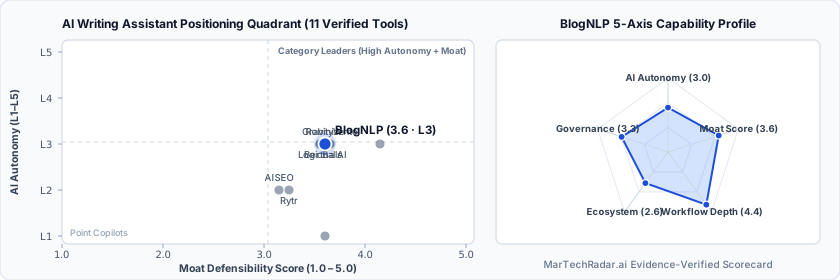
BlogNLP moat & subtrack positioning
Moat resilience is low given heavy architectural reliance on standard OpenAI GPT-4o endpoints and DeepL translation APIs without specialized proprietary model fine-tuning or deep enterprise system integrations.
Editorial review
Fact-checked by Anthony Hay (Senior SEO, Search Intelligence & Content Operations Editor) on .
Background
To address the persistent bottleneck of manual copy drafting and editorial iteration, content operations require structured algorithmic assistance. Headquartered in the United States, BlogNLP delivers a targeted writing and paraphrasing environment engineered for bloggers, marketing teams, and academic researchers. The software structures generative drafting tasks into repeatable workflows, replacing unstructured text editors with specialized generation interfaces.
How BlogNLP works
Operating at an L3 autonomy tier, the system ingests user-specified parameters, target topics, and tonal specifications through structured form inputs. The core processing pipeline orchestrates prompt structures directly into OpenAI's GPT-4o model, executing generation runs across more than 75 standardized templates. For cross-border publishing requirements, the architecture incorporates DeepL API endpoints to deliver linguistic conversion across 29 languages, while an interactive chat module handles context-aware sentence rewriting.
Limitations
Operational considerations and platform boundaries include:
- Third-Party API Dependency: The service relies on external upstream inference providers, leaving generation availability and latency vulnerable to third-party rate limits and model deprecation cycles.
- Editorial Governance Deficits: The platform lacks enterprise-tier governance functions, missing programmatic role-based access controls, multi-stakeholder approval routing, and automated factual verification mechanisms.
- Taxonomy Drift: Prompt-based template outputs require recurring manual supervision, as the model lacks custom knowledge-graph grounding to prevent factual hallucination across complex research domains.
BlogNLP pricing
Commercial procurement follows a direct subscription model starting from $9.99 per month. This Premium deployment grants complete access to the GPT-4o framework, 75+ content templates, DeepL translation processing, and the Chat by BlogNLP module. Tiered commitments do not require enterprise multi-year contracts, functioning primarily through straightforward monthly self-service billing.
How BlogNLP compares
Within the writing and paraphrasing subtrack, BlogNLP positions itself as a lightweight utility alongside AISEO, Rytr, and QuillBot. While QuillBot concentrates heavily on sentence-level syntax manipulation and Rytr emphasizes micro-copy workflows inside marketing frameworks, BlogNLP centers its tooling around GPT-4o access and DeepL translation coverage. The software fits solo creators, editorial freelancers, and small digital agencies requiring template-driven generation without enterprise procurement overhead.
Frequently asked questions about BlogNLP
How much does BlogNLP cost and what pricing tiers are available?
Published pricing summary for BlogNLP: From $9.99/mo. A permanent free plan is not disclosed for BlogNLP. Commercial procurement follows a direct subscription model starting from $9.99 per month. This Premium deployment grants complete access to the GPT-4o framework, 75+ content templates, DeepL translation processing, and the Chat by BlogNLP module.
How does BlogNLP work and how autonomous is its AI architecture?
AI-powered writing and content synthesis assistant utilizing GPT-4o and DeepL to produce template-driven copy, long-form articles, and multilingual. Within AI Writing Assistant (Writing Assistants & Paraphrasing), MarTechRadar rates its execution architecture at L3 · Conditional automation with a verified Moat Score of 3.6 / 5.0 (Proprietary moat). Moat resilience is low given heavy architectural reliance on standard OpenAI GPT-4o endpoints and DeepL translation APIs without specialized proprietary model fine-tuning or deep enterprise system integrations.
What are the main limitations of BlogNLP and when should buyers walk away?
Based on our editorial technical audit, key operational considerations and boundaries for BlogNLP include: (1) Third-Party API Dependency: The service relies on external upstream inference providers, leaving generation availability and latency vulnerable to third-party rate limits and model deprecation cycles. (2) Editorial Governance Deficits: The platform lacks enterprise-tier governance functions, missing programmatic role-based access controls, multi-stakeholder approval routing, and automated factual verification mechanisms. (3) Taxonomy Drift: Prompt-based template outputs require recurring manual supervision, as the model lacks custom knowledge-graph grounding to prevent factual hallucination across complex research domains. Primary procurement walk-away rule: Walk away if your workflow requires uncapped enterprise volume on the From $9.99/mo entry plan without upgrading tiers.
What integrations, compliance certifications, and contract terms apply to BlogNLP?
Key TCO multiplier to watch: Third-Party API Dependency (The service relies on external upstream inference providers, leaving generation availability and latency vulnerable to third-party rate limits and model deprecation cycles.) Before signing a contract, procurement teams should validate exact quota thresholds (seats, credits, or API calls) included in BlogNLP's From $9.99/mo tier before converting from monthly to annual billing.
What are the best BlogNLP alternatives and head-to-head competitors in 2026?
Top fact-checked alternatives to BlogNLP in AI Writing Assistant (Writing Assistants & Paraphrasing) include Typli (From $14.99/mo), Robinize (Custom / enterprise pricing), Cohesive AI (From $2.08/mo), WordHero (Custom / enterprise pricing). Within the writing and paraphrasing subtrack, BlogNLP positions itself as a lightweight utility alongside AISEO, Rytr, and QuillBot.
Verified sources & evidence trail
- Official product domain: https://blognlp.com
- Commercial pricing verification: https://www.blognlp.com/pricing
- First-party governance & documentation links: Privacy
- Editorial audit sign-off: Fact-checked by Anthony Hay on under the MarTechRadar Evidence-Ledger Protocol.