WordHero Review (2026): AI Writing Assistant Pricing, Limits & Alternatives
Bottom line
WordHero is a Web SaaS tool for AI Writing Assistant (Writing Assistants & Paraphrasing) in Copy & Content. Pricing: Custom / enterprise pricing. Best suited to Creators / Solo. Editor ratings: AI autonomy L1 (prompt-assisted); moat score 3.6/5.0 (Proprietary moat). Fact-checked by Tim Fenolz on Oct 15, 2026.
AI-powered content workspace and writing assistant designed to generate marketing copy, campaign assets, and long-form articles across structured templates.
WordHero buyer fit verdict: when to choose vs. when to walk away
Choose WordHero if (Best Fit)
- Target ICP & Stack Fit: You operate as Creators / Solo requiring a Web SaaS deployment for AI Writing Assistant, with verified ecosystem connectivity for LinkedIn.
- L1 Architecture & Defensibility: Low moat defensibility. Operates as a thin UX wrapper around commercial frontier LLM APIs with pre-engineered prompt templates and multi-asset canvas workflows, lacking proprietary foundation models or unique fine-tuning data pipelines.
- Commercial Model Fit: Your procurement budget aligns with Custom / enterprise pricing.
Walk away from WordHero if (Deal-Breakers)
- Walk away if you require transparent self-serve monthly billing or your budget ceiling is under $1,000/mo (WordHero requires sales-gated custom quoting).
- Walk away if your workflow cannot tolerate semantic drift and hallucination: Because the tool relies on general foundation model completion wrappers without automated fact-checking or retrieval-augmented generation pipelines, complex B2B outputs require heavy human verification.
- Walk away if lack of autonomous execution is a deal-breaker for your team: The system lacks native autonomous agent capabilities or headless API webhook triggers, preventing it from publishing directly to content management systems or automated marketing stacks.
WordHero key facts & scorecard
| Pricing | Custom / enterprise pricing |
|---|---|
| Free plan | No / not disclosed |
| Delivery | Web SaaS |
| Audience | Creators / Solo |
| AI autonomy level | L1 · Prompt-assistedEditor-verified |
| Moat tier & score | 3.6 / 5.0 · Proprietary moatEditor-verified |
| Funding | Bootstrapped |
| Company size | 2-10 employees |
| Ecosystem integrations | |
| Governance & docs | Terms ↗ · Privacy ↗ |
| Headquarters | United States |
| Founded | 2021 |
| Last verified |
WordHero pros & cons: strengths vs. operational limitations
Pros: core strengths & capabilities
- Multi-asset marketing canvases: for turning single campaign briefs into cross-channel collateral
- Library of modular copywriting templates: for blog outlines, emails, and social ads
- Context-driven content generation engine: built on commercial large language models
- Interactive long-form document editor: for manual editorial refinement and asset assembly
Cons: operational limitations & risks
- Semantic Drift and Hallucination: Because the tool relies on general foundation model completion wrappers without automated fact-checking or retrieval-augmented generation pipelines, complex B2B outputs require heavy human verification.
- Lack of Autonomous Execution: The system lacks native autonomous agent capabilities or headless API webhook triggers, preventing it from publishing directly to content management systems or automated marketing stacks.
- Brand Tone Consistency: Without dynamic vector embeddings or deep organizational knowledge graphs, multi-channel outputs across large canvases can exhibit voice inconsistencies between generated ad variations and technical editorial drafts.
WordHero TCO & deal-breaker stress test
Simulate 12-month stepped TCO, hidden cost multipliers, contract lock-in exposure, and stack failure modes using only facts verified by Tim Fenolz on · Capture SHA cd9a66ce.
WordHero triggers high-severity friction under your 5-seat / $800/mo constraints. Benchmark the verified subtrack alternatives below before committing.
| Plan / Tier | Verified Rate | Scale Fit | Scope & Quota Notes |
|---|---|---|---|
| Entry / Starter | $48/mo | 1–2 seats | Unlimited fair-use Standard writing |
| Enterprise / Custom | Custom quote | 15–50+ seats (Enterprise SLA) | Sales-negotiated annual contract for custom volume, SSO/RBAC governance, and dedicated SLA. |
- Moat Score
- 3.6 / 5.0
- AI Autonomy
- L1
- Free Tier / Trial
- None disclosed
Triggered audit signals & failure modes
- Opaque Enterprise Quoting vs. SMB/Mid-Market BudgetVerified Pricing Ledger
WordHero does not disclose a public self-serve floor (Custom / enterprise pricing). Buyers with a $800/mo cap face high sales-qualification friction.
- Sales-Gated Contract TermsFact-checked by Tim Fenolz
Pricing is available on request through tailored enterprise sales quotes, with custom enterprise tiers structured around organizational scale, user seats, and workflow volume.
- Primary Operational Bottleneck: Semantic Drift and HallucinationAudit by Tim Fenolz
Because the tool relies on general foundation model completion wrappers without automated fact-checking or retrieval-augmented generation pipelines, complex B2B outputs require heavy human verification.
Hidden TCO Multipliers & Quota Gates
- Annual Billing Headline vs. Monthly Premium: Headline entry rates reflect annual billing commitments (Save up to 25%); month-to-month flexibility carries a higher effective monthly rate or requires annual prepayment.
- Credit & Usage Burn Multiplier: Automated workflows consume metered credits/usage quotas; multi-step enrichment, voice minutes, or high-frequency agent runs can trigger mid-cycle top-up packs.
When to Walk Away & Negotiation Levers
- Walk away if you require transparent self-serve monthly billing or your budget ceiling is under $1,000/mo (WordHero requires sales-gated custom quoting).
- Walk away if your workflow cannot tolerate semantic drift and hallucination: Because the tool relies on general foundation model completion wrappers without automated fact-checking or retrieval-augmented generation pipelines, complex B2B outputs require heavy human verification.
- Walk away if lack of autonomous execution is a deal-breaker for your team: The system lacks native autonomous agent capabilities or headless API webhook triggers, preventing it from publishing directly to content management systems or automated marketing stacks.
- Demand a 30- to 60-day paid pilot opt-out clause in the WordHero order form before signing a 12-month enterprise commitment.
- Require a sandbox proof-of-concept testing semantic drift and hallucination against your live CRM/data schema before annual sign-off.
Ask a custom procurement or TCO stress-test question about WordHero
Lower 5-seat floor (~$10/mo vs. Custom Quote) · Transparent self-serve entry without mandatory annual lock-in
Lower 5-seat floor (~$15/mo vs. Custom Quote) · Transparent self-serve entry without mandatory annual lock-in
WordHero key entities, modules & ecosystem stack
WordHero moat & subtrack positioning
Low moat defensibility. Operates as a thin UX wrapper around commercial frontier LLM APIs with pre-engineered prompt templates and multi-asset canvas workflows, lacking proprietary foundation models or unique fine-tuning data pipelines.
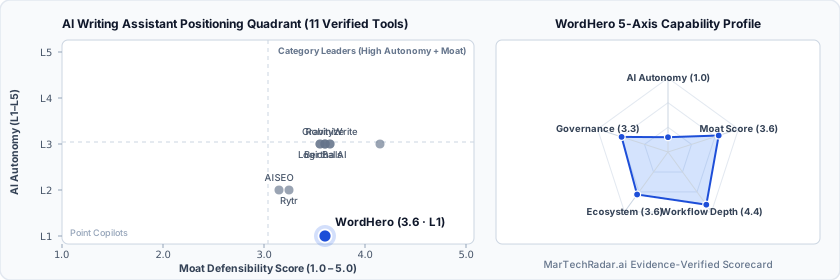
Editorial review
Fact-checked by Tim Fenolz (Lead AdTech, Programmatic & Attribution Analyst) on .
Background
Marketing practitioners and content creators routinely face production bottlenecks when adapting single campaign concepts into multi-channel digital collateral. Founded in 2021 in the United States, WordHero targets agency copywriters, digital marketers, and editorial teams seeking an assistive workspace to accelerate drafting workflows. Operating within the content generation and copywriting subtrack, the software serves as an ideation and composition tool designed to translate centralized messaging into structured marketing assets across channels.
How WordHero works
WordHero functions primarily at Level 1 editorial autonomy, requiring continuous operator input to initiate, refine, and orchestrate generation cycles. The technical architecture relies on an orchestration interface layered over commercial foundational completion models like OpenAI GPT APIs. Within its canvas workspace, users submit campaign briefs, seed keywords, and tone parameters. The system parses these inputs through structured prompt wrappers, chaining modular completions to simultaneously draft campaign emails, LinkedIn posts, advertising copy, and article outlines for human refinement.
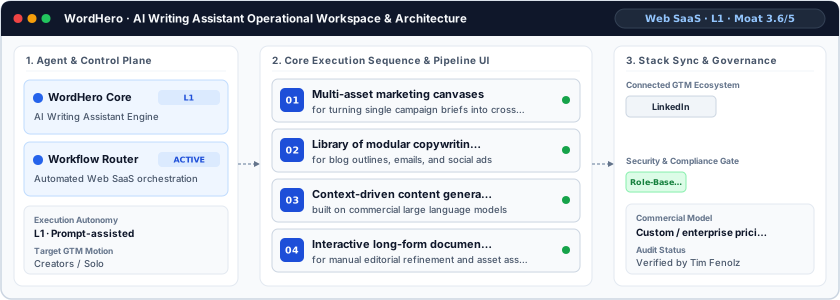
Limitations
Operational considerations and platform boundaries include:
- Semantic Drift and Hallucination: Because the tool relies on general foundation model completion wrappers without automated fact-checking or retrieval-augmented generation pipelines, complex B2B outputs require heavy human verification.
- Lack of Autonomous Execution: The system lacks native autonomous agent capabilities or headless API webhook triggers, preventing it from publishing directly to content management systems or automated marketing stacks.
- Brand Tone Consistency: Without dynamic vector embeddings or deep organizational knowledge graphs, multi-channel outputs across large canvases can exhibit voice inconsistencies between generated ad variations and technical editorial drafts.
WordHero pricing
Pricing is available on request through tailored enterprise sales quotes, with custom enterprise tiers structured around organizational scale, user seats, and workflow volume.
How WordHero compares
WordHero occupies a generalist middle tier against subtrack competitors such as QuillBot, Rytr, and AISEO. While QuillBot concentrates narrowly on sentence-level paraphrasing and academic syntax restructuring, and Rytr provides lightweight, fast micro-copy widgets, WordHero differentiates through multi-asset canvas workspaces. Conversely, technical search engine optimization suites like AISEO offer deeper keyword density analysis and automated SERP extraction. WordHero remains best aligned with mid-market digital agencies and content teams prioritizing unified campaign asset generation over deep algorithmic SEO auditing. It is best suited for enterprise marketing teams and growth practitioners seeking disciplined workflow orchestration.
Frequently asked questions about WordHero
How much does WordHero cost and does it require a custom enterprise quote?
Published pricing summary for WordHero: Custom / enterprise pricing. A permanent free plan is not disclosed for WordHero. Verified tier schedule: Entry / Starter ($48/mo for 1–2 seats); Enterprise / Custom (Custom quote for 15–50+ seats (Enterprise SLA)). Pricing is available on request through tailored enterprise sales quotes, with custom enterprise tiers structured around organizational scale, user seats, and workflow volume.
How does WordHero work and how autonomous is its AI architecture?
AI-powered content workspace and writing assistant designed to generate marketing copy, campaign assets, and long-form articles across structured templates. Within AI Writing Assistant (Writing Assistants & Paraphrasing), MarTechRadar rates its execution architecture at L1 · Prompt-assisted with a verified Moat Score of 3.6 / 5.0 (Proprietary moat). Low moat defensibility. Operates as a thin UX wrapper around commercial frontier LLM APIs with pre-engineered prompt templates and multi-asset canvas workflows, lacking proprietary foundation models or unique fine-tuning data pipelines. Corporate profile: operating at 2-10 employees scale.
What are the main limitations of WordHero and when should buyers walk away?
Based on our editorial technical audit, key operational considerations and boundaries for WordHero include: (1) Semantic Drift and Hallucination: Because the tool relies on general foundation model completion wrappers without automated fact-checking or retrieval-augmented generation pipelines, complex B2B outputs require heavy human verification. (2) Lack of Autonomous Execution: The system lacks native autonomous agent capabilities or headless API webhook triggers, preventing it from publishing directly to content management systems or automated marketing stacks. (3) Brand Tone Consistency: Without dynamic vector embeddings or deep organizational knowledge graphs, multi-channel outputs across large canvases can exhibit voice inconsistencies between generated ad variations and technical editorial drafts. Primary procurement walk-away rule: Walk away if you require transparent self-serve monthly billing or your budget ceiling is under $1,000/mo (WordHero requires sales-gated custom quoting).
What integrations, compliance certifications, and contract terms apply to WordHero?
Verified ecosystem and stack integrations include LinkedIn. Key TCO multiplier to watch: Annual Billing Headline vs. Monthly Premium (Headline entry rates reflect annual billing commitments (Save up to 25%); month-to-month flexibility carries a higher effective monthly rate or requires annual prepayment.) Before signing a contract, procurement teams should demand a 30- to 60-day paid pilot opt-out clause in the WordHero order form before signing a 12-month enterprise commitment.
What are the best WordHero alternatives and head-to-head competitors in 2026?
Top fact-checked alternatives to WordHero in AI Writing Assistant (Writing Assistants & Paraphrasing) include Typli (From $14.99/mo), Robinize (Custom / enterprise pricing), BlogNLP (From $9.99/mo), Cohesive AI (From $2.08/mo). WordHero occupies a generalist middle tier against subtrack competitors such as QuillBot, Rytr, and AISEO.
Verified sources & evidence trail
- Official product domain: https://wordhero.co
- Commercial pricing verification: Verified against official vendor pricing policy (Custom / enterprise pricing)
- Verified corporate entity profiles (
sameAs): LinkedIn Company Profile - First-party governance & documentation links: Terms · Privacy
- Editorial audit sign-off: Fact-checked by Tim Fenolz on under the MarTechRadar Evidence-Ledger Protocol.