Cohesive AI Review (2026): AI Writing Assistant Pricing, Limits & Alternatives
Bottom line
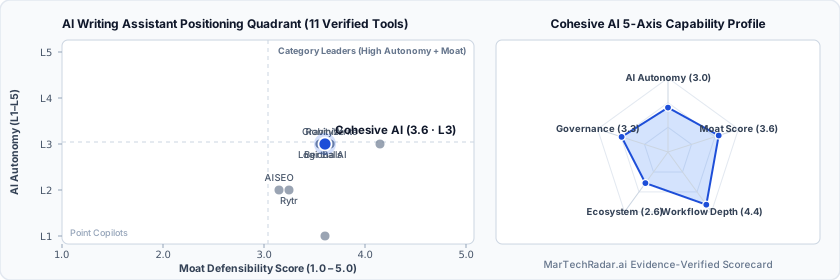
Cohesive AI is a Web SaaS tool for AI Writing Assistant (Writing Assistants & Paraphrasing) in Copy & Content. Pricing: From $2.08/mo. Best suited to B2B SaaS and Creators / Solo. Editor ratings: AI autonomy L3 (conditional automation); moat score 3.6/5.0 (Proprietary moat). Fact-checked by Sarah Per on Oct 14, 2026.
Cohesive AI is a collaborative generative writing workspace that combines structured prompt templates with an inline canvas editor to streamline content.
Cohesive AI buyer fit verdict: when to choose vs. when to walk away
Choose Cohesive AI if (Best Fit)
- Target ICP & Stack Fit: You operate as B2B SaaS and Creators / Solo requiring a Web SaaS deployment for AI Writing Assistant.
- L3 Architecture & Defensibility: Moat strength is low-to-moderate. The solution relies primarily on third-party foundational LLM endpoints wrapped in a templated canvas interface, making defensibility contingent on workflow stickiness rather than proprietary model weights.
- Commercial Model Fit: Your procurement budget aligns with From $2.08/mo.
Walk away from Cohesive AI if (Deal-Breakers)
- Walk away if your workflow requires uncapped enterprise volume on the From $2.08/mo entry plan without upgrading tiers.
- Walk away if your workflow cannot tolerate foundational model dependency: Because the platform acts primarily as an inference abstraction layer on third-party APIs, changes to underlying upstream model behavior directly impact output determinism, latency, and context-window boundaries.
- Walk away if contextual token constraints is a deal-breaker for your team: Generating cohesive long-form research papers or serialized documentation frequently leads to token degradation, resulting in repetitive phrase structures across complex multi-section content generation pipelines.
Cohesive AI key facts & scorecard
| Pricing | From $2.08/moVendor pricing page |
|---|---|
| Free plan | No / not disclosed |
| Delivery | Web SaaS |
| Audience | B2B SaaS, Creators / Solo |
| AI autonomy level | L3 · Conditional automationEditor-verified |
| Moat tier & score | 3.6 / 5.0 · Proprietary moatEditor-verified |
| Funding | Seed |
| Governance & docs | Terms ↗ · Privacy ↗ |
| Headquarters | United States |
| Last verified |
Cohesive AI pros & cons: strengths vs. operational limitations
Pros: core strengths & capabilities
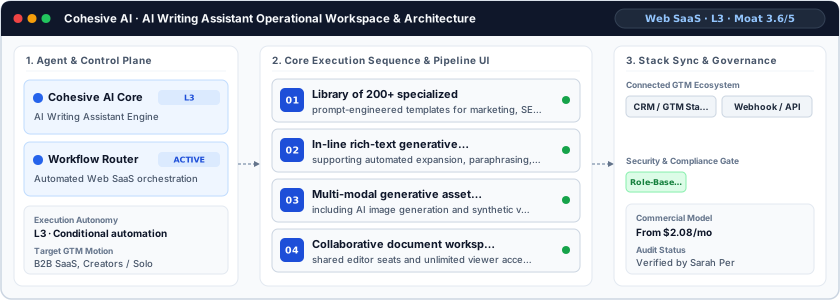
- Library of 200+ specialized: prompt-engineered templates for marketing, SEO, and copywriting
- In-line rich-text generative editor: supporting automated expansion, paraphrasing, and summarization
- Multi-modal generative asset capabilities: including AI image generation and synthetic voiceover tracks
- Collaborative document workspace offering: shared editor seats and unlimited viewer access
Cons: operational limitations & risks
- Foundational Model Dependency: Because the platform acts primarily as an inference abstraction layer on third-party APIs, changes to underlying upstream model behavior directly impact output determinism, latency, and context-window boundaries.
- Contextual Token Constraints: Generating cohesive long-form research papers or serialized documentation frequently leads to token degradation, resulting in repetitive phrase structures across complex multi-section content generation pipelines.
- Enterprise Governance Gaps: The system lacks automated bi-directional synchronization with external digital asset management systems, custom vector embeddings for strict brand guideline enforcement, and granular role-based attribute auditing.
Cohesive AI TCO & deal-breaker stress test
Simulate 12-month stepped TCO, hidden cost multipliers, contract lock-in exposure, and stack failure modes using only facts verified by Sarah Per on · Capture SHA ec0db9ce.
Cohesive AI is viable for 5 seats, but requires commercial or technical verification on the flagged items below.
| Plan / Tier | Verified Rate | Scale Fit | Scope & Quota Notes |
|---|---|---|---|
| Creator | $3.75/mo | 1–2 seats | Subscribe to Agency |
| Creator | $25/mo | 5 seats | For Solopreneurs & Freelancers |
| Agency | $45/mo | 15 seats | For Pro Creators & Growing Teams |
- Moat Score
- 3.6 / 5.0
- AI Autonomy
- L3
- Free Tier / Trial
- None disclosed
Triggered audit signals & failure modes
- Published Self-Serve Entry FloorVerified Pricing Ledger
Cohesive AI publishes a transparent entry point (From $2.08/mo) for initial validation before committing.
- Usage / Credit Burn VolatilityCommercial Model Audit
Cohesive AI uses credit or usage-metered billing (From $2.08/mo). High-volume automated workflows across 5 seats can trigger mid-cycle overage charges.
- Tier Fit for 5-Seat Scale: Creator ($3.75/mo)Verified Tier Schedule
Subscribe to Agency
- Primary Operational Bottleneck: Foundational Model DependencyAudit by Sarah Per
Because the platform acts primarily as an inference abstraction layer on third-party APIs, changes to underlying upstream model behavior directly impact output determinism, latency, and context-window boundaries.
Hidden TCO Multipliers & Quota Gates
- Annual Billing Headline vs. Monthly Premium: Headline entry rates reflect annual billing commitments; month-to-month flexibility carries a higher effective monthly rate or requires annual prepayment.
- Credit & Usage Burn Multiplier: Automated workflows consume metered credits/usage quotas; multi-step enrichment, voice minutes, or high-frequency agent runs can trigger mid-cycle top-up packs.
When to Walk Away & Negotiation Levers
- Walk away if your workflow requires uncapped enterprise volume on the From $2.08/mo entry plan without upgrading tiers.
- Walk away if your workflow cannot tolerate foundational model dependency: Because the platform acts primarily as an inference abstraction layer on third-party APIs, changes to underlying upstream model behavior directly impact output determinism, latency, and context-window boundaries.
- Walk away if contextual token constraints is a deal-breaker for your team: Generating cohesive long-form research papers or serialized documentation frequently leads to token degradation, resulting in repetitive phrase structures across complex multi-section content generation pipelines.
- Validate exact quota thresholds (seats, credits, or API calls) included in Cohesive AI's From $2.08/mo tier before converting from monthly to annual billing.
- Require a sandbox proof-of-concept testing foundational model dependency against your live CRM/data schema before annual sign-off.
Ask a custom procurement or TCO stress-test question about Cohesive AI
Lower 5-seat floor (~$10/mo vs. Usage-Metered)
Lower 5-seat floor (~$15/mo vs. Usage-Metered)
Cohesive AI moat & subtrack positioning
Moat strength is low-to-moderate. The solution relies primarily on third-party foundational LLM endpoints wrapped in a templated canvas interface, making defensibility contingent on workflow stickiness rather than proprietary model weights.
Editorial review
Fact-checked by Sarah Per (Principal Content Systems & Generative Media Editor) on .
Background
For growth marketing teams and solo operators struggling with the operational friction of raw prompt engineering, Cohesive AI provides a structured, template-driven generative writing workspace. Headquartered in the United States, the platform abstracts complex model prompting behind an intuitive editing canvas tailored for copywriters, social marketers, and content strategists. Instead of relying on open-ended conversational interfaces, Cohesive AI structures production around functional assets such as blog outlines, social variants, and marketing collateral, directly serving practitioners focused on accelerating editorial delivery.
How Cohesive AI works
At its technical core, Cohesive AI operates as an orchestration wrapper on top of commercial foundational models, including GPT-3.5 and advanced frontier checkpoints. The engine leverages an interactive rich-text canvas coupled with a catalog of over 200 pre-configured prompt architectures. When an operator triggers a template, Cohesive AI dynamically injects structured parameters into backend inference pipelines, generating grounded textual drafts. The system operates at an L3 autonomy profile, automating draft synthesis and contextual paraphrasing while requiring human-in-the-loop review for final revision, tone calibration, and publishing validation.
Limitations
Operational considerations and platform boundaries include:
- Foundational Model Dependency: Because the platform acts primarily as an inference abstraction layer on third-party APIs, changes to underlying upstream model behavior directly impact output determinism, latency, and context-window boundaries.
- Contextual Token Constraints: Generating cohesive long-form research papers or serialized documentation frequently leads to token degradation, resulting in repetitive phrase structures across complex multi-section content generation pipelines.
- Enterprise Governance Gaps: The system lacks automated bi-directional synchronization with external digital asset management systems, custom vector embeddings for strict brand guideline enforcement, and granular role-based attribute auditing.
Cohesive AI pricing
Cohesive AI monetizes via a tiered software-as-a-service model. Entry-level access begins at $2.08 per month when billed annually, serving individual users seeking baseline template generation. For dedicated production, the Creator tier scales to $25 per editor monthly, unlocking higher template compute allocations, faster inference, and priority generation features. Enterprise buyers must note that multi-seat deployments scale linearly on a per-editor basis, with specialized media generations such as synthetic voice and image tokens capped under monthly quota thresholds.
How Cohesive AI compares
Within the writing assistant ecosystem, Cohesive AI competes with AISEO, Rytr, and QuillBot. While QuillBot concentrates tightly on syntactic rewriting and sentence-level restructuring, Cohesive AI provides broader canvas-based document generation with rich media capabilities. Compared to AISEO's technical search engine focus and programmatic SERP analysis, Cohesive prioritizes creative variety and social distribution templates. The platform is best matched for decentralized content teams and freelance operations prioritizing template diversity over heavy programmatic SEO integration.
Frequently asked questions about Cohesive AI
How much does Cohesive AI cost and what pricing tiers are available?
Published pricing summary for Cohesive AI: From $2.08/mo. A permanent free plan is not disclosed for Cohesive AI. Verified tier schedule: Creator ($3.75/mo for 1–2 seats); Creator ($25/mo for 5 seats); Agency ($45/mo for 15 seats). Cohesive AI monetizes via a tiered software-as-a-service model. Entry-level access begins at $2.08 per month when billed annually, serving individual users seeking baseline template generation.
How does Cohesive AI work and how autonomous is its AI architecture?
Cohesive AI is a collaborative generative writing workspace that combines structured prompt templates with an inline canvas editor to streamline content. Within AI Writing Assistant (Writing Assistants & Paraphrasing), MarTechRadar rates its execution architecture at L3 · Conditional automation with a verified Moat Score of 3.6 / 5.0 (Proprietary moat). Moat strength is low-to-moderate. The solution relies primarily on third-party foundational LLM endpoints wrapped in a templated canvas interface, making defensibility contingent on workflow stickiness rather than proprietary model weights.
What are the main limitations of Cohesive AI and when should buyers walk away?
Based on our editorial technical audit, key operational considerations and boundaries for Cohesive AI include: (1) Foundational Model Dependency: Because the platform acts primarily as an inference abstraction layer on third-party APIs, changes to underlying upstream model behavior directly impact output determinism, latency, and context-window boundaries. (2) Contextual Token Constraints: Generating cohesive long-form research papers or serialized documentation frequently leads to token degradation, resulting in repetitive phrase structures across complex multi-section content generation pipelines. (3) Enterprise Governance Gaps: The system lacks automated bi-directional synchronization with external digital asset management systems, custom vector embeddings for strict brand guideline enforcement, and granular role-based attribute auditing. Primary procurement walk-away rule: Walk away if your workflow requires uncapped enterprise volume on the From $2.08/mo entry plan without upgrading tiers.
What integrations, compliance certifications, and contract terms apply to Cohesive AI?
Key TCO multiplier to watch: Annual Billing Headline vs. Monthly Premium (Headline entry rates reflect annual billing commitments; month-to-month flexibility carries a higher effective monthly rate or requires annual prepayment.) Before signing a contract, procurement teams should validate exact quota thresholds (seats, credits, or API calls) included in Cohesive AI's From $2.08/mo tier before converting from monthly to annual billing.
What are the best Cohesive AI alternatives and head-to-head competitors in 2026?
Top fact-checked alternatives to Cohesive AI in AI Writing Assistant (Writing Assistants & Paraphrasing) include BlogNLP (From $9.99/mo), WordHero (Custom / enterprise pricing), Rytr (Free plan · $7.50–$24.16/mo), QuillBot (Custom / enterprise pricing). Within the writing assistant ecosystem, Cohesive AI competes with AISEO, Rytr, and QuillBot. While QuillBot concentrates tightly on syntactic rewriting and sentence-level restructuring, Cohesive AI provides broader canvas-based document generation with rich media capabilities.
Verified sources & evidence trail
- Official product domain: https://cohesive.so
- Commercial pricing verification: https://cohesive.so/pricing
- First-party governance & documentation links: Terms · Privacy
- Editorial audit sign-off: Fact-checked by Sarah Per on under the MarTechRadar Evidence-Ledger Protocol.