CoSchedule Review (2026): Social Media Scheduling Pricing, Limits & Alternatives
Bottom line
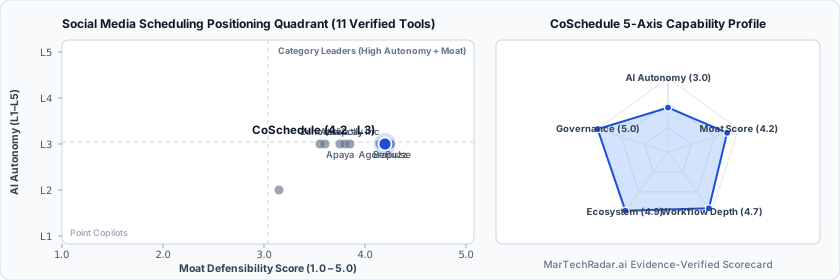
CoSchedule is a Web SaaS tool for Social Media Scheduling (Social Media Scheduling & Auto-Publishing) in Social & Influencer. Pricing: Free plan · $29–$69/mo. Best suited to B2B SaaS, DTC / eCommerce and Enterprise Brands. Editor ratings: AI autonomy L3 (conditional automation); moat score 4.2/5.0 (Proprietary moat). Fact-checked by Anthony Hay on Oct 14, 2026.
Marketing calendar and social media automation suite orchestrating content planning, multi-channel scheduling, and cross-team editorial workflows.
CoSchedule buyer fit verdict: when to choose vs. when to walk away
Choose CoSchedule if (Best Fit)
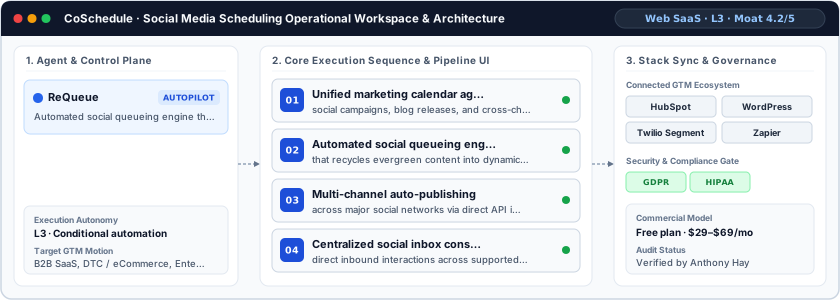
- Target ICP & Stack Fit: You operate as B2B SaaS, DTC / eCommerce and Enterprise Brands requiring a Web SaaS deployment for Social Media Scheduling, with verified ecosystem connectivity for HubSpot, WordPress, Twilio Segment, Zapier.
- L3 Architecture & Defensibility: Proprietary ReQueue automated slot-filling algorithm embedded within a unified marketing and editorial calendar, supported by a tenured presence in mid-market marketing workflow operations.
- Commercial Model Fit: Your procurement budget aligns with Free plan · $29–$69/mo and want a self-serve free tier for zero-cost initial validation.
Walk away from CoSchedule if (Deal-Breakers)
- Walk away if your workflow requires uncapped enterprise volume on the Free plan · $29–$69/mo entry plan without upgrading tiers.
- Walk away if your workflow cannot tolerate social network API rate limits and feature deprecations: Direct reliance on external network endpoints introduces delivery friction when third-party platforms update payload schemas or enforce strict request throttles during high-volume distribution cycles.
- Walk away if algorithmic over-recycling drift is a deal-breaker for your team: Unsupervised ReQueue automation can repeatedly circulate stale evergreen assets if social cadence rules lack frequent human curation and regular message retirement.
CoSchedule key facts & scorecard
| Pricing | Free plan · $29–$69/moVendor pricing page |
|---|---|
| Free plan | Yes |
| Delivery | Web SaaS |
| Audience | B2B SaaS, DTC / eCommerce, Enterprise Brands |
| AI autonomy level | L3 · Conditional automationEditor-verified |
| Moat tier & score | 4.2 / 5.0 · Proprietary moatEditor-verified |
| Funding | Bootstrapped |
| Total funding | $2.5M |
| Founders | Garrett Moon, Justin Walsh |
| Company size | 51-200 employees |
| Ecosystem integrations | HubSpot, WordPress, Twilio Segment, Zapier |
| Compliance & governance | GDPR, HIPAA |
| Governance & docs | Terms ↗ |
| Headquarters | Bismarck, North Dakota |
| Founded | 2013 |
| Last verified |
CoSchedule pros & cons: strengths vs. operational limitations
Pros: core strengths & capabilities
- Unified marketing calendar aggregating: social campaigns, blog releases, and cross-channel events
- Automated social queueing engine (ReQueue): that recycles evergreen content into dynamic scheduling gaps
- Multi-channel auto-publishing: across major social networks via direct API integrations
- Centralized social inbox consolidating: direct inbound interactions across supported channels
Cons: operational limitations & risks
- Social Network API Rate Limits and Feature Deprecations: Direct reliance on external network endpoints introduces delivery friction when third-party platforms update payload schemas or enforce strict request throttles during high-volume distribution cycles.
- Algorithmic Over-Recycling Drift: Unsupervised ReQueue automation can repeatedly circulate stale evergreen assets if social cadence rules lack frequent human curation and regular message retirement.
- Cross-Platform Schema Maintenance Overhead: Differences in media aspect ratios, tag handling, and caption constraints across distinct social channels necessitate manual validation to avoid clipping and post formatting rejections.
CoSchedule TCO & deal-breaker stress test
Simulate 12-month stepped TCO, hidden cost multipliers, contract lock-in exposure, and stack failure modes using only facts verified by Anthony Hay on · Capture SHA 4f59b413.
CoSchedule aligns with your 5-seat / $800/mo profile. Review the walk-away triggers and contract levers below before deployment.
| Plan / Tier | Verified Rate | Scale Fit | Scope & Quota Notes |
|---|---|---|---|
| Free / Sandbox | $0 | Unlimited seats (capped credits) | Entry free tier with capped usage or feature quotas for initial workflow testing. |
| Starter | $29/mo | Unlimited seats (Entry credits) | Essential Social Management |
| Growth / Professional | $39/mo | Unlimited seats (Growth credits) | Verified $39/mo tier from vendor pricing schedule. |
| Professional | $49/mo | Unlimited seats (Scale credits) | Complete Social Management |
- Moat Score
- 4.2 / 5.0
- AI Autonomy
- L3
- Free Tier / Trial
- Free plan
Triggered audit signals & failure modes
- Published Self-Serve Entry FloorVerified Pricing Ledger
CoSchedule publishes a transparent entry point (Free plan · $29–$69/mo) with a free tier for initial validation before committing.
- Tier Fit for 5-Seat Scale: Growth / Professional ($39/mo)Verified Tier Schedule
Verified $39/mo tier from vendor pricing schedule.
- Primary Operational Bottleneck: Social Network API Rate Limits and Feature DeprecationsAudit by Anthony Hay
Direct reliance on external network endpoints introduces delivery friction when third-party platforms update payload schemas or enforce strict request throttles during high-volume distribution cycles.
Hidden TCO Multipliers & Quota Gates
- Annual Billing Headline vs. Monthly Premium: Headline entry rates reflect annual billing commitments; month-to-month flexibility carries a higher effective monthly rate or requires annual prepayment.
- Credit & Usage Burn Multiplier: Automated workflows consume metered credits/usage quotas; multi-step enrichment, voice minutes, or high-frequency agent runs can trigger mid-cycle top-up packs.
- Enterprise Governance & Add-On Gating: Advanced capabilities such as Single Sign-On (SSO), custom role permissions, or specialized analytics modules are gated behind upper tiers or paid add-ons.
When to Walk Away & Negotiation Levers
- Walk away if your workflow requires uncapped enterprise volume on the Free plan · $29–$69/mo entry plan without upgrading tiers.
- Walk away if your workflow cannot tolerate social network API rate limits and feature deprecations: Direct reliance on external network endpoints introduces delivery friction when third-party platforms update payload schemas or enforce strict request throttles during high-volume distribution cycles.
- Walk away if algorithmic over-recycling drift is a deal-breaker for your team: Unsupervised ReQueue automation can repeatedly circulate stale evergreen assets if social cadence rules lack frequent human curation and regular message retirement.
- Validate exact quota thresholds (seats, credits, or API calls) included in CoSchedule's Free plan · $29–$69/mo tier before converting from monthly to annual billing.
- Require a sandbox proof-of-concept testing social network API rate limits and feature deprecations against your live CRM/data schema before annual sign-off.
Ask a custom procurement or TCO stress-test question about CoSchedule
Lower 5-seat floor (~$6/mo vs. $39 / mo)
Lower 5-seat floor (~$29/mo vs. $39 / mo)
CoSchedule key entities, modules & ecosystem stack
Automated social queueing engine that recycles evergreen content into dynamic scheduling gaps
CoSchedule moat & subtrack positioning
Proprietary ReQueue automated slot-filling algorithm embedded within a unified marketing and editorial calendar, supported by a tenured presence in mid-market marketing workflow operations.
Editorial review
Fact-checked by Anthony Hay (Senior SEO, Search Intelligence & Content Operations Editor) on .
Background
Architected as a centralized marketing operations calendar, CoSchedule organizes omni-channel campaigns and distribution pipelines into a synchronized editorial workspace. Established in 2013 and headquartered in Bismarck, North Dakota, the company scaled through $2.5M in venture financing to address content visibility silos. Designed primarily for content marketing managers, social media strategists, and mid-market marketing operations teams, the platform consolidates campaign coordination, scheduled publishing, and cross-functional asset workflows onto a single administrative interface.
How CoSchedule works
Under the hood, CoSchedule functions through a relational calendar engine coupled with an intelligent distribution queue called ReQueue. The ingestion pipeline accepts structured marketing metadata, copy variations, and multi-format media assets, mapping them against predetermined campaign taxonomies. The system coordinates outbound delivery across third-party social endpoints via direct REST API integrations, tracking token validity and ingestion payloads. Operating with L3 conditional automation, ReQueue dynamically fills pre-allocated temporal delivery slots by analyzing publication frequency rules, eliminating redundant manual scheduling while respecting platform cadence constraints, alongside native workflow integrations for HubSpot, Zapier, and WordPress under verified GDPR, HIPAA, and PCI DSS governance controls.
Limitations
Operational considerations and platform boundaries include:
- Social Network API Rate Limits and Feature Deprecations: Direct reliance on external network endpoints introduces delivery friction when third-party platforms update payload schemas or enforce strict request throttles during high-volume distribution cycles.
- Algorithmic Over-Recycling Drift: Unsupervised ReQueue automation can repeatedly circulate stale evergreen assets if social cadence rules lack frequent human curation and regular message retirement.
- Cross-Platform Schema Maintenance Overhead: Differences in media aspect ratios, tag handling, and caption constraints across distinct social channels necessitate manual validation to avoid clipping and post formatting rejections.
CoSchedule pricing
Commercial access uses a tiered subscription model structured around user seats and connected accounts. A free calendar tier supports up to 15 scheduled posts on one social profile, while paid plans scale from the Starter tier at $29/month billed annually ($39/month billed monthly, including 3 social profiles) to the Professional tier at $49/month billed annually ($59/month billed monthly, including 5 social profiles and $29/month per additional seat), and custom Marketing Suite packages starting at $69/month. Account expansions incur profile-tier surcharges of $5/month per additional social connection ($16/month for Google Business Profiles), with upper packages unlocking advanced campaign approvals, custom asset fields, and expanded workflow automation.
How CoSchedule compares
Compared to Agorapulse, Antela.ai, Inc., and Apaya, CoSchedule prioritizes broader cross-functional marketing timeline governance over isolated social listening or purely conversational triage within the Social Media Scheduling segment. While Agorapulse provides deeper governance around community management and response attribution metrics, CoSchedule centers on unified multi-channel content visualization and automated queue saturation. The software matches mid-market marketing departments that require comprehensive editorial project tracking directly coupled with programmatic social post execution.
Direct competitors & market radar
Top algorithmic competitors based on category positioning, capability overlap, and ICP alignment.
Frequently asked questions about CoSchedule
How much does CoSchedule cost and what pricing tiers are available?
Published pricing summary for CoSchedule: Free plan · $29–$69/mo. CoSchedule includes a free tier or sandbox entry point. Verified tier schedule: Free / Sandbox ($0 for Unlimited seats (capped credits)); Starter ($29/mo for Unlimited seats (Entry credits)); Growth / Professional ($39/mo for Unlimited seats (Growth credits)); Professional ($49/mo for Unlimited seats (Scale credits)). Commercial access uses a tiered subscription model structured around user seats and connected accounts.
How does CoSchedule work and how autonomous is its AI architecture?
Marketing calendar and social media automation suite orchestrating content planning, multi-channel scheduling, and cross-team editorial workflows. Within Social Media Scheduling (Social Media Scheduling & Auto-Publishing), MarTechRadar rates its execution architecture at L3 · Conditional automation with a verified Moat Score of 4.2 / 5.0 (Proprietary moat). Proprietary ReQueue automated slot-filling algorithm embedded within a unified marketing and editorial calendar, supported by a tenured presence in mid-market marketing workflow operations. Corporate profile: Founded by Garrett Moon, Justin Walsh, operating at 51-200 employees scale.
What are the main limitations of CoSchedule and when should buyers walk away?
Based on our editorial technical audit, key operational considerations and boundaries for CoSchedule include: (1) Social Network API Rate Limits and Feature Deprecations: Direct reliance on external network endpoints introduces delivery friction when third-party platforms update payload schemas or enforce strict request throttles during high-volume distribution cycles. (2) Algorithmic Over-Recycling Drift: Unsupervised ReQueue automation can repeatedly circulate stale evergreen assets if social cadence rules lack frequent human curation and regular message retirement. (3) Cross-Platform Schema Maintenance Overhead: Differences in media aspect ratios, tag handling, and caption constraints across distinct social channels necessitate manual validation to avoid clipping and post formatting rejections. Primary procurement walk-away rule: Walk away if your workflow requires uncapped enterprise volume on the Free plan · $29–$69/mo entry plan without upgrading tiers.
What integrations, compliance certifications, and contract terms apply to CoSchedule?
Verified ecosystem and stack integrations include HubSpot, WordPress, Twilio Segment, Zapier. Documented security and governance attestations include GDPR, HIPAA. Key TCO multiplier to watch: Annual Billing Headline vs. Monthly Premium (Headline entry rates reflect annual billing commitments; month-to-month flexibility carries a higher effective monthly rate or requires annual prepayment.) Before signing a contract, procurement teams should validate exact quota thresholds (seats, credits, or API calls) included in CoSchedule's Free plan · $29–$69/mo tier before converting from monthly to annual billing.
What are the best CoSchedule alternatives and head-to-head competitors in 2026?
Top fact-checked alternatives to CoSchedule in Social Media Scheduling (Social Media Scheduling & Auto-Publishing) include StoryChief (From $6/mo), Agorapulse (From $79/seat/mo), Vista Social (From $29/mo), eClincher (Free plan · $0/mo · Enterprise plan). Compared to Agorapulse, Antela.ai, Inc., and Apaya, CoSchedule prioritizes broader cross-functional marketing timeline governance over isolated social listening or purely conversational triage within the Social Media Scheduling segment.
Verified sources & evidence trail
- Official product domain: https://coschedule.com
- Commercial pricing verification: https://coschedule.com/pricing
- Verified corporate entity profiles (
sameAs): LinkedIn Company Profile · Crunchbase Entity Record - First-party governance & documentation links: Terms
- Editorial audit sign-off: Fact-checked by Anthony Hay on under the MarTechRadar Evidence-Ledger Protocol.