StoryChief Review (2026): AI Content Marketing Pricing, Limits & Alternatives
Bottom line
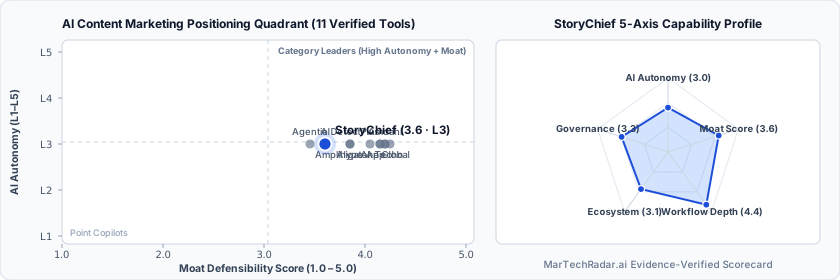
StoryChief is a Web SaaS tool for AI Content Marketing (Enterprise & Long-Form Brand Content) in Copy & Content. Pricing: From $6/mo. Best suited to DTC / eCommerce and Enterprise Brands. Editor ratings: AI autonomy L3 (conditional automation); moat score 3.6/5.0 (Proprietary moat). Fact-checked by Sarah Per on Oct 15, 2026.
Centralized content marketing orchestration platform that unifies planning, multi-LLM drafting, editorial approvals, and multi-channel publishing workflows.
StoryChief buyer fit verdict: when to choose vs. when to walk away
Choose StoryChief if (Best Fit)
- Target ICP & Stack Fit: You operate as DTC / eCommerce and Enterprise Brands requiring a Web SaaS deployment for AI Content Marketing.
- L3 Architecture & Defensibility: Deep bi-directional CMS and social publishing integrations combined with centralized cross-network analytics and collaborative multi-LLM editorial governance.
- Commercial Model Fit: Your procurement budget aligns with From $6/mo.
Walk away from StoryChief if (Deal-Breakers)
- Walk away if your workflow requires uncapped enterprise volume on the From $6/mo entry plan without upgrading tiers.
- Walk away if your workflow cannot tolerate CMS payload serialization limits: Complex custom field mappings or non-standard headless CMS schemas require manual payload reconciliation, limiting out-of-the-box syndication for deeply customized frontends.
- Walk away if AI consumption throttling is a deal-breaker for your team: Generative drafting relies on discrete monthly credit allotments, creating potential execution bottlenecks during high-volume content production cycles without manual tier expansion.
StoryChief key facts & scorecard
| Pricing | From $6/moVendor pricing page |
|---|---|
| Free plan | No / not disclosed |
| Delivery | Web SaaS |
| Audience | DTC / eCommerce, Enterprise Brands |
| AI autonomy level | L3 · Conditional automationEditor-verified |
| Moat tier & score | 3.6 / 5.0 · Proprietary moatEditor-verified |
| Funding | Series A |
| Company size | 11-50 employees |
| Governance & docs | API & Docs ↗ · Terms ↗ · Privacy ↗ |
| Headquarters | Ghent, Flemish Region |
| Founded | 2016 |
| Last verified |
StoryChief pros & cons: strengths vs. operational limitations
Pros: core strengths & capabilities
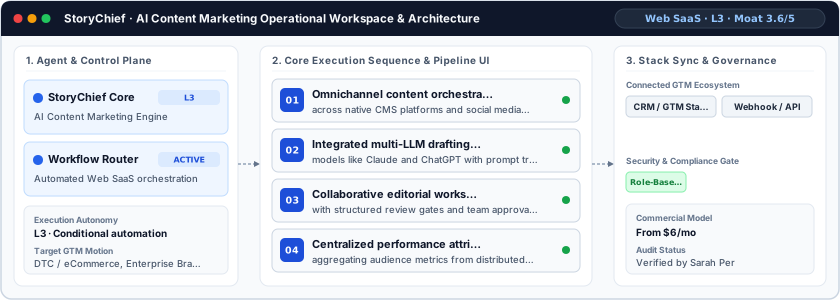
- Omnichannel content orchestration: across native CMS platforms and social media channels
- Integrated multi-LLM drafting supporting: models like Claude and ChatGPT with prompt tracking
- Collaborative editorial workspace: with structured review gates and team approvals
- Centralized performance attribution dashboard: aggregating audience metrics from distributed channels
Cons: operational limitations & risks
- CMS Payload Serialization Limits: Complex custom field mappings or non-standard headless CMS schemas require manual payload reconciliation, limiting out-of-the-box syndication for deeply customized frontends.
- AI Consumption Throttling: Generative drafting relies on discrete monthly credit allotments, creating potential execution bottlenecks during high-volume content production cycles without manual tier expansion.
- Bi-Directional Sync Latency: Post-publication updates executed directly in target CMS repositories do not automatically back-propagate to StoryChief master records, introducing version drift risk.
StoryChief TCO & deal-breaker stress test
Simulate 12-month stepped TCO, hidden cost multipliers, contract lock-in exposure, and stack failure modes using only facts verified by Sarah Per on · Capture SHA c37db5a6.
StoryChief aligns with your 5-seat / $800/mo profile. Review the walk-away triggers and contract levers below before deployment.
| Plan / Tier | Verified Rate | Scale Fit | Scope & Quota Notes |
|---|---|---|---|
| Entry / Starter | $6/mo | 1–2 seats | Every feature, every plan |
| Starter | $59/mo | 5 seats | Build a consistent publishing habit. |
- Moat Score
- 3.6 / 5.0
- AI Autonomy
- L3
- Free Tier / Trial
- None disclosed
Triggered audit signals & failure modes
- Published Self-Serve Entry FloorVerified Pricing Ledger
StoryChief publishes a transparent entry point (From $6/mo) for initial validation before committing.
- Tier Fit for 5-Seat Scale: Starter ($59/mo)Verified Tier Schedule
Build a consistent publishing habit.
- Primary Operational Bottleneck: AI Consumption ThrottlingAudit by Sarah Per
Generative drafting relies on discrete monthly credit allotments, creating potential execution bottlenecks during high-volume content production cycles without manual tier expansion.
Hidden TCO Multipliers & Quota Gates
- Annual Billing Headline vs. Monthly Premium: Headline entry rates reflect annual billing commitments (Save 17%); month-to-month flexibility carries a higher effective monthly rate or requires annual prepayment.
- Credit & Usage Burn Multiplier: Automated workflows consume metered credits/usage quotas; multi-step enrichment, voice minutes, or high-frequency agent runs can trigger mid-cycle top-up packs.
- Enterprise Governance & Add-On Gating: Advanced capabilities such as Single Sign-On (SSO), custom role permissions, or specialized analytics modules are gated behind upper tiers or paid add-ons.
When to Walk Away & Negotiation Levers
- Walk away if your workflow requires uncapped enterprise volume on the From $6/mo entry plan without upgrading tiers.
- Walk away if your workflow cannot tolerate CMS payload serialization limits: Complex custom field mappings or non-standard headless CMS schemas require manual payload reconciliation, limiting out-of-the-box syndication for deeply customized frontends.
- Walk away if AI consumption throttling is a deal-breaker for your team: Generative drafting relies on discrete monthly credit allotments, creating potential execution bottlenecks during high-volume content production cycles without manual tier expansion.
- Validate exact quota thresholds (seats, credits, or API calls) included in StoryChief's From $6/mo tier before converting from monthly to annual billing.
- Require a sandbox proof-of-concept testing CMS payload serialization limits against your live CRM/data schema before annual sign-off.
Ask a custom procurement or TCO stress-test question about StoryChief
Lower 5-seat floor (~$29/mo vs. $59 / mo)
Lower 5-seat floor (~$24/mo vs. $59 / mo)
StoryChief moat & subtrack positioning
Deep bi-directional CMS and social publishing integrations combined with centralized cross-network analytics and collaborative multi-LLM editorial governance.
Editorial review
Fact-checked by Sarah Per (Principal Content Systems & Generative Media Editor) on .
Background
Architected as a centralized hub for omnichannel publishing, StoryChief decouples editorial production from downstream content management systems. Established in 2016 and headquartered in Ghent, Flemish Region, the company targets content marketing directors and multi-brand agency leads who need to coordinate cross-platform publishing pipelines. Rather than forcing editorial teams to manually paste copy across disparate blogs, social accounts, and newsletters, the system centralizes content orchestration upstream from the execution endpoints.
How StoryChief works
StoryChief operates an ingestion and distribution bus that interfaces directly with third-party generative models, including Claude and ChatGPT, alongside native editorial tools. Content artifacts are created within a unified editor, passed through rule-based brand governance guardrails, and mapped into structured payloads. Once approved through deterministic review workflows, the platform's API engine handles multi-channel syndication, pushing formatted assets to CMS platforms and social endpoints simultaneously while aggregating cross-channel engagement telemetry back into an analytics datastore.
Limitations
Operational considerations and platform boundaries include:
- CMS Payload Serialization Limits: Complex custom field mappings or non-standard headless CMS schemas require manual payload reconciliation, limiting out-of-the-box syndication for deeply customized frontends.
- AI Consumption Throttling: Generative drafting relies on discrete monthly credit allotments, creating potential execution bottlenecks during high-volume content production cycles without manual tier expansion.
- Bi-Directional Sync Latency: Post-publication updates executed directly in target CMS repositories do not automatically back-propagate to StoryChief master records, introducing version drift risk.
StoryChief pricing
StoryChief deploys a tiered subscription licensing model structured around operational volume, seat counts, and distribution endpoints. Entry packages begin from $6/month for specialized utility access, scaling into standard tiers like the Starter configuration at $59 per month (or $708 billed yearly) which bundles four social channels, twenty-five monthly articles, and allocated generative credits. Upper tiers scale progressively on user seats, tracked prompts, and enterprise syndication integrations.
How StoryChief compares
Compared to direct category competitors like Typeface and Writer, StoryChief functions as an alternative focused on reliable workflow execution and transparent unit economics. Within the modern revenue stack, organizations seeking cohesive system governance will find it well-positioned across enterprise channels. It is best suited for enterprise marketing teams and growth practitioners seeking disciplined workflow orchestration.
Direct competitors & market radar
Top algorithmic competitors based on category positioning, capability overlap, and ICP alignment.
Frequently asked questions about StoryChief
How much does StoryChief cost and what pricing tiers are available?
Published pricing summary for StoryChief: From $6/mo. A permanent free plan is not disclosed for StoryChief. Verified tier schedule: Entry / Starter ($6/mo for 1–2 seats); Starter ($59/mo for 5 seats). StoryChief deploys a tiered subscription licensing model structured around operational volume, seat counts, and distribution endpoints.
How does StoryChief work and how autonomous is its AI architecture?
Centralized content marketing orchestration platform that unifies planning, multi-LLM drafting, editorial approvals, and multi-channel publishing workflows. Within AI Content Marketing (Enterprise & Long-Form Brand Content), MarTechRadar rates its execution architecture at L3 · Conditional automation with a verified Moat Score of 3.6 / 5.0 (Proprietary moat). Deep bi-directional CMS and social publishing integrations combined with centralized cross-network analytics and collaborative multi-LLM editorial governance. Corporate profile: operating at 11-50 employees scale.
What are the main limitations of StoryChief and when should buyers walk away?
Based on our editorial technical audit, key operational considerations and boundaries for StoryChief include: (1) CMS Payload Serialization Limits: Complex custom field mappings or non-standard headless CMS schemas require manual payload reconciliation, limiting out-of-the-box syndication for deeply customized frontends. (2) AI Consumption Throttling: Generative drafting relies on discrete monthly credit allotments, creating potential execution bottlenecks during high-volume content production cycles without manual tier expansion. (3) Bi-Directional Sync Latency: Post-publication updates executed directly in target CMS repositories do not automatically back-propagate to StoryChief master records, introducing version drift risk. Primary procurement walk-away rule: Walk away if your workflow requires uncapped enterprise volume on the From $6/mo entry plan without upgrading tiers.
What integrations, compliance certifications, and contract terms apply to StoryChief?
First-party governance and developer endpoints verified on domain include: API Docs (https://developers.storychief.io). Key TCO multiplier to watch: Annual Billing Headline vs. Monthly Premium (Headline entry rates reflect annual billing commitments (Save 17%); month-to-month flexibility carries a higher effective monthly rate or requires annual prepayment.) Before signing a contract, procurement teams should validate exact quota thresholds (seats, credits, or API calls) included in StoryChief's From $6/mo tier before converting from monthly to annual billing.
What are the best StoryChief alternatives and head-to-head competitors in 2026?
Top fact-checked alternatives to StoryChief in AI Content Marketing (Enterprise & Long-Form Brand Content) include CoSchedule (Free plan · $29–$69/mo), Machined.ai (From $0.20/mo), Marblism ($24/mo · Enterprise plan), Typa (Free plan · $0/mo). Compared to direct category competitors like Typeface and Writer, StoryChief functions as an alternative focused on reliable workflow execution and transparent unit economics. Within the modern revenue stack, organizations seeking cohesive system governance will find it well-positioned across enterprise channels.
Verified sources & evidence trail
- Official product domain: https://storychief.io
- Commercial pricing verification: https://www.storychief.io/pricing
- Verified corporate entity profiles (
sameAs): LinkedIn Company Profile - First-party governance & documentation links: API & Docs · Terms · Privacy
- Editorial audit sign-off: Fact-checked by Sarah Per on under the MarTechRadar Evidence-Ledger Protocol.