D-ID Review (2026): AI Avatar Pricing, Limits & Alternatives
Bottom line
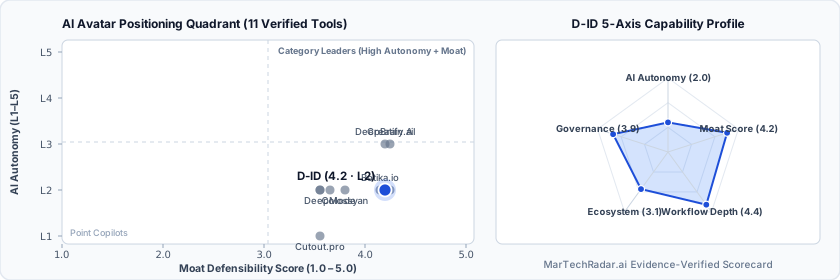
D-ID is a Web SaaS tool for AI Avatar (Digital Avatars & Presenters) in Visual & Creative Media. Pricing: Free plan · $0/mo · Enterprise plan. Best suited to DTC / eCommerce, Enterprise Brands and Creators / Solo. Editor ratings: AI autonomy L2 (workflow copilot); moat score 4.2/5.0 (Proprietary moat). Fact-checked by Jagmeet Sine on Oct 15, 2026.
Generative AI digital human platform that transforms still images and scripts into photorealistic, interactive speaking avatars via API and studio workflows.
D-ID buyer fit verdict: when to choose vs. when to walk away
Choose D-ID if (Best Fit)
- Target ICP & Stack Fit: You operate as DTC / eCommerce, Enterprise Brands and Creators / Solo requiring a Web SaaS deployment for AI Avatar.
- L2 Architecture & Defensibility: Proprietary deep-learning pipelines for single-image facial reenactment and low-latency audio-visual streaming infrastructure give D-ID an established edge in programmatic, interactive avatar deployment.
- Commercial Model Fit: Your procurement budget aligns with Free plan · $0/mo · Enterprise plan and want a self-serve free tier for zero-cost initial validation.
Walk away from D-ID if (Deal-Breakers)
- Walk away if your workflow requires uncapped enterprise volume on the Free plan · $0/mo · Enterprise plan entry plan without upgrading tiers.
- Walk away if your workflow cannot tolerate pose and occlusion sensitivity: Single-image generation degrades significantly when processing extreme profile head angles, asymmetrical lighting, or occluded facial features, introducing warping artifacts around jawlines and eye contours.
- Walk away if high-concurrency streaming latency is a deal-breaker for your team: Real-time streaming agents face sub-second packet synchronization vulnerabilities during concurrent peak sessions, occasionally leading to audio-visual desynchronization over unstable network connections.
D-ID key facts & scorecard
| Pricing | Free plan · $0/mo · Enterprise planVendor pricing page |
|---|---|
| Free plan | Yes |
| Delivery | Web SaaS |
| Audience | DTC / eCommerce, Enterprise Brands, Creators / Solo |
| AI autonomy level | L2 · Workflow copilotEditor-verified |
| Moat tier & score | 4.2 / 5.0 · Proprietary moatEditor-verified |
| Funding | Venture-backed |
| Total funding | $47.9M |
| Founders | Eliran Kuta, Gil Perry, Sella Blondheim |
| Company size | 51-200 employees |
| Governance & docs | API & Docs ↗ · Privacy ↗ |
| Headquarters | New York City, New York |
| Founded | 2017 |
| Last verified |
D-ID pros & cons: strengths vs. operational limitations
Pros: core strengths & capabilities
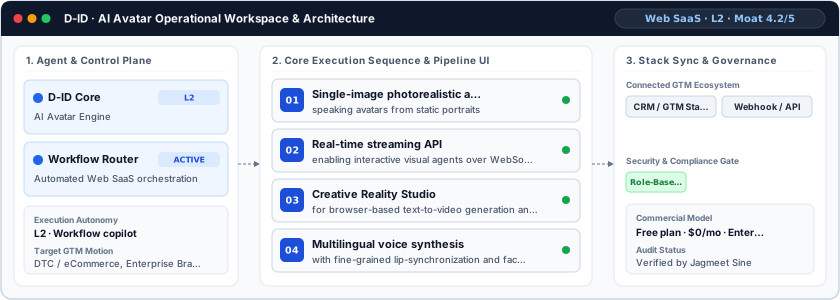
- Single-image photorealistic animation generating: speaking avatars from static portraits
- Real-time streaming API: enabling interactive visual agents over WebSockets and WebRTC
- Creative Reality Studio: for browser-based text-to-video generation and script localization
- Multilingual voice synthesis: with fine-grained lip-synchronization and facial expression tuning
Cons: operational limitations & risks
- Pose and Occlusion Sensitivity: Single-image generation degrades significantly when processing extreme profile head angles, asymmetrical lighting, or occluded facial features, introducing warping artifacts around jawlines and eye contours.
- High-Concurrency Streaming Latency: Real-time streaming agents face sub-second packet synchronization vulnerabilities during concurrent peak sessions, occasionally leading to audio-visual desynchronization over unstable network connections.
- Complex Gestural Immobility: The animation engine restricts synthesis primarily to head, neck, and micro-expression kinematics, offering minimal natural full-body or hand gesture rendering compared to 3D mesh engines.
D-ID TCO & deal-breaker stress test
Simulate 12-month stepped TCO, hidden cost multipliers, contract lock-in exposure, and stack failure modes using only facts verified by Jagmeet Sine on · Capture SHA 7770353d.
D-ID is viable for 5 seats, but requires commercial or technical verification on the flagged items below.
| Plan / Tier | Verified Rate | Scale Fit | Scope & Quota Notes |
|---|---|---|---|
| Free / Sandbox | $0 | 1–2 seats (Evaluation) | Entry free tier with capped usage or feature quotas for initial workflow testing. |
| Standard | $4.7/mo | 1–2 seats | $56 billed annually (20% discount) |
| Pro | $16/mo | 5 seats | Plan name: Pro |
| Lite | $56/mo | 15 seats | Plan name: Lite |
- Moat Score
- 4.2 / 5.0
- AI Autonomy
- L2
- Free Tier / Trial
- Free plan
Triggered audit signals & failure modes
- Opaque Enterprise Quoting vs. SMB/Mid-Market BudgetVerified Pricing Ledger
D-ID does not disclose a public self-serve floor (Free plan · $0/mo · Enterprise plan). Buyers with a $800/mo cap face high sales-qualification friction.
- Published Self-Serve Entry FloorVerified Pricing Ledger
D-ID publishes a transparent entry point (Free plan · $0/mo · Enterprise plan) with a free tier for initial validation before committing.
- Tier Fit for 5-Seat Scale: Standard ($4.7/mo)Verified Tier Schedule
$56 billed annually (20% discount)
- Primary Operational Bottleneck: Pose and Occlusion SensitivityAudit by Jagmeet Sine
Single-image generation degrades significantly when processing extreme profile head angles, asymmetrical lighting, or occluded facial features, introducing warping artifacts around jawlines and eye contours.
Hidden TCO Multipliers & Quota Gates
- Annual Billing Headline vs. Monthly Premium: Headline entry rates reflect annual billing commitments (Save up to 45%); month-to-month flexibility carries a higher effective monthly rate or requires annual prepayment.
- Credit & Usage Burn Multiplier: Automated workflows consume metered credits/usage quotas; multi-step enrichment, voice minutes, or high-frequency agent runs can trigger mid-cycle top-up packs.
When to Walk Away & Negotiation Levers
- Walk away if your workflow requires uncapped enterprise volume on the Free plan · $0/mo · Enterprise plan entry plan without upgrading tiers.
- Walk away if your workflow cannot tolerate pose and occlusion sensitivity: Single-image generation degrades significantly when processing extreme profile head angles, asymmetrical lighting, or occluded facial features, introducing warping artifacts around jawlines and eye contours.
- Walk away if high-concurrency streaming latency is a deal-breaker for your team: Real-time streaming agents face sub-second packet synchronization vulnerabilities during concurrent peak sessions, occasionally leading to audio-visual desynchronization over unstable network connections.
- Validate exact quota thresholds (seats, credits, or API calls) included in D-ID's Free plan · $0/mo · Enterprise plan tier before converting from monthly to annual billing.
- Require a sandbox proof-of-concept testing pose and occlusion sensitivity against your live CRM/data schema before annual sign-off.
Ask a custom procurement or TCO stress-test question about D-ID
Lower 5-seat floor (~$29/mo vs. Custom Quote)
Lower 5-seat floor (~$24/mo vs. Custom Quote)
D-ID moat & subtrack positioning
Proprietary deep-learning pipelines for single-image facial reenactment and low-latency audio-visual streaming infrastructure give D-ID an established edge in programmatic, interactive avatar deployment.
Editorial review
Fact-checked by Jagmeet Sine (Senior MarTech Infrastructure & Agentic Workflow Architect) on .
Background
Established in 2017 and headquartered in New York City, New York, D-ID operates as a generative media infrastructure provider, having secured $47.9M in aggregate institutional funding. The platform targets enterprise product developers, digital marketing teams, and corporate training designers seeking to convert static image assets into interactive speaking presenters. By bridging facial reenactment research with conversational interfaces, D-ID facilitates automated digital human generation across asynchronous and real-time enterprise communication channels.
How D-ID works
At its architectural core, D-ID utilizes proprietary deep learning models that decouple facial identity from motion dynamics. The ingestion pipeline accepts raw portrait imagery alongside audio files or plain text scripts. When processing text, synthetic audio tracks pass into audio-to-lip alignment modules that calculate acoustic phoneme-to-viseme mappings. The neural rendering engine then deforms facial geometry to synthesize photorealistic motion, blink frequencies, and micro-expressions. Operating at an L2 autonomy level, the platform exposes real-time streaming endpoints via WebSockets and WebRTC, enabling programmatic execution of responsive visual agents alongside asynchronous batch rendering.
Limitations
Operational considerations and platform boundaries include:
- Pose and Occlusion Sensitivity: Single-image generation degrades significantly when processing extreme profile head angles, asymmetrical lighting, or occluded facial features, introducing warping artifacts around jawlines and eye contours.
- High-Concurrency Streaming Latency: Real-time streaming agents face sub-second packet synchronization vulnerabilities during concurrent peak sessions, occasionally leading to audio-visual desynchronization over unstable network connections.
- Complex Gestural Immobility: The animation engine restricts synthesis primarily to head, neck, and micro-expression kinematics, offering minimal natural full-body or hand gesture rendering compared to 3D mesh engines.
D-ID pricing
D-ID structures its commercial offering around modular software-as-a-service and consumption-based API tiers. Entry-level testing begins with a trial tier at $0 per month, which provides baseline compute credits, stock avatars, and watermarked outputs. Production deployments transition to scaled self-serve and custom enterprise agreements that meter billable usage by synthesis minutes, real-time stream duration, API endpoint access, and dedicated neural voice allocations.
How D-ID compares
Within the digital avatar category, D-ID competes against vendors like Synthesia, HeyGen, and Colossyan. While Synthesia and Colossyan emphasize structured enterprise learning modules with full-body corporate presenters, D-ID prioritizes low-latency programmatic streaming and single-portrait conversion. HeyGen challenges D-ID on personalized video localization and voice fidelity, yet D-ID retains an architectural advantage for software engineering teams requiring embeddable, bidirectional real-time conversational agents for web and mobile interfaces. It is best suited for enterprise marketing teams and growth practitioners seeking disciplined workflow orchestration.
Direct competitors & market radar
Top algorithmic competitors based on category positioning, capability overlap, and ICP alignment.
Frequently asked questions about D-ID
How much does D-ID cost and what pricing tiers are available?
Published pricing summary for D-ID: Free plan · $0/mo · Enterprise plan. D-ID includes a free tier or sandbox entry point. Verified tier schedule: Free / Sandbox ($0 for 1–2 seats (Evaluation)); Standard ($4.7/mo for 1–2 seats); Pro ($16/mo for 5 seats); Lite ($56/mo for 15 seats). D-ID structures its commercial offering around modular software-as-a-service and consumption-based API tiers. Entry-level testing begins with a trial tier at $0 per month, which provides baseline compute credits, stock avatars, and watermarked outputs.
How does D-ID work and how autonomous is its AI architecture?
Generative AI digital human platform that transforms still images and scripts into photorealistic, interactive speaking avatars via API and studio workflows. Within AI Avatar (Digital Avatars & Presenters), MarTechRadar rates its execution architecture at L2 · Workflow copilot with a verified Moat Score of 4.2 / 5.0 (Proprietary moat). Proprietary deep-learning pipelines for single-image facial reenactment and low-latency audio-visual streaming infrastructure give D-ID an established edge in programmatic, interactive avatar deployment. Corporate profile: Founded by Eliran Kuta, Gil Perry, Sella Blondheim, operating at 51-200 employees scale.
What are the main limitations of D-ID and when should buyers walk away?
Based on our editorial technical audit, key operational considerations and boundaries for D-ID include: (1) Pose and Occlusion Sensitivity: Single-image generation degrades significantly when processing extreme profile head angles, asymmetrical lighting, or occluded facial features, introducing warping artifacts around jawlines and eye contours. (2) High-Concurrency Streaming Latency: Real-time streaming agents face sub-second packet synchronization vulnerabilities during concurrent peak sessions, occasionally leading to audio-visual desynchronization over unstable network connections. (3) Complex Gestural Immobility: The animation engine restricts synthesis primarily to head, neck, and micro-expression kinematics, offering minimal natural full-body or hand gesture rendering compared to 3D mesh engines. Primary procurement walk-away rule: Walk away if your workflow requires uncapped enterprise volume on the Free plan · $0/mo · Enterprise plan entry plan without upgrading tiers.
What integrations, compliance certifications, and contract terms apply to D-ID?
First-party governance and developer endpoints verified on domain include: API Docs (https://docs.d-id.com/reference/get-started). Key TCO multiplier to watch: Annual Billing Headline vs. Monthly Premium (Headline entry rates reflect annual billing commitments (Save up to 45%); month-to-month flexibility carries a higher effective monthly rate or requires annual prepayment.) Before signing a contract, procurement teams should validate exact quota thresholds (seats, credits, or API calls) included in D-ID's Free plan · $0/mo · Enterprise plan tier before converting from monthly to annual billing.
What are the best D-ID alternatives and head-to-head competitors in 2026?
Top fact-checked alternatives to D-ID in AI Avatar (Digital Avatars & Presenters) include Synthesia (Free plan · $29–$89/mo), Brask AI (Custom / enterprise pricing), Naoma (From $249/mo), HeyGen (Free plan · $24–$149/mo). Within the digital avatar category, D-ID competes against vendors like Synthesia, HeyGen, and Colossyan. While Synthesia and Colossyan emphasize structured enterprise learning modules with full-body corporate presenters, D-ID prioritizes low-latency programmatic streaming and single-portrait conversion.
Verified sources & evidence trail
- Official product domain: https://d-id.com
- Commercial pricing verification: https://www.d-id.com/pricing/studio/
- Verified corporate entity profiles (
sameAs): LinkedIn Company Profile · Crunchbase Entity Record - First-party governance & documentation links: API & Docs · Privacy
- Editorial audit sign-off: Fact-checked by Jagmeet Sine on under the MarTechRadar Evidence-Ledger Protocol.