DeepMode Review (2026): AI Avatar Pricing, Limits & Alternatives
Bottom line
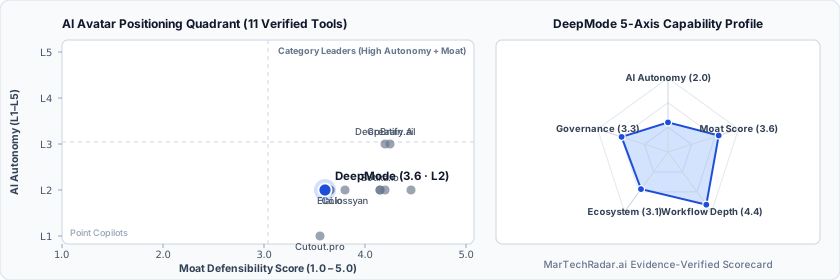
DeepMode is a Web SaaS tool for AI Avatar (Digital Avatars & Presenters) in Visual & Creative Media. Pricing: From $0.10/mo. Best suited to DTC / eCommerce. Editor ratings: AI autonomy L2 (workflow copilot); moat score 3.6/5.0 (Proprietary moat). Fact-checked by Jagmeet Sine on Oct 15, 2026.
AI-powered facial identity training and synthetic media engine generating consistent personal avatars across photos and dynamic video templates.
DeepMode buyer fit verdict: when to choose vs. when to walk away
Choose DeepMode if (Best Fit)
- Target ICP & Stack Fit: You operate as DTC / eCommerce requiring a Web SaaS deployment for AI Avatar.
- L2 Architecture & Defensibility: DeepMode establishes defensibility through fine-tuned identity preservation pipelines that combine single-image LoRA model training with accelerated template rendering. However, because it relies heavily on consumer-grade facial swapping and shared diffusion checkpoints rather than proprietary enterprise motion-capture or speech-synchronization engines, its moat remains modest against full-stack enterprise avatar platforms.
- Commercial Model Fit: Your procurement budget aligns with From $0.10/mo.
Walk away from DeepMode if (Deal-Breakers)
- Walk away if your workflow requires uncapped enterprise volume on the From $0.10/mo entry plan without upgrading tiers.
- Walk away if your workflow cannot tolerate pose and occlusion artifacts: Users encounter operational friction and integration bottlenecks, as the pipeline struggles with Generating assets outside standardized template vectors frequently introduces edge-bleeding around hair boundaries, eyewear, and complex directional lighting rigs.
- Walk away if lack of conversational speech sync is a deal-breaker for your team: Users encounter operational friction and integration bottlenecks, as the pipeline struggles with Unlike full-stack corporate presenter engines, the system emphasizes visual aesthetic loops rather than dynamic script-to-speech phoneme alignment or automated multilingual dubbing.
DeepMode key facts & scorecard
| Pricing | From $0.10/moVendor pricing page |
|---|---|
| Free plan | No / not disclosed |
| Delivery | Web SaaS |
| Audience | DTC / eCommerce |
| AI autonomy level | L2 · Workflow copilotEditor-verified |
| Moat tier & score | 3.6 / 5.0 · Proprietary moatEditor-verified |
| Funding | Pre-seed |
| Founders | Koby Karp |
| Company size | 2-10 employees |
| Headquarters | Limassol, Cyprus |
| Founded | 2024 |
| Last verified |
DeepMode pros & cons: strengths vs. operational limitations
Pros: core strengths & capabilities
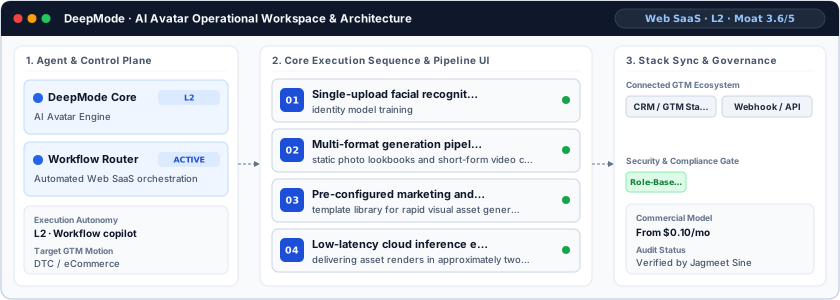
- Single-upload facial recognition and: identity model training
- Multi-format generation pipeline supporting: static photo lookbooks and short-form video clips
- Pre-configured marketing and seasonal: template library for rapid visual asset generation
- Low-latency cloud inference engine: delivering asset renders in approximately two seconds
Cons: operational limitations & risks
- Pose and Occlusion Artifacts: Users encounter operational friction and integration bottlenecks, as the pipeline struggles with Generating assets outside standardized template vectors frequently introduces edge-bleeding around hair boundaries, eyewear, and complex directional lighting rigs.
- Lack of Conversational Speech Sync: Users encounter operational friction and integration bottlenecks, as the pipeline struggles with Unlike full-stack corporate presenter engines, the system emphasizes visual aesthetic loops rather than dynamic script-to-speech phoneme alignment or automated multilingual dubbing.
- Template Rigidity: Users encounter operational friction and integration bottlenecks, as the pipeline struggles with Enterprises are confined to pre-built catalog scenes and set framings, limiting customized brand environment staging and complex multi-actor commercial compositions.
DeepMode TCO & deal-breaker stress test
Simulate 12-month stepped TCO, hidden cost multipliers, contract lock-in exposure, and stack failure modes using only facts verified by Jagmeet Sine on · Capture SHA 52f46891.
DeepMode is viable for 5 seats, but requires commercial or technical verification on the flagged items below.
| Plan / Tier | Verified Rate | Scale Fit | Scope & Quota Notes |
|---|---|---|---|
| Entry / Starter | $10/mo | 1–2 seats | Unlock model training |
| Growth / Professional | $25/mo | 5 seats | $0.125 per image · 37.5% off |
| Scale / Advanced | $40/mo | 15 seats | $0.125 per image · 37.5% off |
- Moat Score
- 3.6 / 5.0
- AI Autonomy
- L2
- Free Tier / Trial
- None disclosed
Triggered audit signals & failure modes
- Published Self-Serve Entry FloorVerified Pricing Ledger
DeepMode publishes a transparent entry point (From $0.10/mo) for initial validation before committing.
- Usage / Credit Burn VolatilityCommercial Model Audit
DeepMode uses credit or usage-metered billing (From $0.10/mo). High-volume automated workflows across 5 seats can trigger mid-cycle overage charges.
- Tier Fit for 5-Seat Scale: Entry / Starter ($10/mo)Verified Tier Schedule
Unlock model training
- Primary Operational Bottleneck: Pose and Occlusion ArtifactsAudit by Jagmeet Sine
Users encounter operational friction and integration bottlenecks, as the pipeline struggles with Generating assets outside standardized template vectors frequently introduces edge-bleeding around hair boundaries, eyewear, and complex directional lighting rigs.
Hidden TCO Multipliers & Quota Gates
- Credit & Usage Burn Multiplier: Automated workflows consume metered credits/usage quotas; multi-step enrichment, voice minutes, or high-frequency agent runs can trigger mid-cycle top-up packs.
- Pose and Occlusion Artifacts: Users encounter operational friction and integration bottlenecks, as the pipeline struggles with Generating assets outside standardized template vectors frequently introduces edge-bleeding around hair boundaries, eyewear, and complex directional lighting rigs.
- Lack of Conversational Speech Sync: Users encounter operational friction and integration bottlenecks, as the pipeline struggles with Unlike full-stack corporate presenter engines, the system emphasizes visual aesthetic loops rather than dynamic script-to-speech phoneme alignment or automated multilingual dubbing.
When to Walk Away & Negotiation Levers
- Walk away if your workflow requires uncapped enterprise volume on the From $0.10/mo entry plan without upgrading tiers.
- Walk away if your workflow cannot tolerate pose and occlusion artifacts: Users encounter operational friction and integration bottlenecks, as the pipeline struggles with Generating assets outside standardized template vectors frequently introduces edge-bleeding around hair boundaries, eyewear, and complex directional lighting rigs.
- Walk away if lack of conversational speech sync is a deal-breaker for your team: Users encounter operational friction and integration bottlenecks, as the pipeline struggles with Unlike full-stack corporate presenter engines, the system emphasizes visual aesthetic loops rather than dynamic script-to-speech phoneme alignment or automated multilingual dubbing.
- Validate exact quota thresholds (seats, credits, or API calls) included in DeepMode's From $0.10/mo tier before converting from monthly to annual billing.
- Require a sandbox proof-of-concept testing pose and occlusion artifacts against your live CRM/data schema before annual sign-off.
Ask a custom procurement or TCO stress-test question about DeepMode
Lower 5-seat floor (~$46/mo vs. Usage-Metered)
Lower 5-seat floor (~$24/mo vs. Usage-Metered)
DeepMode moat & subtrack positioning
DeepMode establishes defensibility through fine-tuned identity preservation pipelines that combine single-image LoRA model training with accelerated template rendering. However, because it relies heavily on consumer-grade facial swapping and shared diffusion checkpoints rather than proprietary enterprise motion-capture or speech-synchronization engines, its moat remains modest against full-stack enterprise avatar platforms.
Editorial review
Fact-checked by Jagmeet Sine (Senior MarTech Infrastructure & Agentic Workflow Architect) on .
Background
Architected around automated facial identity preservation, DeepMode (operating also under the ClipMode interface) was founded in 2024 in Limassol, Cyprus. The platform addresses direct-to-consumer creators, social media marketers, and digital merchandising teams seeking reproducible digital likenesses without recurring photographic studio overhead. By decoupling physical talent production from asset creation, DeepMode synthesizes brand-consistent photos and short-form video content from isolated image inputs, anchoring its functional focus on accessible virtual avatar rendering.
How DeepMode works
Operating at an L2 autonomy tier, DeepMode ingests user-uploaded selfies to extract facial landmark geometry and latent embedding weights. The underlying infrastructure employs fine-tuned diffusion models and facial reenactment pipelines to map identity features onto pre-rendered photographic and video scenes. Once trained, the single identity profile is retained to synthesize media variations across thematic templates, utilizing an optimized cloud GPU pipeline that delivers image generations in approximately two seconds without manual prompt crafting.
Limitations
Operational considerations and platform boundaries include:
- Pose and Occlusion Artifacts: Users encounter operational friction and integration bottlenecks, as the pipeline struggles with Generating assets outside standardized template vectors frequently introduces edge-bleeding around hair boundaries, eyewear, and complex directional lighting rigs.
- Lack of Conversational Speech Sync: Users encounter operational friction and integration bottlenecks, as the pipeline struggles with Unlike full-stack corporate presenter engines, the system emphasizes visual aesthetic loops rather than dynamic script-to-speech phoneme alignment or automated multilingual dubbing.
- Template Rigidity: Users encounter operational friction and integration bottlenecks, as the pipeline struggles with Enterprises are confined to pre-built catalog scenes and set framings, limiting customized brand environment staging and complex multi-actor commercial compositions.
DeepMode pricing
DeepMode operates a hybrid monetization framework combining recurring memberships with credit top-up tiers. Commercial packages are accessible from $0.10/month via entry allocations, alongside a top-tier premium membership priced at $50 per month, billed at $600 annually. Credit consumption scales across dedicated packs, including 50 credits for $10, 200 credits discounted from $40 to $25, and 500 credits discounted from $100 to $50, which yields a generation unit cost of $0.10 per image.
How DeepMode compares
Compared to direct category competitors like Flair.ai and Photoroom, DeepMode functions as an alternative focused on specialized workflow execution. While enterprise solutions such as HeyGen, Synthesia, and Colossyan specialize in enterprise communications, SCORM-compliant training videos, and precise speech-to-lip synchronization, DeepMode concentrates on low-friction personal marketing and social media imagery. HeyGen and Synthesia provide comprehensive multi-lingual corporate avatars and expansive video editing suites, whereas DeepMode provides lightweight, template-driven synthetic identity replication suited for solo creators and agile social teams rather than large corporate training architectures. It is best suited for enterprise marketing teams and growth practitioners seeking disciplined workflow orchestration.
Frequently asked questions about DeepMode
How much does DeepMode cost and what pricing tiers are available?
Published pricing summary for DeepMode: From $0.10/mo. A permanent free plan is not disclosed for DeepMode. Verified tier schedule: Entry / Starter ($10/mo for 1–2 seats); Growth / Professional ($25/mo for 5 seats); Scale / Advanced ($40/mo for 15 seats). DeepMode operates a hybrid monetization framework combining recurring memberships with credit top-up tiers. Commercial packages are accessible from $0.10/month via entry allocations, alongside a top-tier premium membership priced at $50 per month, billed at $600 annually.
How does DeepMode work and how autonomous is its AI architecture?
AI-powered facial identity training and synthetic media engine generating consistent personal avatars across photos and dynamic video templates. Within AI Avatar (Digital Avatars & Presenters), MarTechRadar rates its execution architecture at L2 · Workflow copilot with a verified Moat Score of 3.6 / 5.0 (Proprietary moat). DeepMode establishes defensibility through fine-tuned identity preservation pipelines that combine single-image LoRA model training with accelerated template rendering. However, because it relies heavily on consumer-grade facial swapping and shared diffusion checkpoints rather than proprietary enterprise motion-capture or speech-synchronization engines, its moat remains modest against full-stack enterprise avatar platforms. Corporate profile: Founded by Koby Karp, operating at 2-10 employees scale.
What are the main limitations of DeepMode and when should buyers walk away?
Based on our editorial technical audit, key operational considerations and boundaries for DeepMode include: (1) Pose and Occlusion Artifacts: Users encounter operational friction and integration bottlenecks, as the pipeline struggles with Generating assets outside standardized template vectors frequently introduces edge-bleeding around hair boundaries, eyewear, and complex directional lighting rigs. (2) Lack of Conversational Speech Sync: Users encounter operational friction and integration bottlenecks, as the pipeline struggles with Unlike full-stack corporate presenter engines, the system emphasizes visual aesthetic loops rather than dynamic script-to-speech phoneme alignment or automated multilingual dubbing. (3) Template Rigidity: Users encounter operational friction and integration bottlenecks, as the pipeline struggles with Enterprises are confined to pre-built catalog scenes and set framings, limiting customized brand environment staging and complex multi-actor commercial compositions. Primary procurement walk-away rule: Walk away if your workflow requires uncapped enterprise volume on the From $0.10/mo entry plan without upgrading tiers.
What integrations, compliance certifications, and contract terms apply to DeepMode?
Key TCO multiplier to watch: Credit & Usage Burn Multiplier (Automated workflows consume metered credits/usage quotas; multi-step enrichment, voice minutes, or high-frequency agent runs can trigger mid-cycle top-up packs.) Before signing a contract, procurement teams should validate exact quota thresholds (seats, credits, or API calls) included in DeepMode's From $0.10/mo tier before converting from monthly to annual billing.
What are the best DeepMode alternatives and head-to-head competitors in 2026?
Top fact-checked alternatives to DeepMode in AI Avatar (Digital Avatars & Presenters) include ZMO.ai (Custom / enterprise pricing), Botika.io (From $46/mo), Elai.io (Free plan · $0/mo · Enterprise plan), KreadoAI (Free plan · $0/mo · Enterprise plan). Compared to direct category competitors like Flair.ai and Photoroom, DeepMode functions as an alternative focused on specialized workflow execution.
Verified sources & evidence trail
- Official product domain: https://deepmode.ai
- Commercial pricing verification: https://www.clipmode.ai/pricing
- Verified corporate entity profiles (
sameAs): LinkedIn Company Profile · Crunchbase Entity Record - Editorial audit sign-off: Fact-checked by Jagmeet Sine on under the MarTechRadar Evidence-Ledger Protocol.