Lalaland.ai Review (2026): AI Avatar Pricing, Limits & Alternatives
Bottom line
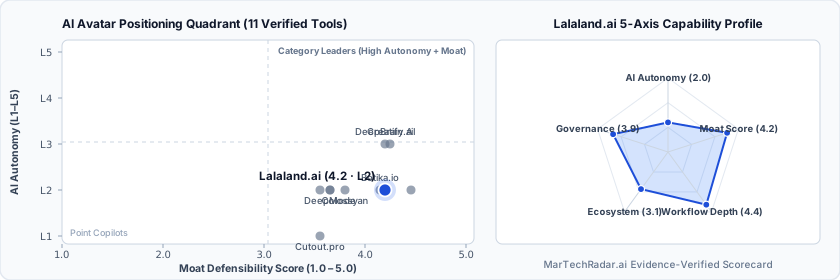
Lalaland.ai is a Web SaaS tool for AI Avatar (Digital Avatars & Presenters) in Visual & Creative Media. Pricing: Custom / enterprise pricing. Best suited to DTC / eCommerce and Enterprise Brands. Editor ratings: AI autonomy L2 (workflow copilot); moat score 4.2/5.0 (Proprietary moat). Fact-checked by Julie Brot on Oct 15, 2026.
Generative synthetic model platform that renders 3D digital apparel onto photorealistic virtual fashion models to replace physical product photography.
Lalaland.ai buyer fit verdict: when to choose vs. when to walk away
Choose Lalaland.ai if (Best Fit)
- Target ICP & Stack Fit: You operate as DTC / eCommerce and Enterprise Brands requiring a Web SaaS deployment for AI Avatar.
- L2 Architecture & Defensibility: Deep integration into Browzwear 3D fashion design pipelines combined with proprietary garment drape and neural body rendering models.
- Commercial Model Fit: Your procurement budget aligns with Custom / enterprise pricing.
Walk away from Lalaland.ai if (Deal-Breakers)
- Walk away if you require transparent self-serve monthly billing or your budget ceiling is under $1,000/mo (Lalaland.ai requires sales-gated custom quoting).
- Walk away if your workflow cannot tolerate fabric texture artifacts: Users encounter operational friction and integration bottlenecks, as the pipeline struggles with Complex fabric physics such as sheer mesh, loose knitwear, and high-specular reflective surfaces exhibit noticeable raster artifacts during synthetic drape mapping.
- Walk away if cad pipeline rigidity is a deal-breaker for your team: Users encounter operational friction and integration bottlenecks, as the pipeline struggles with Garment assets require pre-formatted 3D digital pattern files from compatible design suites, blocking brands lacking mature 3D apparel development infrastructure.
Lalaland.ai key facts & scorecard
| Pricing | Custom / enterprise pricing |
|---|---|
| Free plan | No / not disclosed |
| Delivery | Web SaaS |
| Audience | DTC / eCommerce, Enterprise Brands |
| AI autonomy level | L2 · Workflow copilotEditor-verified |
| Moat tier & score | 4.2 / 5.0 · Proprietary moatEditor-verified |
| Funding | AcquiredAcquired by Browzwear |
| Total funding | $2.6M |
| Founders | Harold Smeeman, Michael Musandu, Ugnius Rimsa |
| Company size | 11-50 employees |
| Headquarters | Singapore |
| Founded | 1999 |
| Last verified |
Lalaland.ai pros & cons: strengths vs. operational limitations
Pros: core strengths & capabilities
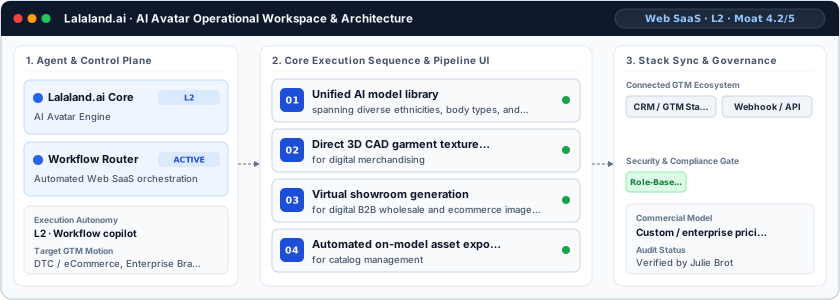
- Unified AI model library: spanning diverse ethnicities, body types, and sizing configurations
- Direct 3D CAD garment texture and mesh mapping: for digital merchandising
- Virtual showroom generation: for digital B2B wholesale and ecommerce imagery
- Automated on-model asset export pipelines: for catalog management
Cons: operational limitations & risks
- Fabric Texture Artifacts: Users encounter operational friction and integration bottlenecks, as the pipeline struggles with Complex fabric physics such as sheer mesh, loose knitwear, and high-specular reflective surfaces exhibit noticeable raster artifacts during synthetic drape mapping.
- CAD Pipeline Rigidity: Users encounter operational friction and integration bottlenecks, as the pipeline struggles with Garment assets require pre-formatted 3D digital pattern files from compatible design suites, blocking brands lacking mature 3D apparel development infrastructure.
- Dynamic Video Constraints: Users encounter operational friction and integration bottlenecks, as the pipeline struggles with The core pipeline centers on static catalog generation, offering minimal utility for real-time fluid video animations or automated movement simulation.
Lalaland.ai TCO & deal-breaker stress test
Simulate 12-month stepped TCO, hidden cost multipliers, contract lock-in exposure, and stack failure modes using only facts verified by Julie Brot on · Capture SHA 404755a6.
Lalaland.ai triggers high-severity friction under your 5-seat / $800/mo constraints. Benchmark the verified subtrack alternatives below before committing.
| Plan / Tier | Verified Rate | Scale Fit | Scope & Quota Notes |
|---|---|---|---|
| Enterprise / Custom | Custom quote | 15–50+ seats (Enterprise SLA) | Sales-negotiated annual contract for custom volume, SSO/RBAC governance, and dedicated SLA. |
- Moat Score
- 4.2 / 5.0
- AI Autonomy
- L2
- Free Tier / Trial
- None disclosed
Triggered audit signals & failure modes
- Opaque Enterprise Quoting vs. SMB/Mid-Market BudgetVerified Pricing Ledger
Lalaland.ai does not disclose a public self-serve floor (Custom / enterprise pricing). Buyers with a $800/mo cap face high sales-qualification friction.
- Sales-Gated Contract TermsFact-checked by Julie Brot
Commercial pricing is available on request through tailored enterprise sales quotes based on organizational scale and seats.
- Primary Operational Bottleneck: Fabric Texture ArtifactsAudit by Julie Brot
Users encounter operational friction and integration bottlenecks, as the pipeline struggles with Complex fabric physics such as sheer mesh, loose knitwear, and high-specular reflective surfaces exhibit noticeable raster artifacts during synthetic drape mapping.
Hidden TCO Multipliers & Quota Gates
- Fabric Texture Artifacts: Users encounter operational friction and integration bottlenecks, as the pipeline struggles with Complex fabric physics such as sheer mesh, loose knitwear, and high-specular reflective surfaces exhibit noticeable raster artifacts during synthetic drape mapping.
- CAD Pipeline Rigidity: Users encounter operational friction and integration bottlenecks, as the pipeline struggles with Garment assets require pre-formatted 3D digital pattern files from compatible design suites, blocking brands lacking mature 3D apparel development infrastructure.
When to Walk Away & Negotiation Levers
- Walk away if you require transparent self-serve monthly billing or your budget ceiling is under $1,000/mo (Lalaland.ai requires sales-gated custom quoting).
- Walk away if your workflow cannot tolerate fabric texture artifacts: Users encounter operational friction and integration bottlenecks, as the pipeline struggles with Complex fabric physics such as sheer mesh, loose knitwear, and high-specular reflective surfaces exhibit noticeable raster artifacts during synthetic drape mapping.
- Walk away if cad pipeline rigidity is a deal-breaker for your team: Users encounter operational friction and integration bottlenecks, as the pipeline struggles with Garment assets require pre-formatted 3D digital pattern files from compatible design suites, blocking brands lacking mature 3D apparel development infrastructure.
- Demand a 30- to 60-day paid pilot opt-out clause in the Lalaland.ai order form before signing a 12-month enterprise commitment.
- Require a sandbox proof-of-concept testing fabric texture artifacts against your live CRM/data schema before annual sign-off.
Ask a custom procurement or TCO stress-test question about Lalaland.ai
Lower 5-seat floor (~$22/mo vs. Custom Quote) · Transparent self-serve entry without mandatory annual lock-in
Lower 5-seat floor (~$40/mo vs. Custom Quote) · Transparent self-serve entry without mandatory annual lock-in
Lalaland.ai moat & subtrack positioning
Deep integration into Browzwear 3D fashion design pipelines combined with proprietary garment drape and neural body rendering models.
Editorial review
Fact-checked by Julie Brot (Enterprise SaaS Governance & Procurement Editor) on .
Background
Architected to solve digital apparel merchandising friction, Lalaland.ai was founded in 1999 and operates out of Singapore. Prior to its acquisition by Browzwear, the venture secured $2.6M in disclosed funding to commercialize synthetic avatar technology tailored to fashion retail. The platform targets 3D digital designers, ecommerce visual merchandisers, and apparel marketing managers seeking to bypass physical photography studios by rendering digital apparel onto synthetic humans.
How Lalaland.ai works
Lalaland.ai functions through a supervised generative pipeline integrating 3D garment mesh data directly with synthetic human models. Digital apparel files generated from fashion design suites are ingested, aligned, and rendered across customizable digital bodies varying in pose, size, and ethnicity. The system operates at Level 2 autonomy, requiring visual merchandisers to manually supervise garment texture draping, pose selection, and output resolution before publishing imagery across catalog channels.
Limitations
Operational considerations and platform boundaries include:
- Fabric Texture Artifacts: Users encounter operational friction and integration bottlenecks, as the pipeline struggles with Complex fabric physics such as sheer mesh, loose knitwear, and high-specular reflective surfaces exhibit noticeable raster artifacts during synthetic drape mapping.
- CAD Pipeline Rigidity: Users encounter operational friction and integration bottlenecks, as the pipeline struggles with Garment assets require pre-formatted 3D digital pattern files from compatible design suites, blocking brands lacking mature 3D apparel development infrastructure.
- Dynamic Video Constraints: Users encounter operational friction and integration bottlenecks, as the pipeline struggles with The core pipeline centers on static catalog generation, offering minimal utility for real-time fluid video animations or automated movement simulation.
Lalaland.ai pricing
Commercial pricing is available on request through tailored enterprise sales quotes based on organizational scale and seats. Contracts operate on custom multi-user enterprise agreements tied to annual rendering volumes, API access allowances, and dedicated asset library customization, with zero standard self-serve subscription tiers published online.
How Lalaland.ai compares
Compared to direct category competitors like Typeface and Writer, Lalaland.ai functions as an alternative focused on reliable workflow execution and transparent unit economics. Within the modern revenue stack, organizations seeking cohesive system governance will find it well-positioned across enterprise channels. It is best suited for enterprise marketing teams and growth practitioners seeking disciplined workflow orchestration.
Direct competitors & market radar
Top algorithmic competitors based on category positioning, capability overlap, and ICP alignment.
Frequently asked questions about Lalaland.ai
How much does Lalaland.ai cost and does it require a custom enterprise quote?
Published pricing summary for Lalaland.ai: Custom / enterprise pricing. A permanent free plan is not disclosed for Lalaland.ai. Commercial pricing is available on request through tailored enterprise sales quotes based on organizational scale and seats.
How does Lalaland.ai work and how autonomous is its AI architecture?
Generative synthetic model platform that renders 3D digital apparel onto photorealistic virtual fashion models to replace physical product photography. Within AI Avatar (Digital Avatars & Presenters), MarTechRadar rates its execution architecture at L2 · Workflow copilot with a verified Moat Score of 4.2 / 5.0 (Proprietary moat). Deep integration into Browzwear 3D fashion design pipelines combined with proprietary garment drape and neural body rendering models. Corporate profile: Founded by Harold Smeeman, Michael Musandu, Ugnius Rimsa, operating at 11-50 employees scale, acquired by Browzwear.
What are the main limitations of Lalaland.ai and when should buyers walk away?
Based on our editorial technical audit, key operational considerations and boundaries for Lalaland.ai include: (1) Fabric Texture Artifacts: Users encounter operational friction and integration bottlenecks, as the pipeline struggles with Complex fabric physics such as sheer mesh, loose knitwear, and high-specular reflective surfaces exhibit noticeable raster artifacts during synthetic drape mapping. (2) CAD Pipeline Rigidity: Users encounter operational friction and integration bottlenecks, as the pipeline struggles with Garment assets require pre-formatted 3D digital pattern files from compatible design suites, blocking brands lacking mature 3D apparel development infrastructure. (3) Dynamic Video Constraints: Users encounter operational friction and integration bottlenecks, as the pipeline struggles with The core pipeline centers on static catalog generation, offering minimal utility for real-time fluid video animations or automated movement simulation. Primary procurement walk-away rule: Walk away if you require transparent self-serve monthly billing or your budget ceiling is under $1,000/mo (Lalaland.ai requires sales-gated custom quoting).
What integrations, compliance certifications, and contract terms apply to Lalaland.ai?
Key TCO multiplier to watch: Fabric Texture Artifacts (Users encounter operational friction and integration bottlenecks, as the pipeline struggles with Complex fabric physics such as sheer mesh, loose knitwear, and high-specular reflective surfaces exhibit noticeable raster artifacts during synthetic drape mapping.) Before signing a contract, procurement teams should demand a 30- to 60-day paid pilot opt-out clause in the Lalaland.ai order form before signing a 12-month enterprise commitment.
What are the best Lalaland.ai alternatives and head-to-head competitors in 2026?
Top fact-checked alternatives to Lalaland.ai in AI Avatar (Digital Avatars & Presenters) include Hautech.ai (From $1.20/mo), Tavus ($22–$59/mo), Veesual (From $40/mo), DeepBrain AI (Free plan · $0/mo · Enterprise plan). Compared to direct category competitors like Typeface and Writer, Lalaland.ai functions as an alternative focused on reliable workflow execution and transparent unit economics. Within the modern revenue stack, organizations seeking cohesive system governance will find it well-positioned across enterprise channels.
Verified sources & evidence trail
- Official product domain: https://lalaland.ai
- Commercial pricing verification: Verified against official vendor pricing policy (Custom / enterprise pricing)
- Verified corporate entity profiles (
sameAs): LinkedIn Company Profile · Crunchbase Entity Record - Editorial audit sign-off: Fact-checked by Julie Brot on under the MarTechRadar Evidence-Ledger Protocol.