DeepBrain AI Review (2026): AI Avatar Pricing, Limits & Alternatives
Bottom line
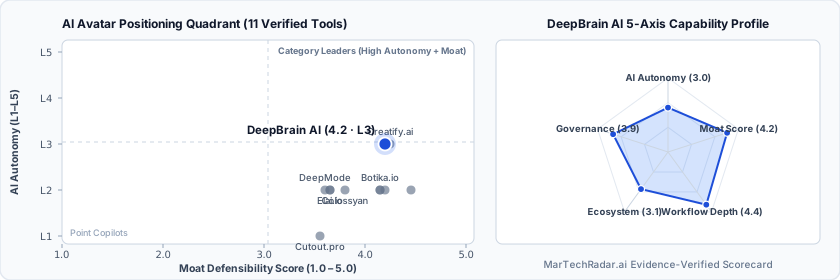
DeepBrain AI is a Web SaaS tool for AI Avatar (Digital Avatars & Presenters) in Visual & Creative Media. Pricing: Free plan · $0/mo · Enterprise plan. Best suited to B2B SaaS and Enterprise Brands. Editor ratings: AI autonomy L3 (conditional automation); moat score 4.2/5.0 (Proprietary moat). Fact-checked by Vasilia Xia on Oct 15, 2026.
DeepBrain AI delivers enterprise synthetic media infrastructure and conversational digital humans for asynchronous corporate video production.
DeepBrain AI buyer fit verdict: when to choose vs. when to walk away
Choose DeepBrain AI if (Best Fit)
- Target ICP & Stack Fit: You operate as B2B SaaS and Enterprise Brands requiring a Web SaaS deployment for AI Avatar.
- L3 Architecture & Defensibility: Proprietary photorealistic digital human rendering architectures coupled with dual-track runtime engines supporting both asynchronous rendering and bidirectional conversational kiosk streaming.
- Commercial Model Fit: Your procurement budget aligns with Free plan · $0/mo · Enterprise plan and want a self-serve free tier for zero-cost initial validation.
Walk away from DeepBrain AI if (Deal-Breakers)
- Walk away if your workflow requires uncapped enterprise volume on the Free plan · $0/mo · Enterprise plan entry plan without upgrading tiers.
- Walk away if your workflow cannot tolerate rendering queue latency: High-resolution 1080p and 4K exports encounter prolonged queue processing times during peak platform usage, delaying time-critical broadcast deployments.
- Walk away if gesticulation range boundaries is a deal-breaker for your team: Avatars exhibit restricted upper-body kinematic dynamism, causing unnatural hand placements and mechanical posturing during expressive corporate monologues.
DeepBrain AI key facts & scorecard
| Pricing | Free plan · $0/mo · Enterprise planVendor pricing page |
|---|---|
| Free plan | Yes |
| Delivery | Web SaaS |
| Audience | B2B SaaS, Enterprise Brands |
| AI autonomy level | L3 · Conditional automationEditor-verified |
| Moat tier & score | 4.2 / 5.0 · Proprietary moatEditor-verified |
| Funding | Venture-backed |
| Total funding | $52M |
| Founders | Eric Seyoung Jang, YongWon Jeon |
| Company size | 51-200 employees |
| Governance & docs | API & Docs ↗ · Terms ↗ · Privacy ↗ |
| Headquarters | Palo Alto, California |
| Founded | 2016 |
| Last verified |
DeepBrain AI pros & cons: strengths vs. operational limitations
Pros: core strengths & capabilities
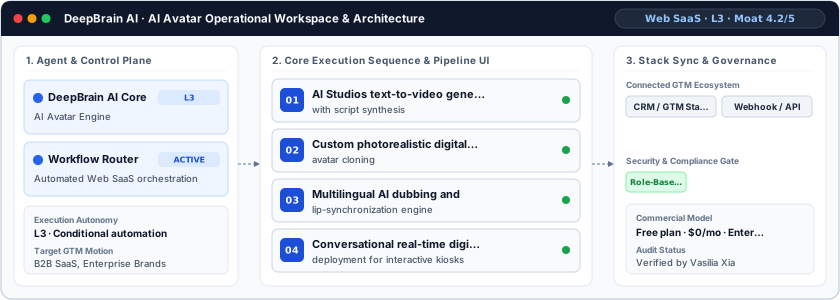
- AI Studios text-to-video generation pipeline: with script synthesis
- Custom photorealistic digital human: avatar cloning
- Multilingual AI dubbing and: lip-synchronization engine
- Conversational real-time digital human: deployment for interactive kiosks
Cons: operational limitations & risks
- Rendering Queue Latency: High-resolution 1080p and 4K exports encounter prolonged queue processing times during peak platform usage, delaying time-critical broadcast deployments.
- Gesticulation Range Boundaries: Avatars exhibit restricted upper-body kinematic dynamism, causing unnatural hand placements and mechanical posturing during expressive corporate monologues.
- Custom Model Calibration Overhead: Training enterprise-grade bespoke digital avatars demands pristine studio footage and extended acoustic validation periods, precluding instantaneous deployment cycles.
DeepBrain AI TCO & deal-breaker stress test
Simulate 12-month stepped TCO, hidden cost multipliers, contract lock-in exposure, and stack failure modes using only facts verified by Vasilia Xia on · Capture SHA e33707f3.
DeepBrain AI is viable for 5 seats, but requires commercial or technical verification on the flagged items below.
| Plan / Tier | Verified Rate | Scale Fit | Scope & Quota Notes |
|---|---|---|---|
| Free / Sandbox | $0 | 1–2 seats (Evaluation) | Entry free tier with capped usage or feature quotas for initial workflow testing. |
| Entry / Starter | $24/mo | 1–2 seats | Best for solo creators producing AI videos without limits |
| Team | $55/mo | 5 seats | Built for teams collaborating on unlimited AI video creation |
| Enterprise / Custom | Custom quote | 15–50+ seats (Enterprise SLA) | Sales-negotiated annual contract for custom volume, SSO/RBAC governance, and dedicated SLA. |
- Moat Score
- 4.2 / 5.0
- AI Autonomy
- L3
- Free Tier / Trial
- Free plan
Triggered audit signals & failure modes
- Opaque Enterprise Quoting vs. SMB/Mid-Market BudgetVerified Pricing Ledger
DeepBrain AI does not disclose a public self-serve floor (Free plan · $0/mo · Enterprise plan). Buyers with a $800/mo cap face high sales-qualification friction.
- Published Self-Serve Entry FloorVerified Pricing Ledger
DeepBrain AI publishes a transparent entry point (Free plan · $0/mo · Enterprise plan) with a free tier for initial validation before committing.
- Tier Fit for 5-Seat Scale: Entry / Starter ($24/mo)Verified Tier Schedule
Best for solo creators producing AI videos without limits
- Primary Operational Bottleneck: Rendering Queue LatencyAudit by Vasilia Xia
High-resolution 1080p and 4K exports encounter prolonged queue processing times during peak platform usage, delaying time-critical broadcast deployments.
Hidden TCO Multipliers & Quota Gates
- Per-Seat Linear Scaling: DeepBrain AI prices licenses on a per-user/seat basis (Free plan · $0/mo · Enterprise plan); expanding from 2 to 15+ operators multiplies base recurring spend linearly.
- Annual Billing Headline vs. Monthly Premium: Headline entry rates reflect annual billing commitments (Save 20%); month-to-month flexibility carries a higher effective monthly rate or requires annual prepayment.
- Credit & Usage Burn Multiplier: Automated workflows consume metered credits/usage quotas; multi-step enrichment, voice minutes, or high-frequency agent runs can trigger mid-cycle top-up packs.
When to Walk Away & Negotiation Levers
- Walk away if your workflow requires uncapped enterprise volume on the Free plan · $0/mo · Enterprise plan entry plan without upgrading tiers.
- Walk away if your workflow cannot tolerate rendering queue latency: High-resolution 1080p and 4K exports encounter prolonged queue processing times during peak platform usage, delaying time-critical broadcast deployments.
- Walk away if gesticulation range boundaries is a deal-breaker for your team: Avatars exhibit restricted upper-body kinematic dynamism, causing unnatural hand placements and mechanical posturing during expressive corporate monologues.
- Validate exact quota thresholds (seats, credits, or API calls) included in DeepBrain AI's Free plan · $0/mo · Enterprise plan tier before converting from monthly to annual billing.
- Require a sandbox proof-of-concept testing rendering queue latency against your live CRM/data schema before annual sign-off.
Ask a custom procurement or TCO stress-test question about DeepBrain AI
Lower 5-seat floor (~$22/mo vs. Custom Quote)
Lower 5-seat floor (~$40/mo vs. Custom Quote)
DeepBrain AI moat & subtrack positioning
Proprietary photorealistic digital human rendering architectures coupled with dual-track runtime engines supporting both asynchronous rendering and bidirectional conversational kiosk streaming.
Editorial review
Fact-checked by Vasilia Xia (E-Commerce, Lifecycle & Retention Marketing Analyst) on .
Background
Architectured around real-time digital human synthesis and automated media generation, DeepBrain AI was founded in 2016 and operates from Palo Alto, California. Backed by $52M in venture funding, the company targets enterprise communications officers, corporate training leads, and customer experience architects. The platform shifts video workflows from physical studio setups to software-driven pipelines, supporting both broadcast content and conversational customer touchpoints.
How DeepBrain AI works
Operating at an L3 autonomy profile, DeepBrain AI's AI Studios pipeline utilizes deep neural rendering models to map phonemes directly to facial landmark deformation meshes. When an operator inputs a source script or prompt, an integrated language model parses pacing while the text-to-speech engine synthesizes audio tracks. Concurrently, the neural animation pipeline synchronizes micro-expressions and oral articulation with sub-second temporal accuracy, generating finalized video streams without manual keyframing.
Limitations
Operational considerations and platform boundaries include:
- Rendering Queue Latency: High-resolution 1080p and 4K exports encounter prolonged queue processing times during peak platform usage, delaying time-critical broadcast deployments.
- Gesticulation Range Boundaries: Avatars exhibit restricted upper-body kinematic dynamism, causing unnatural hand placements and mechanical posturing during expressive corporate monologues.
- Custom Model Calibration Overhead: Training enterprise-grade bespoke digital avatars demands pristine studio footage and extended acoustic validation periods, precluding instantaneous deployment cycles.
DeepBrain AI pricing
Commercial procurement operates on a hybrid tier structure. DeepBrain AI offers an entry-level Free tier ($0/month) that provides three one-minute videos at 720p resolution and basic generative credits for evaluation. Scaled deployments transition to custom enterprise plans governed by annual commitments, dedicated GPU rendering capacity, custom avatar onboarding fees, and interactive conversational API query quotas.
How DeepBrain AI compares
Within the synthetic media sector, DeepBrain AI competes directly against Synthesia, HeyGen, and Colossyan. While HeyGen and Synthesia concentrate strictly on browser-based marketing workflows and localization pipelines, DeepBrain AI differentiates through low-latency bidirectional engines suitable for physical retail kiosks and banking interfaces. However, Colossyan offers tighter branching logic for interactive learning modules, making DeepBrain AI the preferred alternative for enterprises demanding broadcast-grade avatar realism across omnichannel customer terminals. It is best suited for enterprise marketing teams and growth practitioners seeking disciplined workflow orchestration.
Direct competitors & market radar
Top algorithmic competitors based on category positioning, capability overlap, and ICP alignment.
Frequently asked questions about DeepBrain AI
How much does DeepBrain AI cost and what pricing tiers are available?
Published pricing summary for DeepBrain AI: Free plan · $0/mo · Enterprise plan. DeepBrain AI includes a free tier or sandbox entry point. Verified tier schedule: Free / Sandbox ($0 for 1–2 seats (Evaluation)); Entry / Starter ($24/mo for 1–2 seats); Team ($55/mo for 5 seats); Enterprise / Custom (Custom quote for 15–50+ seats (Enterprise SLA)). Commercial procurement operates on a hybrid tier structure. DeepBrain AI offers an entry-level Free tier ($0/month) that provides three one-minute videos at 720p resolution and basic generative credits for evaluation.
How does DeepBrain AI work and how autonomous is its AI architecture?
DeepBrain AI delivers enterprise synthetic media infrastructure and conversational digital humans for asynchronous corporate video production. Within AI Avatar (Digital Avatars & Presenters), MarTechRadar rates its execution architecture at L3 · Conditional automation with a verified Moat Score of 4.2 / 5.0 (Proprietary moat). Proprietary photorealistic digital human rendering architectures coupled with dual-track runtime engines supporting both asynchronous rendering and bidirectional conversational kiosk streaming. Corporate profile: Founded by Eric Seyoung Jang, YongWon Jeon, operating at 51-200 employees scale.
What are the main limitations of DeepBrain AI and when should buyers walk away?
Based on our editorial technical audit, key operational considerations and boundaries for DeepBrain AI include: (1) Rendering Queue Latency: High-resolution 1080p and 4K exports encounter prolonged queue processing times during peak platform usage, delaying time-critical broadcast deployments. (2) Gesticulation Range Boundaries: Avatars exhibit restricted upper-body kinematic dynamism, causing unnatural hand placements and mechanical posturing during expressive corporate monologues. (3) Custom Model Calibration Overhead: Training enterprise-grade bespoke digital avatars demands pristine studio footage and extended acoustic validation periods, precluding instantaneous deployment cycles. Primary procurement walk-away rule: Walk away if your workflow requires uncapped enterprise volume on the Free plan · $0/mo · Enterprise plan entry plan without upgrading tiers.
What integrations, compliance certifications, and contract terms apply to DeepBrain AI?
First-party governance and developer endpoints verified on domain include: API Docs (https://app.aistudios.com/automation/docs). Key TCO multiplier to watch: Per-Seat Linear Scaling (DeepBrain AI prices licenses on a per-user/seat basis (Free plan · $0/mo · Enterprise plan); expanding from 2 to 15+ operators multiplies base recurring spend linearly.) Before signing a contract, procurement teams should validate exact quota thresholds (seats, credits, or API calls) included in DeepBrain AI's Free plan · $0/mo · Enterprise plan tier before converting from monthly to annual billing.
What are the best DeepBrain AI alternatives and head-to-head competitors in 2026?
Top fact-checked alternatives to DeepBrain AI in AI Avatar (Digital Avatars & Presenters) include Brask AI (Custom / enterprise pricing), Tavus ($22–$59/mo), Veesual (From $40/mo), Lalaland.ai (Custom / enterprise pricing). Within the synthetic media sector, DeepBrain AI competes directly against Synthesia, HeyGen, and Colossyan.
Verified sources & evidence trail
- Official product domain: https://deepbrain.io
- Commercial pricing verification: https://www.aistudios.com/pricing
- Verified corporate entity profiles (
sameAs): LinkedIn Company Profile · Crunchbase Entity Record - First-party governance & documentation links: API & Docs · Terms · Privacy
- Editorial audit sign-off: Fact-checked by Vasilia Xia on under the MarTechRadar Evidence-Ledger Protocol.