Flair.ai Review (2026): AI Product Photography Pricing, Limits & Alternatives
Bottom line
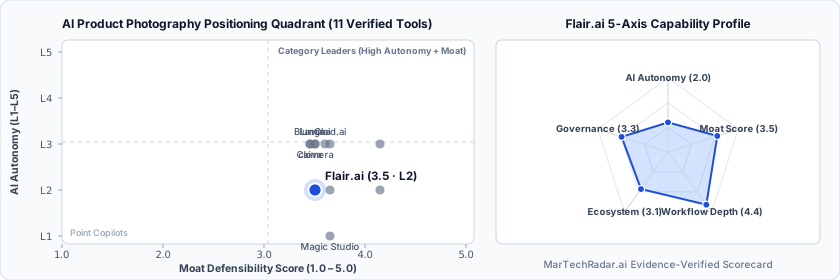
Flair.ai is a Web SaaS tool for AI Product Photography (Product Photography & AI Retouching) in Visual & Creative Media. Pricing: Free plan · $8–$38/mo. Best suited to DTC / eCommerce. Editor ratings: AI autonomy L2 (workflow copilot); moat score 3.5/5.0 (Proprietary moat). Fact-checked by Anthony Hay on Oct 7, 2026.
Flair.ai is an AI-driven product photography and visual generation canvas engineered to produce contextual e-commerce scenes, on-model visuals, and short.
Flair.ai buyer fit verdict: when to choose vs. when to walk away
Choose Flair.ai if (Best Fit)
- Target ICP & Stack Fit: You operate as DTC / eCommerce requiring a Web SaaS deployment for AI Product Photography.
- L2 Architecture & Defensibility: Proprietary spatial canvas interface for real-time asset positioning paired with custom-trained diffusion models optimized for commercial product preservation and realistic lighting alignment.
- Commercial Model Fit: Your procurement budget aligns with Free plan · $8–$38/mo and want a self-serve free tier for zero-cost initial validation.
Walk away from Flair.ai if (Deal-Breakers)
- Walk away if your workflow requires uncapped enterprise volume on the Free plan · $8–$38/mo entry plan without upgrading tiers.
- Walk away if your workflow cannot tolerate edge preservation and label degradation: Fine typographic elements on complex packaging frequently experience micro-distortions during generative diffusion passes, requiring manual masking to preserve packaging fidelity.
- Walk away if quota consumption multipliers is a deal-breaker for your team: Instant image iterations and advertising generations consume four times standard generation credits, rapidly depleting tier allocations during iterative creative testing.
Flair.ai key facts & scorecard
| Pricing | Free plan · $8–$38/moVendor pricing page |
|---|---|
| Free plan | Yes |
| Delivery | Web SaaS |
| Audience | DTC / eCommerce |
| AI autonomy level | L2 · Workflow copilotEditor-verified |
| Moat tier & score | 3.5 / 5.0 · Proprietary moatEditor-verified |
| Funding | Seed |
| Total funding | SeedBacked by CRV (Charles River Ventures) |
| Founders | Antonio Cao, Mickey Friedman |
| Company size | 2-10 employees |
| Governance & docs | Terms ↗ |
| Headquarters | San Francisco, California |
| Founded | 2022 |
| Last verified |
Flair.ai pros & cons: strengths vs. operational limitations
Pros: core strengths & capabilities
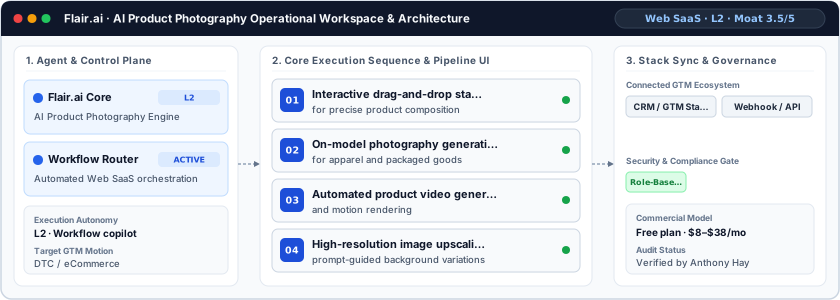
- Interactive drag-and-drop staging canvas: for precise product composition
- On-model photography generation: for apparel and packaged goods
- Automated product video generation: and motion rendering
- High-resolution image upscaling and: prompt-guided background variations
Cons: operational limitations & risks
- Edge Preservation and Label Degradation: Fine typographic elements on complex packaging frequently experience micro-distortions during generative diffusion passes, requiring manual masking to preserve packaging fidelity.
- Quota Consumption Multipliers: Instant image iterations and advertising generations consume four times standard generation credits, rapidly depleting tier allocations during iterative creative testing.
- Photometric Consistency Across Batches: Generating cohesive SKU series across varying aspect ratios occasionally yields inconsistent directional lighting and shadow depth between individual product angles.
Flair.ai TCO & deal-breaker stress test
Simulate 12-month stepped TCO, hidden cost multipliers, contract lock-in exposure, and stack failure modes using only facts verified by Anthony Hay on · Capture SHA 7178968d.
Flair.ai aligns with your 5-seat / $800/mo profile. Review the walk-away triggers and contract levers below before deployment.
| Plan / Tier | Verified Rate | Scale Fit | Scope & Quota Notes |
|---|---|---|---|
| Free / Sandbox | $0 | 1–2 seats (Evaluation) | Entry free tier with capped usage or feature quotas for initial workflow testing. |
| Pro | $8/mo | 1–2 seats | 2 video generations |
| Pro | $26/mo | 5 seats | Up to 8 Standard or 2 Fast Custom Models |
| Scale | $38/mo | 15 seats | Verified $38/mo tier from vendor pricing schedule. |
- Moat Score
- 3.5 / 5.0
- AI Autonomy
- L2
- Free Tier / Trial
- Free plan
Triggered audit signals & failure modes
- Published Self-Serve Entry FloorVerified Pricing Ledger
Flair.ai publishes a transparent entry point (Free plan · $8–$38/mo) with a free tier for initial validation before committing.
- Tier Fit for 5-Seat Scale: Pro ($8/mo)Verified Tier Schedule
2 video generations
- Primary Operational Bottleneck: Quota Consumption MultipliersAudit by Anthony Hay
Instant image iterations and advertising generations consume four times standard generation credits, rapidly depleting tier allocations during iterative creative testing.
Hidden TCO Multipliers & Quota Gates
- Credit & Usage Burn Multiplier: Automated workflows consume metered credits/usage quotas; multi-step enrichment, voice minutes, or high-frequency agent runs can trigger mid-cycle top-up packs.
- Enterprise Governance & Add-On Gating: Advanced capabilities such as Single Sign-On (SSO), custom role permissions, or specialized analytics modules are gated behind upper tiers or paid add-ons.
When to Walk Away & Negotiation Levers
- Walk away if your workflow requires uncapped enterprise volume on the Free plan · $8–$38/mo entry plan without upgrading tiers.
- Walk away if your workflow cannot tolerate edge preservation and label degradation: Fine typographic elements on complex packaging frequently experience micro-distortions during generative diffusion passes, requiring manual masking to preserve packaging fidelity.
- Walk away if quota consumption multipliers is a deal-breaker for your team: Instant image iterations and advertising generations consume four times standard generation credits, rapidly depleting tier allocations during iterative creative testing.
- Validate exact quota thresholds (seats, credits, or API calls) included in Flair.ai's Free plan · $8–$38/mo tier before converting from monthly to annual billing.
- Require a sandbox proof-of-concept testing edge preservation and label degradation against your live CRM/data schema before annual sign-off.
Ask a custom procurement or TCO stress-test question about Flair.ai
Lower 5-seat floor (~$10/mo vs. $26 / mo)
Lower 5-seat floor (~$23/mo vs. $26 / mo)
Flair.ai moat & subtrack positioning
Proprietary spatial canvas interface for real-time asset positioning paired with custom-trained diffusion models optimized for commercial product preservation and realistic lighting alignment.
Editorial review
Fact-checked by Anthony Hay (Senior SEO, Search Intelligence & Content Operations Editor) on .
Background
Operating within the digital commerce merchandising sector, Flair.ai addresses the capital overhead and scheduling friction of traditional physical studio production. Established in 2022 in San Francisco, California, the company engineers an automated visual generation workspace tailored for direct-to-consumer operators, brand marketers, and catalog production teams. Rather than coordinating physical props, lighting rigs, and staging studios, commercial teams utilize Flair.ai to composite digital product assets into photorealistic marketing scenes. Within modern visual workflows, the platform functions as a targeted composition studio that accelerates high-volume visual asset creation.
How Flair.ai works
At its technical foundation, Flair.ai operates at Level 2 assistive autonomy via an interactive visual staging canvas. The platform ingests standard product photography, performs automated background segmentation, and isolates foreground packshots. Users construct spatial compositions by arranging product assets alongside virtual props and directional lighting prompts. The generative rendering engine pairs diffusion backbones with conditioning algorithms that calculate synthetic contact shadows, atmospheric reflections, and perspective matching. Furthermore, the pipeline supports automated multi-angle variations, on-model rendering, and short-form video synthesis using motion interpolation models.
Limitations
Operational considerations and platform boundaries include:
- Edge Preservation and Label Degradation: Fine typographic elements on complex packaging frequently experience micro-distortions during generative diffusion passes, requiring manual masking to preserve packaging fidelity.
- Quota Consumption Multipliers: Instant image iterations and advertising generations consume four times standard generation credits, rapidly depleting tier allocations during iterative creative testing.
- Photometric Consistency Across Batches: Generating cohesive SKU series across varying aspect ratios occasionally yields inconsistent directional lighting and shadow depth between individual product angles.
Flair.ai pricing
Flair.ai operates a self-serve SaaS model structured around generation volume, custom model training, and compute prioritization. The company maintains an entry tier at $0 per month for basic evaluation, extending through paid commercial tiers priced from $8 to $38 per month. Mid-range production needs are served by intermediate plans including $26 per month, which unlock higher asset caps, accelerated rendering queues, and multi-model custom training allotments. High-throughput commercial brands require enterprise arrangements for dedicated pipeline throughput and shared collaboration workspaces.
How Flair.ai compares
In the AI visual staging category, Flair.ai competes directly against Blunge, Caimera, and Clova. While Blunge emphasizes rapid programmatic background swaps and Clova focuses on broad visual media pipelines, Flair.ai differentiates through its spatial canvas that provides granular control over asset placement and synthetic lighting conditions. Conversely, Caimera targets automated batch workflows for marketplace catalogs, whereas Flair.ai prioritizes interactive compositional editing. The platform suits growth-stage retail brands requiring rapid, high-fidelity ad creative without dedicating technical resources to complex 3D rendering engines.
Direct competitors & market radar
Top algorithmic competitors based on category positioning, capability overlap, and ICP alignment.
Frequently asked questions about Flair.ai
How much does Flair.ai cost and what pricing tiers are available?
Published pricing summary for Flair.ai: Free plan · $8–$38/mo. Flair.ai includes a free tier or sandbox entry point. Verified tier schedule: Free / Sandbox ($0 for 1–2 seats (Evaluation)); Pro ($8/mo for 1–2 seats); Pro ($26/mo for 5 seats); Scale ($38/mo for 15 seats). Flair.ai operates a self-serve SaaS model structured around generation volume, custom model training, and compute prioritization. The company maintains an entry tier at $0 per month for basic evaluation, extending through paid commercial tiers priced from $8 to $38 per month.
How does Flair.ai work and how autonomous is its AI architecture?
Flair.ai is an AI-driven product photography and visual generation canvas engineered to produce contextual e-commerce scenes, on-model visuals, and short. Within AI Product Photography (Product Photography & AI Retouching), MarTechRadar rates its execution architecture at L2 · Workflow copilot with a verified Moat Score of 3.5 / 5.0 (Proprietary moat). Proprietary spatial canvas interface for real-time asset positioning paired with custom-trained diffusion models optimized for commercial product preservation and realistic lighting alignment. Corporate profile: Founded by Antonio Cao, Mickey Friedman, operating at 2-10 employees scale.
What are the main limitations of Flair.ai and when should buyers walk away?
Based on our editorial technical audit, key operational considerations and boundaries for Flair.ai include: (1) Edge Preservation and Label Degradation: Fine typographic elements on complex packaging frequently experience micro-distortions during generative diffusion passes, requiring manual masking to preserve packaging fidelity. (2) Quota Consumption Multipliers: Instant image iterations and advertising generations consume four times standard generation credits, rapidly depleting tier allocations during iterative creative testing. (3) Photometric Consistency Across Batches: Generating cohesive SKU series across varying aspect ratios occasionally yields inconsistent directional lighting and shadow depth between individual product angles. Primary procurement walk-away rule: Walk away if your workflow requires uncapped enterprise volume on the Free plan · $8–$38/mo entry plan without upgrading tiers.
What integrations, compliance certifications, and contract terms apply to Flair.ai?
Key TCO multiplier to watch: Credit & Usage Burn Multiplier (Automated workflows consume metered credits/usage quotas; multi-step enrichment, voice minutes, or high-frequency agent runs can trigger mid-cycle top-up packs.) Before signing a contract, procurement teams should validate exact quota thresholds (seats, credits, or API calls) included in Flair.ai's Free plan · $8–$38/mo tier before converting from monthly to annual billing.
What are the best Flair.ai alternatives and head-to-head competitors in 2026?
Top fact-checked alternatives to Flair.ai in AI Product Photography (Product Photography & AI Retouching) include FancyTech (Custom / enterprise pricing), Blunge ($10–$20/mo), Caimera ($15–$117/seat/mo), Pixelcut (Free plan · $0/mo · Enterprise plan). In the AI visual staging category, Flair.ai competes directly against Blunge, Caimera, and Clova.
Verified sources & evidence trail
- Official product domain: https://flair.ai
- Commercial pricing verification: https://flair.ai/pricing
- Verified corporate entity profiles (
sameAs): LinkedIn Company Profile · Crunchbase Entity Record - First-party governance & documentation links: Terms
- Editorial audit sign-off: Fact-checked by Anthony Hay on under the MarTechRadar Evidence-Ledger Protocol.