Blunge Review (2026): AI Product Photography Pricing, Limits & Alternatives
Bottom line
Blunge is a Web SaaS tool for AI Product Photography (Product Photography & AI Retouching) in Visual & Creative Media. Pricing: $10–$20/mo. Best suited to eCommerce Brands, Creative Agencies and Performance Video Marketers. Editor ratings: AI autonomy L3 (conditional automation); moat score 3.5/5.0 (Proprietary moat). Fact-checked by Jiacky Lee on Oct 10, 2026.
Blunge is an AI creative design agent that ingests brand kits and product assets to autonomously generate and refine on-brand commercial marketing imagery.
Blunge buyer fit verdict: when to choose vs. when to walk away
Choose Blunge if (Best Fit)
- Target ICP & Stack Fit: You operate as eCommerce Brands, Creative Agencies and Performance Video Marketers requiring a Web SaaS deployment for AI Product Photography.
- L3 Architecture & Defensibility: Blunge combines conversational workflow management with automated brand kit parsing, enabling style-consistent asset generation via closed iterative feedback loops.
- Commercial Model Fit: Your procurement budget aligns with $10–$20/mo.
Walk away from Blunge if (Deal-Breakers)
- Walk away if your workflow requires uncapped enterprise volume on the $10–$20/mo entry plan without upgrading tiers.
- Walk away if your workflow cannot tolerate high-fidelity edge compositing: Fine-detail extraction on translucent packaging, complex glass reflections, or thin wireframes can exhibit boundary artifacts, necessitating external manual retouching.
- Walk away if brand kit typography enforcement is a deal-breaker for your team: The diffusion pipeline occasionally struggles with exact proprietary font rendering and kerning alignment, requiring vector overlays outside the generative engine.
Blunge key facts & scorecard
| Pricing | $10–$20/moVendor pricing page |
|---|---|
| Free plan | No / not disclosed |
| Delivery | Web SaaS |
| Audience | eCommerce Brands, Creative Agencies, Performance Video Marketers |
| AI autonomy level | L3 · Conditional automationEditor-verified |
| Moat tier & score | 3.5 / 5.0 · Proprietary moatEditor-verified |
| Funding | Seed |
| Total funding | SeedBacked by Google for Startups |
| Company size | 2-10 employees |
| Governance & docs | Changelog ↗ · Terms ↗ · Privacy ↗ |
| Headquarters | Sydney, Australia |
| Founded | 2024 |
| Last verified |
Blunge pros & cons: strengths vs. operational limitations
Pros: core strengths & capabilities
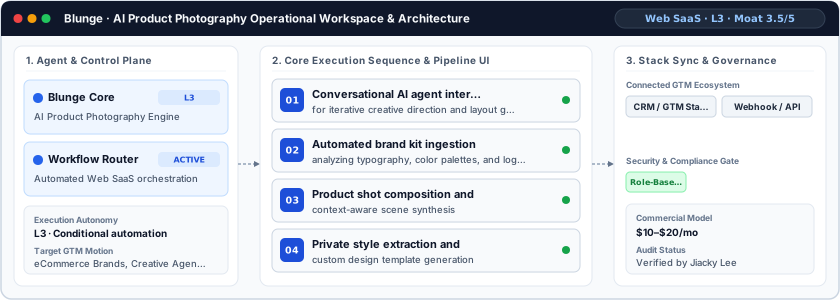
- Conversational AI agent interface: for iterative creative direction and layout generation
- Automated brand kit ingestion: analyzing typography, color palettes, and logos
- Product shot composition and: context-aware scene synthesis
- Private style extraction and: custom design template generation
Cons: operational limitations & risks
- High-Fidelity Edge Compositing: Fine-detail extraction on translucent packaging, complex glass reflections, or thin wireframes can exhibit boundary artifacts, necessitating external manual retouching.
- Brand Kit Typography Enforcement: The diffusion pipeline occasionally struggles with exact proprietary font rendering and kerning alignment, requiring vector overlays outside the generative engine.
- Throughput and Concurrency Limits: Batch operations are bounded by generation speed in the conversational canvas, restricting high-volume catalog processing compared to headless batch APIs.
Blunge TCO & deal-breaker stress test
Simulate 12-month stepped TCO, hidden cost multipliers, contract lock-in exposure, and stack failure modes using only facts verified by Jiacky Lee on · Capture SHA 85e07872.
Blunge aligns with your 5-seat / $800/mo profile. Review the walk-away triggers and contract levers below before deployment.
| Plan / Tier | Verified Rate | Scale Fit | Scope & Quota Notes |
|---|---|---|---|
| Unlimited | $10/mo | 1–2 seats | Limited access to Blunge tools |
| Pro | $20/mo | 5 seats | Generated images are private, full ownership |
- Moat Score
- 3.5 / 5.0
- AI Autonomy
- L3
- Free Tier / Trial
- None disclosed
Triggered audit signals & failure modes
- Published Self-Serve Entry FloorVerified Pricing Ledger
Blunge publishes a transparent entry point ($10–$20/mo) for initial validation before committing.
- Tier Fit for 5-Seat Scale: Pro ($20/mo)Verified Tier Schedule
Generated images are private, full ownership
- Primary Operational Bottleneck: High-Fidelity Edge CompositingAudit by Jiacky Lee
Fine-detail extraction on translucent packaging, complex glass reflections, or thin wireframes can exhibit boundary artifacts, necessitating external manual retouching.
Hidden TCO Multipliers & Quota Gates
- Credit & Usage Burn Multiplier: Automated workflows consume metered credits/usage quotas; multi-step enrichment, voice minutes, or high-frequency agent runs can trigger mid-cycle top-up packs.
- High-Fidelity Edge Compositing: Fine-detail extraction on translucent packaging, complex glass reflections, or thin wireframes can exhibit boundary artifacts, necessitating external manual retouching.
- Brand Kit Typography Enforcement: The diffusion pipeline occasionally struggles with exact proprietary font rendering and kerning alignment, requiring vector overlays outside the generative engine.
When to Walk Away & Negotiation Levers
- Walk away if your workflow requires uncapped enterprise volume on the $10–$20/mo entry plan without upgrading tiers.
- Walk away if your workflow cannot tolerate high-fidelity edge compositing: Fine-detail extraction on translucent packaging, complex glass reflections, or thin wireframes can exhibit boundary artifacts, necessitating external manual retouching.
- Walk away if brand kit typography enforcement is a deal-breaker for your team: The diffusion pipeline occasionally struggles with exact proprietary font rendering and kerning alignment, requiring vector overlays outside the generative engine.
- Validate exact quota thresholds (seats, credits, or API calls) included in Blunge's $10–$20/mo tier before converting from monthly to annual billing.
- Require a sandbox proof-of-concept testing high-fidelity edge compositing against your live CRM/data schema before annual sign-off.
Ask a custom procurement or TCO stress-test question about Blunge
Lower 5-seat floor (~$8/mo vs. $20 / mo)
Lower 5-seat floor (~$8/mo vs. $20 / mo)
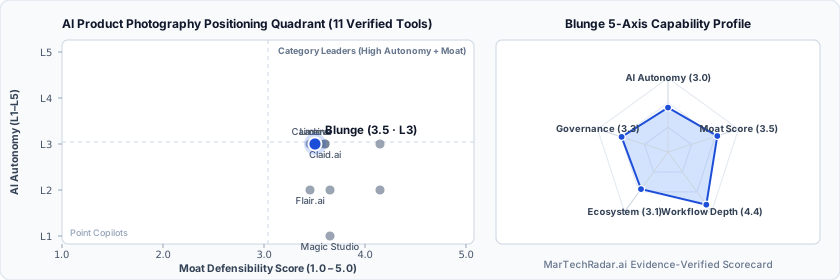
Blunge moat & subtrack positioning
Blunge combines conversational workflow management with automated brand kit parsing, enabling style-consistent asset generation via closed iterative feedback loops.
Editorial review
Fact-checked by Jiacky Lee (Managing Editor, AI Autonomy & Moat Methodology) on .
Background
E-commerce brands and growth marketing teams face persistent bottlenecks when producing catalog-scale marketing assets that strictly conform to visual brand guidelines. Headquartered in Sydney, Australia, and founded in 2024, Blunge addresses this challenge by functioning as an autonomous generative design agent. The platform targets creative directors, digital merchandisers, and performance marketers seeking to convert raw product photographs into finished campaign assets without manual rendering cycles.
How Blunge works
Blunge operates through a conversational design agent that ingests brand kits, reference assets, and product captures into a multi-modal pipeline. Upon ingesting brand vectors—including hex palettes, typography, and logo assets—the system applies context-aware diffusion pipelines to isolate the subject and synthesise compliant commercial backgrounds. Operating at L3 conditional autonomy, the agent translates conversational feedback into iterative compositional adjustments, generating variations while enforcing style constraints across the catalog.
Limitations
Operational considerations and platform boundaries include:
- High-Fidelity Edge Compositing: Fine-detail extraction on translucent packaging, complex glass reflections, or thin wireframes can exhibit boundary artifacts, necessitating external manual retouching.
- Brand Kit Typography Enforcement: The diffusion pipeline occasionally struggles with exact proprietary font rendering and kerning alignment, requiring vector overlays outside the generative engine.
- Throughput and Concurrency Limits: Batch operations are bounded by generation speed in the conversational canvas, restricting high-volume catalog processing compared to headless batch APIs.
Blunge pricing
Commercial access to Blunge follows a monthly credit subscription. A functional tier provides entry at $0 per month with public image outputs and restricted commercial rights. Paid tiers unlock full commercial usage and asset privacy, starting with the Basic plan at $10 per month for moderate generation volumes, scaling up to the Pro plan at $20 per month for expanded credit allocations and access to advanced editing modules.
How Blunge compares
Within the product photography space, Blunge differentiates from competitors like Flair.ai, Caimera, and clova through its agentic chat workflow rather than static canvas compositing. While Flair.ai relies heavily on prompt-driven scene staging and clova optimizes around automated e-commerce cutouts, Blunge embeds brand kit parameters directly into an iterative conversational workflow. The platform suits mid-market direct-to-consumer operators requiring continuous, on-brand creative testing without dedicated studio staging overhead.
Frequently asked questions about Blunge
How much does Blunge cost and what pricing tiers are available?
Published pricing summary for Blunge: $10–$20/mo. A permanent free plan is not disclosed for Blunge. Verified tier schedule: Unlimited ($10/mo for 1–2 seats); Pro ($20/mo for 5 seats). Commercial access to Blunge follows a monthly credit subscription. A functional tier provides entry at $0 per month with public image outputs and restricted commercial rights.
How does Blunge work and how autonomous is its AI architecture?
Blunge is an AI creative design agent that ingests brand kits and product assets to autonomously generate and refine on-brand commercial marketing imagery. Within AI Product Photography (Product Photography & AI Retouching), MarTechRadar rates its execution architecture at L3 · Conditional automation with a verified Moat Score of 3.5 / 5.0 (Proprietary moat). Blunge combines conversational workflow management with automated brand kit parsing, enabling style-consistent asset generation via closed iterative feedback loops. Corporate profile: operating at 2-10 employees scale.
What are the main limitations of Blunge and when should buyers walk away?
Based on our editorial technical audit, key operational considerations and boundaries for Blunge include: (1) High-Fidelity Edge Compositing: Fine-detail extraction on translucent packaging, complex glass reflections, or thin wireframes can exhibit boundary artifacts, necessitating external manual retouching. (2) Brand Kit Typography Enforcement: The diffusion pipeline occasionally struggles with exact proprietary font rendering and kerning alignment, requiring vector overlays outside the generative engine. (3) Throughput and Concurrency Limits: Batch operations are bounded by generation speed in the conversational canvas, restricting high-volume catalog processing compared to headless batch APIs. Primary procurement walk-away rule: Walk away if your workflow requires uncapped enterprise volume on the $10–$20/mo entry plan without upgrading tiers.
What integrations, compliance certifications, and contract terms apply to Blunge?
Key TCO multiplier to watch: Credit & Usage Burn Multiplier (Automated workflows consume metered credits/usage quotas; multi-step enrichment, voice minutes, or high-frequency agent runs can trigger mid-cycle top-up packs.) Before signing a contract, procurement teams should validate exact quota thresholds (seats, credits, or API calls) included in Blunge's $10–$20/mo tier before converting from monthly to annual billing.
What are the best Blunge alternatives and head-to-head competitors in 2026?
Top fact-checked alternatives to Blunge in AI Product Photography (Product Photography & AI Retouching) include clova ($23–$95/mo), Flair.ai (Free plan · $8–$38/mo), Caimera ($15–$117/seat/mo), Photoroom (Free plan · $7.50–$82.50/mo). Within the product photography space, Blunge differentiates from competitors like Flair.ai, Caimera, and clova through its agentic chat workflow rather than static canvas compositing.
Verified sources & evidence trail
- Official product domain: https://www.blunge.ai
- Commercial pricing verification: https://www.blunge.ai/pricing?returnTo=%2F
- Verified corporate entity profiles (
sameAs): LinkedIn Company Profile · Crunchbase Entity Record - First-party governance & documentation links: Changelog · Terms · Privacy
- Editorial audit sign-off: Fact-checked by Jiacky Lee on under the MarTechRadar Evidence-Ledger Protocol.