clova Review (2026): AI Product Photography Pricing, Limits & Alternatives
Bottom line
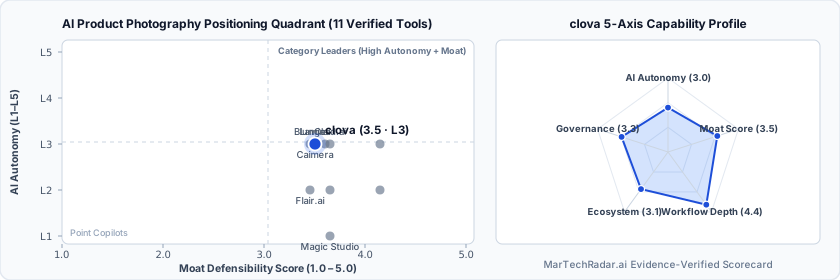
clova is a Web SaaS tool for AI Product Photography (Product Photography & AI Retouching) in Visual & Creative Media. Pricing: $23–$95/mo. Best suited to eCommerce Brands, Creative Agencies and Performance Video Marketers. Editor ratings: AI autonomy L3 (conditional automation); moat score 3.5/5.0 (Proprietary moat). Fact-checked by Jiacky Lee on Oct 10, 2026.
Conversational AI creative studio generating brand-consistent product photography, digital ads, and social media creative assets from unified chat prompts.
clova buyer fit verdict: when to choose vs. when to walk away
Choose clova if (Best Fit)
- Target ICP & Stack Fit: You operate as eCommerce Brands, Creative Agencies and Performance Video Marketers requiring a Web SaaS deployment for AI Product Photography.
- L3 Architecture & Defensibility: Proprietary conversational prompt-to-scene orchestration pipeline integrating multi-asset brand kits with fine-tuned latent diffusion image and video generation models.
- Commercial Model Fit: Your procurement budget aligns with $23–$95/mo.
Walk away from clova if (Deal-Breakers)
- Walk away if your workflow requires uncapped enterprise volume on the $23–$95/mo entry plan without upgrading tiers.
- Walk away if your workflow cannot tolerate resolution and compute gating: Access to 4K exports and synthetic video rendering is strictly restricted by tier, forcing lower tiers to operate with 1K outputs that require external upscaling for high-resolution print or billboard placements.
- Walk away if brand kit capacity constraints is a deal-breaker for your team: Entry-level configurations enforce a hard ceiling of a single brand kit and three active projects, creating severe operational friction for multi-brand agencies managing diverse visual taxonomies.
clova key facts & scorecard
| Pricing | $23–$95/moVendor pricing page |
|---|---|
| Free plan | No / not disclosed |
| Delivery | Web SaaS |
| Audience | eCommerce Brands, Creative Agencies, Performance Video Marketers |
| AI autonomy level | L3 · Conditional automationEditor-verified |
| Moat tier & score | 3.5 / 5.0 · Proprietary moatEditor-verified |
| Funding | Seed |
| Total funding | SeedBacked by Founders, Inc. |
| Founders | Ryan Bailey, William Wang |
| Company size | 2-10 employees |
| Headquarters | San Francisco, California |
| Founded | 2025 |
| Last verified |
clova pros & cons: strengths vs. operational limitations
Pros: core strengths & capabilities
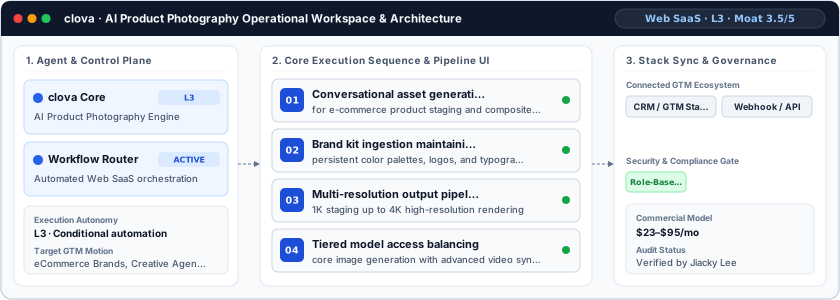
- Conversational asset generation: for e-commerce product staging and composite ad creatives
- Brand kit ingestion maintaining: persistent color palettes, logos, and typographic styles
- Multi-resolution output pipeline supporting: 1K staging up to 4K high-resolution rendering
- Tiered model access balancing: core image generation with advanced video synthesis engines
Cons: operational limitations & risks
- Resolution and compute gating: Access to 4K exports and synthetic video rendering is strictly restricted by tier, forcing lower tiers to operate with 1K outputs that require external upscaling for high-resolution print or billboard placements.
- Brand kit capacity constraints: Entry-level configurations enforce a hard ceiling of a single brand kit and three active projects, creating severe operational friction for multi-brand agencies managing diverse visual taxonomies.
- Credit consumption volatility: Workflows rely on variable credit deductions where multi-shot iterations or video synthesis rapidly deplete monthly allocations, causing asset pipelines to stall during intensive creative iteration cycles.
clova TCO & deal-breaker stress test
Simulate 12-month stepped TCO, hidden cost multipliers, contract lock-in exposure, and stack failure modes using only facts verified by Jiacky Lee on · Capture SHA 8a90ec17.
clova aligns with your 5-seat / $800/mo profile. Review the walk-away triggers and contract levers below before deployment.
| Plan / Tier | Verified Rate | Scale Fit | Scope & Quota Notes |
|---|---|---|---|
| Basic | $23/mo | 1–2 seats | Everything you need for occasional projects and testing ideas. |
| Pro | $95/mo | 5 seats | Billed $1140 annually · Save $288 compared to monthly |
- Moat Score
- 3.5 / 5.0
- AI Autonomy
- L3
- Free Tier / Trial
- None disclosed
Triggered audit signals & failure modes
- Published Self-Serve Entry FloorVerified Pricing Ledger
clova publishes a transparent entry point ($23–$95/mo) for initial validation before committing.
- Tier Fit for 5-Seat Scale: Pro ($95/mo)Verified Tier Schedule
Billed $1140 annually · Save $288 compared to monthly
- Primary Operational Bottleneck: Resolution and compute gatingAudit by Jiacky Lee
Access to 4K exports and synthetic video rendering is strictly restricted by tier, forcing lower tiers to operate with 1K outputs that require external upscaling for high-resolution print or billboard placements.
Hidden TCO Multipliers & Quota Gates
- Annual Billing Headline vs. Monthly Premium: Headline entry rates reflect annual billing commitments (SAVE UP TO 21%); month-to-month flexibility carries a higher effective monthly rate or requires annual prepayment.
- Credit & Usage Burn Multiplier: Automated workflows consume metered credits/usage quotas; multi-step enrichment, voice minutes, or high-frequency agent runs can trigger mid-cycle top-up packs.
When to Walk Away & Negotiation Levers
- Walk away if your workflow requires uncapped enterprise volume on the $23–$95/mo entry plan without upgrading tiers.
- Walk away if your workflow cannot tolerate resolution and compute gating: Access to 4K exports and synthetic video rendering is strictly restricted by tier, forcing lower tiers to operate with 1K outputs that require external upscaling for high-resolution print or billboard placements.
- Walk away if brand kit capacity constraints is a deal-breaker for your team: Entry-level configurations enforce a hard ceiling of a single brand kit and three active projects, creating severe operational friction for multi-brand agencies managing diverse visual taxonomies.
- Validate exact quota thresholds (seats, credits, or API calls) included in clova's $23–$95/mo tier before converting from monthly to annual billing.
- Require a sandbox proof-of-concept testing resolution and compute gating against your live CRM/data schema before annual sign-off.
Ask a custom procurement or TCO stress-test question about clova
Lower 5-seat floor (~$8/mo vs. $95 / mo)
Lower 5-seat floor (~$10/mo vs. $95 / mo)
clova moat & subtrack positioning
Proprietary conversational prompt-to-scene orchestration pipeline integrating multi-asset brand kits with fine-tuned latent diffusion image and video generation models.
Editorial review
Fact-checked by Jiacky Lee (Managing Editor, AI Autonomy & Moat Methodology) on .
Background
Established in 2025 in San Francisco, California, Clova operates as a conversational creative studio built to eliminate manual staging overhead for modern e-commerce visual pipelines. Designed primarily for digital marketing teams and direct-to-consumer brand operators, the system unifies generative product photography, commercial advertising layouts, and brand collateral generation within a single chat-driven interface. By transforming unstructured text directions into structured visual assets, Clova replaces fragmented photo shoot logistics and external agency workflows with deterministic, software-driven asset generation.
How clova works
Under the hood, Clova operates an L3 autonomous creative pipeline driven by multi-modal diffusion frameworks and conversational prompt decomposition. When a user submits an asset directive, the system parses composition targets, product dimensions, and scene constraints against ingested brand kits. Visual synthesis utilizes a tiered model routing system: foundational image models handle baseline scene compositing and lighting alignment at 1K resolution, while high-tier pipelines execute high-fidelity 4K upscaling, surface retouching, and synthetic video rendering without manual rotoscoping.
Limitations
Operational considerations and platform boundaries include:
- Resolution and compute gating: Access to 4K exports and synthetic video rendering is strictly restricted by tier, forcing lower tiers to operate with 1K outputs that require external upscaling for high-resolution print or billboard placements.
- Brand kit capacity constraints: Entry-level configurations enforce a hard ceiling of a single brand kit and three active projects, creating severe operational friction for multi-brand agencies managing diverse visual taxonomies.
- Credit consumption volatility: Workflows rely on variable credit deductions where multi-shot iterations or video synthesis rapidly deplete monthly allocations, causing asset pipelines to stall during intensive creative iteration cycles.
clova pricing
Clova distributes its software via a tiered subscription model structured around monthly generation credits and technical feature gates. Commercial tiers range from $23 per month on an annual billing schedule up to $95 per month for higher computational quotas. The foundational tier provides core diffusion models at 1K resolution, while upper-tier packages unlock 4K exports, expanded project workspaces, multi-brand repositories, and generative video capabilities without digital watermarks.
How clova compares
In contrast to canvas-oriented platforms like Flair.ai that emphasize spatial positioning controls, Clova relies on conversational prompting to assemble compositions. While specialized tools like Blunge and Caimera focus predominantly on isolated catalog retouching and background replacement, Clova unifies product photography with complete social campaign collateral. The platform is best suited for lean e-commerce growth teams requiring rapid, multi-channel creative generation without managing complex manual design tooling.
Frequently asked questions about clova
How much does clova cost and what pricing tiers are available?
Published pricing summary for clova: $23–$95/mo. A permanent free plan is not disclosed for clova. Verified tier schedule: Basic ($23/mo for 1–2 seats); Pro ($95/mo for 5 seats). Clova distributes its software via a tiered subscription model structured around monthly generation credits and technical feature gates. Commercial tiers range from $23 per month on an annual billing schedule up to $95 per month for higher computational quotas.
How does clova work and how autonomous is its AI architecture?
Conversational AI creative studio generating brand-consistent product photography, digital ads, and social media creative assets from unified chat prompts. Within AI Product Photography (Product Photography & AI Retouching), MarTechRadar rates its execution architecture at L3 · Conditional automation with a verified Moat Score of 3.5 / 5.0 (Proprietary moat). Proprietary conversational prompt-to-scene orchestration pipeline integrating multi-asset brand kits with fine-tuned latent diffusion image and video generation models. Corporate profile: Founded by Ryan Bailey, William Wang, operating at 2-10 employees scale.
What are the main limitations of clova and when should buyers walk away?
Based on our editorial technical audit, key operational considerations and boundaries for clova include: (1) Resolution and compute gating: Access to 4K exports and synthetic video rendering is strictly restricted by tier, forcing lower tiers to operate with 1K outputs that require external upscaling for high-resolution print or billboard placements. (2) Brand kit capacity constraints: Entry-level configurations enforce a hard ceiling of a single brand kit and three active projects, creating severe operational friction for multi-brand agencies managing diverse visual taxonomies. (3) Credit consumption volatility: Workflows rely on variable credit deductions where multi-shot iterations or video synthesis rapidly deplete monthly allocations, causing asset pipelines to stall during intensive creative iteration cycles. Primary procurement walk-away rule: Walk away if your workflow requires uncapped enterprise volume on the $23–$95/mo entry plan without upgrading tiers.
What integrations, compliance certifications, and contract terms apply to clova?
Key TCO multiplier to watch: Annual Billing Headline vs. Monthly Premium (Headline entry rates reflect annual billing commitments (SAVE UP TO 21%); month-to-month flexibility carries a higher effective monthly rate or requires annual prepayment.) Before signing a contract, procurement teams should validate exact quota thresholds (seats, credits, or API calls) included in clova's $23–$95/mo tier before converting from monthly to annual billing.
What are the best clova alternatives and head-to-head competitors in 2026?
Top fact-checked alternatives to clova in AI Product Photography (Product Photography & AI Retouching) include Blunge ($10–$20/mo), Flair.ai (Free plan · $8–$38/mo), Canva Magic Studio (Free plan · $0/mo · Enterprise plan), Magic Studio (Free plan · $0/mo · Enterprise plan). In contrast to canvas-oriented platforms like Flair.ai that emphasize spatial positioning controls, Clova relies on conversational prompting to assemble compositions.
Verified sources & evidence trail
- Official product domain: https://joinclova.com
- Commercial pricing verification: https://www.joinclova.com/pricing
- Verified corporate entity profiles (
sameAs): LinkedIn Company Profile · Crunchbase Entity Record - Editorial audit sign-off: Fact-checked by Jiacky Lee on under the MarTechRadar Evidence-Ledger Protocol.