Lamina Review (2026): AI Product Photography Pricing, Limits & Alternatives
Bottom line
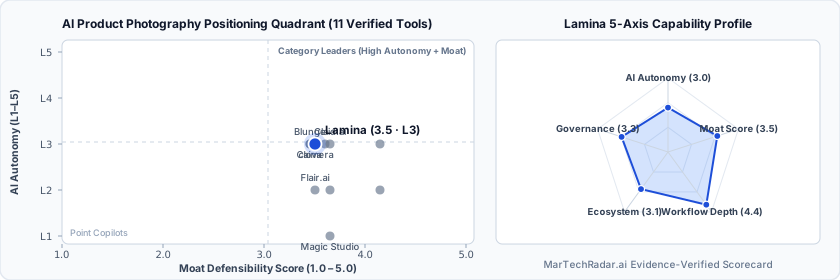
Lamina is a Web SaaS tool for AI Product Photography (Product Photography & AI Retouching) in Visual & Creative Media. Pricing: $59–$99/mo. Best suited to eCommerce Brands, Creative Agencies and Performance Video Marketers. Editor ratings: AI autonomy L3 (conditional automation); moat score 3.5/5.0 (Proprietary moat). Fact-checked by Jiacky Lee on Oct 10, 2026.
AI creative generation platform enabling e-commerce and brand teams to transform creative briefs and raw product inputs into high-resolution commercial.
Lamina buyer fit verdict: when to choose vs. when to walk away
Choose Lamina if (Best Fit)
- Target ICP & Stack Fit: You operate as eCommerce Brands, Creative Agencies and Performance Video Marketers requiring a Web SaaS deployment for AI Product Photography.
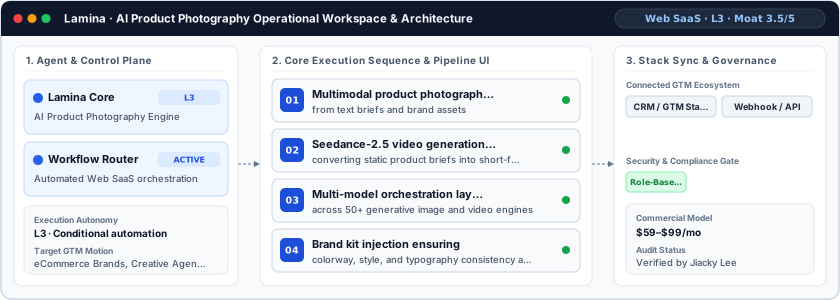
- L3 Architecture & Defensibility: Proprietary prompt-to-campaign translation engine integrating 50+ diffusion and video models (including Seedance-2.5) paired with automated brand-kit styling constraints to maintain product geometry across generation passes.
- Commercial Model Fit: Your procurement budget aligns with $59–$99/mo.
Walk away from Lamina if (Deal-Breakers)
- Walk away if your workflow requires uncapped enterprise volume on the $59–$99/mo entry plan without upgrading tiers.
- Walk away if your workflow cannot tolerate high-frequency texture hallucination: Complex physical surfaces such as reflective metallic finishes or micro-weave fabrics can suffer from synthetic artifacts during rapid prompt adjustments, necessitating manual seed filtering.
- Walk away if credit-constrained video iteration is a deal-breaker for your team: Generating dynamic video clips via Seedance-2.5 rapidly depletes allocation quotas, limiting continuous trial-and-error experimentation across large SKU variants.
Lamina key facts & scorecard
| Pricing | $59–$99/moVendor pricing page |
|---|---|
| Free plan | No / not disclosed |
| Delivery | Web SaaS |
| Audience | eCommerce Brands, Creative Agencies, Performance Video Marketers |
| AI autonomy level | L3 · Conditional automationEditor-verified |
| Moat tier & score | 3.5 / 5.0 · Proprietary moatEditor-verified |
| Funding | Pre-seed |
| Total funding | Pre-seedBacked by Bootstrapped |
| Company size | 11-50 employees |
| Governance & docs | Trust & Security ↗ · System Status ↗ · API & Docs ↗ · Changelog ↗ · Terms ↗ · Privacy ↗ |
| Headquarters | Sunnyvale, California |
| Founded | 2026 |
| Last verified |
Lamina pros & cons: strengths vs. operational limitations
Pros: core strengths & capabilities
- Multimodal product photography generation: from text briefs and brand assets
- Seedance-2.5 video generation module: converting static product briefs into short-form video
- Multi-model orchestration layer routing: across 50+ generative image and video engines
- Brand kit injection ensuring: colorway, style, and typography consistency across shoots
Cons: operational limitations & risks
- High-Frequency Texture Hallucination: Complex physical surfaces such as reflective metallic finishes or micro-weave fabrics can suffer from synthetic artifacts during rapid prompt adjustments, necessitating manual seed filtering.
- Credit-Constrained Video Iteration: Generating dynamic video clips via Seedance-2.5 rapidly depletes allocation quotas, limiting continuous trial-and-error experimentation across large SKU variants.
- Catalog Schema Ingestion Overhead: High-volume SKU ingestion through external APIs requires meticulous pre-formatting of masking layers and dimension parameters to avoid background blending defects.
Lamina TCO & deal-breaker stress test
Simulate 12-month stepped TCO, hidden cost multipliers, contract lock-in exposure, and stack failure modes using only facts verified by Jiacky Lee on · Capture SHA 9c914521.
Lamina aligns with your 5-seat / $800/mo profile. Review the walk-away triggers and contract levers below before deployment.
| Plan / Tier | Verified Rate | Scale Fit | Scope & Quota Notes |
|---|---|---|---|
| Teams | $59/mo | 1–2 seats | 3,200 credits / month |
| Scale | $99/mo | 5 seats | 5,500 credits / month |
- Moat Score
- 3.5 / 5.0
- AI Autonomy
- L3
- Free Tier / Trial
- None disclosed
Triggered audit signals & failure modes
- Published Self-Serve Entry FloorVerified Pricing Ledger
Lamina publishes a transparent entry point ($59–$99/mo) for initial validation before committing.
- Tier Fit for 5-Seat Scale: Scale ($99/mo)Verified Tier Schedule
5,500 credits / month
- Primary Operational Bottleneck: Credit-Constrained Video IterationAudit by Jiacky Lee
Generating dynamic video clips via Seedance-2.5 rapidly depletes allocation quotas, limiting continuous trial-and-error experimentation across large SKU variants.
Hidden TCO Multipliers & Quota Gates
- Annual Billing Headline vs. Monthly Premium: Headline entry rates reflect annual billing commitments (SAVE 20%); month-to-month flexibility carries a higher effective monthly rate or requires annual prepayment.
- Credit & Usage Burn Multiplier: Automated workflows consume metered credits/usage quotas; multi-step enrichment, voice minutes, or high-frequency agent runs can trigger mid-cycle top-up packs.
When to Walk Away & Negotiation Levers
- Walk away if your workflow requires uncapped enterprise volume on the $59–$99/mo entry plan without upgrading tiers.
- Walk away if your workflow cannot tolerate high-frequency texture hallucination: Complex physical surfaces such as reflective metallic finishes or micro-weave fabrics can suffer from synthetic artifacts during rapid prompt adjustments, necessitating manual seed filtering.
- Walk away if credit-constrained video iteration is a deal-breaker for your team: Generating dynamic video clips via Seedance-2.5 rapidly depletes allocation quotas, limiting continuous trial-and-error experimentation across large SKU variants.
- Validate exact quota thresholds (seats, credits, or API calls) included in Lamina's $59–$99/mo tier before converting from monthly to annual billing.
- Require a sandbox proof-of-concept testing high-frequency texture hallucination against your live CRM/data schema before annual sign-off.
Ask a custom procurement or TCO stress-test question about Lamina
Lower 5-seat floor (~$8/mo vs. $99 / mo)
Lower 5-seat floor (~$10/mo vs. $99 / mo)
Lamina moat & subtrack positioning
Proprietary prompt-to-campaign translation engine integrating 50+ diffusion and video models (including Seedance-2.5) paired with automated brand-kit styling constraints to maintain product geometry across generation passes.
Editorial review
Fact-checked by Jiacky Lee (Managing Editor, AI Autonomy & Moat Methodology) on .
Background
Brand and e-commerce growth teams face persistent production bottlenecks when orchestrating catalog imagery, lifestyle staging, and video assets across recurring retail cycles. Established in 2026 in Sunnyvale, California, Lamina addresses this job-to-be-done by providing an automated creative engine that converts brand kits and conceptual briefs into production-grade commercial media. Designed for digital merchandisers, creative directors, and catalog operations teams, the platform replaces physical studio setups with autonomous synthetic photography and generative video workflows within modern retail environments.
How Lamina works
Lamina operates through a coordinated multimodal asset synthesis architecture executing at Level 3 autonomy. The data ingestion pipeline extracts core product silhouettes, lighting guidelines, and brand colorways directly from client brand kits and uploaded brief files. Generative processing routes these structured inputs through an orchestration layer featuring more than fifty generative engines, including the Seedance-2.5 model for dynamic video composition. The platform maintains product geometry through constrained latent conditioning, preventing distortion during automated re-lighting, scene generation, and aspect ratio adjustments.
Limitations
Operational considerations and platform boundaries include:
- High-Frequency Texture Hallucination: Complex physical surfaces such as reflective metallic finishes or micro-weave fabrics can suffer from synthetic artifacts during rapid prompt adjustments, necessitating manual seed filtering.
- Credit-Constrained Video Iteration: Generating dynamic video clips via Seedance-2.5 rapidly depletes allocation quotas, limiting continuous trial-and-error experimentation across large SKU variants.
- Catalog Schema Ingestion Overhead: High-volume SKU ingestion through external APIs requires meticulous pre-formatting of masking layers and dimension parameters to avoid background blending defects.
Lamina pricing
The commercial licensing model uses credit-based subscription tiers alongside programmatic REST API endpoints. Entry-level usage begins on a self-serve baseline plan, progressing to the Creator tier priced at $59 per month for active marketing teams requiring 3,200 monthly generation credits. High-volume catalog teams scale into higher operational tiers reaching $99 per month for increased credit capacity and expanded parallel video synthesis lanes. Generated assets confer commercial rights, with credit consumption calculated per synthetic image render or discrete second of generated video.
How Lamina compares
Within the product photography and AI retouching domain, Lamina competes with Blunge, Caimera, and Clova. While Blunge focuses strictly on single-frame background replacements and Caimera emphasizes algorithmic retouching filters for existing human studio photography, Lamina differentiates through deep integration of video generation using Seedance-2.5 and flexible multi-model orchestration. Clova offers strong localized asset adaptation, yet Lamina excels in campaign-level continuity from a unified brand kit. The platform best serves mid-market to enterprise direct-to-consumer retailers seeking automated catalog generation across multi-channel campaigns.
Frequently asked questions about Lamina
How much does Lamina cost and what pricing tiers are available?
Published pricing summary for Lamina: $59–$99/mo. A permanent free plan is not disclosed for Lamina. Verified tier schedule: Teams ($59/mo for 1–2 seats); Scale ($99/mo for 5 seats). The commercial licensing model uses credit-based subscription tiers alongside programmatic REST API endpoints. Entry-level usage begins on a self-serve baseline plan, progressing to the Creator tier priced at $59 per month for active marketing teams requiring 3,200 monthly generation credits.
How does Lamina work and how autonomous is its AI architecture?
AI creative generation platform enabling e-commerce and brand teams to transform creative briefs and raw product inputs into high-resolution commercial. Within AI Product Photography (Product Photography & AI Retouching), MarTechRadar rates its execution architecture at L3 · Conditional automation with a verified Moat Score of 3.5 / 5.0 (Proprietary moat). Proprietary prompt-to-campaign translation engine integrating 50+ diffusion and video models (including Seedance-2.5) paired with automated brand-kit styling constraints to maintain product geometry across generation passes. Corporate profile: operating at 11-50 employees scale.
What are the main limitations of Lamina and when should buyers walk away?
Based on our editorial technical audit, key operational considerations and boundaries for Lamina include: (1) High-Frequency Texture Hallucination: Complex physical surfaces such as reflective metallic finishes or micro-weave fabrics can suffer from synthetic artifacts during rapid prompt adjustments, necessitating manual seed filtering. (2) Credit-Constrained Video Iteration: Generating dynamic video clips via Seedance-2.5 rapidly depletes allocation quotas, limiting continuous trial-and-error experimentation across large SKU variants. (3) Catalog Schema Ingestion Overhead: High-volume SKU ingestion through external APIs requires meticulous pre-formatting of masking layers and dimension parameters to avoid background blending defects. Primary procurement walk-away rule: Walk away if your workflow requires uncapped enterprise volume on the $59–$99/mo entry plan without upgrading tiers.
What integrations, compliance certifications, and contract terms apply to Lamina?
First-party governance and developer endpoints verified on domain include: Trust/Security (https://uselamina.ai/security), Status (https://uselamina.ai/status), API Docs (https://docs.uselamina.ai). Key TCO multiplier to watch: Annual Billing Headline vs. Monthly Premium (Headline entry rates reflect annual billing commitments (SAVE 20%); month-to-month flexibility carries a higher effective monthly rate or requires annual prepayment.) Before signing a contract, procurement teams should validate exact quota thresholds (seats, credits, or API calls) included in Lamina's $59–$99/mo tier before converting from monthly to annual billing.
What are the best Lamina alternatives and head-to-head competitors in 2026?
Top fact-checked alternatives to Lamina in AI Product Photography (Product Photography & AI Retouching) include Blunge ($10–$20/mo), Caimera ($15–$117/seat/mo), Photoroom (Free plan · $7.50–$82.50/mo), clova ($23–$95/mo). Within the product photography and AI retouching domain, Lamina competes with Blunge, Caimera, and Clova.
Verified sources & evidence trail
- Official product domain: https://uselamina.ai
- Commercial pricing verification: https://uselamina.ai/pricing
- Verified corporate entity profiles (
sameAs): LinkedIn Company Profile · Crunchbase Entity Record - First-party governance & documentation links: Trust & Security · System Status · API & Docs · Changelog · Terms · Privacy
- Editorial audit sign-off: Fact-checked by Jiacky Lee on under the MarTechRadar Evidence-Ledger Protocol.