InVideo AI Review (2026): AI Video Generation Pricing, Limits & Alternatives
Bottom line
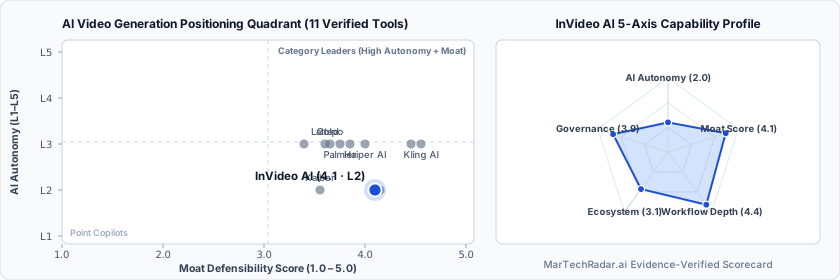
InVideo AI is a Web SaaS tool for AI Video Generation (Generative Commercial Video & Media) in Visual & Creative Media. Pricing: Free plan · $20–$150/seat/mo. Best suited to DTC / eCommerce and Creators / Solo. Editor ratings: AI autonomy L2 (workflow copilot); moat score 4.1/5.0 (Proprietary moat). Fact-checked by Jiacky Lee on Oct 5, 2026.
Prompt-to-video production platform combining automated script generation, asset assembly, and synthetic voice synthesis for cross-channel video creation.
InVideo AI buyer fit verdict: when to choose vs. when to walk away
Choose InVideo AI if (Best Fit)
- Target ICP & Stack Fit: You operate as DTC / eCommerce and Creators / Solo requiring a Web SaaS deployment for AI Video Generation.
- L2 Architecture & Defensibility: Moderate technical defensibility centered on prompt-to-timeline orchestration and high-volume asset indexing, constrained by reliance on third-party foundational LLMs and commodity stock footage libraries.
- Commercial Model Fit: Your procurement budget aligns with Free plan · $20–$150/seat/mo and want a self-serve free tier for zero-cost initial validation.
Walk away from InVideo AI if (Deal-Breakers)
- Walk away if your workflow requires uncapped enterprise volume on the Free plan · $20–$150/seat/mo entry plan without upgrading tiers.
- Walk away if your workflow cannot tolerate semantic asset alignment: Automated asset matching frequently selects generic or contextually disconnected stock footage when scripts address technical, niche B2B concepts, demanding extensive manual replacement.
- Walk away if timeline editing granularity is a deal-breaker for your team: Text-prompt modifications to existing generated scenes can cause unintentional reframing or timeline drift, lacking the determinism found in non-linear professional editors.
InVideo AI key facts & scorecard
| Pricing | Free plan · $20–$150/seat/moVendor pricing page |
|---|---|
| Free plan | Yes |
| Delivery | Web SaaS |
| Audience | DTC / eCommerce, Creators / Solo |
| AI autonomy level | L2 · Workflow copilotEditor-verified |
| Moat tier & score | 4.1 / 5.0 · Proprietary moatEditor-verified |
| Funding | Series B |
| Total funding | $52.5MBacked by Peak XV Partners, Tiger Global Management |
| Founders | Abhilash Hande, Anshul Khandelwal, Harsh Vakharia, Pankit Chheda |
| Company size | 51-200 employees |
| Governance & docs | Privacy ↗ |
| Headquarters | San Francisco, United States |
| Founded | 2017 |
| Last verified |
InVideo AI pros & cons: strengths vs. operational limitations
Pros: core strengths & capabilities
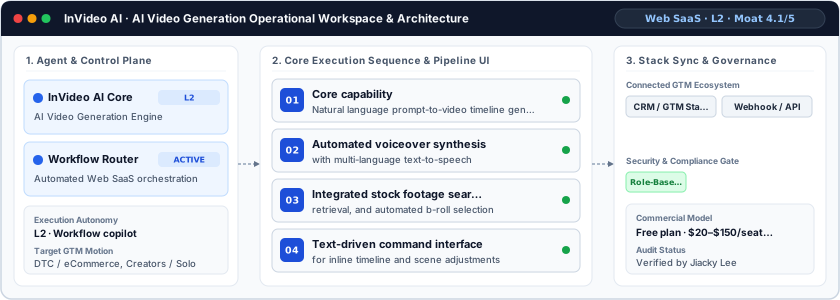
- Core capability: Natural language prompt-to-video timeline generation
- Automated voiceover synthesis: with multi-language text-to-speech
- Integrated stock footage search,: retrieval, and automated b-roll selection
- Text-driven command interface: for inline timeline and scene adjustments
Cons: operational limitations & risks
- Semantic Asset Alignment: Automated asset matching frequently selects generic or contextually disconnected stock footage when scripts address technical, niche B2B concepts, demanding extensive manual replacement.
- Timeline Editing Granularity: Text-prompt modifications to existing generated scenes can cause unintentional reframing or timeline drift, lacking the determinism found in non-linear professional editors.
- Render Latency Under Concurrency: Queue processing during peak utilization creates significant export delays for extended multi-minute video renders, complicating tight content publication schedules.
InVideo AI TCO & deal-breaker stress test
Simulate 12-month stepped TCO, hidden cost multipliers, contract lock-in exposure, and stack failure modes using only facts verified by Jiacky Lee on · Capture SHA 769fc92e.
InVideo AI aligns with your 5-seat / $800/mo profile. Review the walk-away triggers and contract levers below before deployment.
| Plan / Tier | Verified Rate | Scale Fit | Scope & Quota Notes |
|---|---|---|---|
| Free / Sandbox | $0 | 1–2 seats (Evaluation) | Entry free tier with capped usage or feature quotas for initial workflow testing. |
| Business | $20/seat/mo | 1–2 seats | 400 credits per seat/mo |
| Growth / Professional | $150/seat/mo | 5 seats | Verified $150/seat/mo tier from vendor pricing schedule. |
- Moat Score
- 4.1 / 5.0
- AI Autonomy
- L2
- Free Tier / Trial
- Free plan
Triggered audit signals & failure modes
- Published Self-Serve Entry FloorVerified Pricing Ledger
InVideo AI publishes a transparent entry point (Free plan · $20–$150/seat/mo) with a free tier for initial validation before committing.
- Linear Per-Seat Scaling (5 Seats × $20/seat/mo)Commercial Model Audit
Base license scales linearly with operator headcount ($100/mo for 5 seats on Business).
- Primary Operational Bottleneck: Semantic Asset AlignmentAudit by Jiacky Lee
Automated asset matching frequently selects generic or contextually disconnected stock footage when scripts address technical, niche B2B concepts, demanding extensive manual replacement.
Hidden TCO Multipliers & Quota Gates
- Per-Seat Linear Scaling: InVideo AI prices licenses on a per-user/seat basis (Free plan · $20–$150/seat/mo); expanding from 2 to 15+ operators multiplies base recurring spend linearly.
- Annual Billing Headline vs. Monthly Premium: Headline entry rates reflect annual billing commitments (Save $288); month-to-month flexibility carries a higher effective monthly rate or requires annual prepayment.
- Credit & Usage Burn Multiplier: Automated workflows consume metered credits/usage quotas; multi-step enrichment, voice minutes, or high-frequency agent runs can trigger mid-cycle top-up packs.
When to Walk Away & Negotiation Levers
- Walk away if your workflow requires uncapped enterprise volume on the Free plan · $20–$150/seat/mo entry plan without upgrading tiers.
- Walk away if your workflow cannot tolerate semantic asset alignment: Automated asset matching frequently selects generic or contextually disconnected stock footage when scripts address technical, niche B2B concepts, demanding extensive manual replacement.
- Walk away if timeline editing granularity is a deal-breaker for your team: Text-prompt modifications to existing generated scenes can cause unintentional reframing or timeline drift, lacking the determinism found in non-linear professional editors.
- Validate exact quota thresholds (seats, credits, or API calls) included in InVideo AI's Free plan · $20–$150/seat/mo tier before converting from monthly to annual billing.
- Require a sandbox proof-of-concept testing semantic asset alignment against your live CRM/data schema before annual sign-off.
Ask a custom procurement or TCO stress-test question about InVideo AI
Lower 5-seat floor (~$10/mo vs. $100 / mo)
Lower 5-seat floor (~$24/mo vs. $100 / mo)
InVideo AI moat & subtrack positioning
Moderate technical defensibility centered on prompt-to-timeline orchestration and high-volume asset indexing, constrained by reliance on third-party foundational LLMs and commodity stock footage libraries.
Editorial review
Fact-checked by Jiacky Lee (Managing Editor, AI Autonomy & Moat Methodology) on .
Background
InVideo AI functions as an automated video generation platform engineered to convert natural language prompts into complete, editable audiovisual compositions. Headquartered in San Francisco, United States, and founded in 2017, the organization has raised $52.5M in venture funding. Directed at digital marketing agencies, growth operators, and social media production teams, the system addresses the operational bottleneck of manually scripting, assembling b-roll footage, and synchronizing voiceovers for high-frequency video distribution across social channels.
How InVideo AI works
The platform utilizes a multi-step generative orchestration pipeline structured to streamline end-to-end media production. Upon ingestion of user prompts defining audience, narrative style, and duration, an LLM generates a structured scene-by-scene script. The engine extracts thematic entities and semantic keywords to query integrated media libraries for stock video clips, images, and audio tracks. In parallel, a neural text-to-speech module synthesizes speech tracks aligned to script timestamps. The system assembles these layers into an editable timeline canvas, allowing users to modify assets via natural language directives or manual asset swaps prior to cloud-based FFmpeg rendering.
Limitations
Operational considerations and platform boundaries include:
- Semantic Asset Alignment: Automated asset matching frequently selects generic or contextually disconnected stock footage when scripts address technical, niche B2B concepts, demanding extensive manual replacement.
- Timeline Editing Granularity: Text-prompt modifications to existing generated scenes can cause unintentional reframing or timeline drift, lacking the determinism found in non-linear professional editors.
- Render Latency Under Concurrency: Queue processing during peak utilization creates significant export delays for extended multi-minute video renders, complicating tight content publication schedules.
InVideo AI pricing
Commercial access operates under a tiered monthly software-as-a-service model. Entry tiers begin at $20 per month per seat, providing foundational generation credits and stock asset allowances. Higher operational tiers extend up to $150 per month per seat, unlocking expanded generative minutes, elevated storage quotas, and team collaboration features. A complimentary tier is maintained for testing, with advanced asset licenses and compute overages constrained by monthly allocation ceilings.
How InVideo AI compares
Within generative media, InVideo AI focuses on structured compilation rather than pure diffusion-based synthesis. Competitors such as Kling AI and Haiper AI prioritize foundational video diffusion models that generate raw, physics-aware motion footage from text, offering deeper visual novelties but requiring external assembly. Kaiber emphasizes stylized, artistic visual effects across music and entertainment workflows. InVideo AI remains positioned for commercial marketing teams requiring rapid template-based assembly over custom diffusion-generated imagery.
Direct competitors & market radar
Top algorithmic competitors based on category positioning, capability overlap, and ICP alignment.
Frequently asked questions about InVideo AI
How much does InVideo AI cost per seat and does it have a free plan?
Published pricing summary for InVideo AI: Free plan · $20–$150/seat/mo. InVideo AI includes a free tier or sandbox entry point. Verified tier schedule: Free / Sandbox ($0 for 1–2 seats (Evaluation)); Business ($20/seat/mo for 1–2 seats); Growth / Professional ($150/seat/mo for 5 seats). Commercial access operates under a tiered monthly software-as-a-service model. Entry tiers begin at $20 per month per seat, providing foundational generation credits and stock asset allowances.
How does InVideo AI work and how autonomous is its AI architecture?
Prompt-to-video production platform combining automated script generation, asset assembly, and synthetic voice synthesis for cross-channel video creation. Within AI Video Generation (Generative Commercial Video & Media), MarTechRadar rates its execution architecture at L2 · Workflow copilot with a verified Moat Score of 4.1 / 5.0 (Proprietary moat). Moderate technical defensibility centered on prompt-to-timeline orchestration and high-volume asset indexing, constrained by reliance on third-party foundational LLMs and commodity stock footage libraries. Corporate profile: Founded by Abhilash Hande, Anshul Khandelwal, Harsh Vakharia, Pankit Chheda, operating at 51-200 employees scale.
What are the main limitations of InVideo AI and when should buyers walk away?
Based on our editorial technical audit, key operational considerations and boundaries for InVideo AI include: (1) Semantic Asset Alignment: Automated asset matching frequently selects generic or contextually disconnected stock footage when scripts address technical, niche B2B concepts, demanding extensive manual replacement. (2) Timeline Editing Granularity: Text-prompt modifications to existing generated scenes can cause unintentional reframing or timeline drift, lacking the determinism found in non-linear professional editors. (3) Render Latency Under Concurrency: Queue processing during peak utilization creates significant export delays for extended multi-minute video renders, complicating tight content publication schedules. Primary procurement walk-away rule: Walk away if your workflow requires uncapped enterprise volume on the Free plan · $20–$150/seat/mo entry plan without upgrading tiers.
What integrations, compliance certifications, and contract terms apply to InVideo AI?
Key TCO multiplier to watch: Per-Seat Linear Scaling (InVideo AI prices licenses on a per-user/seat basis (Free plan · $20–$150/seat/mo); expanding from 2 to 15+ operators multiplies base recurring spend linearly.) Before signing a contract, procurement teams should validate exact quota thresholds (seats, credits, or API calls) included in InVideo AI's Free plan · $20–$150/seat/mo tier before converting from monthly to annual billing.
What are the best InVideo AI alternatives and head-to-head competitors in 2026?
Top fact-checked alternatives to InVideo AI in AI Video Generation (Generative Commercial Video & Media) include Topview.ai (From $0.12/mo), Lumen5 (From $19/mo), Kaiber ($10–$99/mo), Haiper AI (Custom / enterprise pricing). Within generative media, InVideo AI focuses on structured compilation rather than pure diffusion-based synthesis.
Verified sources & evidence trail
- Official product domain: https://invideo.io
- Commercial pricing verification: https://invideo.io/pricing
- Verified corporate entity profiles (
sameAs): LinkedIn Company Profile · Crunchbase Entity Record - First-party governance & documentation links: Privacy
- Editorial audit sign-off: Fact-checked by Jiacky Lee on under the MarTechRadar Evidence-Ledger Protocol.