Haiper AI Review (2026): AI Video Generation Pricing, Limits & Alternatives
Bottom line
Haiper AI is a Web SaaS tool for AI Video Generation (Generative Commercial Video & Media) in Visual & Creative Media. Pricing: Custom / enterprise pricing. Best suited to Creators / Solo. Editor ratings: AI autonomy L3 (conditional automation); moat score 4.0/5.0 (Proprietary moat). Fact-checked by Sarah Per on Oct 12, 2026.
Perceptual foundation video model synthesizing high-fidelity commercial motion shots, camera controls, and physics-informed animations from text and image.
Haiper AI buyer fit verdict: when to choose vs. when to walk away
Choose Haiper AI if (Best Fit)
- Target ICP & Stack Fit: You operate as Creators / Solo requiring a Web SaaS deployment for AI Video Generation.
- L3 Architecture & Defensibility: Moat derives from proprietary spatio-temporal video diffusion architectures developed by ex-DeepMind researchers, optimizing frame consistency and motion dynamics over generalized open-source checkpoints.
- Commercial Model Fit: Your procurement budget aligns with Custom / enterprise pricing.
Walk away from Haiper AI if (Deal-Breakers)
- Walk away if you require transparent self-serve monthly billing or your budget ceiling is under $1,000/mo (Haiper AI requires sales-gated custom quoting).
- Walk away if your workflow cannot tolerate temporal coherence drift: Complex multi-subject scenes with high kinetic activity experience anatomy warping and background degradation beyond initial keyframes.
- Walk away if rendering latency and GPU resource contention is a deal-breaker for your team: High-resolution 4K diffusion generation queues can encounter variable execution delays during peak compute demand windows.
Haiper AI key facts & scorecard
| Pricing | Custom / enterprise pricing |
|---|---|
| Free plan | No / not disclosed |
| Delivery | Web SaaS |
| Audience | Creators / Solo |
| AI autonomy level | L3 · Conditional automationEditor-verified |
| Moat tier & score | 4.0 / 5.0 · Proprietary moatEditor-verified |
| Funding | Seed |
| Total funding | $19.2MBacked by Octopus Ventures |
| Founders | Yishu Miao, Ziyu Wang |
| Company size | 11-50 employees |
| Governance & docs | API & Docs ↗ |
| Headquarters | Cargo Works, 1-2 Hatfields, London, GB |
| Founded | 2021 |
| Last verified |
Haiper AI pros & cons: strengths vs. operational limitations
Pros: core strengths & capabilities
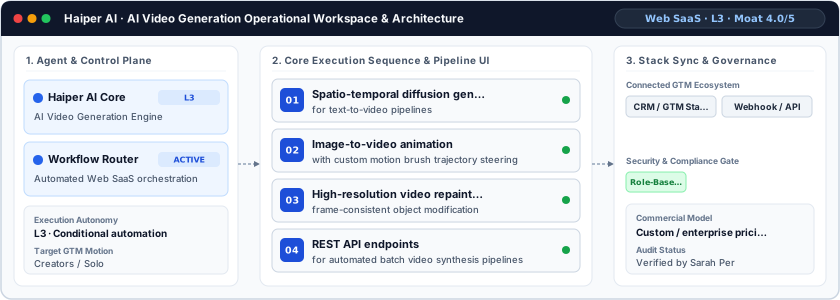
- Spatio-temporal diffusion generation: for text-to-video pipelines
- Image-to-video animation: with custom motion brush trajectory steering
- High-resolution video repainting and: frame-consistent object modification
- REST API endpoints: for automated batch video synthesis pipelines
Cons: operational limitations & risks
- Temporal coherence drift: Complex multi-subject scenes with high kinetic activity experience anatomy warping and background degradation beyond initial keyframes.
- Rendering latency and GPU resource contention: High-resolution 4K diffusion generation queues can encounter variable execution delays during peak compute demand windows.
- Text-prompt spatial ambiguity: Precise multi-plane camera direction often requires iterative prompt engineering due to weak zero-shot compliance with coordinate-specific prompts.
Haiper AI TCO & deal-breaker stress test
Simulate 12-month stepped TCO, hidden cost multipliers, contract lock-in exposure, and stack failure modes using only facts verified by Sarah Per on · Capture SHA 152d69c4.
Haiper AI triggers high-severity friction under your 5-seat / $800/mo constraints. Benchmark the verified subtrack alternatives below before committing.
| Plan / Tier | Verified Rate | Scale Fit | Scope & Quota Notes |
|---|---|---|---|
| Enterprise / Custom | Custom quote | 15–50+ seats (Enterprise SLA) | Sales-negotiated annual contract for custom volume, SSO/RBAC governance, and dedicated SLA. |
- Moat Score
- 4.0 / 5.0
- AI Autonomy
- L3
- Free Tier / Trial
- None disclosed
Triggered audit signals & failure modes
- Opaque Enterprise Quoting vs. SMB/Mid-Market BudgetVerified Pricing Ledger
Haiper AI does not disclose a public self-serve floor (Custom / enterprise pricing). Buyers with a $800/mo cap face high sales-qualification friction.
- Sales-Gated Contract TermsFact-checked by Sarah Per
Commercial access is provisioned through custom enterprise licensing, with pricing available on request through tailored enterprise sales quotes based on organizational scale and seats.
- Primary Operational Bottleneck: Temporal coherence driftAudit by Sarah Per
Complex multi-subject scenes with high kinetic activity experience anatomy warping and background degradation beyond initial keyframes.
Hidden TCO Multipliers & Quota Gates
- Credit & Usage Burn Multiplier: Automated workflows consume metered credits/usage quotas; multi-step enrichment, voice minutes, or high-frequency agent runs can trigger mid-cycle top-up packs.
- Temporal coherence drift: Complex multi-subject scenes with high kinetic activity experience anatomy warping and background degradation beyond initial keyframes.
- Rendering latency and GPU resource contention: High-resolution 4K diffusion generation queues can encounter variable execution delays during peak compute demand windows.
When to Walk Away & Negotiation Levers
- Walk away if you require transparent self-serve monthly billing or your budget ceiling is under $1,000/mo (Haiper AI requires sales-gated custom quoting).
- Walk away if your workflow cannot tolerate temporal coherence drift: Complex multi-subject scenes with high kinetic activity experience anatomy warping and background degradation beyond initial keyframes.
- Walk away if rendering latency and GPU resource contention is a deal-breaker for your team: High-resolution 4K diffusion generation queues can encounter variable execution delays during peak compute demand windows.
- Demand a 30- to 60-day paid pilot opt-out clause in the Haiper AI order form before signing a 12-month enterprise commitment.
- Require a sandbox proof-of-concept testing temporal coherence drift against your live CRM/data schema before annual sign-off.
Ask a custom procurement or TCO stress-test question about Haiper AI
Lower 5-seat floor (~$15/mo vs. Custom Quote) · Transparent self-serve entry without mandatory annual lock-in
Lower 5-seat floor (~$10/mo vs. Custom Quote) · Transparent self-serve entry without mandatory annual lock-in
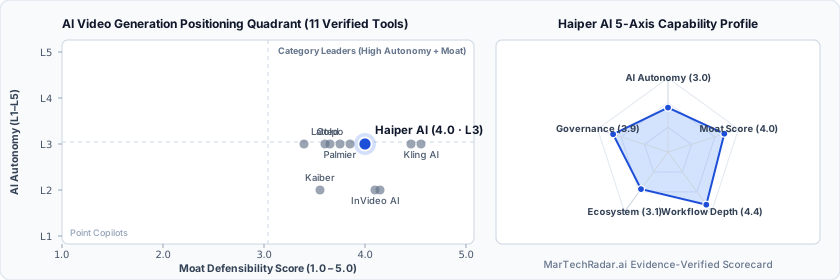
Haiper AI moat & subtrack positioning
Moat derives from proprietary spatio-temporal video diffusion architectures developed by ex-DeepMind researchers, optimizing frame consistency and motion dynamics over generalized open-source checkpoints.
Editorial review
Fact-checked by Sarah Per (Principal Content Systems & Generative Media Editor) on .
Background
Built around proprietary spatio-temporal diffusion models, Haiper AI delivers generative video synthesis aimed at creative studios, performance marketing agencies, and game designers. Founded in 2021 and headquartered at Cargo Works, 1-2 Hatfields, London, GB, the company has raised $19.2M in venture funding. The platform targets visual artists and brand production teams seeking to reduce live-action production overhead by generating video clips directly from textual and visual specifications.
How Haiper AI works
Architecturally, the platform functions at Level 3 conditional autonomy using foundational latent diffusion networks trained to maintain spatial consistency across temporal dimensions. The ingestion pipeline accepts structured text prompts or static reference imagery, encoding visual semantics through dense cross-attention mechanisms. The model predicts frame-to-frame motion vectors using physics-informed perceptual priors, reducing morphing artifacts during multi-second sequences. Users configure trajectory guidance, camera pans, and motion brush parameters before rendering passes finalize frame interpolation and export normalized video streams.
Limitations
Operational considerations and platform boundaries include:
- Temporal coherence drift: Complex multi-subject scenes with high kinetic activity experience anatomy warping and background degradation beyond initial keyframes.
- Rendering latency and GPU resource contention: High-resolution 4K diffusion generation queues can encounter variable execution delays during peak compute demand windows.
- Text-prompt spatial ambiguity: Precise multi-plane camera direction often requires iterative prompt engineering due to weak zero-shot compliance with coordinate-specific prompts.
Haiper AI pricing
Commercial access is provisioned through custom enterprise licensing, with pricing available on request through tailored enterprise sales quotes based on organizational scale and seats. Contracts typically grant dedicated GPU rendering allocations, priority inference queue slots, fine-tuning rights on private IP assets, and programmatic API query tiers.
How Haiper AI compares
Within generative media, Haiper AI differentiates via its foundational research pedigree against template-heavy aggregation tools like InVideo AI. While InVideo AI automates script-to-video editing workflows using stock assets, Haiper AI computes novel synthetic footage from scratch. Compared to Kaiber, which prioritizes stylized artistic visual transforms, and Kling AI, which delivers longer continuity sequences, Haiper targets granular visual effects manipulation. It best suits production departments needing custom asset generation within rapid pre-visualization pipelines.
Frequently asked questions about Haiper AI
How much does Haiper AI cost and does it require a custom enterprise quote?
Published pricing summary for Haiper AI: Custom / enterprise pricing. A permanent free plan is not disclosed for Haiper AI. Commercial access is provisioned through custom enterprise licensing, with pricing available on request through tailored enterprise sales quotes based on organizational scale and seats.
How does Haiper AI work and how autonomous is its AI architecture?
Perceptual foundation video model synthesizing high-fidelity commercial motion shots, camera controls, and physics-informed animations from text and image. Within AI Video Generation (Generative Commercial Video & Media), MarTechRadar rates its execution architecture at L3 · Conditional automation with a verified Moat Score of 4.0 / 5.0 (Proprietary moat). Moat derives from proprietary spatio-temporal video diffusion architectures developed by ex-DeepMind researchers, optimizing frame consistency and motion dynamics over generalized open-source checkpoints. Corporate profile: Founded by Yishu Miao, Ziyu Wang, operating at 11-50 employees scale.
What are the main limitations of Haiper AI and when should buyers walk away?
Based on our editorial technical audit, key operational considerations and boundaries for Haiper AI include: (1) Temporal coherence drift: Complex multi-subject scenes with high kinetic activity experience anatomy warping and background degradation beyond initial keyframes. (2) Rendering latency and GPU resource contention: High-resolution 4K diffusion generation queues can encounter variable execution delays during peak compute demand windows. (3) Text-prompt spatial ambiguity: Precise multi-plane camera direction often requires iterative prompt engineering due to weak zero-shot compliance with coordinate-specific prompts. Primary procurement walk-away rule: Walk away if you require transparent self-serve monthly billing or your budget ceiling is under $1,000/mo (Haiper AI requires sales-gated custom quoting).
What integrations, compliance certifications, and contract terms apply to Haiper AI?
First-party governance and developer endpoints verified on domain include: API Docs (https://docs.haiper.ai/llms.txt). Key TCO multiplier to watch: Credit & Usage Burn Multiplier (Automated workflows consume metered credits/usage quotas; multi-step enrichment, voice minutes, or high-frequency agent runs can trigger mid-cycle top-up packs.) Before signing a contract, procurement teams should demand a 30- to 60-day paid pilot opt-out clause in the Haiper AI order form before signing a 12-month enterprise commitment.
What are the best Haiper AI alternatives and head-to-head competitors in 2026?
Top fact-checked alternatives to Haiper AI in AI Video Generation (Generative Commercial Video & Media) include InVideo AI (Free plan · $20–$150/seat/mo), Kling AI (From $0.14), Kaiber ($10–$99/mo), Runway Gen-3 (Free plan · $15–$95/mo). Within generative media, Haiper AI differentiates via its foundational research pedigree against template-heavy aggregation tools like InVideo AI. While InVideo AI automates script-to-video editing workflows using stock assets, Haiper AI computes novel synthetic footage from scratch.
Verified sources & evidence trail
- Official product domain: https://haiper.ai
- Commercial pricing verification: Verified against official vendor pricing policy (Custom / enterprise pricing)
- Verified corporate entity profiles (
sameAs): LinkedIn Company Profile · Crunchbase Entity Record - First-party governance & documentation links: API & Docs
- Editorial audit sign-off: Fact-checked by Sarah Per on under the MarTechRadar Evidence-Ledger Protocol.