Kaiber Review (2026): AI Video Generation Pricing, Limits & Alternatives
Bottom line
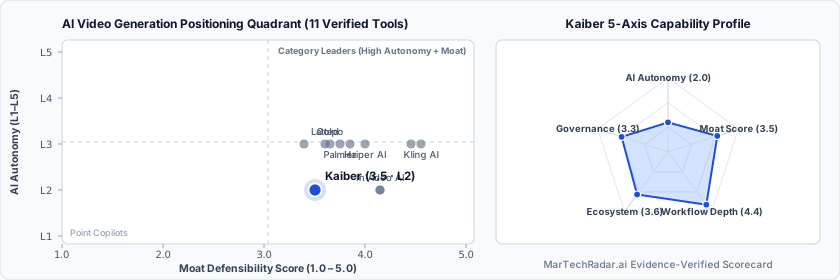
Kaiber is a Web SaaS tool for AI Video Generation (Generative Commercial Video & Media) in Visual & Creative Media. Pricing: $10–$99/mo. Best suited to Creators / Solo. Editor ratings: AI autonomy L2 (workflow copilot); moat score 3.5/5.0 (Proprietary moat). Fact-checked by Jagmeet Sine on Oct 12, 2026.
Creative generative video studio combining latent diffusion synthesis, audio-reactive beat synchronization, and multi-track canvas editing.
Kaiber buyer fit verdict: when to choose vs. when to walk away
Choose Kaiber if (Best Fit)
- Target ICP & Stack Fit: You operate as Creators / Solo requiring a Web SaaS deployment for AI Video Generation, with verified ecosystem connectivity for Zoom.
- L2 Architecture & Defensibility: Defensibility centers on audio-reactive timing pipelines and stylization control systems tailored for music producers and creative agencies, though broader diffusion video foundational models present commoditization pressure.
- Commercial Model Fit: Your procurement budget aligns with $10–$99/mo.
Walk away from Kaiber if (Deal-Breakers)
- Walk away if your workflow requires uncapped enterprise volume on the $10–$99/mo entry plan without upgrading tiers.
- Walk away if your workflow cannot tolerate temporal consistency and artifact drift: Sustained sequential scenes suffer from progressive seed drift, resulting in flickering textures and morphing subject anatomy during complex motion sequences.
- Walk away if audio waveform mapping rigidity is a deal-breaker for your team: Automated beat synchronization relies strictly on transient threshold peaks, which can trigger erratic frame transformations during dense polyphonic or ambient arrangements.
Kaiber key facts & scorecard
| Pricing | $10–$99/moVendor pricing page |
|---|---|
| Free plan | No / not disclosed |
| Delivery | Web SaaS |
| Audience | Creators / Solo |
| AI autonomy level | L2 · Workflow copilotEditor-verified |
| Moat tier & score | 3.5 / 5.0 · Proprietary moatEditor-verified |
| Funding | Seed |
| Total funding | SeedBacked by EQT Ventures, Crush Ventures |
| Founders | Christine Zuniga, Ede Schweizer, Eric Gao, Jacky Lu |
| Company size | 2-10 employees |
| Ecosystem integrations | Zoom |
| Governance & docs | Terms ↗ · Privacy ↗ |
| Headquarters | Arcadia, California, United States |
| Founded | 2023 |
| Last verified |
Kaiber pros & cons: strengths vs. operational limitations
Pros: core strengths & capabilities
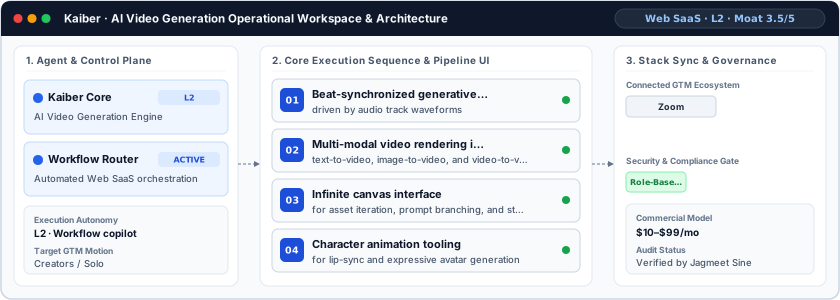
- Beat-synchronized generative video synthesis: driven by audio track waveforms
- Multi-modal video rendering including: text-to-video, image-to-video, and video-to-video style transfers
- Infinite canvas interface: for asset iteration, prompt branching, and storyboarding
- Character animation tooling: for lip-sync and expressive avatar generation
Cons: operational limitations & risks
- Temporal Consistency and Artifact Drift: Sustained sequential scenes suffer from progressive seed drift, resulting in flickering textures and morphing subject anatomy during complex motion sequences.
- Audio Waveform Mapping Rigidity: Automated beat synchronization relies strictly on transient threshold peaks, which can trigger erratic frame transformations during dense polyphonic or ambient arrangements.
- Export Granularity and Render Latency: High-resolution multi-layer renders encounter GPU queue bottlenecks under high platform concurrency, lacking native round-trip EDL interchange with non-linear editors.
Kaiber TCO & deal-breaker stress test
Simulate 12-month stepped TCO, hidden cost multipliers, contract lock-in exposure, and stack failure modes using only facts verified by Jagmeet Sine on · Capture SHA 846ac6a4.
Kaiber aligns with your 5-seat / $800/mo profile. Review the walk-away triggers and contract levers below before deployment.
| Plan / Tier | Verified Rate | Scale Fit | Scope & Quota Notes |
|---|---|---|---|
| Starter | $10/mo | 1–2 seats | For individuals exploring AI creation |
| Unlimited | $99/mo | 5 seats | 5,000 credits per month |
- Moat Score
- 3.5 / 5.0
- AI Autonomy
- L2
- Free Tier / Trial
- None disclosed
Triggered audit signals & failure modes
- Published Self-Serve Entry FloorVerified Pricing Ledger
Kaiber publishes a transparent entry point ($10–$99/mo) for initial validation before committing.
- Tier Fit for 5-Seat Scale: Unlimited ($99/mo)Verified Tier Schedule
5,000 credits per month
- Primary Operational Bottleneck: Temporal Consistency and Artifact DriftAudit by Jagmeet Sine
Sustained sequential scenes suffer from progressive seed drift, resulting in flickering textures and morphing subject anatomy during complex motion sequences.
Hidden TCO Multipliers & Quota Gates
- Credit & Usage Burn Multiplier: Automated workflows consume metered credits/usage quotas; multi-step enrichment, voice minutes, or high-frequency agent runs can trigger mid-cycle top-up packs.
- Temporal Consistency and Artifact Drift: Sustained sequential scenes suffer from progressive seed drift, resulting in flickering textures and morphing subject anatomy during complex motion sequences.
- Audio Waveform Mapping Rigidity: Automated beat synchronization relies strictly on transient threshold peaks, which can trigger erratic frame transformations during dense polyphonic or ambient arrangements.
When to Walk Away & Negotiation Levers
- Walk away if your workflow requires uncapped enterprise volume on the $10–$99/mo entry plan without upgrading tiers.
- Walk away if your workflow cannot tolerate temporal consistency and artifact drift: Sustained sequential scenes suffer from progressive seed drift, resulting in flickering textures and morphing subject anatomy during complex motion sequences.
- Walk away if audio waveform mapping rigidity is a deal-breaker for your team: Automated beat synchronization relies strictly on transient threshold peaks, which can trigger erratic frame transformations during dense polyphonic or ambient arrangements.
- Validate exact quota thresholds (seats, credits, or API calls) included in Kaiber's $10–$99/mo tier before converting from monthly to annual billing.
- Require a sandbox proof-of-concept testing temporal consistency and artifact drift against your live CRM/data schema before annual sign-off.
Ask a custom procurement or TCO stress-test question about Kaiber
Lower 5-seat floor (~$15/mo vs. $99 / mo)
Lower 5-seat floor (~$10/mo vs. $99 / mo)
Kaiber key entities, modules & ecosystem stack
Kaiber moat & subtrack positioning
Defensibility centers on audio-reactive timing pipelines and stylization control systems tailored for music producers and creative agencies, though broader diffusion video foundational models present commoditization pressure.
Editorial review
Fact-checked by Jagmeet Sine (Senior MarTech Infrastructure & Agentic Workflow Architect) on .
Background
Kaiber addresses the operational bottleneck of producing audio-reactive visual media and stylized video assets without manual frame-by-frame post-production. Headquartered in Arcadia, California, United States, and founded in 2023, the platform targets creative directors, musicians, and digital marketing agencies. The platform centralizes generative workflows into an integrated creative suite, serving teams that require high-cadence social video, tour visuals, and promotional media linked to sound design.
How Kaiber works
Operating at an L2 autonomy tier, the system pairs multi-modal latent diffusion architectures with deterministic audio-signal processing algorithms. The ingestion pipeline extracts transient markers and frequency peaks from uploaded audio stems, mapping rhythmic dynamics directly to camera motion prompts, zoom rates, and diffusion noise schedules. Production teams configure animations across text-to-video, keyframe-to-video, and video-to-video modalities, while an interactive canvas environment manages spatial arrangement, prompt branching, and multi-layer timeline assemblies.
Limitations
Operational considerations and platform boundaries include:
- Temporal Consistency and Artifact Drift: Sustained sequential scenes suffer from progressive seed drift, resulting in flickering textures and morphing subject anatomy during complex motion sequences.
- Audio Waveform Mapping Rigidity: Automated beat synchronization relies strictly on transient threshold peaks, which can trigger erratic frame transformations during dense polyphonic or ambient arrangements.
- Export Granularity and Render Latency: High-resolution multi-layer renders encounter GPU queue bottlenecks under high platform concurrency, lacking native round-trip EDL interchange with non-linear editors.
Kaiber pricing
Commercial access operates via tiered monthly software subscriptions spanning $10 to $99 per month, backed by generation credit allocations. Entry-level accounts begin at $10 per month for foundational generation pipelines, scaling to $99 for high-volume asset output and expanded concurrency. A introductory trial is structured at $5 for five days, providing short-term platform evaluation before converting into ongoing subscription tiers.
How Kaiber compares
Within generative media tooling, Kaiber occupies an artistic niche compared to script-to-video automation suites like InVideo AI, which focus on corporate presentations and narration layouts. When evaluated against general-purpose foundation model platforms like Kling AI and Haiper AI, Kaiber trades raw physical fidelity for audio synchronization and stylized visual filters. It remains optimal for creative agencies producing music-driven brand campaigns.
Direct competitors & market radar
Top algorithmic competitors based on category positioning, capability overlap, and ICP alignment.
Frequently asked questions about Kaiber
How much does Kaiber cost and what pricing tiers are available?
Published pricing summary for Kaiber: $10–$99/mo. A permanent free plan is not disclosed for Kaiber. Verified tier schedule: Starter ($10/mo for 1–2 seats); Unlimited ($99/mo for 5 seats). Commercial access operates via tiered monthly software subscriptions spanning $10 to $99 per month, backed by generation credit allocations. Entry-level accounts begin at $10 per month for foundational generation pipelines, scaling to $99 for high-volume asset output and expanded concurrency.
How does Kaiber work and how autonomous is its AI architecture?
Creative generative video studio combining latent diffusion synthesis, audio-reactive beat synchronization, and multi-track canvas editing. Within AI Video Generation (Generative Commercial Video & Media), MarTechRadar rates its execution architecture at L2 · Workflow copilot with a verified Moat Score of 3.5 / 5.0 (Proprietary moat). Defensibility centers on audio-reactive timing pipelines and stylization control systems tailored for music producers and creative agencies, though broader diffusion video foundational models present commoditization pressure. Corporate profile: Founded by Christine Zuniga, Ede Schweizer, Eric Gao, Jacky Lu, operating at 2-10 employees scale.
What are the main limitations of Kaiber and when should buyers walk away?
Based on our editorial technical audit, key operational considerations and boundaries for Kaiber include: (1) Temporal Consistency and Artifact Drift: Sustained sequential scenes suffer from progressive seed drift, resulting in flickering textures and morphing subject anatomy during complex motion sequences. (2) Audio Waveform Mapping Rigidity: Automated beat synchronization relies strictly on transient threshold peaks, which can trigger erratic frame transformations during dense polyphonic or ambient arrangements. (3) Export Granularity and Render Latency: High-resolution multi-layer renders encounter GPU queue bottlenecks under high platform concurrency, lacking native round-trip EDL interchange with non-linear editors. Primary procurement walk-away rule: Walk away if your workflow requires uncapped enterprise volume on the $10–$99/mo entry plan without upgrading tiers.
What integrations, compliance certifications, and contract terms apply to Kaiber?
Verified ecosystem and stack integrations include Zoom. Key TCO multiplier to watch: Credit & Usage Burn Multiplier (Automated workflows consume metered credits/usage quotas; multi-step enrichment, voice minutes, or high-frequency agent runs can trigger mid-cycle top-up packs.) Before signing a contract, procurement teams should validate exact quota thresholds (seats, credits, or API calls) included in Kaiber's $10–$99/mo tier before converting from monthly to annual billing.
What are the best Kaiber alternatives and head-to-head competitors in 2026?
Top fact-checked alternatives to Kaiber in AI Video Generation (Generative Commercial Video & Media) include InVideo AI (Free plan · $20–$150/seat/mo), Kling AI (From $0.14), Haiper AI (Custom / enterprise pricing), Runway Gen-3 (Free plan · $15–$95/mo). Within generative media tooling, Kaiber occupies an artistic niche compared to script-to-video automation suites like InVideo AI, which focus on corporate presentations and narration layouts.
Verified sources & evidence trail
- Official product domain: https://kaiber.ai
- Commercial pricing verification: https://kaiber.ai/pricing
- Verified corporate entity profiles (
sameAs): LinkedIn Company Profile · Crunchbase Entity Record - First-party governance & documentation links: Terms · Privacy
- Editorial audit sign-off: Fact-checked by Jagmeet Sine on under the MarTechRadar Evidence-Ledger Protocol.