Pika Labs Review (2026): AI Video Generation Pricing, Limits & Alternatives
Bottom line
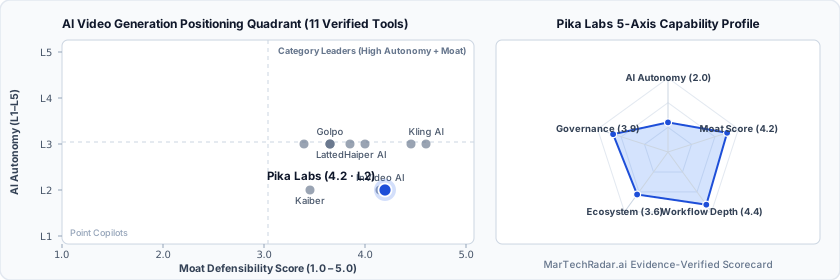
Pika Labs is a Web SaaS tool for AI Video Generation (Generative Commercial Video & Media) in Visual & Creative Media. Pricing: Free plan · $10–$50/mo. Best suited to DTC / eCommerce and Creators / Solo. Editor ratings: AI autonomy L2 (workflow copilot); moat score 4.2/5.0 (Proprietary moat). Fact-checked by Jagmeet Sine on Oct 7, 2026.
Generative video diffusion workspace providing camera trajectory manipulation, character motion transfer, and multimodal scene expansion for commercial.
Pika Labs buyer fit verdict: when to choose vs. when to walk away
Choose Pika Labs if (Best Fit)
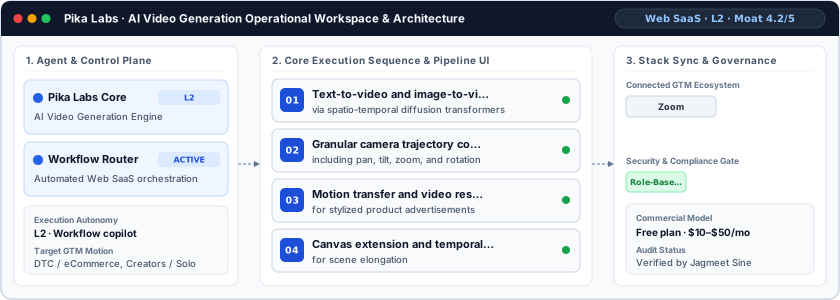
- Target ICP & Stack Fit: You operate as DTC / eCommerce and Creators / Solo requiring a Web SaaS deployment for AI Video Generation, with verified ecosystem connectivity for Zoom.
- L2 Architecture & Defensibility: Proprietary spatio-temporal video diffusion models combined with targeted camera manipulation controls, modular character motion transfer, and integrated multi-model inference pipelines.
- Commercial Model Fit: Your procurement budget aligns with Free plan · $10–$50/mo and want a self-serve free tier for zero-cost initial validation.
Walk away from Pika Labs if (Deal-Breakers)
- Walk away if your workflow requires uncapped enterprise volume on the Free plan · $10–$50/mo entry plan without upgrading tiers.
- Walk away if your workflow cannot tolerate temporal consistency drift: Complex physical interactions, intricate limb movements, and fine typographic elements frequently suffer from structural morphing and spatial hallucination across extended frame intervals.
- Walk away if inference latency and concurrency is a deal-breaker for your team: High-demand cluster queues generate variable rendering latency, constraining real-time storyboard prototyping and programmatic batch asset rendering workflows.
Pika Labs key facts & scorecard
| Pricing | Free plan · $10–$50/moVendor pricing page |
|---|---|
| Free plan | Yes |
| Delivery | Web SaaS |
| Audience | DTC / eCommerce, Creators / Solo |
| AI autonomy level | L2 · Workflow copilotEditor-verified |
| Moat tier & score | 4.2 / 5.0 · Proprietary moatEditor-verified |
| Funding | Series B |
| Total funding | $135MBacked by Spark Capital, Lightspeed Venture Partners |
| Founders | Chelin Meng, Demi Guo |
| Company size | 11-50 employees |
| Ecosystem integrations | Zoom |
| Governance & docs | Terms ↗ · Privacy ↗ |
| Headquarters | Palo Alto, California |
| Founded | 2023 |
| Last verified |
Pika Labs pros & cons: strengths vs. operational limitations
Pros: core strengths & capabilities
- Text-to-video and image-to-video generation: via spatio-temporal diffusion transformers
- Granular camera trajectory controls: including pan, tilt, zoom, and rotation
- Motion transfer and video reskinning engines: for stylized product advertisements
- Canvas extension and temporal video expansion: for scene elongation
Cons: operational limitations & risks
- Temporal Consistency Drift: Complex physical interactions, intricate limb movements, and fine typographic elements frequently suffer from structural morphing and spatial hallucination across extended frame intervals.
- Inference Latency and Concurrency: High-demand cluster queues generate variable rendering latency, constraining real-time storyboard prototyping and programmatic batch asset rendering workflows.
- Deterministic Camera Trajectory Limits: Granular camera parameter overrides lack precise absolute coordinate bindings, occasionally producing non-linear trajectory drifts during composite motion prompts.
Pika Labs TCO & deal-breaker stress test
Simulate 12-month stepped TCO, hidden cost multipliers, contract lock-in exposure, and stack failure modes using only facts verified by Jagmeet Sine on · Capture SHA 0d391c6e.
Pika Labs aligns with your 5-seat / $800/mo profile. Review the walk-away triggers and contract levers below before deployment.
| Plan / Tier | Verified Rate | Scale Fit | Scope & Quota Notes |
|---|---|---|---|
| Free / Sandbox | $0 | 1–2 seats (Evaluation) | Entry free tier with capped usage or feature quotas for initial workflow testing. |
| Starter | $10/mo | 1–2 seats | Verified $10/mo tier from vendor pricing schedule. |
| Growth / Professional | $50/mo | 5 seats | Verified $50/mo tier from vendor pricing schedule. |
- Moat Score
- 4.2 / 5.0
- AI Autonomy
- L2
- Free Tier / Trial
- Free plan
Triggered audit signals & failure modes
- Published Self-Serve Entry FloorVerified Pricing Ledger
Pika Labs publishes a transparent entry point (Free plan · $10–$50/mo) with a free tier for initial validation before committing.
- Tier Fit for 5-Seat Scale: Growth / Professional ($50/mo)Verified Tier Schedule
Verified $50/mo tier from vendor pricing schedule.
- Primary Operational Bottleneck: Temporal Consistency DriftAudit by Jagmeet Sine
Complex physical interactions, intricate limb movements, and fine typographic elements frequently suffer from structural morphing and spatial hallucination across extended frame intervals.
Hidden TCO Multipliers & Quota Gates
- Annual Billing Headline vs. Monthly Premium: Headline entry rates reflect annual billing commitments (Save 20%); month-to-month flexibility carries a higher effective monthly rate or requires annual prepayment.
- Credit & Usage Burn Multiplier: Automated workflows consume metered credits/usage quotas; multi-step enrichment, voice minutes, or high-frequency agent runs can trigger mid-cycle top-up packs.
When to Walk Away & Negotiation Levers
- Walk away if your workflow requires uncapped enterprise volume on the Free plan · $10–$50/mo entry plan without upgrading tiers.
- Walk away if your workflow cannot tolerate temporal consistency drift: Complex physical interactions, intricate limb movements, and fine typographic elements frequently suffer from structural morphing and spatial hallucination across extended frame intervals.
- Walk away if inference latency and concurrency is a deal-breaker for your team: High-demand cluster queues generate variable rendering latency, constraining real-time storyboard prototyping and programmatic batch asset rendering workflows.
- Validate exact quota thresholds (seats, credits, or API calls) included in Pika Labs's Free plan · $10–$50/mo tier before converting from monthly to annual billing.
- Require a sandbox proof-of-concept testing temporal consistency drift against your live CRM/data schema before annual sign-off.
Ask a custom procurement or TCO stress-test question about Pika Labs
Lower 5-seat floor (~$23/mo vs. $50 / mo)
Lower 5-seat floor (~$40/mo vs. $50 / mo)
Pika Labs key entities, modules & ecosystem stack
Pika Labs moat & subtrack positioning
Proprietary spatio-temporal video diffusion models combined with targeted camera manipulation controls, modular character motion transfer, and integrated multi-model inference pipelines.
Editorial review
Fact-checked by Jagmeet Sine (Senior MarTech Infrastructure & Agentic Workflow Architect) on .
Background
Pika Labs, established in 2023 and headquartered in Palo Alto, California, builds generative visual synthesis infrastructure designed for creative directors and commercial production teams. Backed by $135M in venture funding, the company addresses the operational bottleneck of rendering short-form video assets from static media and conceptual prompts. Rather than relying on physical production sets or complex 3D rendering pipelines, the platform enables commercial video editors and brand marketers to programmatically generate, stylize, and iterate on dynamic visual sequences.
How Pika Labs works
Operating at an L2 autonomy level, the technical architecture utilizes spatio-temporal diffusion transformer models to synthesize multi-frame visual continuity. Users provide prompt tokens or raster image inputs, configuring explicit motion vectors such as horizontal pans, vertical tilts, dynamic zooms, and frame rates. The generation pipeline ingests input parameters to compute temporal cross-attention layers, synchronizing visual attributes across keyframes. Furthermore, specialized utility endpoints handle targeted operations like motion transfer, video extension, and character reskinning, linking generated video outputs with synthetic audio layers and speech models.
Limitations
Operational considerations and platform boundaries include:
- Temporal Consistency Drift: Complex physical interactions, intricate limb movements, and fine typographic elements frequently suffer from structural morphing and spatial hallucination across extended frame intervals.
- Inference Latency and Concurrency: High-demand cluster queues generate variable rendering latency, constraining real-time storyboard prototyping and programmatic batch asset rendering workflows.
- Deterministic Camera Trajectory Limits: Granular camera parameter overrides lack precise absolute coordinate bindings, occasionally producing non-linear trajectory drifts during composite motion prompts.
Pika Labs pricing
Pika Labs provisions its compute resources through a tiered subscription architecture structured around monthly generation credits. Beyond an introductory free tier, commercial plans scale from $10 to $50 per month depending on compute allotment, priority queue access, and generation resolution caps. High-volume creative studios purchase incremental credit allocations to support extensive parallel rendering pipelines and extended video duration outputs.
How Pika Labs compares
Within the generative media landscape, Pika Labs competes directly with Haiper AI, InVideo AI, and Kaiber. While InVideo AI focuses on template-driven script-to-video automation for content marketers, and Kaiber caters to stylized audio-reactive visualizers, Pika Labs differentiates through granular motion transfer, flexible model routing, and direct camera trajectory controls. The platform is best matched for agile creative agencies and digital advertising studios seeking rapid conceptual video generation without dedicated 3D post-production overhead.
Frequently asked questions about Pika Labs
How much does Pika Labs cost and what pricing tiers are available?
Published pricing summary for Pika Labs: Free plan · $10–$50/mo. Pika Labs includes a free tier or sandbox entry point. Verified tier schedule: Free / Sandbox ($0 for 1–2 seats (Evaluation)); Starter ($10/mo for 1–2 seats); Growth / Professional ($50/mo for 5 seats). Pika Labs provisions its compute resources through a tiered subscription architecture structured around monthly generation credits. Beyond an introductory free tier, commercial plans scale from $10 to $50 per month depending on compute allotment, priority queue access, and generation resolution caps.
How does Pika Labs work and how autonomous is its AI architecture?
Generative video diffusion workspace providing camera trajectory manipulation, character motion transfer, and multimodal scene expansion for commercial. Within AI Video Generation (Generative Commercial Video & Media), MarTechRadar rates its execution architecture at L2 · Workflow copilot with a verified Moat Score of 4.2 / 5.0 (Proprietary moat). Proprietary spatio-temporal video diffusion models combined with targeted camera manipulation controls, modular character motion transfer, and integrated multi-model inference pipelines. Corporate profile: Founded by Chelin Meng, Demi Guo, operating at 11-50 employees scale.
What are the main limitations of Pika Labs and when should buyers walk away?
Based on our editorial technical audit, key operational considerations and boundaries for Pika Labs include: (1) Temporal Consistency Drift: Complex physical interactions, intricate limb movements, and fine typographic elements frequently suffer from structural morphing and spatial hallucination across extended frame intervals. (2) Inference Latency and Concurrency: High-demand cluster queues generate variable rendering latency, constraining real-time storyboard prototyping and programmatic batch asset rendering workflows. (3) Deterministic Camera Trajectory Limits: Granular camera parameter overrides lack precise absolute coordinate bindings, occasionally producing non-linear trajectory drifts during composite motion prompts. Primary procurement walk-away rule: Walk away if your workflow requires uncapped enterprise volume on the Free plan · $10–$50/mo entry plan without upgrading tiers.
What integrations, compliance certifications, and contract terms apply to Pika Labs?
Verified ecosystem and stack integrations include Zoom. Key TCO multiplier to watch: Annual Billing Headline vs. Monthly Premium (Headline entry rates reflect annual billing commitments (Save 20%); month-to-month flexibility carries a higher effective monthly rate or requires annual prepayment.) Before signing a contract, procurement teams should validate exact quota thresholds (seats, credits, or API calls) included in Pika Labs's Free plan · $10–$50/mo tier before converting from monthly to annual billing.
What are the best Pika Labs alternatives and head-to-head competitors in 2026?
Top fact-checked alternatives to Pika Labs in AI Video Generation (Generative Commercial Video & Media) include InVideo AI (Free plan · $20–$150/seat/mo), Kaiber ($10–$99/mo), Haiper AI (Custom / enterprise pricing), Zebracat (From $23/mo). Within the generative media landscape, Pika Labs competes directly with Haiper AI, InVideo AI, and Kaiber.
Verified sources & evidence trail
- Official product domain: https://pika.art
- Commercial pricing verification: https://pika.art/pricing
- Verified corporate entity profiles (
sameAs): LinkedIn Company Profile · Crunchbase Entity Record - First-party governance & documentation links: Terms · Privacy
- Editorial audit sign-off: Fact-checked by Jagmeet Sine on under the MarTechRadar Evidence-Ledger Protocol.