Zebracat Review (2026): AI Video Generation Pricing, Limits & Alternatives
Bottom line
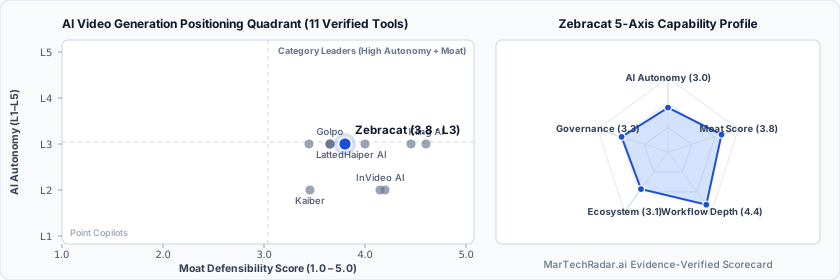
Zebracat is a Web SaaS tool for AI Video Generation (Generative Commercial Video & Media) in Visual & Creative Media. Pricing: From $23/mo. Best suited to B2B SaaS and DTC / eCommerce. Editor ratings: AI autonomy L3 (conditional automation); moat score 3.8/5.0 (Proprietary moat). Fact-checked by Jiacky Lee on Oct 12, 2026.
Autonomous social video production agent converting scripts, URLs, and text prompts into multi-platform short-form video assets.
Zebracat buyer fit verdict: when to choose vs. when to walk away
Choose Zebracat if (Best Fit)
- Target ICP & Stack Fit: You operate as B2B SaaS and DTC / eCommerce requiring a Web SaaS deployment for AI Video Generation.
- L3 Architecture & Defensibility: Moat defensibility is moderate and primarily anchored in its verticalized workflow automation, combining automated storyboarding, B-roll selection, voice synthesis, and direct scheduling. Because it relies on external diffusion video models and stock media APIs, long-term defensibility depends on retention loops established through brand kits and programmatic distribution workflows rather than underlying model weights.
- Commercial Model Fit: Your procurement budget aligns with From $23/mo.
Walk away from Zebracat if (Deal-Breakers)
- Walk away if your workflow requires uncapped enterprise volume on the From $23/mo entry plan without upgrading tiers.
- Walk away if your workflow cannot tolerate generative artifacting and coherence: Purely synthetic video scenes remain vulnerable to temporal morphing, character inconsistency across sequential shots, and low-fidelity rendering of hands or fine text.
- Walk away if credit throttling and compute caps is a deal-breaker for your team: Strict monthly allowances on generative compute credits limit high-volume experimentation, requiring teams to fall back on basic stock libraries when allocations deplete.
Zebracat key facts & scorecard
| Pricing | From $23/moVendor pricing page |
|---|---|
| Free plan | No / not disclosed |
| Delivery | Web SaaS |
| Audience | B2B SaaS, DTC / eCommerce |
| AI autonomy level | L3 · Conditional automationEditor-verified |
| Moat tier & score | 3.8 / 5.0 · Proprietary moatEditor-verified |
| Funding | Seed |
| Founders | Michael Baumgartner, Reza Zolf |
| Company size | 11-50 employees |
| Governance & docs | Privacy ↗ |
| Headquarters | Lohmühlenstraße 65, Berlin, 12435, DE |
| Founded | 2022 |
| Last verified |
Zebracat pros & cons: strengths vs. operational limitations
Pros: core strengths & capabilities
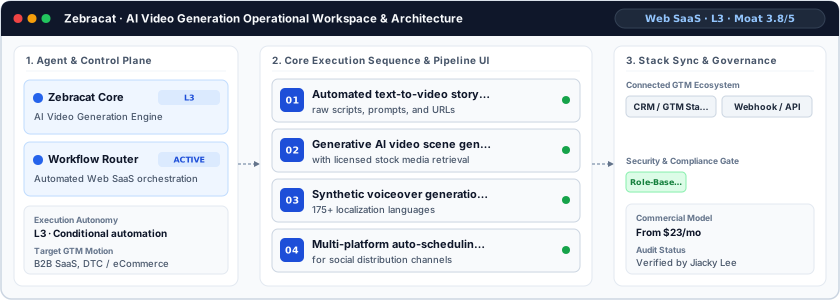
- Automated text-to-video storyboarding from: raw scripts, prompts, and URLs
- Generative AI video scene generation coupled: with licensed stock media retrieval
- Synthetic voiceover generation spanning: 175+ localization languages
- Multi-platform auto-scheduling pipeline: for social distribution channels
Cons: operational limitations & risks
- Generative Artifacting and Coherence: Purely synthetic video scenes remain vulnerable to temporal morphing, character inconsistency across sequential shots, and low-fidelity rendering of hands or fine text.
- Credit Throttling and Compute Caps: Strict monthly allowances on generative compute credits limit high-volume experimentation, requiring teams to fall back on basic stock libraries when allocations deplete.
- Static Layout Rigidity: Automated storyboarding lacks advanced scene-layer compositing, constraining intricate custom visual effects, dynamic multi-track masking, or bespoke audio sidechaining.
Zebracat TCO & deal-breaker stress test
Simulate 12-month stepped TCO, hidden cost multipliers, contract lock-in exposure, and stack failure modes using only facts verified by Jiacky Lee on · Capture SHA 58d7a0bf.
Zebracat is viable for 5 seats, but requires commercial or technical verification on the flagged items below.
| Plan / Tier | Verified Rate | Scale Fit | Scope & Quota Notes |
|---|---|---|---|
| Entry / Starter | $23/mo | 1–2 seats | Verified $23/mo tier from vendor pricing schedule. |
| Growth / Professional | $39/mo | 5 seats | Verified $39/mo tier from vendor pricing schedule. |
| Scale / Advanced | $59/mo | 15 seats | Verified $59/mo tier from vendor pricing schedule. |
- Moat Score
- 3.8 / 5.0
- AI Autonomy
- L3
- Free Tier / Trial
- None disclosed
Triggered audit signals & failure modes
- Published Self-Serve Entry FloorVerified Pricing Ledger
Zebracat publishes a transparent entry point (From $23/mo) for initial validation before committing.
- Usage / Credit Burn VolatilityCommercial Model Audit
Zebracat uses credit or usage-metered billing (From $23/mo). High-volume automated workflows across 5 seats can trigger mid-cycle overage charges.
- Tier Fit for 5-Seat Scale: Growth / Professional ($39/mo)Verified Tier Schedule
Verified $39/mo tier from vendor pricing schedule.
- Primary Operational Bottleneck: Credit Throttling and Compute CapsAudit by Jiacky Lee
Strict monthly allowances on generative compute credits limit high-volume experimentation, requiring teams to fall back on basic stock libraries when allocations deplete.
Hidden TCO Multipliers & Quota Gates
- Annual Billing Headline vs. Monthly Premium: Headline entry rates reflect annual billing commitments (Save 40%); month-to-month flexibility carries a higher effective monthly rate or requires annual prepayment.
- Credit & Usage Burn Multiplier: Automated workflows consume metered credits/usage quotas; multi-step enrichment, voice minutes, or high-frequency agent runs can trigger mid-cycle top-up packs.
When to Walk Away & Negotiation Levers
- Walk away if your workflow requires uncapped enterprise volume on the From $23/mo entry plan without upgrading tiers.
- Walk away if your workflow cannot tolerate generative artifacting and coherence: Purely synthetic video scenes remain vulnerable to temporal morphing, character inconsistency across sequential shots, and low-fidelity rendering of hands or fine text.
- Walk away if credit throttling and compute caps is a deal-breaker for your team: Strict monthly allowances on generative compute credits limit high-volume experimentation, requiring teams to fall back on basic stock libraries when allocations deplete.
- Validate exact quota thresholds (seats, credits, or API calls) included in Zebracat's From $23/mo tier before converting from monthly to annual billing.
- Require a sandbox proof-of-concept testing generative artifacting and coherence against your live CRM/data schema before annual sign-off.
Ask a custom procurement or TCO stress-test question about Zebracat
Lower 5-seat floor (~$10/mo vs. $39 / mo)
Lower 5-seat floor (~$10/mo vs. $39 / mo)
Zebracat moat & subtrack positioning
Moat defensibility is moderate and primarily anchored in its verticalized workflow automation, combining automated storyboarding, B-roll selection, voice synthesis, and direct scheduling. Because it relies on external diffusion video models and stock media APIs, long-term defensibility depends on retention loops established through brand kits and programmatic distribution workflows rather than underlying model weights.
Editorial review
Fact-checked by Jiacky Lee (Managing Editor, AI Autonomy & Moat Methodology) on .
Background
Zebracat addresses the resource-intensive bottleneck of producing organic and paid short-form video content at high publication frequencies. Established in 2022 and headquartered at Lohmühlenstraße 65, Berlin, Germany, the company builds automated production workflows targeting social media growth teams, performance marketers, and digital agencies. Rather than forcing creators through manual non-linear video editors, the platform abstracts asset assembly into a unified workflow designed specifically for TikTok, Instagram Reels, and YouTube Shorts generation.
How Zebracat works
The platform functions as an L3 semi-autonomous agent that parses raw copy, blog URLs, or prompts into sequential shot lists. Its generative pipeline leverages large language models to break narratives into structured scenes, programmatically matching each beat with either stock footage or synthetically generated video clips. Concurrently, an integrated voice engine synthesizes localized speech tracks across 175+ languages, aligning pacing to generated subtitles. Users retain timeline editability to swap assets or apply brand kit styles before rendering the compiled composition.
Limitations
Operational considerations and platform boundaries include:
- Generative Artifacting and Coherence: Purely synthetic video scenes remain vulnerable to temporal morphing, character inconsistency across sequential shots, and low-fidelity rendering of hands or fine text.
- Credit Throttling and Compute Caps: Strict monthly allowances on generative compute credits limit high-volume experimentation, requiring teams to fall back on basic stock libraries when allocations deplete.
- Static Layout Rigidity: Automated storyboarding lacks advanced scene-layer compositing, constraining intricate custom visual effects, dynamic multi-track masking, or bespoke audio sidechaining.
Zebracat pricing
Commercial access operates on a multi-tiered subscription model structured by generation quotas, compute credits, and processing priority. Entry-level access begins at $23 per month billed annually under the Cat Mode plan, which provides 15 video renders and 350 generative credits per month. Upgrades scale through tiers such as $39, $59, and $99 per month, provisioning higher allocations of generative render capacity, expanded avatar access, and expedited queue processing.
How Zebracat compares
Within the generative video ecosystem, Zebracat competes alongside InVideo AI, Kaiber, and Haiper AI. While Haiper AI and Kaiber focus on raw model diffusion and stylistic video-to-video manipulation, Zebracat prioritizes structured commercial throughput. InVideo AI offers a broader general-purpose editing suite, but Zebracat optimizes for social velocity via direct scheduling hooks. The platform is best suited for performance marketing operations seeking automated short-form output without maintaining dedicated video editing personnel.
Direct competitors & market radar
Top algorithmic competitors based on category positioning, capability overlap, and ICP alignment.
Frequently asked questions about Zebracat
How much does Zebracat cost and what pricing tiers are available?
Published pricing summary for Zebracat: From $23/mo. A permanent free plan is not disclosed for Zebracat. Verified tier schedule: Entry / Starter ($23/mo for 1–2 seats); Growth / Professional ($39/mo for 5 seats); Scale / Advanced ($59/mo for 15 seats). Commercial access operates on a multi-tiered subscription model structured by generation quotas, compute credits, and processing priority. Entry-level access begins at $23 per month billed annually under the Cat Mode plan, which provides 15 video renders and 350 generative credits per month.
How does Zebracat work and how autonomous is its AI architecture?
Autonomous social video production agent converting scripts, URLs, and text prompts into multi-platform short-form video assets. Within AI Video Generation (Generative Commercial Video & Media), MarTechRadar rates its execution architecture at L3 · Conditional automation with a verified Moat Score of 3.8 / 5.0 (Proprietary moat). Moat defensibility is moderate and primarily anchored in its verticalized workflow automation, combining automated storyboarding, B-roll selection, voice synthesis, and direct scheduling. Because it relies on external diffusion video models and stock media APIs, long-term defensibility depends on retention loops established through brand kits and programmatic distribution workflows rather than underlying model weights. Corporate profile: Founded by Michael Baumgartner, Reza Zolf, operating at 11-50 employees scale.
What are the main limitations of Zebracat and when should buyers walk away?
Based on our editorial technical audit, key operational considerations and boundaries for Zebracat include: (1) Generative Artifacting and Coherence: Purely synthetic video scenes remain vulnerable to temporal morphing, character inconsistency across sequential shots, and low-fidelity rendering of hands or fine text. (2) Credit Throttling and Compute Caps: Strict monthly allowances on generative compute credits limit high-volume experimentation, requiring teams to fall back on basic stock libraries when allocations deplete. (3) Static Layout Rigidity: Automated storyboarding lacks advanced scene-layer compositing, constraining intricate custom visual effects, dynamic multi-track masking, or bespoke audio sidechaining. Primary procurement walk-away rule: Walk away if your workflow requires uncapped enterprise volume on the From $23/mo entry plan without upgrading tiers.
What integrations, compliance certifications, and contract terms apply to Zebracat?
Key TCO multiplier to watch: Annual Billing Headline vs. Monthly Premium (Headline entry rates reflect annual billing commitments (Save 40%); month-to-month flexibility carries a higher effective monthly rate or requires annual prepayment.) Before signing a contract, procurement teams should validate exact quota thresholds (seats, credits, or API calls) included in Zebracat's From $23/mo tier before converting from monthly to annual billing.
What are the best Zebracat alternatives and head-to-head competitors in 2026?
Top fact-checked alternatives to Zebracat in AI Video Generation (Generative Commercial Video & Media) include Kaiber ($10–$99/mo), MiniMax Hailuo (Custom / enterprise pricing), Pika Labs (Free plan · $10–$50/mo), Golpo (From $39.99/mo). Within the generative video ecosystem, Zebracat competes alongside InVideo AI, Kaiber, and Haiper AI. While Haiper AI and Kaiber focus on raw model diffusion and stylistic video-to-video manipulation, Zebracat prioritizes structured commercial throughput.
Verified sources & evidence trail
- Official product domain: https://zebracat.ai
- Commercial pricing verification: https://www.zebracat.ai/pricing
- Verified corporate entity profiles (
sameAs): LinkedIn Company Profile · Crunchbase Entity Record - First-party governance & documentation links: Privacy
- Editorial audit sign-off: Fact-checked by Jiacky Lee on under the MarTechRadar Evidence-Ledger Protocol.