Kling AI Review (2026): AI Video Generation Pricing, Limits & Alternatives
Bottom line
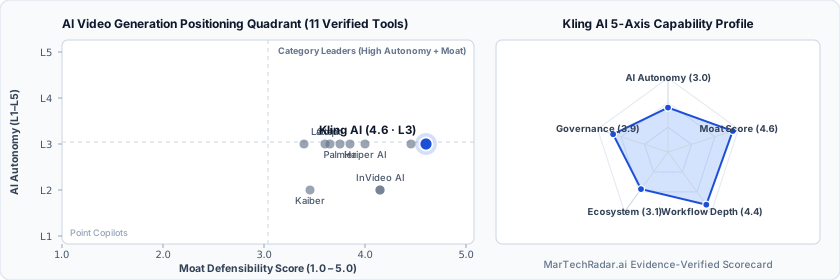
Kling AI is a Web SaaS tool for AI Video Generation (Generative Commercial Video & Media) in Visual & Creative Media. Pricing: From $0.14. Best suited to DTC / eCommerce, Enterprise Brands and Creators / Solo. Editor ratings: AI autonomy L3 (conditional automation); moat score 4.6/5.0 (Proprietary moat (category leader)). Fact-checked by Tim Fenolz on Oct 12, 2026.
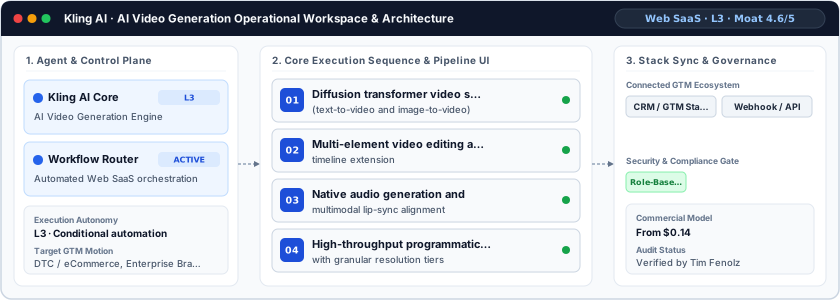
Diffusion transformer video generation model enabling physics-grounded text-to-video, image-to-video, and programmatic commercial media generation.
Kling AI buyer fit verdict: when to choose vs. when to walk away
Choose Kling AI if (Best Fit)
- Target ICP & Stack Fit: You operate as DTC / eCommerce, Enterprise Brands and Creators / Solo requiring a Web SaaS deployment for AI Video Generation.
- L3 Architecture & Defensibility: Defensibility stems from proprietary 3D Spatio-Temporal VAE architectures paired with large-scale compute infrastructure funded by Kuaishou, yielding superior physical motion realism and native audio-visual synchronization.
- Commercial Model Fit: Your procurement budget aligns with From $0.14.
Walk away from Kling AI if (Deal-Breakers)
- Walk away if your workflow requires uncapped enterprise volume on the From $0.14 entry plan without upgrading tiers.
- Walk away if your workflow cannot tolerate high latency queue overhead: High GPU compute overhead introduces queue wait times during peak generation runs, making interactive real-time editing loops difficult for fast iteration.
- Walk away if anatomical and physics drift is a deal-breaker for your team: Complex multi-agent scenes still suffer from temporal degradation and limb distortion across clips extended beyond basic generation durations.
Kling AI key facts & scorecard
| Pricing | From $0.14Vendor pricing page |
|---|---|
| Free plan | No / not disclosed |
| Delivery | Web SaaS |
| Audience | DTC / eCommerce, Enterprise Brands, Creators / Solo |
| AI autonomy level | L3 · Conditional automationEditor-verified |
| Moat tier & score | 4.6 / 5.0 · Proprietary moat (category leader)Editor-verified |
| Funding | Public company |
| Total funding | $3B |
| Company size | 10,001+ employees |
| Governance & docs | API & Docs ↗ · Changelog ↗ · Privacy ↗ |
| Headquarters | /, Singapore, SG |
| Founded | 2024 |
| Last verified |
Kling AI pros & cons: strengths vs. operational limitations
Pros: core strengths & capabilities
- Diffusion transformer video synthesis: (text-to-video and image-to-video)
- Multi-element video editing and: timeline extension
- Native audio generation and: multimodal lip-sync alignment
- High-throughput programmatic Video API: with granular resolution tiers
Cons: operational limitations & risks
- High Latency Queue Overhead: High GPU compute overhead introduces queue wait times during peak generation runs, making interactive real-time editing loops difficult for fast iteration.
- Anatomical and Physics Drift: Complex multi-agent scenes still suffer from temporal degradation and limb distortion across clips extended beyond basic generation durations.
- Deterministic Control Boundaries: Fine-grained camera angle and deterministic trajectory modifications remain heuristic, requiring multiple seed re-rolls to achieve exact frame composition.
Kling AI TCO & deal-breaker stress test
Simulate 12-month stepped TCO, hidden cost multipliers, contract lock-in exposure, and stack failure modes using only facts verified by Tim Fenolz on · Capture SHA 41da58ad.
Kling AI is viable for 5 seats, but requires commercial or technical verification on the flagged items below.
| Plan / Tier | Verified Rate | Scale Fit | Scope & Quota Notes |
|---|---|---|---|
| Entry / Starter | $0.14/mo | 1–2 seats | Model Billing Type Features Price (720P) Price (1080P) Price (4K) |
- Moat Score
- 4.6 / 5.0
- AI Autonomy
- L3
- Free Tier / Trial
- None disclosed
Triggered audit signals & failure modes
- Published Self-Serve Entry FloorVerified Pricing Ledger
Kling AI publishes a transparent entry point (From $0.14) for initial validation before committing.
- Usage / Credit Burn VolatilityCommercial Model Audit
Kling AI uses credit or usage-metered billing (From $0.14). High-volume automated workflows across 5 seats can trigger mid-cycle overage charges.
- Primary Operational Bottleneck: High Latency Queue OverheadAudit by Tim Fenolz
High GPU compute overhead introduces queue wait times during peak generation runs, making interactive real-time editing loops difficult for fast iteration.
Hidden TCO Multipliers & Quota Gates
- Credit & Usage Burn Multiplier: Automated workflows consume metered credits/usage quotas; multi-step enrichment, voice minutes, or high-frequency agent runs can trigger mid-cycle top-up packs.
- High Latency Queue Overhead: High GPU compute overhead introduces queue wait times during peak generation runs, making interactive real-time editing loops difficult for fast iteration.
- Anatomical and Physics Drift: Complex multi-agent scenes still suffer from temporal degradation and limb distortion across clips extended beyond basic generation durations.
When to Walk Away & Negotiation Levers
- Walk away if your workflow requires uncapped enterprise volume on the From $0.14 entry plan without upgrading tiers.
- Walk away if your workflow cannot tolerate high latency queue overhead: High GPU compute overhead introduces queue wait times during peak generation runs, making interactive real-time editing loops difficult for fast iteration.
- Walk away if anatomical and physics drift is a deal-breaker for your team: Complex multi-agent scenes still suffer from temporal degradation and limb distortion across clips extended beyond basic generation durations.
- Validate exact quota thresholds (seats, credits, or API calls) included in Kling AI's From $0.14 tier before converting from monthly to annual billing.
- Require a sandbox proof-of-concept testing high latency queue overhead against your live CRM/data schema before annual sign-off.
Ask a custom procurement or TCO stress-test question about Kling AI
Lower 5-seat floor (~$15/mo vs. Usage-Metered)
Lower 5-seat floor (~$100/mo vs. Usage-Metered)
Kling AI moat & subtrack positioning
Defensibility stems from proprietary 3D Spatio-Temporal VAE architectures paired with large-scale compute infrastructure funded by Kuaishou, yielding superior physical motion realism and native audio-visual synchronization.
Editorial review
Fact-checked by Tim Fenolz (Lead AdTech, Programmatic & Attribution Analyst) on .
Background
Backed by $3B in cumulative corporate and research funding through Kuaishou Technology, Kling AI was founded in 2024 with operational headquarters in Singapore, SG. The platform positions itself as an enterprise foundation model for video and image synthesis, directly targeting creative directors, performance marketing agencies, and media engineering teams. Rather than functioning as a lightweight video template wrapper, Kling AI provides deep synthetic media generation designed for high-fidelity commercial production workflows.
How Kling AI works
Under the hood, Kling AI deploys a 3D Spatio-Temporal Video Autoencoder coupled with a large-scale diffusion transformer architecture. The system compresses raw spatial and temporal frames into a joint latent manifold, processing motion vectors, light refraction, and physical collisions simultaneously. By parsing multi-modal prompts, the model coordinates text-to-video, multi-image-to-video, and camera path dynamics, outputting cinematic shots with native audio-visual synchronization across 720p, 1080p, and 4K resolutions.
Limitations
Operational considerations and platform boundaries include:
- High Latency Queue Overhead: High GPU compute overhead introduces queue wait times during peak generation runs, making interactive real-time editing loops difficult for fast iteration.
- Anatomical and Physics Drift: Complex multi-agent scenes still suffer from temporal degradation and limb distortion across clips extended beyond basic generation durations.
- Deterministic Control Boundaries: Fine-grained camera angle and deterministic trajectory modifications remain heuristic, requiring multiple seed re-rolls to achieve exact frame composition.
Kling AI pricing
Commercial access operates primarily on a consumption foundation. Programmatic developers and enterprise production pipelines utilize a credit-denominated Video API starting at $0.14 per unit on a pay-as-you-go schedule. Compute usage scales by generated duration, resolution tier (spanning 720p to 4K), and multimodal toggles such as native audio, while packaged prepaid allocations support predictable budget procurement for high-volume rendering workloads.
How Kling AI compares
Within the generative media landscape, Kling AI competes against tools like Kaiber, Haiper AI, and InVideo AI. While InVideo AI targets automated social video composition through stock assets and Kaiber specializes in stylized artistic animations, Kling AI focuses on underlying physical world simulation and high-resolution generative realism. Its primary trade-off is infrastructure weight: it lacks template-driven timeline editors, making it ideal for technical teams needing raw generative video pipelines rather than pre-assembled social clips.
Direct competitors & market radar
Top algorithmic competitors based on category positioning, capability overlap, and ICP alignment.
Frequently asked questions about Kling AI
How much does Kling AI cost and what pricing tiers are available?
Published pricing summary for Kling AI: From $0.14. A permanent free plan is not disclosed for Kling AI. Commercial access operates primarily on a consumption foundation. Programmatic developers and enterprise production pipelines utilize a credit-denominated Video API starting at $0.14 per unit on a pay-as-you-go schedule.
How does Kling AI work and how autonomous is its AI architecture?
Diffusion transformer video generation model enabling physics-grounded text-to-video, image-to-video, and programmatic commercial media generation. Within AI Video Generation (Generative Commercial Video & Media), MarTechRadar rates its execution architecture at L3 · Conditional automation with a verified Moat Score of 4.6 / 5.0 (Proprietary moat (category leader)). Defensibility stems from proprietary 3D Spatio-Temporal VAE architectures paired with large-scale compute infrastructure funded by Kuaishou, yielding superior physical motion realism and native audio-visual synchronization. Corporate profile: operating at 10,001+ employees scale.
What are the main limitations of Kling AI and when should buyers walk away?
Based on our editorial technical audit, key operational considerations and boundaries for Kling AI include: (1) High Latency Queue Overhead: High GPU compute overhead introduces queue wait times during peak generation runs, making interactive real-time editing loops difficult for fast iteration. (2) Anatomical and Physics Drift: Complex multi-agent scenes still suffer from temporal degradation and limb distortion across clips extended beyond basic generation durations. (3) Deterministic Control Boundaries: Fine-grained camera angle and deterministic trajectory modifications remain heuristic, requiring multiple seed re-rolls to achieve exact frame composition. Primary procurement walk-away rule: Walk away if your workflow requires uncapped enterprise volume on the From $0.14 entry plan without upgrading tiers.
What integrations, compliance certifications, and contract terms apply to Kling AI?
First-party governance and developer endpoints verified on domain include: API Docs (https://kling.ai/docs/user-policy). Key TCO multiplier to watch: Credit & Usage Burn Multiplier (Automated workflows consume metered credits/usage quotas; multi-step enrichment, voice minutes, or high-frequency agent runs can trigger mid-cycle top-up packs.) Before signing a contract, procurement teams should validate exact quota thresholds (seats, credits, or API calls) included in Kling AI's From $0.14 tier before converting from monthly to annual billing.
What are the best Kling AI alternatives and head-to-head competitors in 2026?
Top fact-checked alternatives to Kling AI in AI Video Generation (Generative Commercial Video & Media) include InVideo AI (Free plan · $20–$150/seat/mo), Kaiber ($10–$99/mo), Haiper AI (Custom / enterprise pricing), Runway Gen-3 (Free plan · $15–$95/mo). Within the generative media landscape, Kling AI competes against tools like Kaiber, Haiper AI, and InVideo AI.
Verified sources & evidence trail
- Official product domain: https://klingai.com
- Commercial pricing verification: https://kling.ai/dev/pricing
- Verified corporate entity profiles (
sameAs): LinkedIn Company Profile · Crunchbase Entity Record - First-party governance & documentation links: API & Docs · Changelog · Privacy
- Editorial audit sign-off: Fact-checked by Tim Fenolz on under the MarTechRadar Evidence-Ledger Protocol.